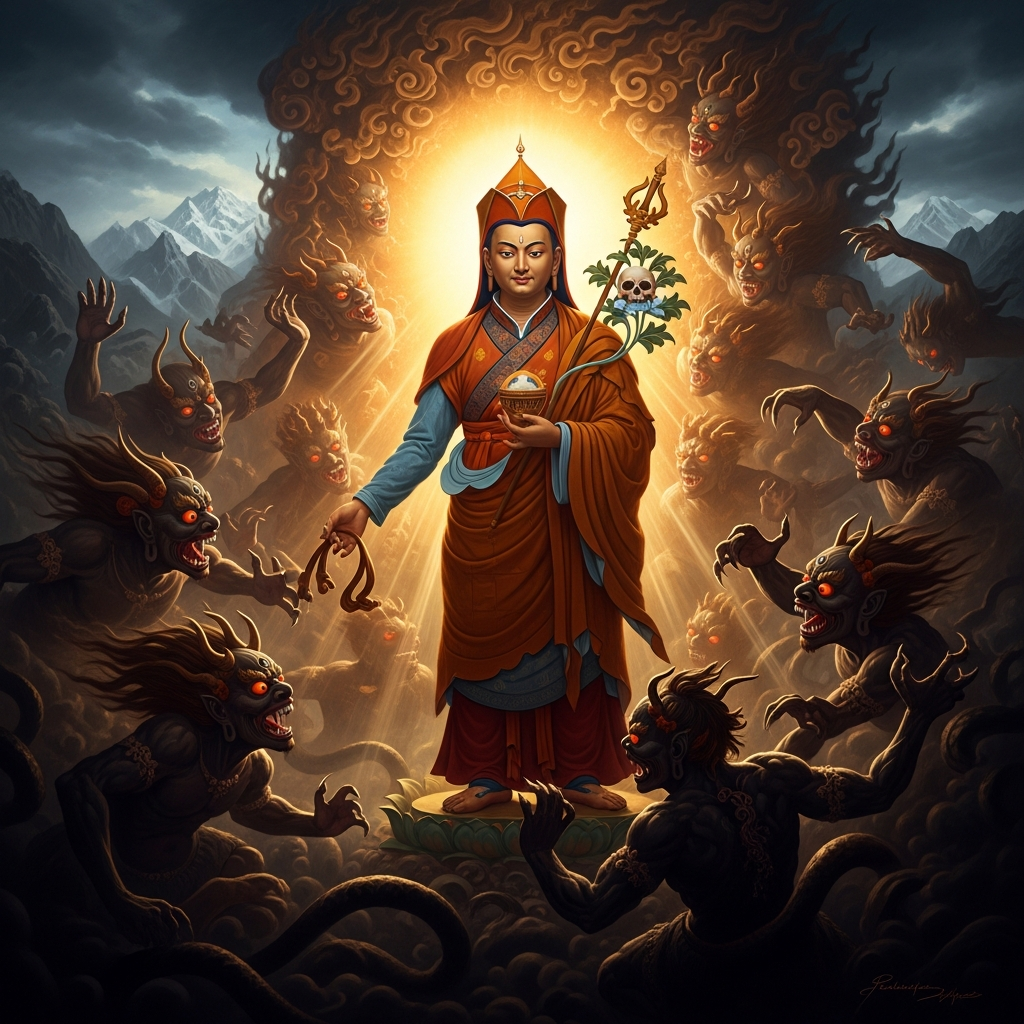
Longchenpa Writes the Treasury in Exile
c. 1350-1363 CE · Bhutan, exile from Tibet · Gangri Thökar hermitage in Tibet; Tharpa Ling in Bhutan; Samye Chimphu
Contents
Longchenpa (1308-1364 CE), the greatest systematizer of Dzogchen — the Great Perfection — is driven from Tibet by a jealous king and spends years in Bhutan in extreme poverty. In this forced destitution, living in a cave with no possessions, he writes the Seven Treasuries: the most comprehensive and brilliant treatment of Dzogchen ever produced.
- When
- c. 1350-1363 CE · Bhutan, exile from Tibet
- Where
- Gangri Thökar hermitage in Tibet; Tharpa Ling in Bhutan; Samye Chimphu
He arrives at his teacher’s camp in winter without a tent.
Kumaradza, the master of the Nyingthig — the Heart Essence teachings of Dzogchen — practices and teaches from an encampment that moves with the seasons across the high ground east of the Yarlung valley, because Kumaradza is from the tradition of the wandering yogi and does not believe in buildings. He has a small circle of students who move with him. When Longchenpa joins them, he is in his mid-twenties and has already been studying for two decades — at Sangphu Neutok monastery, where he mastered the scholastic curriculum; in independent retreat, where he discovered the scholastic curriculum was not sufficient.
He arrives and there is nothing for him to shelter in. Other students have makeshift tents of animal skin. He does not. He wraps himself in a large burlap sack — the Namkhai Nyingpo, the text he later writes describing this period, is specific about the burlap — and sits in it during the teachings and sleeps in it at night. He cannot afford butter for the lamp, so he studies by memory in the dark. He is cold constantly.
Kumaradza teaches him.
Dzogchen — the Great Perfection, in Tibetan rdzogs chen — is the summit of the Nyingma school’s understanding. It holds that the nature of mind is already perfect, already fully awake, already complete. The error is not a deficiency that practice adds to but an obscuration that practice dissolves. All the graduated paths — all the progressive stages of tantra, all the accumulations of merit and wisdom, all the visualization practices and mantra recitations — are, from the Dzogchen perspective, useful in the way that scaffolding is useful: they support the construction but are not the building.
The building is the nature of mind, which was always already there.
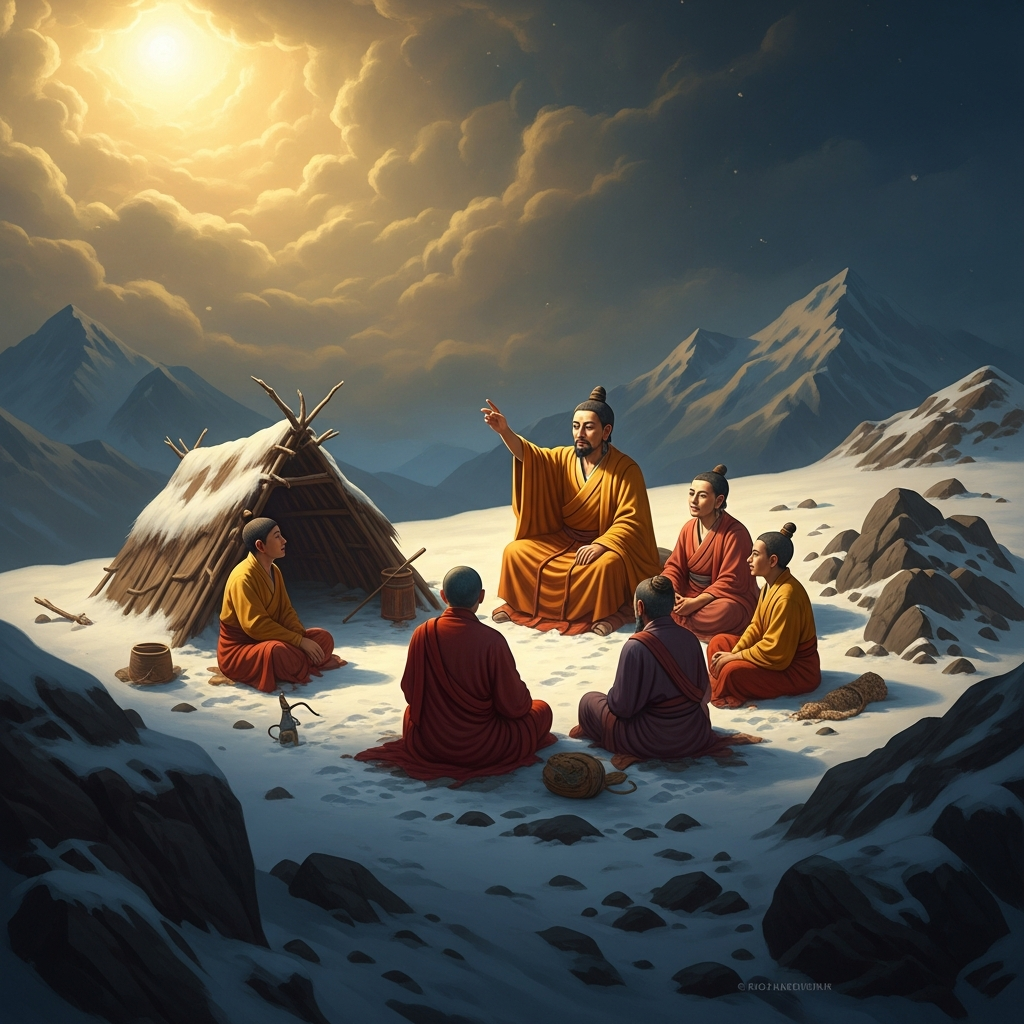
The pointing-out instruction — ngo sprod — is the moment when the teacher indicates this directly to the student: not by explaining it but by creating the conditions in which the student recognizes it directly. Kumaradza gives this instruction in the field, in the snow, by pointing at the sky and saying: look. Just that. Look, without adding anything to the looking.
Longchenpa looks.
He later writes that the recognition took place gradually and then completely, the way a cloud dissolves — not at a specific moment but in a process that, looking back, has a clear before and after. Before the process: knowing about the nature of mind. After: knowing it as one knows one’s own hand.
He stays with Kumaradza for years. He receives the entire Nyingthig transmission. He goes into solitary retreat at Gangri Thökar — White Skull Snow Mountain — a hermitage above the Phenyul valley north of Lhasa, and practices for years.
The jealous king is Changchub Rinchen, the powerful administrator who controls central Tibet in the mid-fourteenth century under the nominal authority of the Sa-skya lamas who are themselves under Mongol suzerainty — a complex political situation that Longchenpa navigates badly, or perhaps does not try to navigate at all, which amounts to the same thing.
The specific offense is not entirely clear across sources. What is clear is that Changchub Rinchen, who is consolidating power in central Tibet and does not appreciate autonomous religious figures with large followings who are not aligned with his patronage network, makes it impossible for Longchenpa to remain at Gangri Thökar. There is a formal expulsion. Longchenpa leaves Tibet for Bhutan.
He arrives with nothing. He has had nothing before — the burlap sack, the lamp without butter — but this is different. This is not voluntary poverty accepted in exchange for great teaching. This is involuntary displacement with no return date and no institutional support and no certainty that the political situation that expelled him will change.
He settles at Tharpa Ling, in the mountains of Bhutan. He begins to write.
The Seven Treasuries (mdzod bdun) are the project of the exile years.
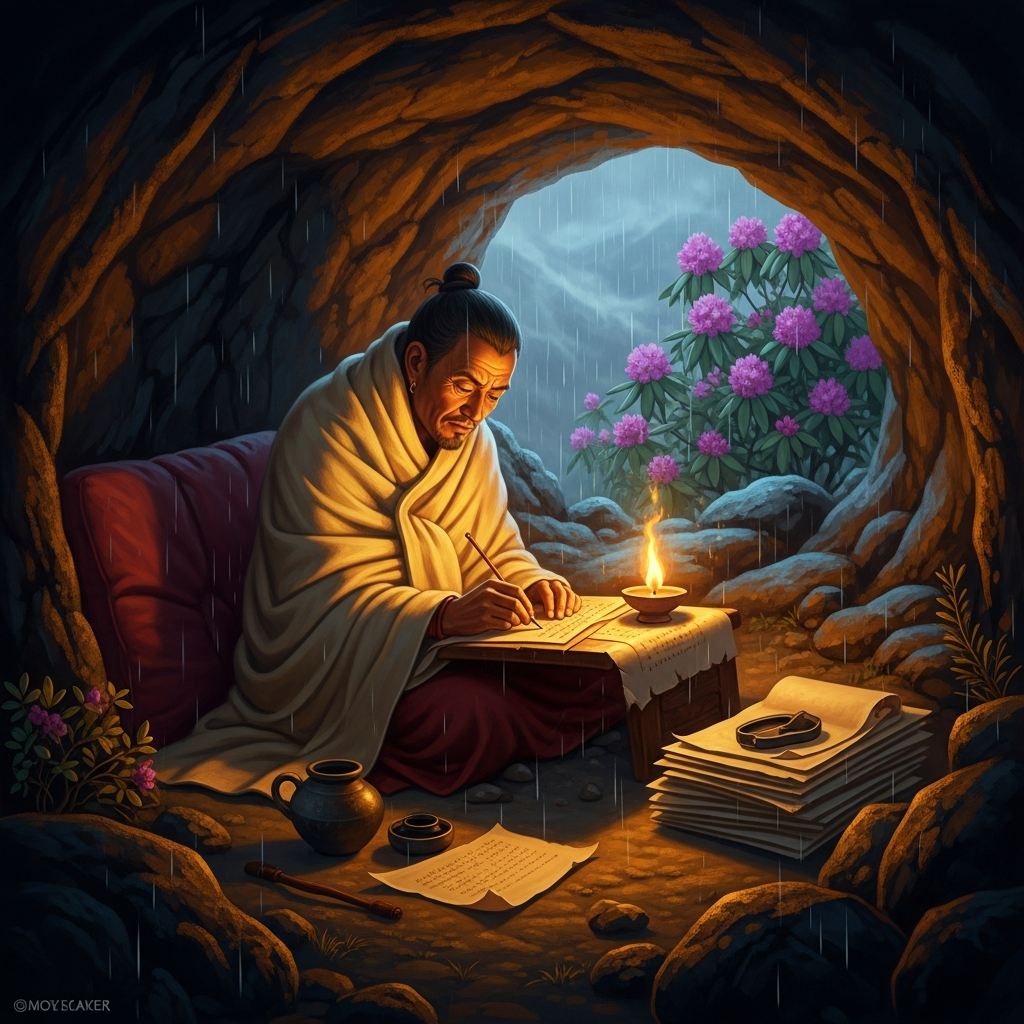
The scope is extraordinary and the circumstances are not. He is writing in a cave or a simple building — sources differ — in conditions of poverty that the tradition preserves with the same precision it applies to spiritual events. He has limited parchment. He writes small. He has interruptions from the political situation back in Tibet that require correspondence and careful navigation. He has students who have followed him from Gangri Thökar and who require teaching.
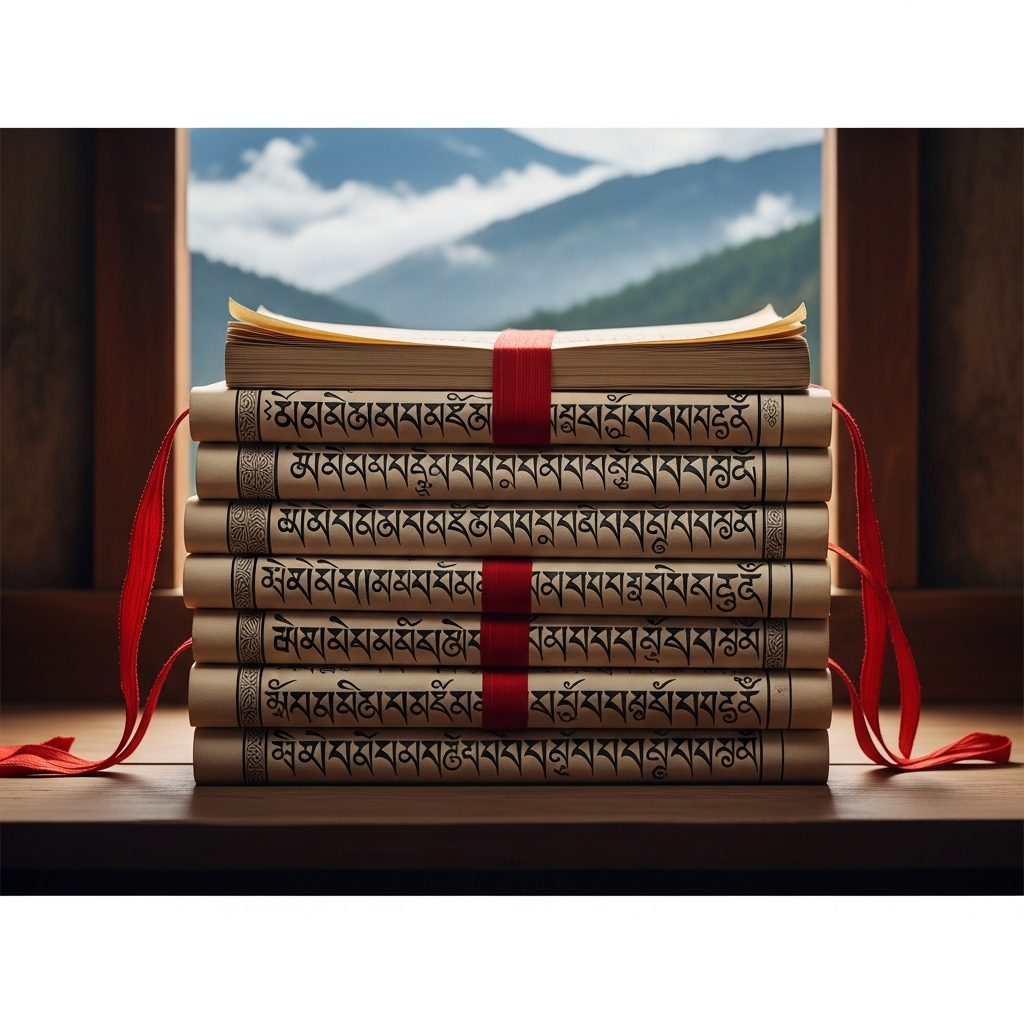
He writes seven complete treatises:
The Precious Treasury of the Dharmadhatu (Chos dbyings rin po che mdzod) — the philosophical foundation, addressing the ultimate nature of phenomena and mind.
The Precious Treasury of the Way of Abiding (Gnas lugs rin po che mdzod) — the intermediate view, addressing how the ultimate nature appears as the conventional.
The Precious Treasury of Wish-Fulfillment (Yid bzhin rin po che mdzod) — the survey of all nine vehicles of the Buddhist path as understood in the Nyingma system.
The Precious Treasury of Instructions (Man ngag rin po che mdzod) — the practical instructions for realization, from the preliminary practices through the highest tantric yoga.
The Precious Treasury of the Higher Teachings (gSang ba bla na med pa rin po che mdzod) — the secret instructions on the innermost Nyingthig.
The Precious Treasury of Philosophical Tenets (Grub mtha’ rin po che mdzod) — the systematic comparison of all major Buddhist and non-Buddhist philosophical schools, showing where they agree and where they diverge and what the Dzogchen view adds that none of them contains.
The Precious Treasury of Words and Their Meanings (Tshig don rin po che mdzod) — the most comprehensive, the systematic exposition of the entire Dzogchen view, ground, path, and fruition.
Together they constitute the most thorough treatment of a Buddhist tradition’s complete path ever written by a single author. They are clear in the way that only someone who has understood the entire system can be clear — not the clarity of summarization but the clarity of someone who has walked the whole territory and can therefore describe any part of it from the inside.
The Grub mtha’ mdzod — the Treasury of Philosophical Tenets — is the work that makes other scholars of the period uncomfortable in the particular way that rigorous comparison always makes partisans uncomfortable.
He surveys the Buddhist schools with the precision of someone who has mastered each one: Vaibhashika, Sautrantika, Chittamatra, Madhyamaka — the four classical schools of Indian Buddhism — and then the Tibetan developments, Sakya and Kagyu and Kadampa. He shows where each one draws the line on the nature of reality and consciousness. He shows what each line correctly perceives and where it stops short.
Then he shows what the Dzogchen view adds that none of the others contains: not a new metaphysical claim, exactly, but a different register of the same claim. The Madhyamaka says phenomena are empty of inherent existence. Dzogchen says: yes, and the awareness that recognizes this emptiness is itself the luminosity that the emptiness is empty of. These are not the same statement. The Madhyamaka can be understood as a view one holds. Dzogchen can only be understood as a recognition one has.
The distinction sounds academic. It is not. The practical difference is everything.
He writes in these conditions — cold, poorly supplied, politically displaced, responsible for a circle of students he is also teaching — for more than a decade. He also writes the Nyingthig Yabzhi — the Heart Essence in Four Parts — which consolidates the most important transmission texts of the Nyingthig cycle. He writes the auto-commentary to the Tshig don mdzod. He writes meditation instructions for individual students. He writes letters to religious figures in Tibet navigating the political situation.
The quantity alone is extraordinary. The quality — the precision, the reach, the structural clarity — is what makes the tradition call him the Second Omniscient One, after Manjushri, the bodhisattva of wisdom.
He is eventually allowed to return to Tibet. He spends his final years at Samye Chimphu — the hermitage above Samye monastery where Padmasambhava and Yeshe Tsogyal had practiced five centuries earlier. He dies there in 1364.
He is fifty-six years old.
The Seven Treasuries are still the standard reference texts for the Dzogchen view in the Nyingma school. The Tibetan tradition reads them the way a Western philosophical tradition might read Kant or Aristotle: as the works that organized a field so completely that everything before them is preliminary and everything after them is commentary.
The Namkhai Nyingpo — the account of his time with Kumaradza in the winter camp, in the burlap sack — is sometimes read as a teaching on the relationship between poverty and clarity. The students who came to him in Bhutan describe a teacher who was more available, more precise, more directly transmissive in the conditions of the exile than he had been before. As if the loss of everything institutional had removed a filter between the teacher and the teaching.
The exile was not incidental to the Treasuries. The Treasuries could only have been written by someone who had nothing.
The cave in Bhutan is still there.
Scenes
Longchenpa in a shallow cave in the Bhutanese mountains, wrapped in a single thin robe against the cold, writing by the light of a butter lamp
 Generating art…
 High on a mountain slope above the treeline, Longchenpa sits before his teacher Kumaradza in a small circle of students
 Generating art…
 A stack of seven manuscripts on a simple wooden surface, each bound with a strip of red silk, each densely written
 Generating art…
 Echoes Across Traditions
Entities
- Longchenpa
- Longchen Rabjam
- Vimalamitra
- Kumaradza
- Changchub Rinchen
Sources
- Longchenpa, *The Precious Treasury of the Basic Space of Phenomena* (*Chos dbyings rin po che mdzod*) (trans. Richard Barron, Padma, 2001)
- Longchenpa, *The Precious Treasury of the Way of Abiding* (trans. Richard Barron, Padma, 1998)
- David Germano, 'Architecture and Absence in the Secret Tantric History of the Great Perfection,' *Journal of the International Association of Buddhist Studies* 17.2 (1994)
- Tulku Thondup, *Masters of Meditation and Miracles: Lives of the Great Buddhist Masters of India and Tibet* (Shambhala, 1996)
- Kennard Lipman and Merrill Peterson, trans., *You Are the Eyes of the World* (Longchenpa, Snow Lion, 2000)
- Sam van Schaik, *Tibet: A History* (Yale, 2011), ch. 5