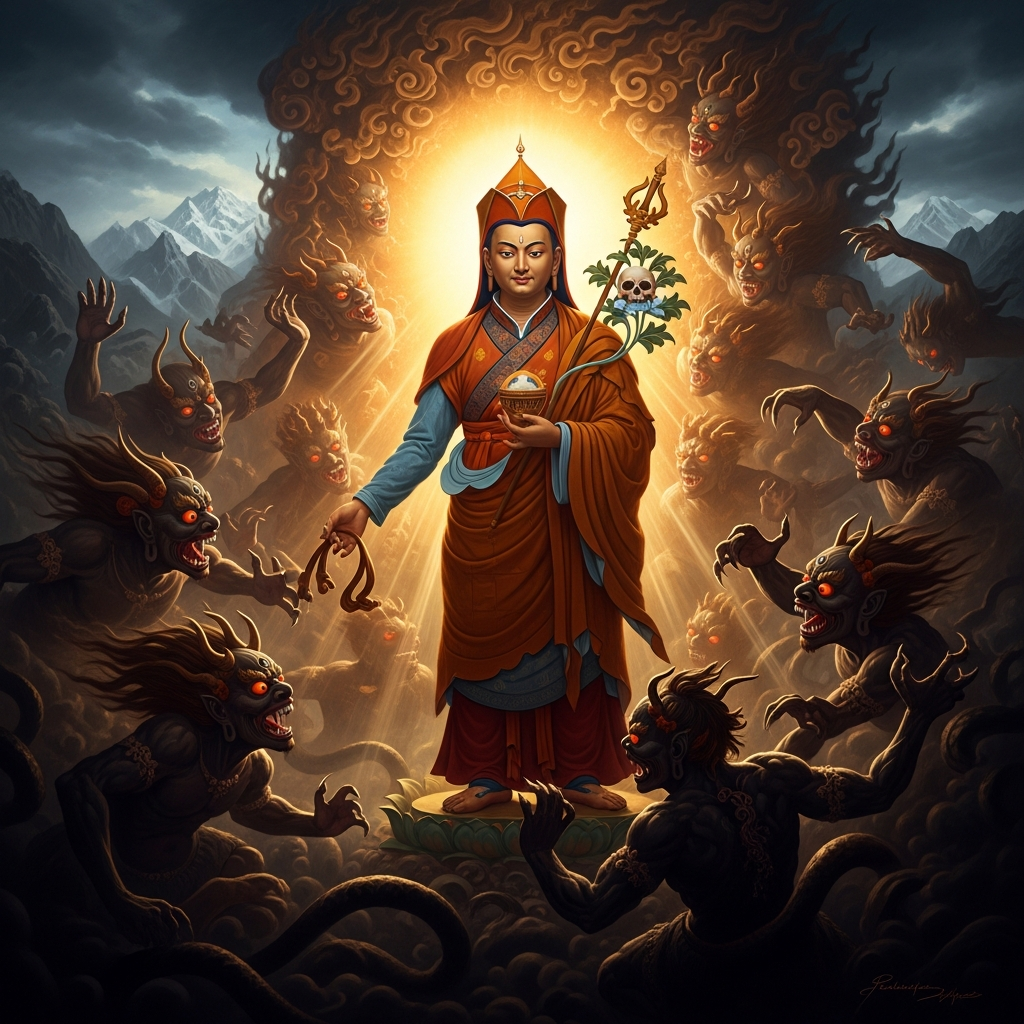
Yeshe Tsogyal Sits with the Dead
c. 777-817 CE · Tibet and the Himalayan high country · Charnel grounds and mountain caves across Tibet, Nepal, and Bhutan — particularly Tidro cave in the Zho valley and Paro Taktsang in Bhutan
Contents
Yeshe Tsogyal — Padmasambhava's consort, the first Tibetan woman to achieve full enlightenment — undertakes years of practice alone in charnel grounds, meditating among corpses and offering her body to the spirits who come. She does not flee them. She masters fear itself, becoming the primary keeper of the hidden teachings that will sustain Tibetan Buddhism for centuries.
- When
- c. 777-817 CE · Tibet and the Himalayan high country
- Where
- Charnel grounds and mountain caves across Tibet, Nepal, and Bhutan — particularly Tidro cave in the Zho valley and Paro Taktsang in Bhutan
She arrives at the charnel ground before dawn, which is the correct time.
The charnel ground — dur khrod in Tibetan, literally the place where corpses are cut — is not a graveyard in the Western sense. There are no graves. The dead are brought here to be dismembered and fed to the vultures, which is the Tibetan sky-burial, the most efficient way to process a body in a land too rocky and too cold for burial, too wood-scarce for cremation. What remains after the birds finish is scattered, and the ground absorbs it over seasons, and then more bodies are brought, and this has been happening in the same places for centuries. The charnel grounds are permanently alive with the residue of dissolution.
She has come here deliberately.
Padmasambhava taught her the practice. He found her — the texts are specific about this — as a princess of the Kharchen clan, one of seven women proposed to Trisong Detsen as a royal wife. The king accepted her, then gave her to his teacher. She accepted being given. She was sixteen. The tradition does not frame this as a transaction, exactly — it frames it as a recognition, the teacher identifying the student whose capacity matches the teaching — but the transaction is there, and Yeshe Tsogyal herself, in the autobiography she dictated late in her life, does not pretend it was comfortable.
What she received in return for the discomfort was everything.
He transmits to her directly: the Vajravarahi practice, the Phurba cycle, the Yangdak Heruka, the full range of the Nyingma tantric canon as it existed in the eighth century. He identifies her not as his consort in the social sense but as his khandroma — his dakini, literally sky-goer, the female principle of enlightened energy that the Vajrayana understands as essential to the transmission itself. The doctrine teaches that certain transmissions cannot be completed without the khandroma; she is not the assistant but the ground.
She memorizes everything.
This is not metaphor. In a tradition where texts are rare and literacy is not universal, the primary storage medium for teachings is human memory, and Yeshe Tsogyal’s memory is described, across multiple sources, in terms that suggest an ability to retain teaching after a single hearing with perfect accuracy. She becomes Padmasambhava’s primary scribe, his primary repository, the person who records not just what he teaches in formal sessions but what he says between sessions, what he says when he thinks only she is listening, what he reveals in the moment of transmission that cannot be planned.
She is, in effect, building the library that will sustain Tibetan Buddhism for the next twelve centuries.
But before she can hold the teachings safely, she must empty herself of the thing that makes the holding unreliable: fear.
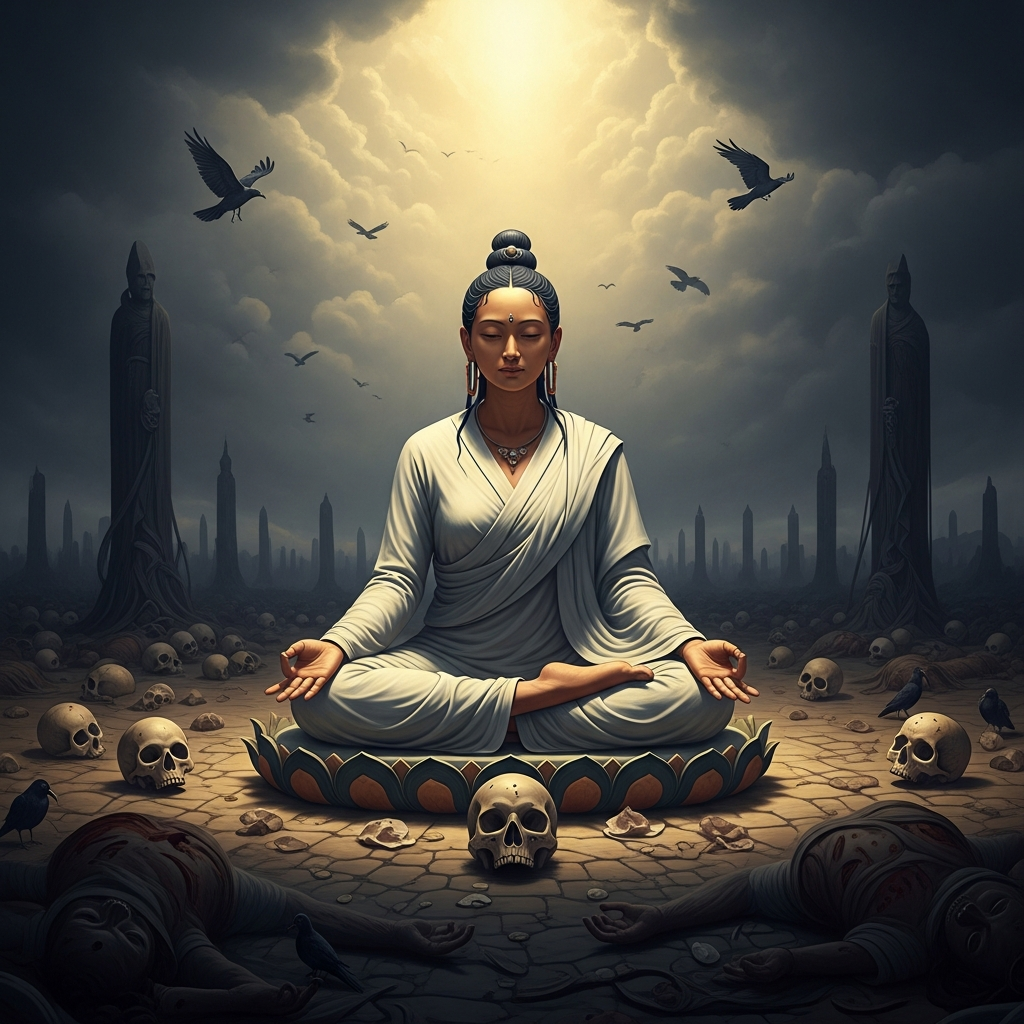
She goes to the charnel ground at Tidro, in the Zho valley in central Tibet, and she sits down.
The first days are manageable in the way that the first days of extreme practice are always manageable — the body and mind are still oriented toward the ordinary. She sits. She meditates. The smell is what it is. The birds arrive and do their work. She watches. She focuses on the visualization she has been given: the deity-form of Vajravarahi, the Diamond Sow, a female tantric deity depicted as red-skinned, dancing, holding a curved knife and a skull-cup. The practice is to dissolve the boundary between herself and the deity — not to imagine she is Vajravarahi as a kind of spiritual theater, but to actually, technically, become the deity-form through a series of visualization stages that rewrite the practitioner’s self-perception from the inside.
This is working on the assumption that what we ordinarily call the self is not fixed. It is a habit. A pattern of mental repetition that can, under the right conditions, be interrupted and replaced by a pattern that has more to do with the actual nature of awareness. The charnel ground is chosen precisely because it is the environment most hostile to ordinary self-maintenance. Everything here says: the self dissolves. Everything here says: the body is temporary. Everything here says: there is no solid thing to protect.
She sits in it and practices.
The spirits come.
Sky Dancer, her autobiography as reconstructed by Keith Dowman from the Tibetan, describes them in the taxonomic detail that Tibetan Buddhist texts apply to everything: the shidre, the spirits of the newly dead who do not yet know they are dead; the gongpo, the malicious spirits that cluster around charnel grounds because of the accumulated psychic residue of grief; the mamos, the wild feminine spirits whose relationship to practitioners in this place is ambivalent and boundary-testing.
They are not purely psychological phenomena in the way a Western reader might be tempted to interpret them. They are genuinely, in the Tibetan framework, entities with their own existence, their own needs, their own capacity to harm or help. And they come to her because she is sitting in their territory, awake, during the hours when they move.
The first time they come — the texts say this happened three nights into her charnel ground practice — they are testing. They present themselves as menacing. They pull at her attention with images of threat: her own death, the deaths of people she loves, the dissolution of everything she values. This is what the Tibetan tradition calls nyam — visionary experience during meditation practice, not to be confused with reality but not to be dismissed as mere imagination either. It is the practice surfacing material.
She does not flee. She does not scream. She does not close her eyes.
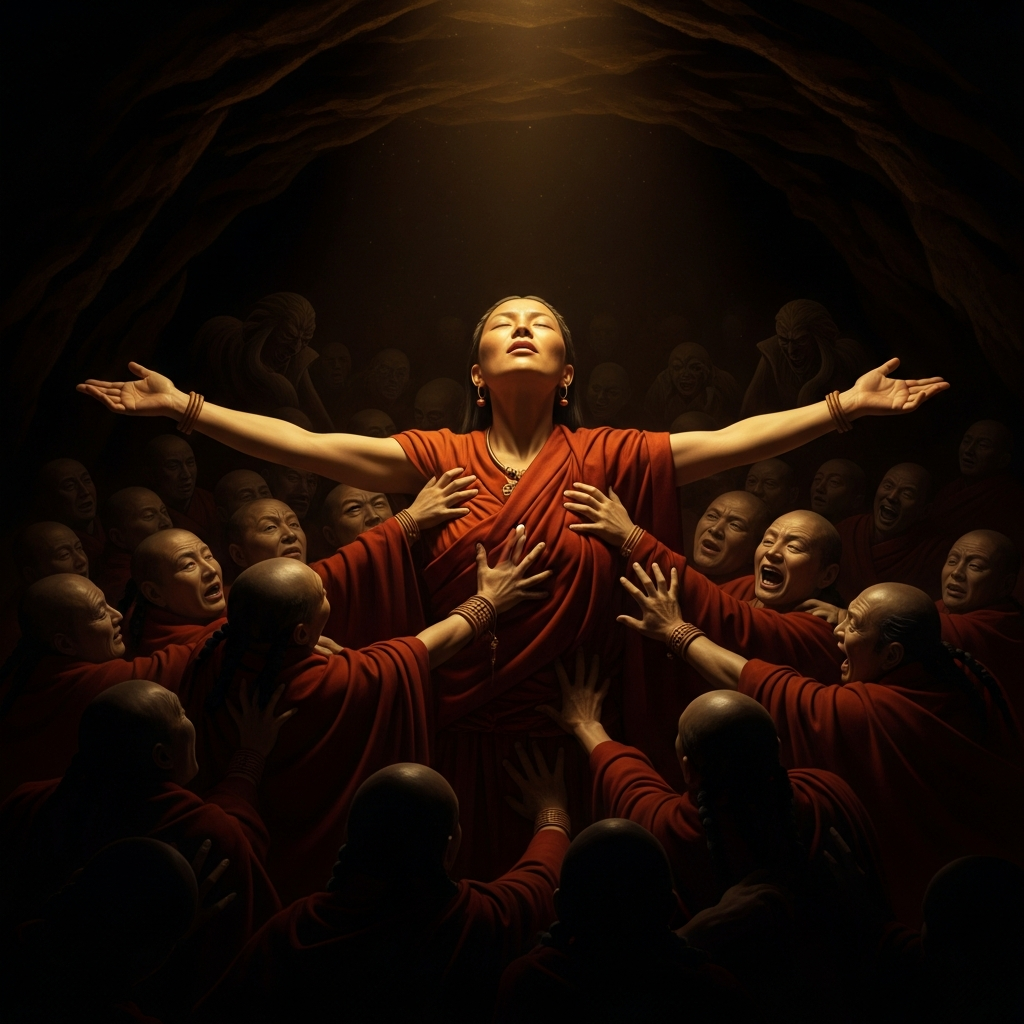
She opens her hands.
The offering of the body is the most radical practice in the Vajrayana arsenal, and it is what she does.
It is formalized, in later Tibetan Buddhism, as the chöd practice that Machig Labdrön will develop in the eleventh century — but Yeshe Tsogyal practices an earlier form, transmitted directly from Padmasambhava, that has the same structure: you visualize your body as an offering. You call the spirits to a feast. You are the host and the feast simultaneously. Every fear-response that arises — every instinct to protect the body, to preserve the self, to maintain separation from what is frightening — is met with the opposite gesture: here. Take it. I am not this.
The logic is precise. Fear, in the Vajrayana analysis, is the belief that there is a self to protect. The charnel ground, with its constant demonstration that bodies are impermanent and selves are constructed, is the most efficient environment for challenging that belief. The spirits, with their demands and threats, are the most efficient teachers of the same lesson. She offers the body to the spirits not because she is suicidal but because she is testing the hypothesis that the thing she is protecting does not require protection.
Each night, she opens her hands.
Each morning, she is still there.
The practice continues for years.
The texts are not precise about duration in the way that modern biography would require. What they record is the shape of the transformation: the practitioner who arrived at the charnel ground afraid, who learned the mechanics of fear by sitting inside it for long enough that the fear exhausted itself, who came out the other side with a relationship to death and dissolution that can only be described as friendly.
She does not become immune to discomfort. She becomes fluent in it. There is a difference: immunity suggests the difficult things are no longer present; fluency means they are present and no longer obstructive. She knows the territory of dissolution the way a mountain guide knows a pass — every turn, every false step, every place where the light comes through.
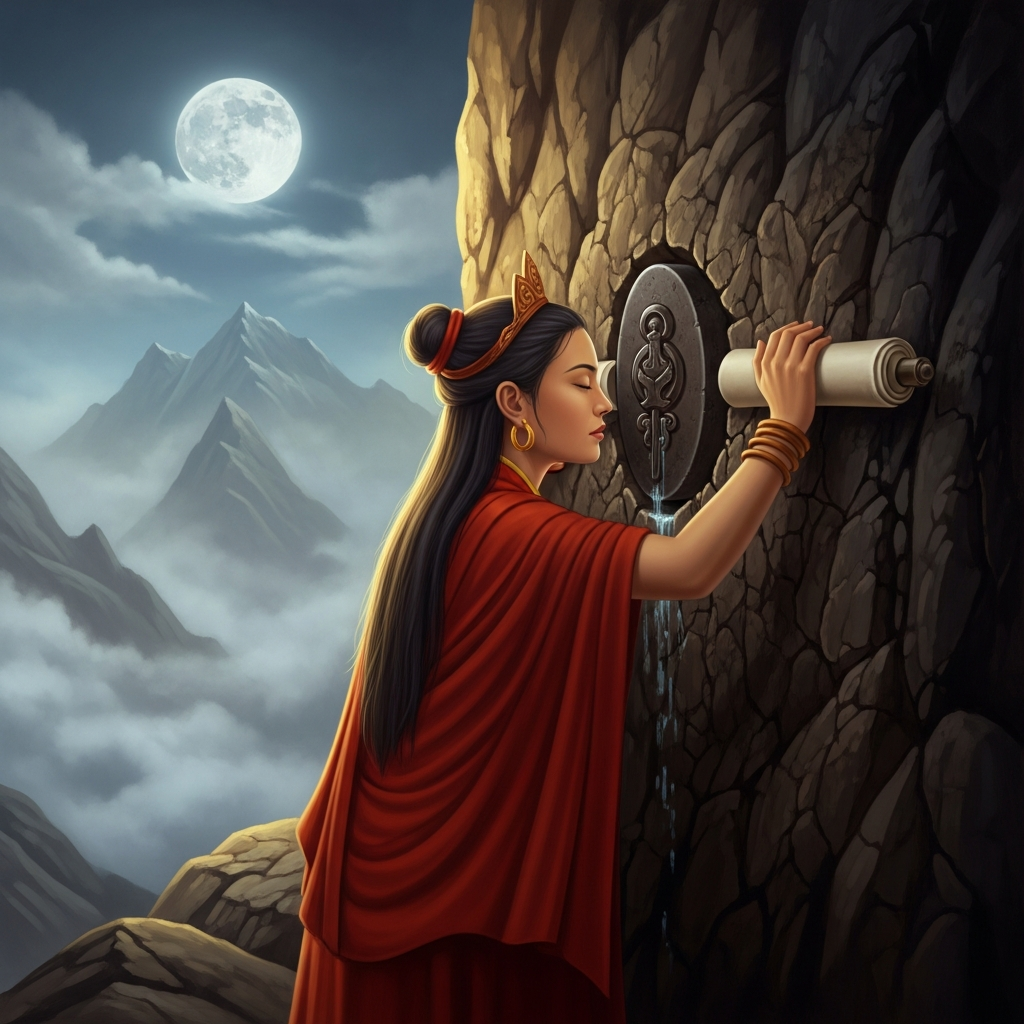
This is the competence Padmasambhava has been training her toward. She is not just a repository for the teachings; she is their insurance. When a teaching is hidden — pressed into a cliff face, concealed in a lake bed, encoded in a mind — it needs to be hidden by someone whose own mind is stable enough to carry the hiding-place reliably, whose own presence does not disturb the fabric of what she is entrusting to the landscape.
The charnel ground is where she becomes that person.
She hides hundreds of termas.
The Padma Thang Yig — the Lotus Chronicle that is the primary biography of Padmasambhava — was hidden by Yeshe Tsogyal and recovered by the terton Orgyen Lingpa in the fourteenth century. The Bardo Thödol — the Book of the Dead — was hidden by her and recovered by Karma Lingpa, also in the fourteenth century. The Longchen Nyingthig cycle, the foundation of Dzogchen practice, was hidden by her and recovered by Jigme Lingpa in the eighteenth century. These three texts alone are among the most widely read in Tibetan Buddhism; all three came from her hands.
The tradition counts over a hundred major terma cycles in the Nyingma school. Yeshe Tsogyal is the source, directly or indirectly, of the majority of them.
She dictates her autobiography late in her life — the Namthar, the liberation story, transmitted to her disciple Tashi Khyidren and then hidden as a terma itself, recovered only in the twentieth century. In it she is candid about what the practice cost: the cold, the hunger, the specific texture of fear that the charnel grounds generated and that she had to pass through repeatedly before she was through it. She is also candid about what she found on the other side.
She says: the teachings are not abstract. They are the description of what actually happens when you sit down and stop protecting yourself. Everything Padmasambhava taught me, I verified in the charnel ground.
She achieves the rainbow body — the Tibetan Buddhist understanding of full enlightenment at death, in which the physical body dissolves into light — in the early ninth century, in a cave at Paro Taktsang in Bhutan, the Tiger’s Nest, the site where Padmasambhava had meditated a generation earlier.
She is the first Tibetan person to achieve this.
She is forty years older than he is. She outlives him in Tibet by decades.
The tradition refers to her as the Mother of Tibetan Buddhism — not the consort, not the assistant, but the mother: the one who carried the teachings through the body of her practice and transmitted them to the centuries that came after. Without her memorization, her charnel ground practice, her concealment of hundreds of termas in the landscape of Tibet and Nepal and Bhutan, the Nyingma school does not exist in the form it exists.
The rock at Paro Taktsang still shows, according to the tradition, the handprint she pressed into it. Stone, they say, yielded to her touch.
Scenes
Yeshe Tsogyal seated in lotus posture at the center of a charnel ground at dawn, surrounded by skulls and decomposing forms
 Generating art…
 In a dark cave, Yeshe Tsogyal extends her arms outward in the gesture of giving, as spirits in semi-visible forms crowd around her, pulling at her robes, pressing against her skin
 Generating art…
 Yeshe Tsogyal pressing a scroll of teachings into the face of a cliff by moonlight, the rock opening to receive it like water
 Generating art…
 Echoes Across Traditions
Entities
- Yeshe Tsogyal
- Padmasambhava
- Guru Rinpoche
- Tashi Khyidren

Sources
- Yeshe Tsogyal, *Sky Dancer: The Secret Life and Songs of Lady Yeshe Tsogyel* (trans. Keith Dowman, Routledge, 1984)
- Thinley Norbu, *Magic Dance: The Display of the Self-Nature of the Five Wisdom Dakinis* (Jewel, 1985)
- Judith Simmer-Brown, *Dakini's Warm Breath: The Feminine Principle in Tibetan Buddhism* (Shambhala, 2001)
- Janet Gyatso, *Apparitions of the Self: The Secret Autobiographies of a Tibetan Visionary* (Princeton, 1998)
- *Padma Thang Yig* (the *Lotus Chronicle*, attributed to Yeshe Tsogyal, redacted 14th century by Orgyen Lingpa)
- Reginald A. Ray, *Secret of the Vajra World: The Tantric Buddhism of Tibet* (Shambhala, 2001)