Milarepa Calls Down the Hailstorm
c. 1052-1070 CE · Gungthang, central Tibet · Gungthang, central Tibet — the family estate and the surrounding valley; the sorcerer's cave in Khulung
Contents
Before he becomes Tibet's greatest saint, Milarepa is a sorcerer. His aunt and uncle have stolen his inheritance. His mother sends him north to learn black magic. He returns and calls down a hailstorm that destroys the harvest, then conjures the collapse of his uncle's house during a wedding feast, killing 35 people. The horror of what he has done drives him to find Marpa.
- When
- c. 1052-1070 CE · Gungthang, central Tibet
- Where
- Gungthang, central Tibet — the family estate and the surrounding valley; the sorcerer's cave in Khulung
His father’s name was Mila Sherab Gyaltsen and he died when the boy was seven.
The death is the hinge. What follows from it — the next decade, the inheritance withheld, the family reduced to servants on their own land — follows from it with the logic of a stone rolling downhill. The uncle and aunt take the estate into trust, as arranged. The trust extends. The trust becomes possession. The boy grows into a young man who carries water and herds animals on land his father owned and his uncle now controls, who watches his mother grow thin and hard, who understands, in the granular way that children understand injustice before they have words for it, that something is wrong and has been wrong for years.
His mother’s name is White Garland. She is not soft. She has been patient for a decade and patience has served nothing and she is done with it.
She scrapes together silver — borrowed from relatives, extracted from the narrowest margins of the family’s reduced circumstances — and she sends him north to find Yungton Trogyal, a practitioner of the black arts in the valley of Khulung. She is specific about what she wants. She does not want a slow curse. She does not want reputation destroyed or crops diminished. She wants the family dead. She wants the crops to fail and she wants the people responsible to die.
She says: if you come back without having learned enough to do this, I will kill myself in front of you.
He believes her. She means it.
Yungton Trogyal is old and initially reluctant. He tests the boy — the usual assessment of capacity, patience, sincerity — and finds that the boy has an aptitude for the weather-working and spirit-binding arts that unsettles him slightly. The aptitude is not the product of prior training. It is the product of a quality the texts call sa, which might be translated as ground or capacity — the inherited potential that some practitioners bring to a practice the way some people bring natural pitch to music.
He teaches him the hail-working. The visualization sequences, the mantra structures, the binding of wind-spirits to specific intentions. The practice is technically demanding and requires a quality of focused rage — controlled, directed, precise — that the boy has accumulated across ten years of watching his mother carry water on land that should be hers.
He has plenty.
He sends the hailstorm first.
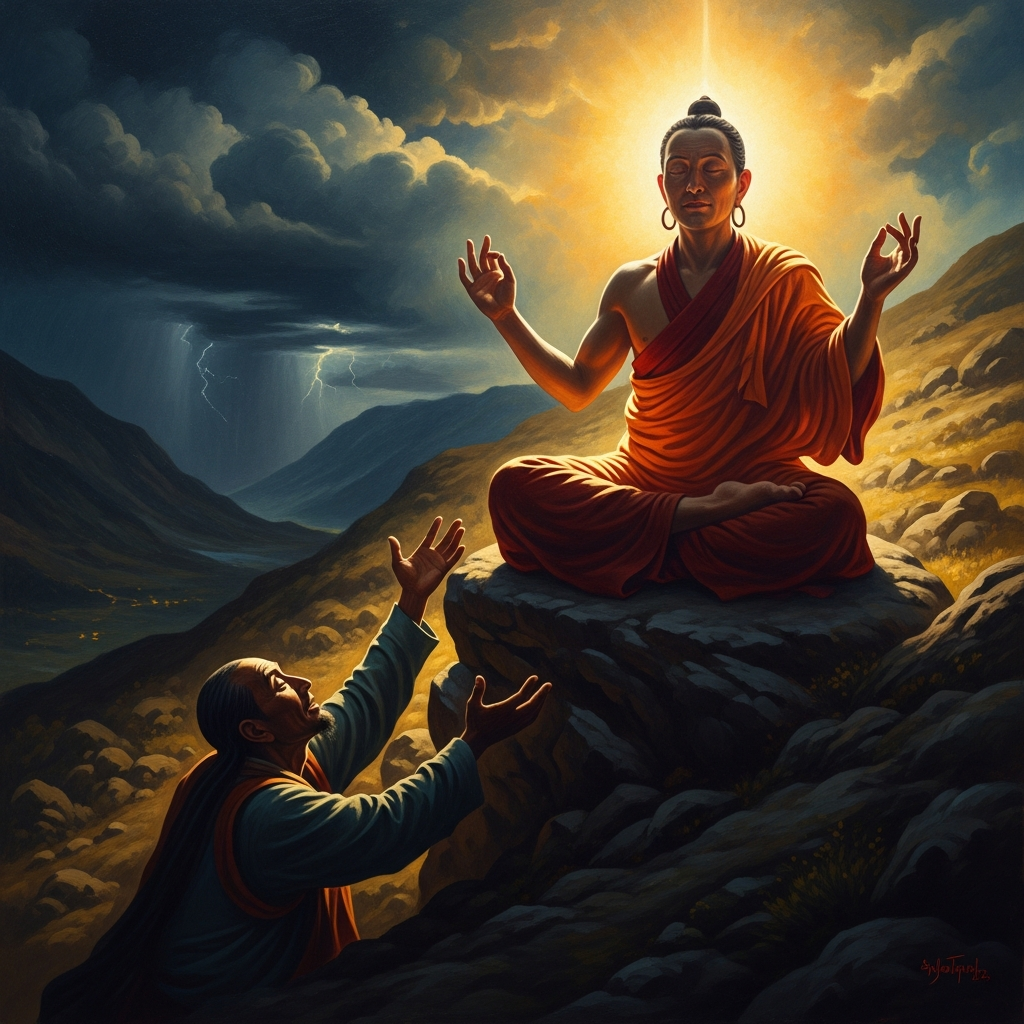
He sits on the high ground above his uncle’s valley on a clear day and he calls the weather. The Life of Milarepa describes the process in the taxonomic detail that the tradition applies to practices it wants taken seriously: the visualization of the weather-working deity, the mantra sequence, the specific binding of the air-spirits to the direction of the uncle’s fields. The storm arrives and it is not random. It is pointed. It destroys his uncle’s harvest in precise rows, field by field, leaving the surrounding farmland intact. The selectivity is the message: this is not weather. This is address.
His uncle’s family is frightened. They are not destroyed.
His mother sends word: more.
The wedding is the opportunity.
His uncle’s son is marrying. The house — built on land that belonged to Milarepa’s father, land that passed into his uncle’s possession through a decade of slow appropriation — is full of people celebrating. Thirty-five of them, the texts say. Relatives, neighbors, guests from the next valley, children. The groom. The wedding party.
He has been working on the house’s central pillar for weeks. The specific practice is not named in the texts — it is a binding of a spirit to the structural element, a serpent-force wound around the pillar’s load-bearing capacity, waiting for the signal. During the wedding feast, when the dancing is at its height, he gives the signal.
The pillar fails. The roof comes down.
The groom’s horse, tethered outside, breaks both its legs in the panic and has to be killed. The texts count the dead: thirty-five people. His aunt and uncle, by some arrangement of fate or location, survive. The groom, the guests, the neighbors, the children who had nothing to do with any arrangement made before they were born — these are the thirty-five.
He watches from the hillside.
His mother is satisfied. She shouts his name across the valley. She declares what he has done. He is not being careful about disguising his role. The village already knows.
The guilt does not arrive immediately.
This is the detail that distinguishes this account from a simple revenge narrative: the guilt arrives on a delay, the way severe injuries sometimes do, as the body’s analgesic systems extend their protection past the point where it serves any function. He is, in the immediate aftermath, exactly what he set out to be. He has done what his mother asked. He has demonstrated the capacity she sent him to acquire. The uncle’s family has been broken.
Then — in the weeks after, in the specific stillness that follows the expenditure of enormous directed rage — he begins to understand the arithmetic.
He can name some of the thirty-five from childhood. He knows whose daughter, whose son. He knows the groom. He knows that the celebration that was happening in the moment the roof came down was genuine. These were people who, that morning, had nothing to do with his family’s ruin. They were inside the wrong house at the wrong moment. They were collateral to a vengeance that had already, through the hailstorm, been made legible. The aunt and uncle were not among them.
He killed the bystanders. He spared the perpetrators.
He goes back to Yungton Trogyal and says: I need the dharma now. I need teachings that can purify this weight of karma. Give me the path.
Trogyal — who is honest in the way that teachers in genuine traditions are usually honest about the limits of their method — tells him: I don’t have what you need. The black arts cannot be reversed by the black arts. You need a different teacher entirely. There is a man in Lhodrak — Marpa, they call him Marpa the Translator. He has brought back the tantric transmissions from Naropa in India. If anyone has a teaching large enough for what you’ve accumulated, it is him.
He walks south toward Lhodrak with the deaths on his back.
He does not reframe them. He does not construct a narrative in which the deaths were justified by what preceded them or proportionate to the original theft or consistent with any larger justice. He carries them as they are: thirty-five people at a wedding feast. He killed thirty-five people at a wedding feast. He is looking for a teacher who can survive the full size of that and still offer him a way forward.
The Life of Milarepa is explicit, throughout Milarepa’s own account of this period, about the absence of self-forgiveness.
This is not neurotic guilt — the self-flagellation of someone who needs the guilt to maintain a particular self-concept. It is, in the Tibetan Buddhist framework, accurate perception. He did what he did. The consequences are real and will mature across lifetimes unless something extraordinary intervenes. He is not asking for the assessment to be softened. He is asking whether the path is large enough to work on this particular assessment.
This is the question he brings to Marpa.
Marpa’s answer — the four towers, the years without a formal teaching, the initiation finally given and then suspended and then given again — is not a theological reassurance. It is a method: a specific set of practices, chosen and sequenced by someone who can see the shape of the karma and knows what can move it. The towers are not an explanation of why thirty-five deaths can be purified. They are the purification itself.
He builds the towers. He tears them down. He builds them again. He carries the stones.
The tradition preserves this story at the front of the biography — before the caves, before the songs, before the students and the rainbow and the death — because it establishes the question the biography answers. The question is not abstract. It is: this specific mass of karma. These thirty-five specific people. This specific man.
Can the path actually work on this?
The biography is the answer.
The answer is given not in doctrine but in a life: this large. This specific. These thirty-five people.
Milarepa’s songs are still sung in Tibetan monasteries every year. His biography is still the most widely read text in the Kagyu tradition. He is, by any measure, the tradition’s most beloved figure — more than Naropa, more than Marpa, more even than Gampopa who organized the school.
The murders are the first chapter. They are never edited out.
Scenes
Milarepa's mother, White Garland, stands in the doorway of a stone farmhouse that was once theirs, watching the uncle and aunt's household move freely through what should be her son's inheritance
 Generating art…
 On a rocky hillside above the valley, Milarepa sits in the thunderstorm posture, eyes closed, arms raised
 Generating art…
 The ruins of his uncle's house at night, smoke rising from the collapse
 Generating art…
 Echoes Across Traditions
Entities
- Milarepa
- Jetsun Milarepa
- White Garland
- Yungton Trogyal
- Marpa the Translator
Sources
- Tsangnyön Heruka, *The Life of Milarepa* (trans. Andrew Quintman, Penguin Classics, 2010)
- Tsangnyön Heruka, *The Hundred Thousand Songs of Milarepa* (trans. Garma C. C. Chang, Shambhala, 1999)
- Lobsang P. Lhalungpa, trans., *The Life of Milarepa* (Shambhala, 1984)
- Reginald A. Ray, *Secret of the Vajra World: The Tantric Buddhism of Tibet* (Shambhala, 2001)
- Donald S. Lopez Jr., *Religions of Tibet in Practice* (Princeton, 1997)
- Per Kvaerne, 'Milarepa,' in *Encyclopedia of Religion*, 2nd ed. (Macmillan, 2005)