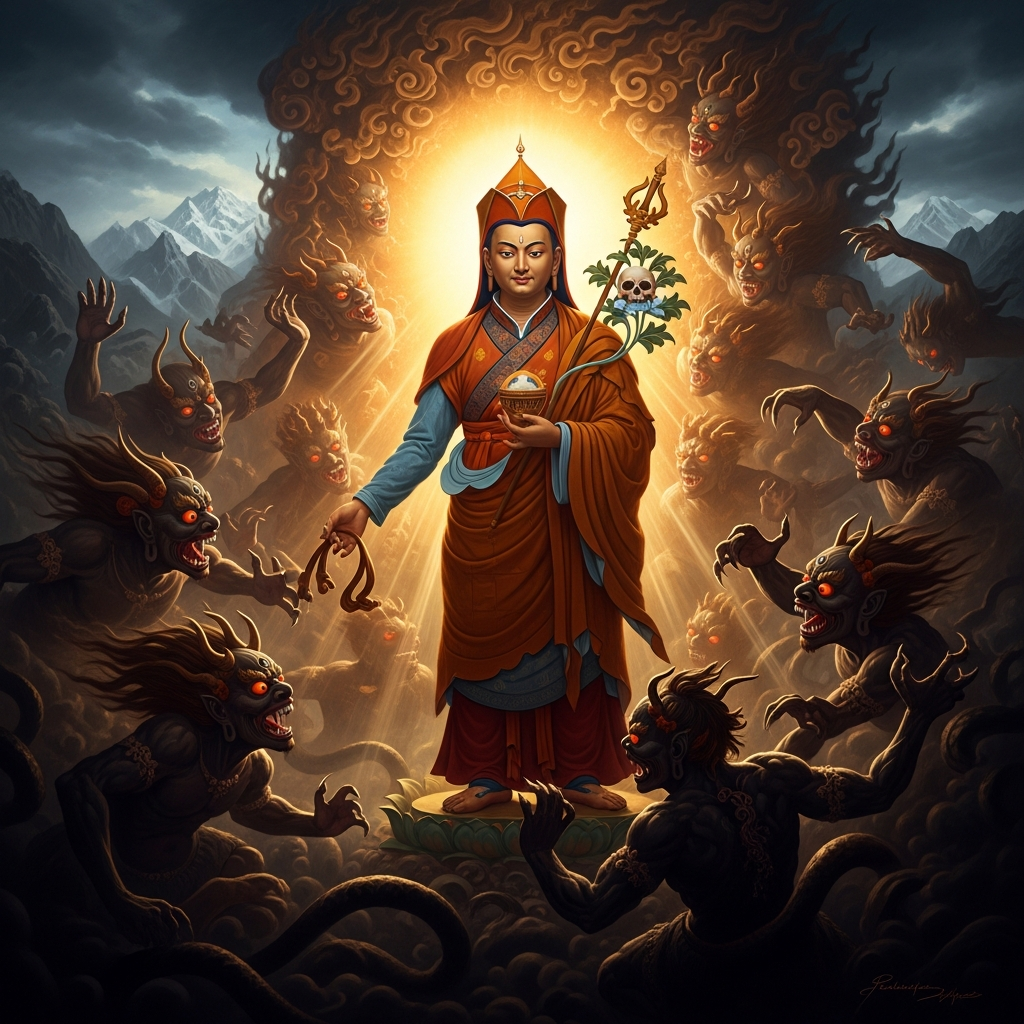
Machig Labdrön Cuts the Self
c. 1055-1149 CE · Tibet and the Himalayan high country · Central Tibet, particularly the Zangri Khangmar hermitage; the high passes of the Himalayan range
Contents
Machig Labdrön, born around 1055 CE reading sutras before she can walk, develops the chöd practice — offering your body as a feast to demons rather than fleeing them. She becomes the only Tibetan woman to found a major school of Buddhism that spread back to India, reversing the usual direction of transmission.
- When
- c. 1055-1149 CE · Tibet and the Himalayan high country
- Where
- Central Tibet, particularly the Zangri Khangmar hermitage; the high passes of the Himalayan range
She reads the sutras before she can walk.
The hagiography is specific about this: in her previous life she was a monk named Monlam Druppa who read and memorized sutras throughout his life and died reciting them. She was born as the daughter of a lay practitioner in Lab in central Tibet around 1055 CE, and the first intelligible sounds she made as an infant were sutric syllables. Her father, who had enough religious education to recognize what he was hearing, presented her to a local teacher at an age when other children were learning to balance on their feet.
The teacher tested her. He held up a text she had never seen and she read it aloud from the first line. He held up a second. She read that one too. He asked her what the words meant. She told him. He sat with this for a long time and then arranged for her to be trained.
She is, from the beginning, a prodigy of a specific kind: not a child who grasps things quickly but a child in whom something has already been grasped, who reads fluently in a language she has not been taught because she has not arrived empty. The Tibetan Buddhist understanding of this is pakpa — the continuation of attainments from previous lives, a kind of spiritual memory that bypasses the ordinary curriculum. She does not need to be introduced to the texts. She needs to be given time to remember what she already knows.
She encounters Phadampa Sangye when she is in her twenties, already established as a reader and chanter of texts in a monastery near Shigatse. He is Indian, wandering, old, and considered by the tradition to be one of the most accomplished tantric masters of the century — the teacher who will also transmit teachings to the siddha Dampa who links to the Zhije lineage. He sees her across a courtyard.
He says, according to the Chod Kyi Byung Khungs — the history of the chöd tradition — something that sounds like an insult and is actually a transmission: Great Bliss — abandon the village and the monastery and go to the charnel grounds.
She understands.
What he is saying is not leave your training. What he is saying is your training is complete enough to become dangerous in the wrong container. The monastic setting cultivates precision, learning, the gradual accumulation of correct understanding. It also, inevitably, cultivates the self that accumulates it. It is possible to spend a lifetime in a monastery becoming more and more learned and becoming, simultaneously, more and more consolidated as a learner — the self-sense thickening with each correct answer, each successful debate, each position of respect earned through demonstrated scholarship. The dharma describes exactly this trap and she is near it.
The charnel grounds are the antidote. They are where the consolidation stops.
The chöd practice that she develops — gcod in Tibetan, meaning literally to cut — begins from a premise she articulates with the directness of a woman who has thought this through completely:
The demons are not the problem. The practitioner who flees the demon is the problem.
Every spiritual system has its demons — the obstacles, the adversaries, the internal and external forces that impede the path. The standard response is to overcome them: to generate virtues that outweigh vices, to accumulate merit against negative karma, to train in wisdom until the obstacles dissolve. Chöd takes a different line. It says: the obstacle is sustained by your resistance to it. Every time you flee the demon, you confirm that the demon has something you need. Every time you protect the body from what threatens it, you reinforce the belief that the body contains something worth protecting.
The chöd ritual stages this confrontation deliberately. The practitioner goes to a charnel ground or a crossroads or a site known for spirit activity — anywhere the atmosphere is charged with the forces that ordinary people avoid. She plays the damaru, the hand-drum, and rings the ghanta, the bell, which together create the sonic environment of the practice. She visualizes her consciousness separating from her body and standing above it. She invites every demon, every hungry spirit, every obstacle-force, every fear in her own mind, to come to the feast she is preparing.
Then she visualizes the body cut open and offered: the flesh as food, the blood as drink, the bones as fuel. Everything. She is the host. The feast is herself.
The point is what happens next.
A practitioner who has performed this ritual sincerely — not as a visualization of something she is watching from a safe distance but as a genuine offering from someone who has temporarily suspended the protection of self — finds, reliably, according to the tradition, that the demons take the offered feast and leave satisfied. They had no quarrel with her. They had a quarrel with her fear. The fear was the door that kept calling them. The fear said: there is something here worth having. The offering says: here it is. The offering resolves the call.
The deeper finding is that the self she feared to lose was not what she thought it was. What she discovers, in the space after the offering, is an awareness that was never the body she just gave away. It was there before the visualization began. It will be there after. It does not require the body to continue, and knowing this — in the visceral, post-offering knowledge that the body’s dissolution provides — is not a theory about non-self but an experience of it.
This is what Phadampa Sangye means when he tells her to go to the charnel grounds.
She becomes, over the next decades, the primary teacher of what is now recognized as the Machig Labdrön lineage of chöd — distinct from the earlier practices it drew on, formalized in her own voice, transmissible in the way that only a teaching organized around a central insight can be.
She settles, eventually, at Zangri Khangmar — Red Rock Fortress — a hermitage above the Yarlung valley in central Tibet. Students come from across the plateau. She is difficult to approach, physically: the hermitage requires a serious climb and she does not modify her schedule for visitors who have not made the journey on foot. But those who arrive find a teacher whose instruction is immediately direct in a way that scholarly instruction is not. She does not explain the practice in the same way a text explains something. She demonstrates it. She shows students how to hold the drum. She stays in the room when the fear comes.
She sends her students to Indian practitioners — Phadampa Sangye’s circle, the mahasiddhas of Bengal and Bihar — and the Indian practitioners come back to her. The word moves, as word of genuine breakthrough always moves, faster than institutional channels.
The Indian pandits arrive as a test.
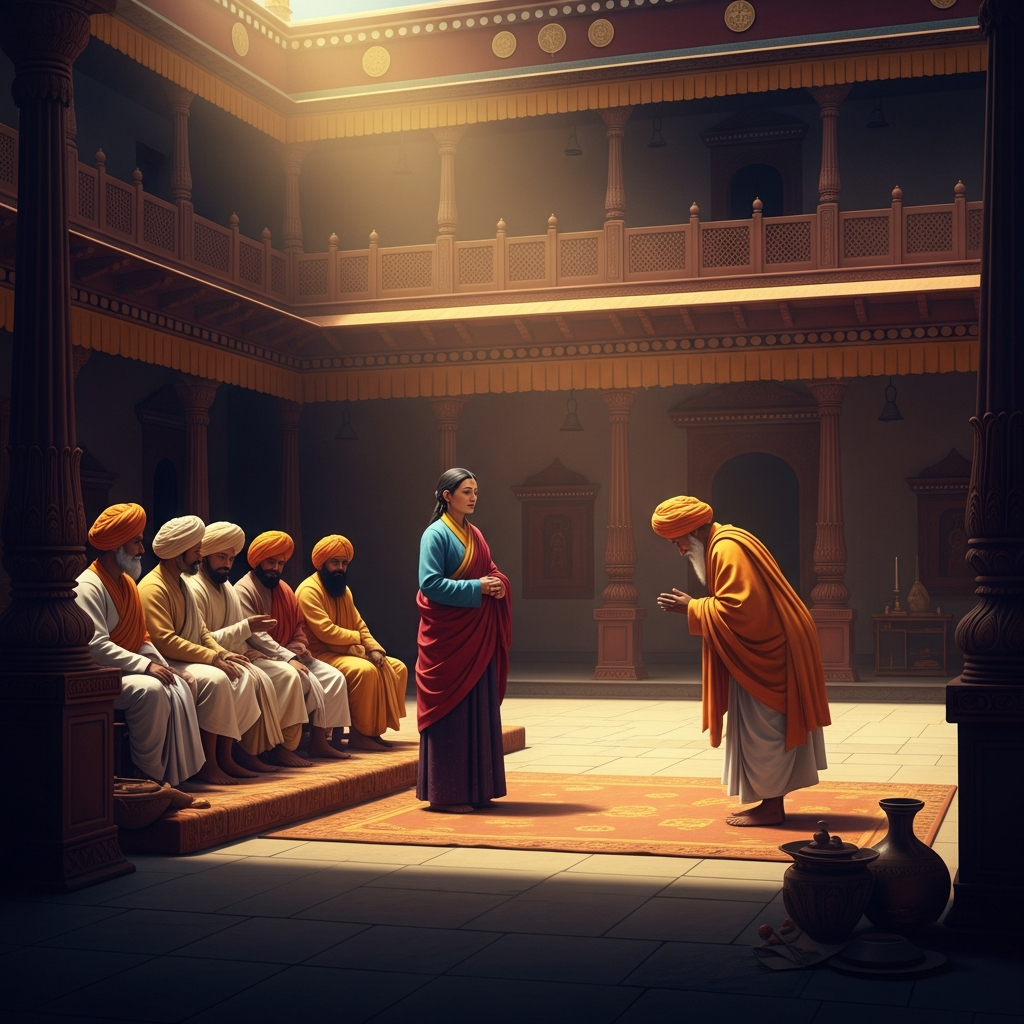
The texts describe a formal debate — a rtsod pa, the traditional Tibetan and Indian mode of establishing doctrinal validity — in which a delegation of scholars from the great Indian monasteries challenges her on the doctrinal foundation of chöd. Their claim is that it has no scriptural basis in the existing canon: it is not in the Vinaya, not in the Prajnaparamita, not in the Tantric canon. If it cannot be traced to the Buddha’s words, it is not dharma.
She debates them for three days.
Her argument is not that chöd appears verbatim in a canonical text. Her argument is that the Prajnaparamita Sutras — the perfection of wisdom literature — contain the seed: the teaching that phenomena have no inherent self, that clinging to the body as a real and permanent possession is the root error that generates all suffering. Chöd is the perfection of wisdom rendered as embodied practice. The text is the map; she is giving them the territory.
The debate ends, according to the tradition, with the lead pandit bowing.
He does not bow from defeat. He bows from recognition — the specific recognition of someone who has been shown that the thing he understood conceptually has, in this woman’s practice, been realized. He can see the difference. He returns to India and teaches chöd to the communities there.
This is the reversal that makes Machig Labdrön historically unique: for five centuries, teachings have flowed from India to Tibet. The dharma traveled north with the scholars and masters who brought it. She is the only Tibetan woman — arguably the only Tibetan practitioner — whose teaching moved south, back to India, because Indian scholars recognized something in it that the Indian canon did not already contain.
She lives, by some accounts, to ninety-five. She has children by her consort Thopabhadra — three of them, who become her primary inheritors — and this too is unusual: a woman who founds a school while raising a family, who holds both the domestic and the realized life simultaneously without treating them as contradictory.
Late in her life, students ask her to define the demon. She has been teaching for decades. She has sent students to charnel grounds in every climate and at every altitude Tibet offers. She has formalized the ritual, the music, the visualization, the stages. She has debated the pandits. She answers the question carefully.
She says: the demon is not the thing that frightens you. The demon is the clinging to the thing it frightens you to lose. If you are not clinging, nothing can use your fear against you. If nothing can use your fear against you, the demon has no leverage. A demon with no leverage is just a sound in the air.
She says: go to the charnel grounds. Take your drum. When they come, open your hands.
The chöd lineage descends from Machig Labdrön through her children and students to the present day. It is practiced across all four schools of Tibetan Buddhism — unusual for a teaching that began outside the monastic mainstream — and it has absorbed into the broader Vajrayana curriculum without losing the specific quality of directness that she gave it.
The damaru and ghanta she used in her practice are still in existence in a monastery in central Tibet.
Her teaching on the demon remains in circulation: it is quoted in modern therapeutic literature, in trauma studies, in mindfulness-based clinical contexts that have no connection to her tradition and no awareness of her name. The formulation works independently of its source. This is, from the Vajrayana perspective, exactly how a genuine transmission should behave — it moves into whatever container can hold it and continues to operate.
She cut the right thing.
Scenes
Machig Labdrön stands at the edge of a high cliff in the mountains at midnight, dressed in white, a damaru hand-drum in her right hand and a ghanta bell in her left, her long unbound hair streaming in the wind
 Generating art…
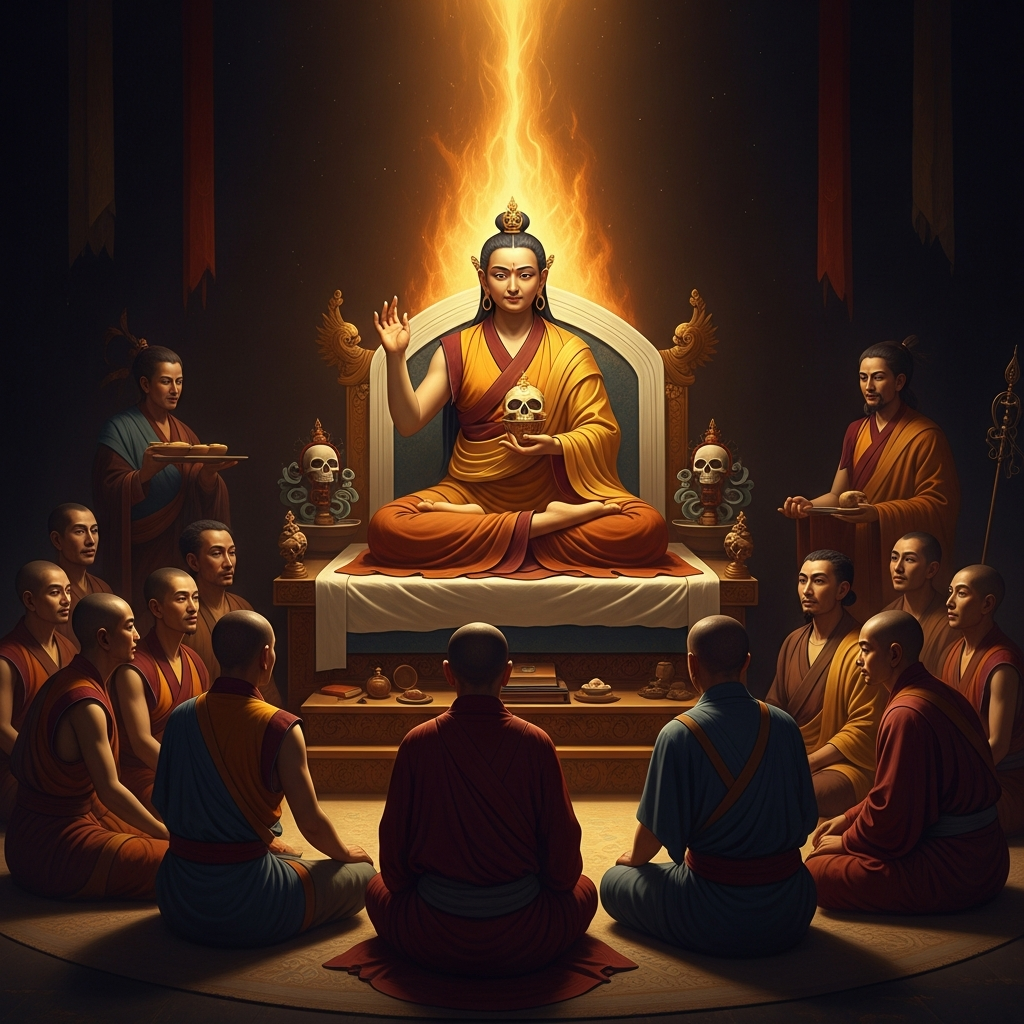
 Machig Labdrön seated on a low throne before a circle of students — monks and laypeople and wandering yogis intermingled — her right hand raised in the gesture of teaching, her left holding a skull-cup
 Generating art…
 In a courtyard of an Indian monastery, Machig Labdrön stands before a panel of Indian pandits who have come to challenge her teaching
 Generating art…
 Echoes Across Traditions
Entities
- Machig Labdrön
- Phadampa Sangye
- Thopabhadra
- Sonam Lama
Sources
- Jerome Edou, *Machig Labdron and the Foundations of Chod* (Snow Lion, 1996)
- Sarah Harding, trans., *Machik's Complete Explanation: Clarifying the Meaning of Chod* (Snow Lion, 2003)
- Judith Simmer-Brown, *Dakini's Warm Breath: The Feminine Principle in Tibetan Buddhism* (Shambhala, 2001)
- Tsultrim Allione, *Women of Wisdom* (Routledge, 1984; Snow Lion, 2000)
- Janet Gyatso, 'The Development of the Good Doctrine: Narrative and Doctrine in the Legend of Machig Labdron,' in *Religions of Tibet in Practice* (Princeton, 1997)
- Cyrus Stearns, *King of the Empty Plain: The Tibetan Iron-Bridge Builder Tangtong Gyalpo* (Snow Lion, 2007)