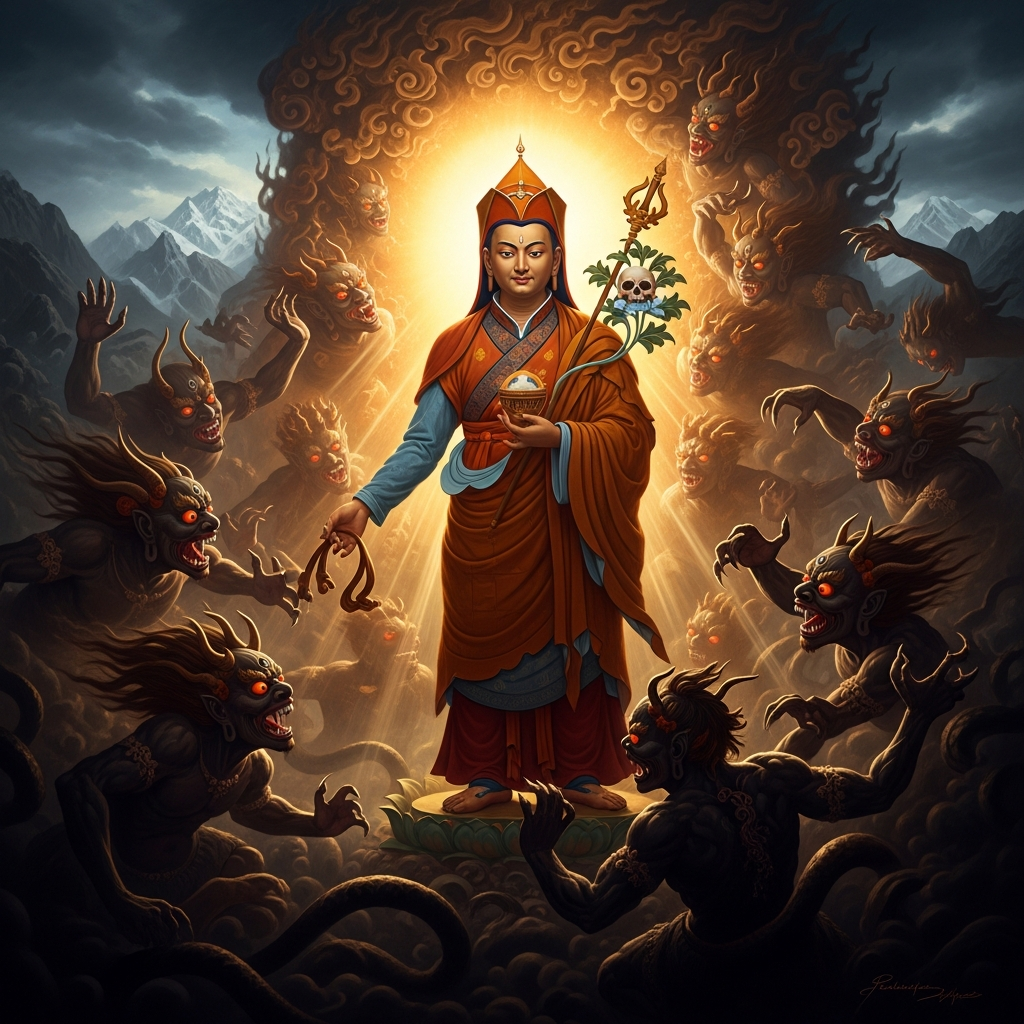
Marpa Throws the Gold into the Air
c. 1012-1097 CE · Tibet and northern India · Lhodrak, southern Tibet — and three overland journeys south through the Himalaya to Nalanda and the plains of Bengal
Contents
Marpa the Translator makes three brutal journeys from Tibet to India to receive teachings from Naropa, carrying gold each time to pay for the transmissions. On the third journey, Naropa tells him the gold is worthless — all the gold in the universe could not purchase the dharma. Marpa throws it into the air. This moment founds the Kagyu lineage.
- When
- c. 1012-1097 CE · Tibet and northern India
- Where
- Lhodrak, southern Tibet — and three overland journeys south through the Himalaya to Nalanda and the plains of Bengal
He goes the first time for gold’s worth of teachings and comes back carrying the gold’s worth.
Marpa of Lhodrak is thirty years old on the first journey. He has been studying Sanskrit since childhood under a gruff local translator named Drogmi and has become, through sheer force of linguistic aptitude and obsessive application, good enough to know that the translations he is working from are incomplete. The dharma texts available in Tibet in the early eleventh century are good. They are not the whole library. The whole library is in India, in Sanskrit, in the heads of the masters at Nalanda and Vikramashila and in the forests of Bengal where the wandering mahasiddhas are practicing what the monasteries do not teach.
He collects gold. This takes years — selling land, borrowing from relatives, accepting contributions from students he has not yet produced, arguing against the conventional Tibetan wisdom that one should not spend everything on a single venture. He collects more gold than any single person in Lhodrak has assembled for a journey to India.
He crosses the passes south. The journey is three years one way in conditions that make the word difficult inadequate: altitude sickness, bandits, monsoon, disease, passes that require ropes and the willingness to believe the next handhold will be there. He arrives in Bihar, finds Naropa — who is no longer at Nalanda but wandering, as great teachers often are, somewhere between monastic life and the complete freedom beyond it — and presents the gold.
Naropa teaches him. He stays years. He accumulates transmissions: the Guhyasamaja, the Chakrasamvara, the Hevajra cycle, the mahamudra pointing-out instructions. He pays for them in gold, in service, in the steady demonstration of a student who can be trusted with difficult material.
He carries the transmissions home in his memory — writing is not feasible for most of the journey — and he begins translating.
He goes the second time because the first time was not enough.
This is a specific kind of insufficiency: not a gap in the material he received but a gap in his own realization. He has the transmissions. He can translate them. He understands them in the way that a skilled musician understands a score — he can read it, analyze it, produce it faithfully. He cannot yet play it from the inside.
He collects gold again. Less, this time, because there is less available — the first journey consumed the reservoir. He patches together what he can, crosses the passes again, finds Naropa again. Naropa recognizes him. There is the particular warmth of teacher-student recognition across a gap — the teacher seeing immediately what has changed and what has not.
He receives more transmissions. He stays. He goes back.
He is now the most important Buddhist translator in Tibet. He has students. He has a family — Dagmema, his wife, who manages the estate while he is away and who is described across sources as a woman of unusual equanimity and genuine realization. He teaches the transmissions he has brought back. He translates texts with the precision of someone who has heard the teachings explained by their source.
He knows there is still something he does not have.
He goes the third time in his fifties.
The gold situation is now genuinely difficult. The two previous journeys have depleted the resources available to him in ways that a third journey will push past the point of conventional solvency. He gathers what he can. It is not what it was the first time. He crosses the passes knowing this is probably the last crossing — the body, at this age, does not have an indefinite number of high-altitude journeys left in it.
He finds Naropa.
Naropa looks at the gold.
He says, in the formulation the tradition has preserved across a thousand years of retelling: bring all the gold in the world. Pile it at my feet. It would not buy the dharma. Not a single teaching. Not a single syllable.
This is a harder statement than it sounds.
The first two journeys were not wasted. Naropa taught him for years across those two visits. The gold was spent and the teachings were received and the teachings are genuine. Naropa is not repudiating the transaction. He is identifying what the transaction could not purchase — the specific thing Marpa has been trying to acquire across thirty years of assembly and travel.
The thing that gold buys is access: access to the teacher, access to the teaching environment, access to the transmission ceremony. These are necessary. They are not sufficient. The actual transmission — the pointing-out of mind’s nature, the direct introduction to mahamudra — happens when the student is ready in a way that has nothing to do with how much gold they brought. It happens when the student has genuinely exhausted every means of getting the teaching through ordinary effort and is genuinely present with the fact that the effort alone is insufficient.
Marpa has spent thirty years on the journey. He has spent everything he had on two occasions. He is crossing the passes for the third time in his fifties, physically depleted, with diminished gold, and he knows — in the bone-deep way that only comes from this much accumulated evidence — that he is still not there.
He is there.
Naropa tells him: throw the gold into the air.
He throws it.
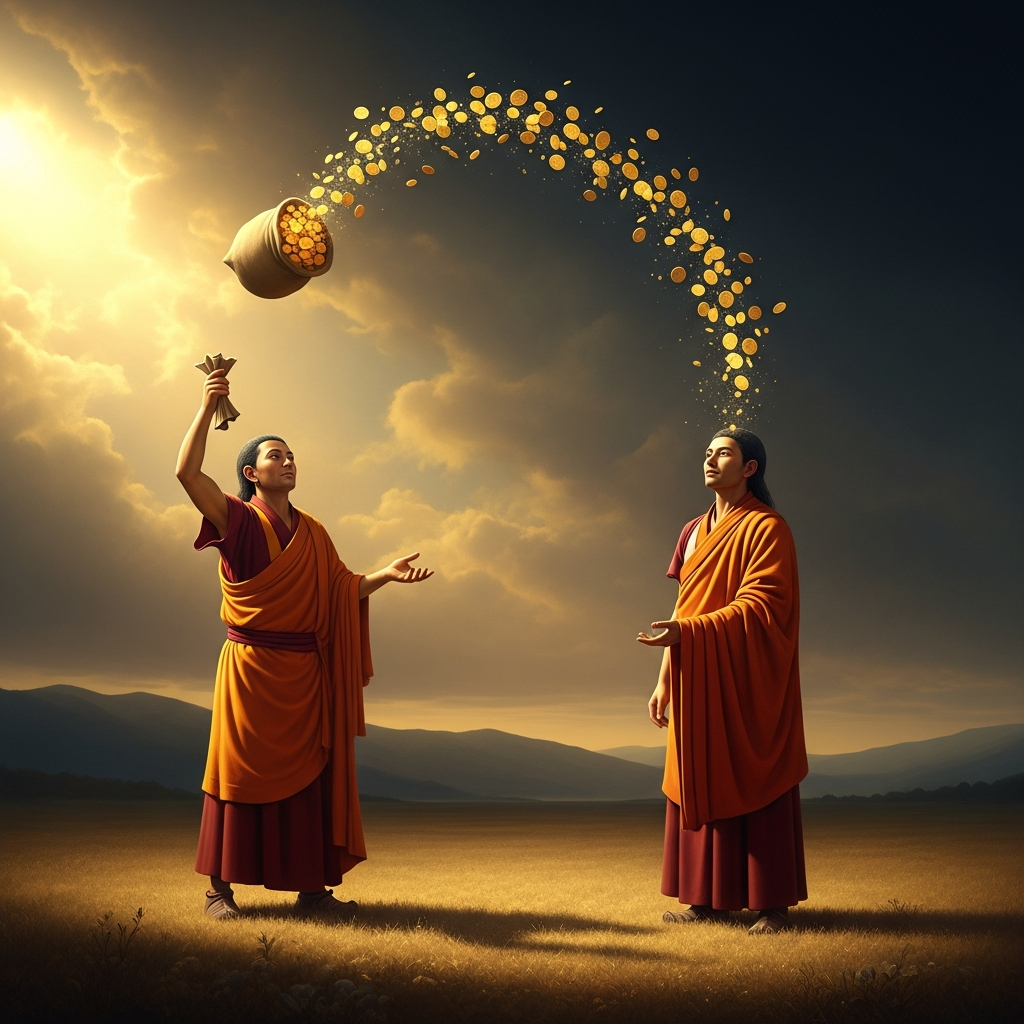
The bag opens as it arcs — or he throws it openly, no bag, the individual pieces catching the light — and the gold scatters across the field in the way that things scatter when released without any plan to recover them. This is the gesture: not a ritual offering, not a donation to the teacher’s community, not an exchange for anything. Just the release. Just the opening of the hands and the letting go of the instrument that was supposed to purchase the thing it cannot purchase.
The moment of release is the moment of transmission.
Naropa teaches him mahamudra directly after this. The formal transmission ceremony, the initiation, the pointing-out instruction — all of it. The texts say this transmission is different from what he received on the first and second journeys: not because the content is different but because the receiver is different. He has arrived without the gold. He has thrown it away. He is empty of the thing he was using to manage the relationship to the teacher.
He stays for years. He receives the transmission in its fullness. He returns to Tibet.
He is sixty-something when he returns. He has perhaps thirty years of active teaching and translation ahead of him. He spends them with the precision of someone who knows exactly how much time there is and what it needs to contain.
He teaches. He translates. He organizes the Kagyu lineage — the lineage that descends from Tilopa through Naropa through himself — into a transmissible form. He writes the direct instructions for mahamudra practice in Tibetan, adapted to the Tibetan student, drawing on three decades of transmission and thirty more years of practice.
He receives students. One of them is a young man from Gungthang who arrives with an introduction from his previous teacher: I have killed thirty-five people. Can you help?
He looks at this young man for a long time.
He says: I need a field plowed.
He has spent his life learning how to give the dharma to someone who is ready for it. He has spent his life learning that readiness cannot be purchased, cannot be assembled, cannot be produced by the teacher’s good intentions or the student’s desperate need. It can only be created by a process that removes what stands in the way.
He knows exactly what stands in the way of this particular young man.
He tells him to plow the field. Then he tells him to build a tower.
The Kagyu school — one of the four main schools of Tibetan Buddhism — counts today several million adherents across Tibet, Mongolia, Bhutan, the Himalayan foothills, and the global diaspora. Every Kagyu lama in this lineage traces through Gampopa through Milarepa through Marpa through Naropa through Tilopa.
Marpa’s translations are still used. The texts he carried back across the Himalayan passes — in his memory, written on strips of cloth sewn into his robe, encoded in the transmission ceremonies he memorized because there was no other way — are still the primary texts of the lineage.
He threw the gold into the air.
It is still in the air.
Scenes
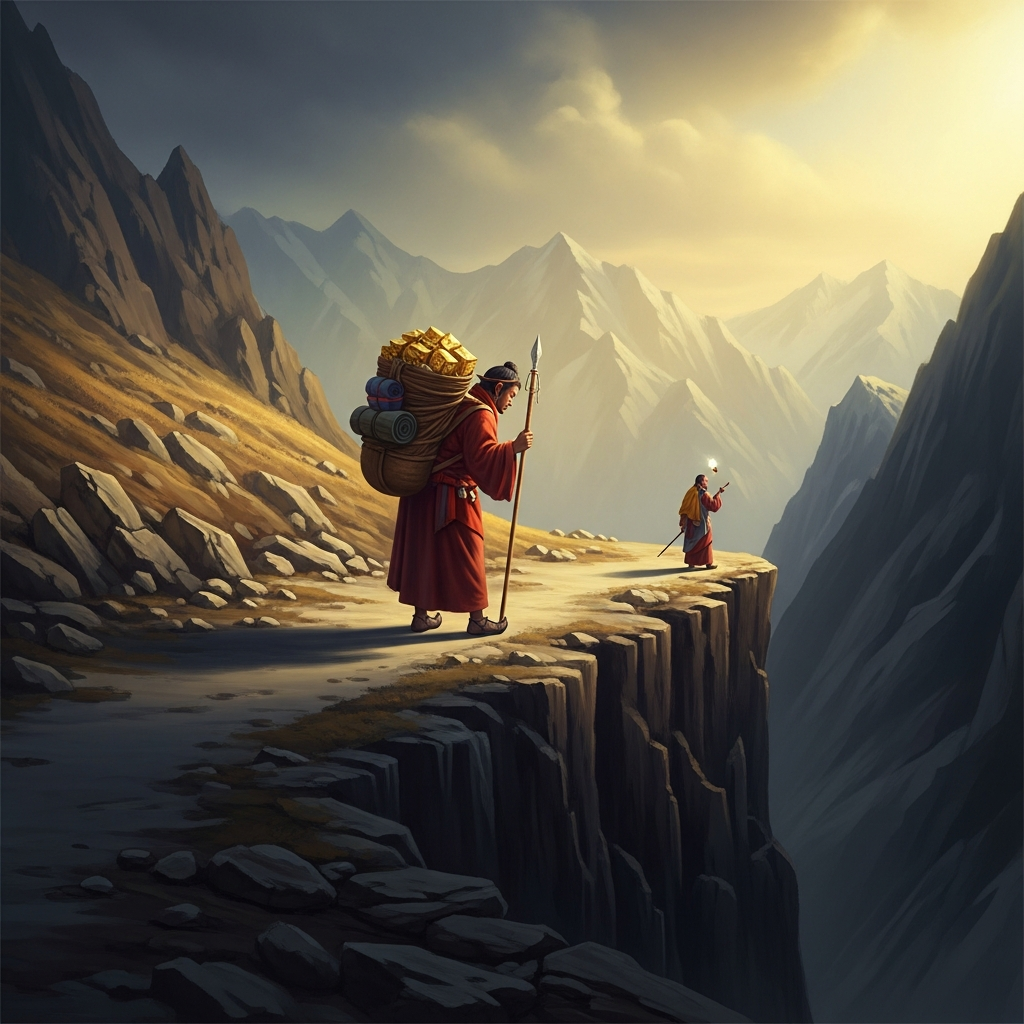
Marpa on the high Himalayan passes heading south into India, a heavy pack on his back containing gold from the Tibetan plateau
 Generating art…
 Naropa and Marpa standing in an open field
 Generating art…
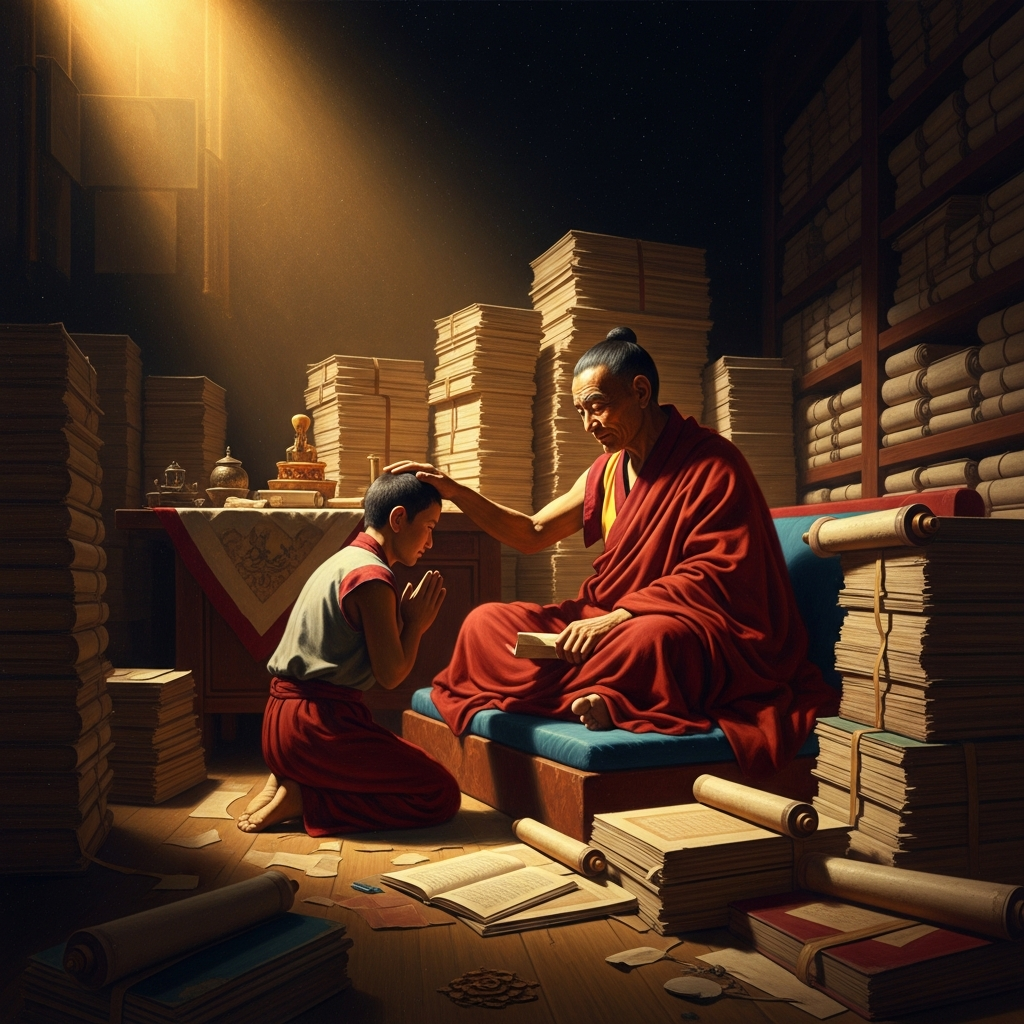
 Marpa in his study in Lhodrak, surrounded by the texts he translated across thirty years of journeys, his hand on the head of Milarepa who kneels before him in the moment of formal transmission
 Generating art…
 Echoes Across Traditions
Entities
- Marpa the Translator
- Marpa Lotsawa
- Naropa
- Maitripa
- Dagmema
Sources
- Nalanda Translation Committee, trans., *The Life of Marpa the Translator* (Prajnaparamita Press, 1982; Shambhala, 1995)
- Tsangnyön Heruka, *The Life of Milarepa* (trans. Andrew Quintman, Penguin Classics, 2010)
- Herbert V. Guenther, *The Life and Teaching of Naropa* (Oxford, 1963)
- Reginald A. Ray, *Indestructible Truth: The Living Spirituality of Tibetan Buddhism* (Shambhala, 2000)
- Chogyam Trungpa, *Journey without Goal: The Tantric Wisdom of the Buddha* (Shambhala, 1981)
- Glenn H. Mullin, *The Kagyu Masters* (Snow Lion, 2005)