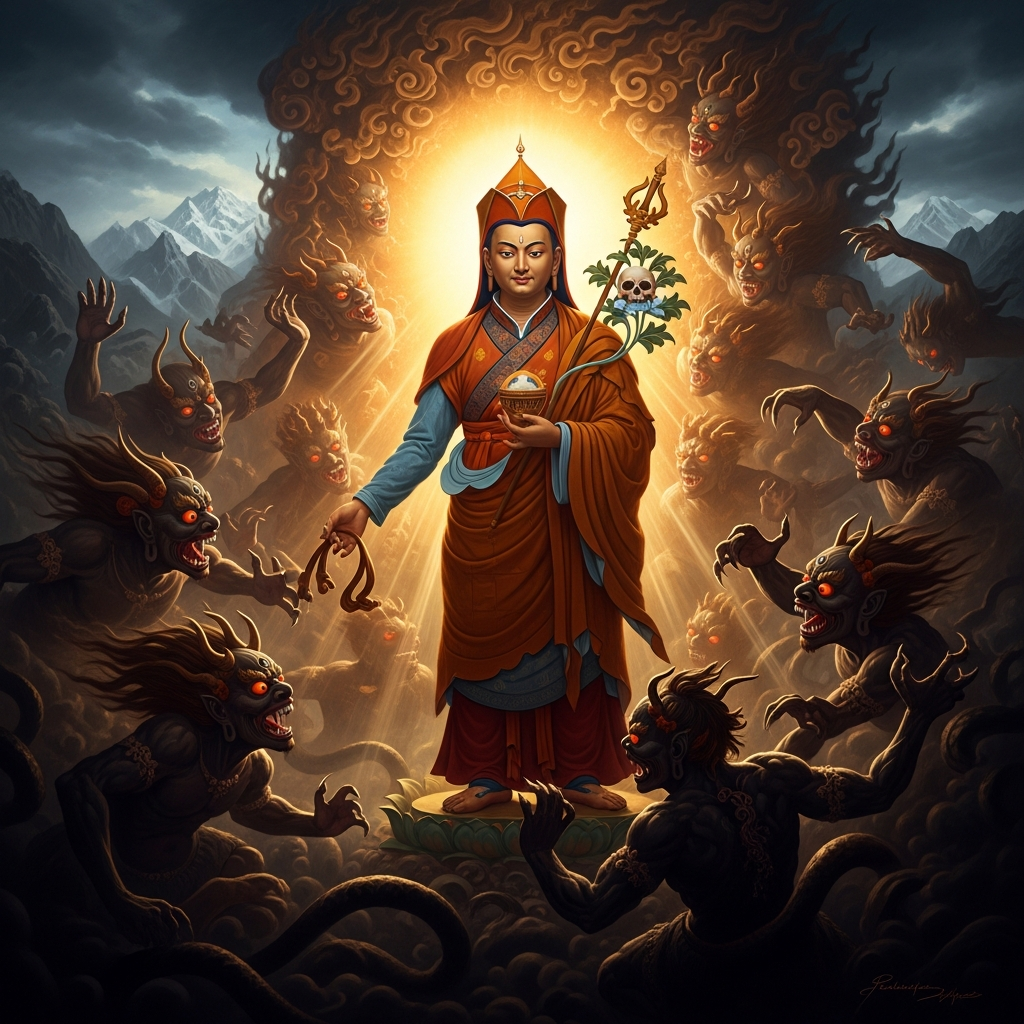
Padmasambhava on the Roof of the World
c. 762-779 CE · the Tibetan plateau, from Mangyul on the western border to the site of Samye monastery in the Yarlung valley
Contents
The Lotus-Born tantric master rides into Tibet at the king's invitation and, mountain by mountain, binds the indigenous demons by oath as protectors of a dharma that does not yet exist.
- When
- c. 762-779 CE
- Where
- the Tibetan plateau, from Mangyul on the western border to the site of Samye monastery in the Yarlung valley
The invitation arrives in the form of a grief.
King Trisong Detsen of Tibet, in his Yarlung-valley capital, is twenty-five years old and has decided to import the dharma. He has read what reached his court from China and India. He believes Tibet’s mountain culture — Bön, the indigenous shamanic religion of soul-eating demons and astral journeys — has held his people in a kind of magnificent darkness. He has invited the most accomplished Indian Buddhist scholar of the century, Shantarakshita, abbot of Nalanda, to come and teach.
Shantarakshita arrives. The mountains do not allow him to work.
Earthquakes shake his foundations. Lightning strikes his retinue. His translators sicken. The local lha — the mountain gods, glacier-spirits, lake-witches, snow-demons — recognize him correctly as the leading edge of an invasion and respond as any indigenous pantheon would. After a year, Shantarakshita gives up. Before he leaves, he tells the king: send for one more man. There is only one I know who can do this. He is from Oddiyana. He was born from a lotus on the lake of Dhanakosha. He does not negotiate with mountains. He commands them.
The king sends.
Padmasambhava enters Tibet through the Mangyul pass.
He is, even by hagiographic standards, an unusual figure. Born — the Padma Thang Yig will insist — not from a womb but spontaneously, on a lotus blossom in the middle of a lake in the Swat Valley, a fully formed eight-year-old boy holding a vajra and a skull-cup. Trained at Nalanda. Married, briefly, to a princess of Zahor whose father tried to burn him alive on a sandalwood pyre, only to find — when the smoke cleared — a lake where the pyre had been and Padmasambhava sitting on a lotus in the middle of it. He has, by the time he crosses into Tibet, spent decades in cremation grounds practicing the wrathful tantras the institutional monasteries do not teach.
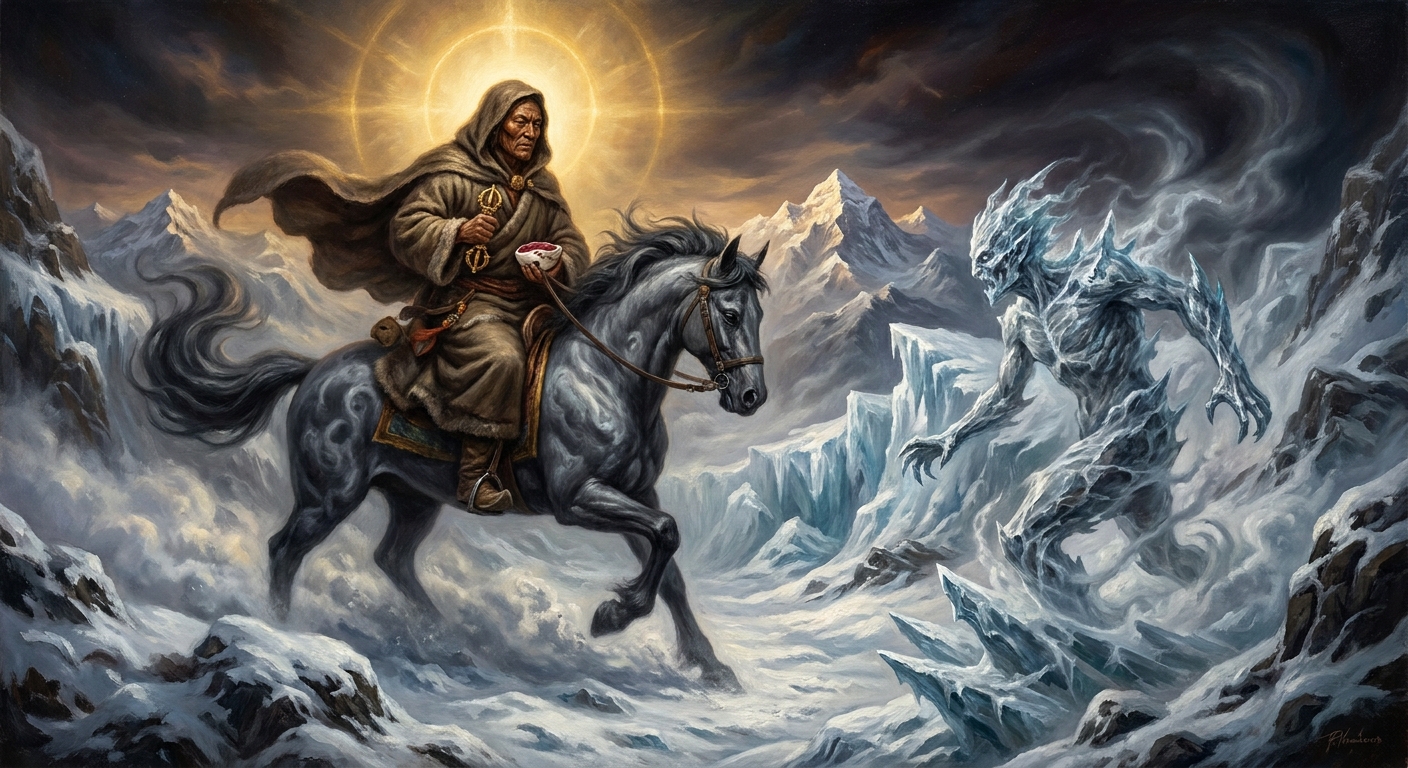
He is riding a horse. The horse is the color of storm-cloud.
The first demon meets him on the pass.
It is a glacier-spirit — du, in the Bön taxonomy — and it has snowed out three of Trisong Detsen’s previous emissaries. It comes for him in the form of a wall of weather: blizzard rolling down the col, visibility nothing, the temperature dropping below survival in the space of a breath.
He stops his horse.
He does not chant a peaceful sutra. He chants the Vajrakilaya mantra — the wrathful tantric ritual of the diamond dagger, syllables sharp enough to split spirit-flesh — and points his ritual phurba at the heart of the storm. The texts say the storm freezes mid-fall. Each snowflake hangs in the air. The demon is forced into visible form, kneels in the snow, and asks for mercy.
He grants mercy.
But the mercy has a shape: take the vow. From this hour you are not the master of this pass. You are its protector — the dharmapala, the dharma-protector. You will guard the travelers you used to bury. You will stand watch over a religion that does not yet exist on this mountain. Refuse, and I will dissolve you into the syllables you came from.
The glacier-spirit takes the vow. Padmasambhava names it. The horse moves on.
He does this, the texts say, mountain by mountain. Lake by lake. Pass by pass.
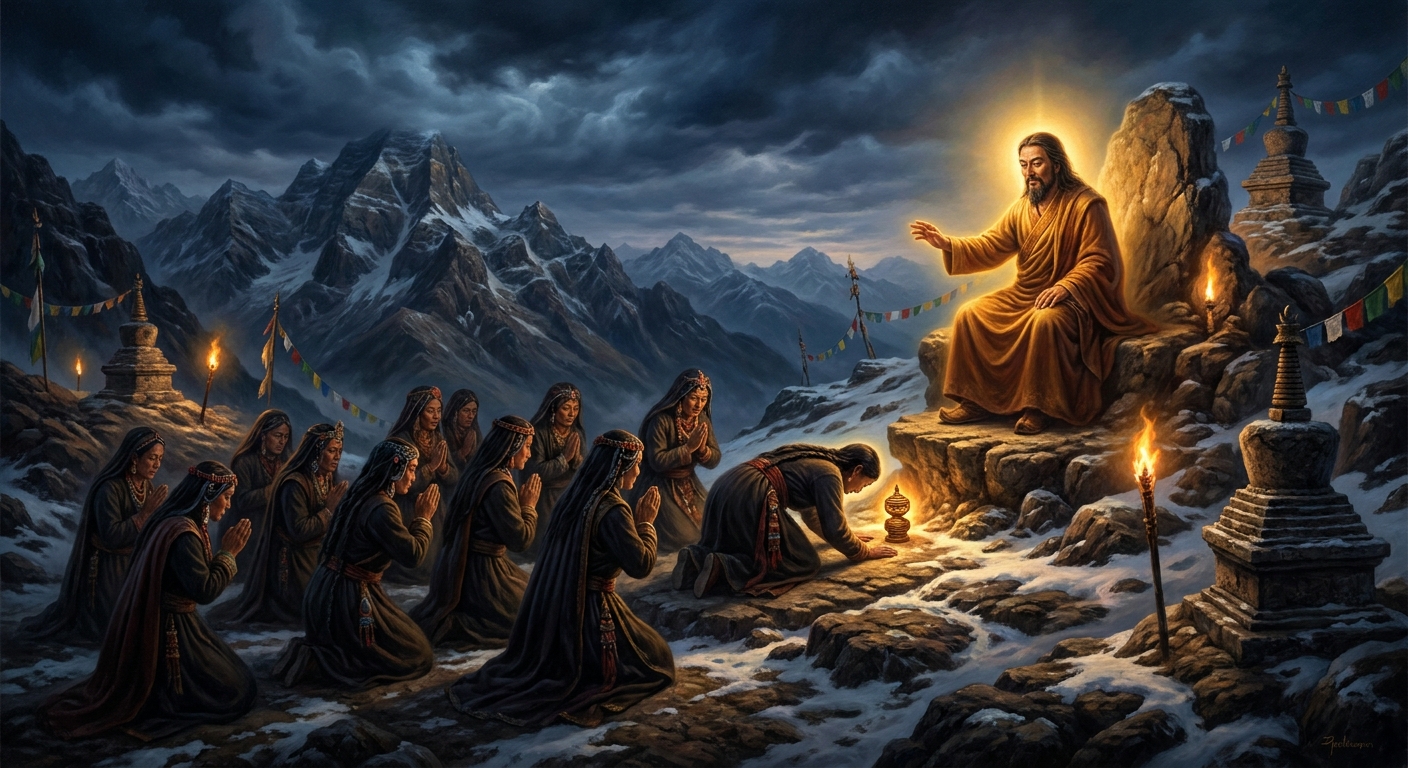
The twelve Tenma goddesses — local witches of the cardinal directions, who had been eating travelers since before any king’s writ ran — meet him on the slopes of Mount Hepori in a circle of bone-fires and demand his liver. He invites them to sit. He explains, with terrifying patience, the law of cause and effect: every liver they have eaten is a debt their next thousand lifetimes will pay. He offers an alternative. Become protectors. Take the oath. Your hunger will be redirected; you will eat only the obstacles to dharma, not its travelers. One by one — the youngest first, the eldest last — they kneel. He gives each one a samaya name. They are still invoked, by those names, in every Tibetan Buddhist ritual today.
The pattern repeats from Mangyul to the Yarlung plain. Lake-spirits, sky-burial demons, the naga of the boiling springs at Yangpachen, the gyalpo who possessed kings, the mamo who killed children in their sleep. He does not exorcise them. He does not burn their shrines. He binds them by oath and writes them, with their original names, into the new pantheon.
This is the unusual thing.
Christian missionaries in pagan Europe were, in the same century, cutting down sacred oaks. Boniface felled the Donar Oak in 723. Charlemagne would massacre the Saxons at Verden in 782 for refusing baptism. The dharma does it the other way. The lha keep their mountains. The Tenma keep their directions. The lake-witches keep their lakes. They simply work, now, for a different boss.
The result is a religion that does not feel imposed. The Tibetan farmer who circumambulates a stupa in 779 is also still leaving butter on the rock his grandfather left butter on; the rock-spirit is still there, still local, just now wearing a Sanskrit name and a vow. Bön survives, in altered form, beside Buddhism rather than under it. The two traditions argue for centuries — they still argue — but neither erases the other.
Vajrayana Buddhism, the Diamond Vehicle, is born in this negotiation.
He arrives at the site of Samye in the Yarlung valley.
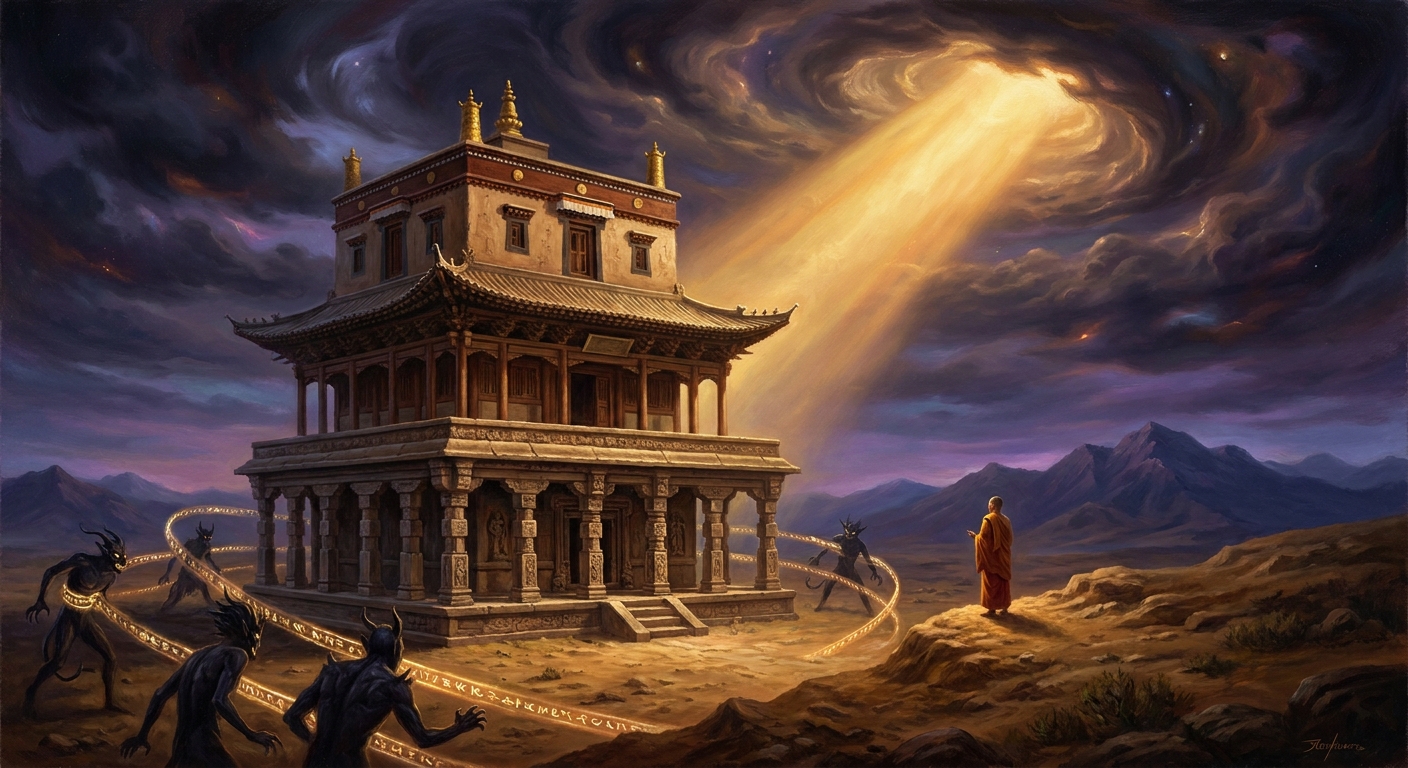
Trisong Detsen has chosen the spot. Shantarakshita has returned, summoned again. The three of them — king, scholar, tantric master — preside over the construction of the first monastery in Tibetan history. It is built, deliberately, as a mandala: a central temple representing Mount Meru, four temples at the cardinal points representing the four continents, eight smaller ones for the subcontinents. Three storeys; each in a different national style — Indian on the ground, Chinese on the second, Tibetan on the third — to declare, architecturally, that the dharma has come from many directions and will speak in all of them.
Construction begins in 763. The texts say it would have failed — demons tearing down at night what the workers built by day — except that Padmasambhava walks the perimeter every evening, calling each bound spirit to its post. You took the vow. Stand watch. The walls hold. The temple goes up. Samye is consecrated, by traditional reckoning, in 779 CE.
The first seven Tibetan monks are ordained inside it. Padmasambhava names them. The line that begins with those seven runs, unbroken, to the present.
Before he leaves Tibet — riding back out, the texts insist, on a horse that simply walks into the air and disappears toward the southwest — he hides his teachings.
Not in libraries. In rocks, in lakes, in the minds of his consort Yeshe Tsogyal and a hundred other students. Termas, the hidden treasures, to be discovered by tertons in centuries when the dharma is endangered. The hidden teachings are still being recovered. Major terma cycles were revealed in the 11th, 14th, 17th, and 20th centuries. The Bardo Thödol — the so-called Tibetan Book of the Dead — was a terma found by the terton Karma Lingpa in the 14th century in the side of a mountain. The mountain, it turns out, was one of the ones Padmasambhava had bound by oath six hundred years earlier.
The demon was holding the book.
Tibetan Buddhism today claims roughly twenty million adherents, plus the millions more across Mongolia, Bhutan, parts of China, and the global diaspora that followed the 1959 exile. Every Nyingma lineage — the Old School, the oldest of the four Tibetan schools — traces directly to the seven monks Padmasambhava ordained at Samye. The fourteenth Dalai Lama, in interviews, still refers to him simply as “Guru Rinpoche” — the Precious Master.
The wrathful protector deities depicted on every Tibetan thangka — the bull-headed Yamantaka, the six-armed Mahakala, the twelve Tenma in their cardinal mandalas — are, almost without exception, the demons Padmasambhava bound. They retain their original Tibetan iconography: the fangs, the crowns of skulls, the necklaces of severed heads, the ornaments of human bone. Buddhism in India had no taste for this imagery. Tibet kept it, intact, because the figures wearing it had been there first and were under contract.
The Padma Thang Yig, the Lotus Chronicle, is read aloud in Nyingma monasteries on the tenth day of every lunar month — Guru Rinpoche’s day. The chant has not, in twelve centuries, been allowed to break.
The mountain still holds. The vow is still in force.
Scenes
He crosses the Mangyul pass into Tibet on a horse the color of storm-cloud
 Generating art…
 On the slopes of Mount Hepori, the twelve Tenma goddesses — local witches who eat travelers — kneel one by one and take the vow
 Generating art…
 Samye monastery rising on the Yarlung plain — the first monastery in Tibet, its three storeys built in three different national styles, every demon of the plateau bound to its protection
 Generating art…
 Echoes Across Traditions
Entities
- Padmasambhava
- Guru Rinpoche
- King Trisong Detsen
- Yeshe Tsogyal
- the twelve Tenma goddesses
- Shantarakshita

Sources
- *Padma Thang Yig* (the *Lotus Chronicle*, attributed to Yeshe Tsogyal, redacted 14th century by Orgyen Lingpa)
- Yeshe Tsogyal, *The Life and Liberation of Padmasambhava* (trans. Erik Pema Kunsang / Kenneth Douglas & Gwendolyn Bays, 1978)
- Robert A. F. Thurman, *Essential Tibetan Buddhism* (HarperOne, 1995)
- Matthew Kapstein, *The Tibetan Assimilation of Buddhism* (Oxford, 2000)
- Donald W. Mitchell, *Buddhism: Introducing the Buddhist Experience* (Oxford, 2002), ch. 9
- Sam van Schaik, *Tibet: A History* (Yale, 2011), ch. 1-2
