Milarepa and the Black Magic
c. 1070-1082 CE · Central Tibet · Gungthang and Lhodrak, central Tibet
Contents
A young Tibetan man, robbed of his inheritance and driven by his mother's grief, learns sorcery and kills thirty-five people at a wedding. Then he has to live with it.
- When
- c. 1070-1082 CE · Central Tibet
- Where
- Gungthang and Lhodrak, central Tibet
His father’s name was Mila Sherab Gyaltsen, and he died when the boy was seven.
That is the beginning of the story, though it will not feel like the beginning for years. The father dies and the estate — the house, the fields, the turquoise ornaments, the wool, all of it — passes by arrangement to the uncle and aunt, who are to hold it in trust until the boy comes of age. The uncle and aunt hold it. They hold it so thoroughly that by the time the boy is a young man they have decided they would like to keep it. The mother, the boy, and his sister are put to work as servants on land that should have been theirs. They sleep on straw. They eat what is left.
The mother’s name is White Garland. She is not a soft woman by nature and this decade of humiliation has burned out everything soft. She watches her son grow into a young man who is lean and patient and who has, she thinks, the kind of intelligence that could be aimed. She makes a plan.
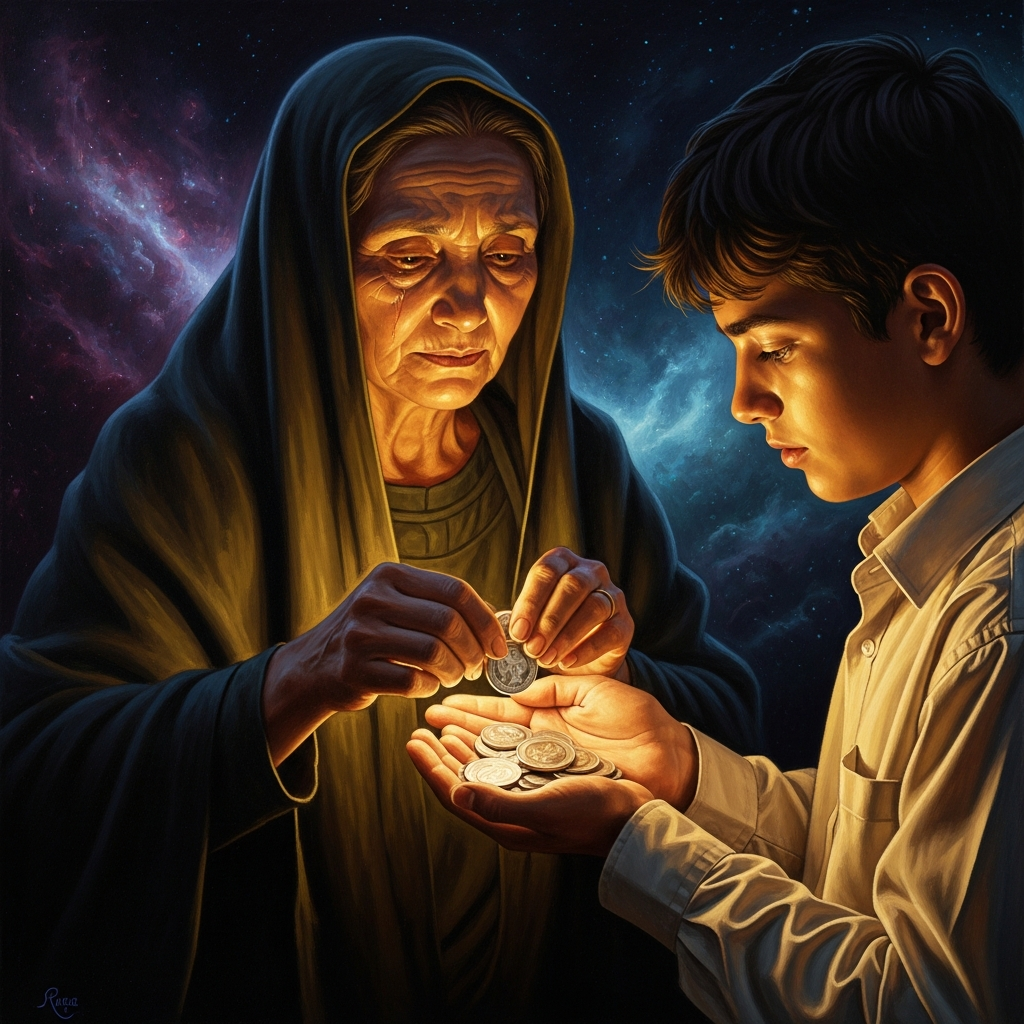
She scrapes together enough silver — begged from relatives, wrested from what little the family’s fallen position allows — and she sends him north to find a teacher in the black arts. She is specific about what she wants. She does not want him to ruin his uncle’s reputation. She does not want a curse that festers slowly. She wants the crops to fail and she wants the family to die.
She tells him: if you come back without having learned enough to destroy them, I will kill myself in front of you.
This is not metaphor. He believes her. She means it.
He finds the sorcerer Yungton Trogyal in the valley of Khulung. Trogyal is old and skeptical and the boy has nothing much to offer except the story of what was done to his family, which is considerable, and a quality of grief so genuine and clean that the teacher eventually agrees. He teaches him the dü rituals — the hail conjurations, the black weather magic — and the boy turns out to have an aptitude for this that unsettles even his teacher.
He sends the hailstorm first.
He sits in the high ground above his uncle’s valley and he calls the weather. The texts describe what happens in technical detail, which is the Tibetan Buddhist way of indicating that this was a real practice with real mechanics, not a fairy tale: the visualization, the mantra sequences, the binding of wind-spirits to the intention. The hailstorm arrives on a clear day and it is specific. It destroys his uncle’s harvest with the precision of a grievance — field by field, row by row — and leaves the surrounding countryside intact. There is no ambiguity about the source. Everyone knows. The village talks.
His uncle’s family is frightened. They are not destroyed.
His mother sends word: more.
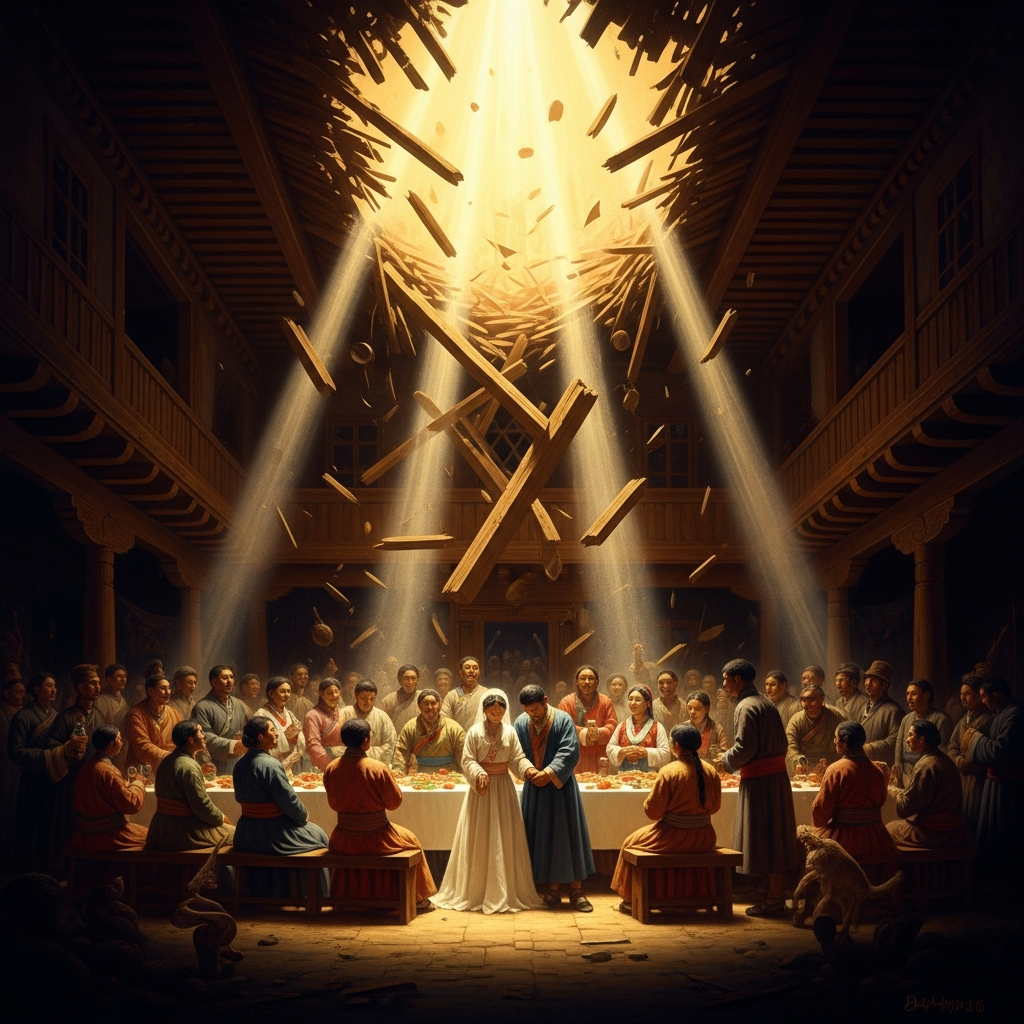
The cousin’s wedding is the opportunity. The house his uncle built on Milarepa’s family’s land is full of people — thirty-five of them at the celebration, packed under a roof that is, by now, structurally supported by a pillar Milarepa’s magic has been quietly working on for weeks. The texts are measured about this. He binds a black serpent to the pillar. The serpent writhes. The pillar fails.
The roof comes down during the dancing.
Thirty-five people. The groom’s horse breaks its legs in panic and has to be killed. His aunt and uncle survive. The loss of their children and grandchildren and neighbors, the smoke, the screaming, the village’s transformation of its grief into rage — this is the harvest. He watches from the hills.
He is, in the aftermath, exactly what he set out to be. His mother is satisfied. She shouts his praises across the valley.
The guilt does not arrive immediately. In the texts, Milarepa describes the weeks after the destruction with the flat precision of a man reporting weather: the village’s fury, his flight, the satisfaction he had performed. Then — gradually, the way an injury reveals its depth only after the adrenaline clears — he begins to understand what he has made.
Thirty-five people.
He can name some of them from childhood. He knows whose daughter, whose son. He knows the groom. He knows that the celebration that was happening in the moment the roof came down was genuine, that these were people who had, that morning, nothing to do with his family’s ruin. They were collateral to a vengeance that was already complete. The aunt and uncle lived. The bystanders died.
He goes back to his teacher. He says: I need the dharma. I need a path that can clean this. Give me teachings that can purify this weight of karma.
Trogyal, who is honest, tells him: I don’t have what you need. The black arts are not reversible by black arts. You need a different kind of teacher entirely. There is a man — Marpa, they call him Marpa the Translator, in Lhodrak. If anyone has a teaching large enough for what you’ve accumulated, it is him.
He walks south toward Lhodrak with the deaths on his back.
The Life of Milarepa is explicit that he carries no illusion about what he has done. He does not reframe it. He does not tell himself the victims had it coming, or that his uncle’s original crime justified what followed, or that the cosmic balance has been restored. He knows — in the specific, granular way that Tibetan Buddhism insists one must know one’s karma — that he has killed thirty-five people at a wedding and destroyed a harvest and that the consequences of this will persist across lifetimes unless something extraordinary intervenes.
This is the unusual feature of the story: the sin is not minimized as a precondition for the teaching. It is held at full size. The darkness is not softened before the light arrives.
He is looking for a teacher who can survive the full size of what he has done and still offer him a path forward.
Milarepa will find Marpa. Marpa will not make it easy. Nothing about the purification of this particular ledger will be fast or comfortable or cheap. But the tradition keeps this story at the front of the biography — before the caves, before the songs, before the disciples and the realization — because it establishes the only thing that matters: how large a mountain of karma the path can actually move.
The answer the biography gives is: this large. This specific. These thirty-five people.
The answer is given not in doctrine but in a life.
Scenes
His mother presses silver into his hands and tells him to go learn sorcery
 Generating art…
 The hailstorm over his aunt and uncle's fields — conjured at distance, a wall of ice that flattens every stalk, every row, every green thing his relatives had planted for the year ahead
 Generating art…
 Thirty-five people at the wedding feast inside the collapsed house
 Generating art…
 Echoes Across Traditions
Entities
- Milarepa
- Jetsun Milarepa
- Yungton Trogyal
- Khulung Yungton
Sources
- Tsangnyön Heruka, *The Life of Milarepa* (trans. Andrew Quintman, Penguin Classics, 2010)
- Tsangnyön Heruka, *The Hundred Thousand Songs of Milarepa* (trans. Garma C. C. Chang, Shambhala, 1999)
- Lobsang P. Lhalungpa, *Milarepa: The Poet-Saint of Tibet* (Shambhala, 1984)
- Reginald A. Ray, *Secret of the Vajra World: The Tantric Buddhism of Tibet* (Shambhala, 2001)
- Donald S. Lopez Jr., *Religions of Tibet in Practice* (Princeton, 1997)