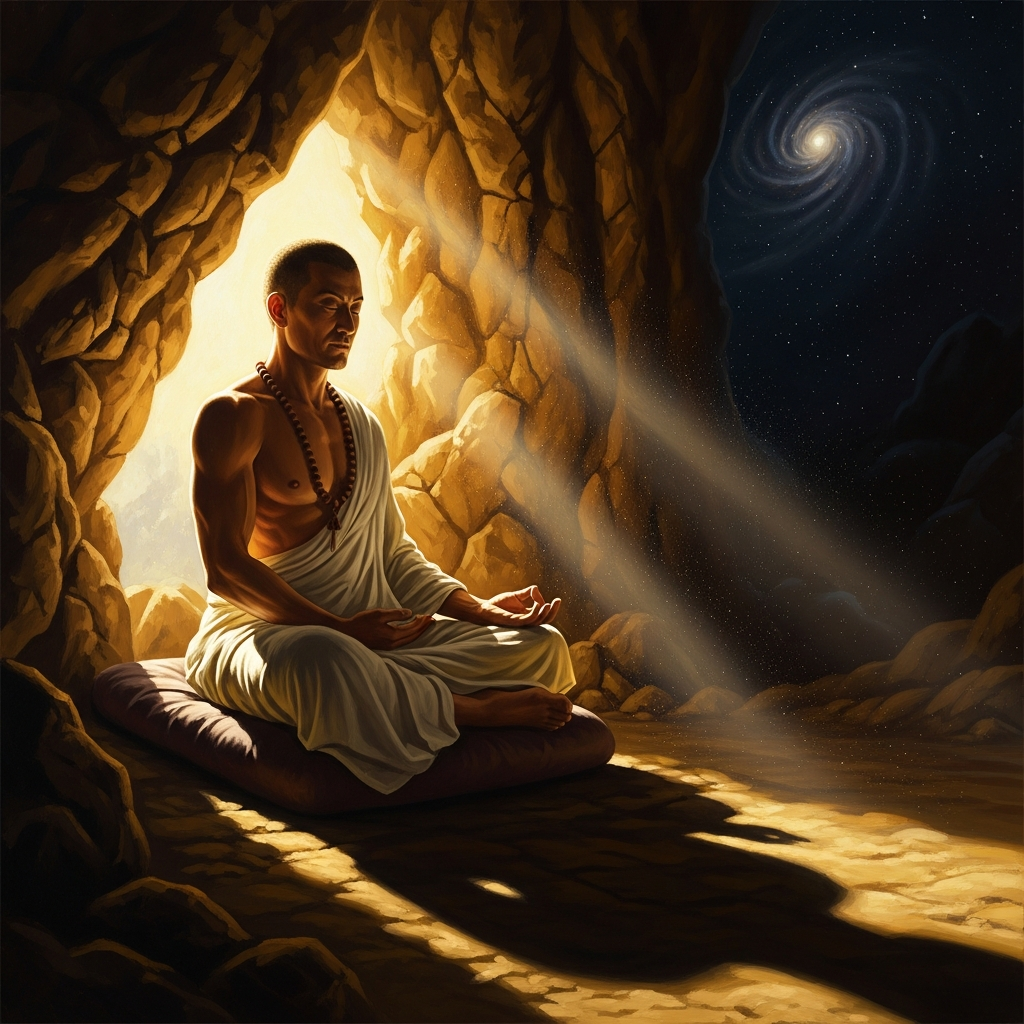
Milarepa and the Four Towers
c. 1082-1092 CE · Lhodrak, southern Tibet · Lhodrak, southern Tibet — Marpa's estate on the Lhodrak River
Contents
Marpa the Translator makes Milarepa build a stone tower alone, tear it down, build it again, tear it down again — four towers over years of labor. Then, when Milarepa's back is raw and his hope is gone, Marpa weeps and initiates him.
- When
- c. 1082-1092 CE · Lhodrak, southern Tibet
- Where
- Lhodrak, southern Tibet — Marpa's estate on the Lhodrak River
He arrives at Marpa’s estate on the Lhodrak River in the condition of a man who has done something he cannot undo and knows it. He is thin, purposeful, and terrified in the specific way of someone who has assessed their own karma and found it catastrophic. He introduces himself honestly: I am Milarepa from Gungthang. I killed thirty-five people with sorcery. I want to know if the dharma is large enough to clean this.
Marpa looks at him for a long time.
Marpa is not young. He has made the journey from Tibet to India three times — an overland route of extraordinary hardship through the high passes to the plains, to the monastery at Nalanda, to the feet of the great masters Naropa and Maitripa — and he has carried the Kagyu tantric lineage back each time in his memory, since writing in those conditions is not possible. He is broad, direct, and he drinks barley beer without apology. He is the most important translator of his century and he knows it. He is also, the texts suggest, a difficult man to like and an impossible man to fool.
He says: I need a field plowed.
The first task is agricultural. Then there are repairs. Then errands. Then more repairs. Milarepa works on the estate for months without a single formal teaching. The other students — Marpa has a circle of disciples, accomplished practitioners, some of them already deep in their tantric training — receive teachings, receive initiations, attend transmissions. Milarepa carries things and fixes things and is told, repeatedly, that his karma from the black arts is too thick for the teachings to penetrate. He must work it off first.
He accepts this. He is trying to be patient. He has thirty-five deaths. He will work.
Then Marpa says: I want a tower built. Nine storeys. On that ridge. Alone.
He quarries his own stone. He does not ask for help — he learns quickly that Marpa will not permit it. The other students watch from a distance. Dagmema, Marpa’s wife, who is the only person on the estate who consistently treats Milarepa with kindness, brings him food and occasionally sits with him in the evenings when his back is too destroyed to continue working. She says, quietly, that she does not understand what her husband is doing. She says she trusts him.
The back opens in the second month. The skin over his shoulder blades and lumbar region, abraded daily by rough stone, blisters, cracks, bleeds, and does not have time to fully heal before the next day’s labor. He bandages it. He continues.
The first tower rises. Nine storeys. Round. It takes the better part of a year.
Marpa walks to it, examines it, and tells him to tear it down.
He offers a reason: I built this in a moment of anger. The structure is inauspicious. Take it apart and put the stones back where they came from.
Milarepa tears it down. He puts the stones back.
Marpa tells him: build it again. Semicircular this time. On the same site.
He builds it. The back has not healed from the first tower. He builds the second one anyway. It takes eight months.
Marpa tells him to tear it down.
This is the moment — the demolition of the second tower — where the Life of Milarepa becomes, quietly, one of the most precise accounts of what it costs to persist under conditions of total arbitrariness. Milarepa knows, by this point, that Marpa’s reasons are not the real reason. He knows the towers are a test. He knows the test has something to do with his karma and something to do with his capacity to endure, and he does not know how many more towers there will be.
He tears down the second tower.
He builds a third one. Triangular, on a different site. It takes months. Marpa inspects it and says: I was drunk when I told you to build here. Tear it down. Put the stones back.
He does.
He begins the fourth tower. He is in genuine despair by now — a specific, particular despair that is not self-pity exactly but the exhaustion of a man who has done everything he was asked and received nothing in return and cannot see the end of the sequence. He goes to Dagmema one night and tells her he cannot continue. He says he is thinking of leaving. He says maybe his karma is simply too heavy, maybe there is no teaching large enough, maybe the whole thing is a lie.
Dagmema, who loves him in the way that great teachers’ wives sometimes love the students their husbands are most ruthlessly working on, tells him: stay. And — in a moment of kindness that will itself become part of the teaching’s structure — she goes to Marpa and begs him to give Milarepa at least the preliminary initiation, to give him something to hold onto.
Marpa refuses Dagmema. Then he agrees. He convenes the students and tells Milarepa he will receive the initiation now.
The initiation begins. It is one of the Kagyu tantric transmissions — the texts do not specify which one, deliberately. In the middle of it, Marpa stops. He says: I have to tell you something. Dagmema arranged this. I agreed as a kindness to her, not because your karma is ready. This initiation is not yours yet.
He cancels it. He sends Milarepa back to finish the fourth tower.
The fourth tower is nine storeys, square. It is the one that still appears in illustrations of this story. Milarepa finishes it.
Then Marpa calls all his students together and initiates Milarepa fully — the complete transmission of the Kagyu tantric lineage, everything Marpa brought back from Naropa in India. During the initiation, the texts record, Marpa weeps. Not from pride. Not from satisfaction at having produced a great student. He weeps because he knows what the trials cost, and he imposed them deliberately on the student he identified from the beginning as the one most capable of bearing them, which meant the one he could push hardest, which is its own kind of love and its own kind of cruelty.
After the initiation, he tells Milarepa what the towers were. He says: your karma required a purification proportional to its weight. Doctrinal teachings would not have touched it. Instructions would not have reached through it. Physical labor and repeated frustration — the systematic removal of every ordinary support — was the only practice large enough to begin to clear the way. The towers were not a test of your endurance. The towers were the dharma. You have been practicing for five years.
Milarepa sits with this for a long time.
He has built four towers and torn down three of them, and the one still standing is the teaching, and the teaching is that the path looked nothing like a path from inside it.
He will go into the caves next. He will eat nettles and generate the inner fire and compose the Hundred Thousand Songs and his skin will turn green and hunters will find him in the snow and take him for a demon. All of that is still ahead. What he has now is the transmission — the living thread of instruction running back through Marpa to Naropa to the mahasiddhas of India — and the four towers worth of evidence that he is capable of receiving it.
He is, by now, the practitioner his guru always knew he would be. The knowing was not comfortable for either of them. It was, however, correct.
Scenes
Milarepa carries stones from the riverbed alone
 Generating art…
 Marpa looks at the completed tower and tells him to tear it down
 Generating art…
 Marpa weeps during the initiation — not from pride, but because the trials he imposed on the student he loves most were the hardest thing he has ever done
 Generating art…
 Echoes Across Traditions
Entities
- Milarepa
- Marpa the Translator
- Marpa Lotsawa
- Dagmema
- Naropa
Sources
- Tsangnyön Heruka, *The Life of Milarepa* (trans. Andrew Quintman, Penguin Classics, 2010)
- Tsangnyön Heruka, *The Hundred Thousand Songs of Milarepa* (trans. Garma C. C. Chang, Shambhala, 1999)
- Lobsang P. Lhalungpa, *Milarepa: The Poet-Saint of Tibet* (Shambhala, 1984)
- Herbert Guenther, *The Life and Teaching of Naropa* (Oxford, 1963)
- Reginald A. Ray, *Indestructible Truth: The Living Spirituality of Tibetan Buddhism* (Shambhala, 2000)