Rabi'a Extinguishes Hell
Late Umayyad / Early Abbasid · ~780 CE · Basra, in the marshlands of southern Iraq — caravan city, slave market, cradle of early Sufism
Contents
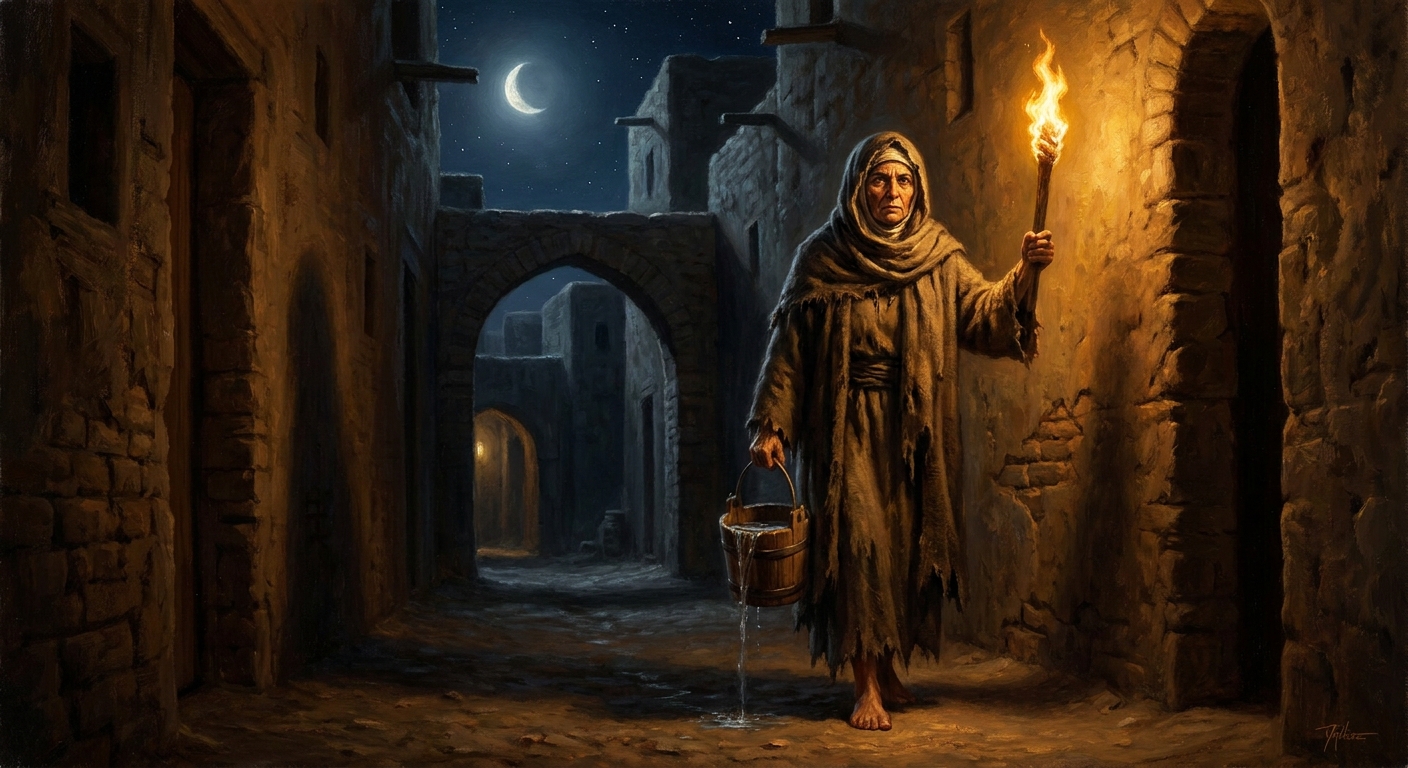
A freed slave walks the streets of Basra with a torch and a bucket of water — to burn down paradise and douse the fires of hell, so that God might at last be loved for His own sake.
- When
- Late Umayyad / Early Abbasid · ~780 CE
- Where
- Basra, in the marshlands of southern Iraq — caravan city, slave market, cradle of early Sufism
It is afternoon in Basra, and the streets are too hot for sandals.
She walks anyway. Barefoot. A small woman, past fifty, freed from slavery so long ago that the rope-marks on her wrists have faded to a kind of script. In one hand she carries a torch, lit, hissing in the desert air. In the other hand she carries a wooden bucket, and the bucket sloshes water at every step.
The merchants stop their bargaining to watch her pass. The water-sellers — her trade, once — set down their skins. A Qur’an reciter on the corner forgets his verse mid-line.
Someone finally asks. Mother Rabi’a, where are you going with fire and water in the heat of the day?
She does not slow down. To set paradise alight, she says. And to put out the fires of hell.
The crowd that follows her is not large at first. A boy with a basket of dates. Two students of Hasan al-Basri who recognize her from the night-vigils at the mosque. An old woman who once shared her bread.
By the time she reaches the canal, the crowd is large enough that someone shouts the question for her to answer.
Why?
She turns. The torch flares. The bucket trembles in her grip.
So that the veil of these two may be lifted, she says, and it may be seen who worships God for God’s own self. Not from fear of His fire. Not from desire for His garden. For Him alone — because He is.
The boy with the dates does not understand. The students of Hasan al-Basri understand exactly, and one of them sits down in the dust as if struck.
She has been saying it for years, in smaller rooms.
Hasan, the great preacher of Basra, who taught half the city to weep over its sins, came to her once and asked her to marry him. I have no need of a husband, she said. I am married to the Truth. He asked her how she had attained this rank. By losing all I had found, she said.
Another teacher came. He had heard she prayed all night. He asked her what she said in those prayers, what petitions she made. O God, she answered, if I worship Thee in fear of hell, burn me in hell. If I worship Thee in hope of paradise, exclude me from paradise. But if I worship Thee for Thine own sake, withhold not from me Thine eternal beauty.
He went home and wrote it down. It is the first time, in Arabic, that anyone speaks to God like that.
The merchants make their excuses. The torch is theatrical, they say. The bucket is a parable. She is a woman of the desert and the desert breeds extremes.
But the students of Hasan al-Basri have already begun to copy her sayings. The slave-girls in the kitchens of Basra repeat them to each other while grinding wheat. A caravan from Kufa carries her words north. Within a generation they are in Khorasan. Within two, in Andalusia. Within five, a poet in Konya — a man named Jalal al-Din — will write that the lover does not seek the Beloved for any reason; the lover is the reason, and there is no other.
That sentence belongs to Rumi, but it began in a bucket of water in a Basran street.
She walks down to the canal. She tips the bucket. The water spills out, soaks into the dust, vanishes within a minute under the sun. She holds the torch over the canal. The flame hisses, gutters, dies in a curl of black smoke.
Symbolic, of course. She has burned no actual paradise. She has extinguished no actual hell. The Day of Judgment is unimpressed. The fires below remain lit. The rivers above still run with milk and honey for those who are promised them.
But something in the theology of Basra is, after this afternoon, different.
The boy with the dates will tell the story to his grandchildren. The grandchildren will tell it to traveling Sufis. The Sufis will tell it for a thousand years.
She lives a long time. She refuses every offer of marriage. She refuses the gifts of the wealthy. She lives in a single room with a brick for a pillow, a reed mat, and a clay jug. When she is asked what she has, she says: I have Him.
When she dies — old, blind in one eye, still poor — she is buried outside Basra in an unmarked grave. The location is forgotten within a century. There is no shrine. There is no relic. There is only the saying, copied and copied, traveling on caravans and in memorized lines:
If I worship Thee in fear of hell, burn me in hell.
It is the sentence that splits Islamic devotion in two — into the religion of the Garden, and the religion of the Beloved.
She did not invent the love of God. The Qur’an itself promises that He loves a people who love Him (5:54). What Rabi’a invented was the refusal of every other reason. Before her, a Muslim could love God and also want paradise. After her, the saints had to choose. Most chose her.
The torch and the bucket are almost certainly literary. ‘Attar tells the story two centuries after her death, and he is a poet. But the prayer is older, and the prayer is hers, and the prayer says the same thing the torch says: that the calculus of fear and reward is itself the veil. Burn it, drown it, keep walking.
She is the patron, the mother, the first voice of Sufi love. Every dervish who ever spun did so on an axis she planted.
Scenes
Barefoot in the noon heat of Basra, she walks the streets with a torch in one hand and a sloshing bucket in the other
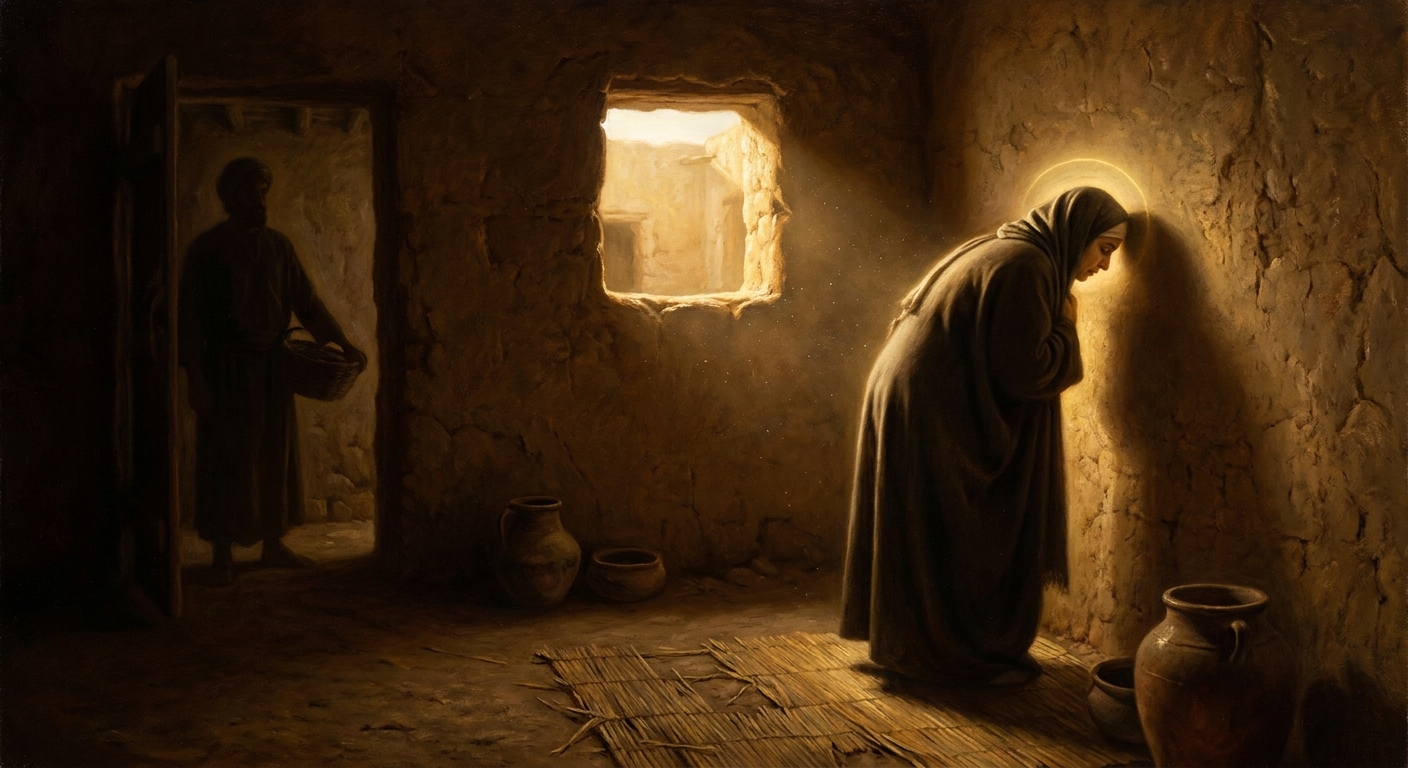
Generating art… In her bare hut she keeps her face turned to the wall, refusing to glance at the gardener-suitor lest his face occlude the Beloved's
 Generating art…
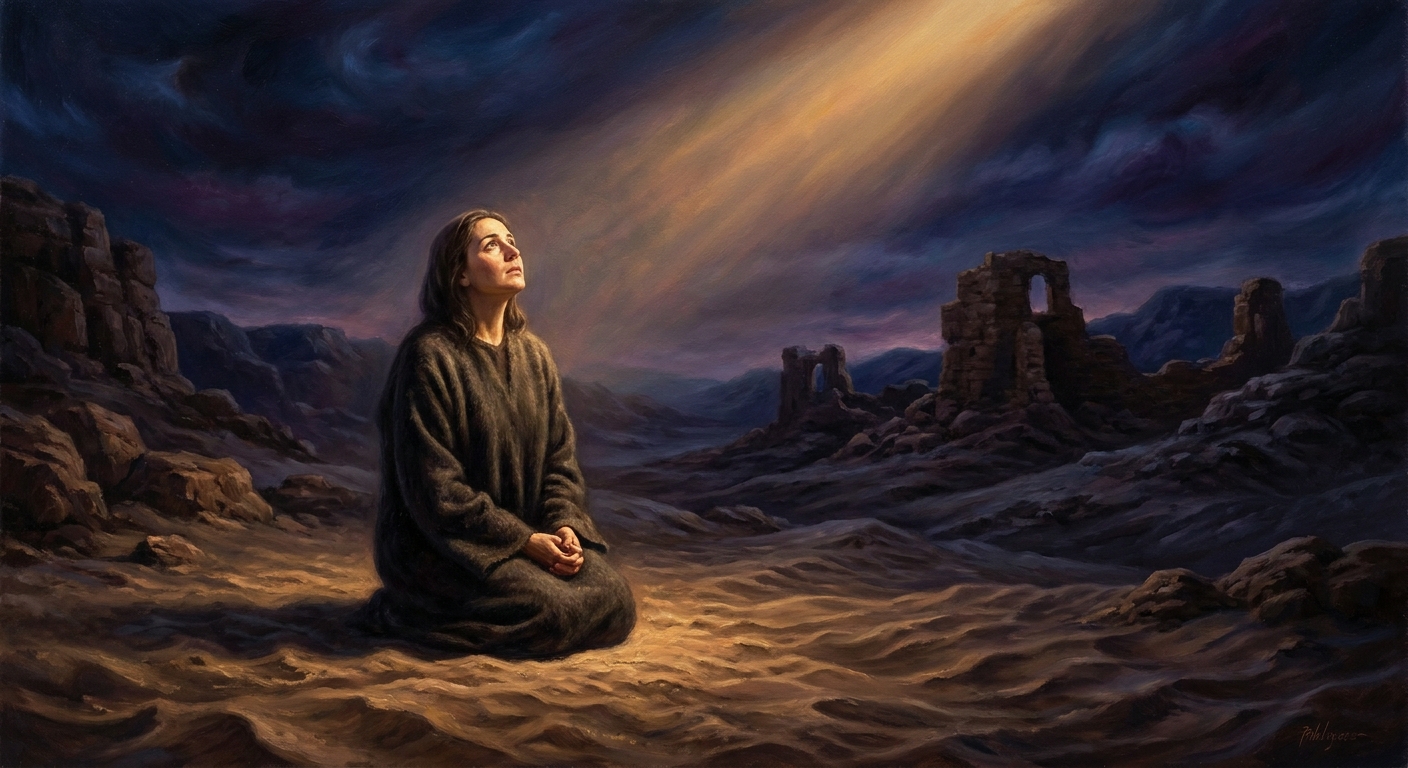
 Alone in the desert at dawn, she kneels on the cooling sand and speaks to God as though no fire and no garden lay between them
 Generating art…
 Echoes Across Traditions
Entities
- Rabi'a al-Adawiyya
- Hasan al-Basri
- the Beloved
- the People of Basra
Sources
- Margaret Smith, *Rabi'a the Mystic and Her Fellow-Saints in Islam* (Cambridge, 1928)
- Farid al-Din 'Attar, *Tadhkirat al-Awliya* (~1220) — the earliest extended hagiography
- Annemarie Schimmel, *Mystical Dimensions of Islam* (UNC Press, 1975), ch. 1
- Rkia Cornell, *Rabi'a from Narrative to Myth* (Oneworld, 2019)
- Michael Sells (trans.), *Early Islamic Mysticism* (Paulist, 1996)