The Youth at the Ka'ba
Ayyubid Caliphate · 1202-1204 CE (599-601 AH) · the Ka'ba in Mecca, during *tawaf* in the cool hours after midnight, in the year of the second pilgrimage
Contents
Circumambulating the House at midnight, an Andalusian pilgrim meets a luminous Youth who has been waiting for him since before the world was made — and dictates the book that becomes Sufism's metaphysical spine.
- When
- Ayyubid Caliphate · 1202-1204 CE (599-601 AH)
- Where
- the Ka'ba in Mecca, during *tawaf* in the cool hours after midnight, in the year of the second pilgrimage
He has come from Murcia, and Seville, and Tunis, and Cairo. Now he is in Mecca for the second time, and it is the third hour after midnight, and the heat of the day is finally gone.
He walks the tawaf alone. The pilgrims who came in the daylight have returned to their lodges. The black cube ahead of him absorbs the lamplight without giving anything back. He rounds the southern corner — the Yemeni — and lifts a hand to the wall as the law prescribes, and the stone is cold under his palm, colder than the desert night should make it.
He is thirty-seven years old. He has been seeing visions since he was a boy in Andalusia. He has met Khidr on the bridge in Seville. He has been initiated, in dream, by every prophet from Adam onward. He has, in some sense, been waiting his entire life to round this exact corner.
A figure is walking beside him.
The figure is a young man.
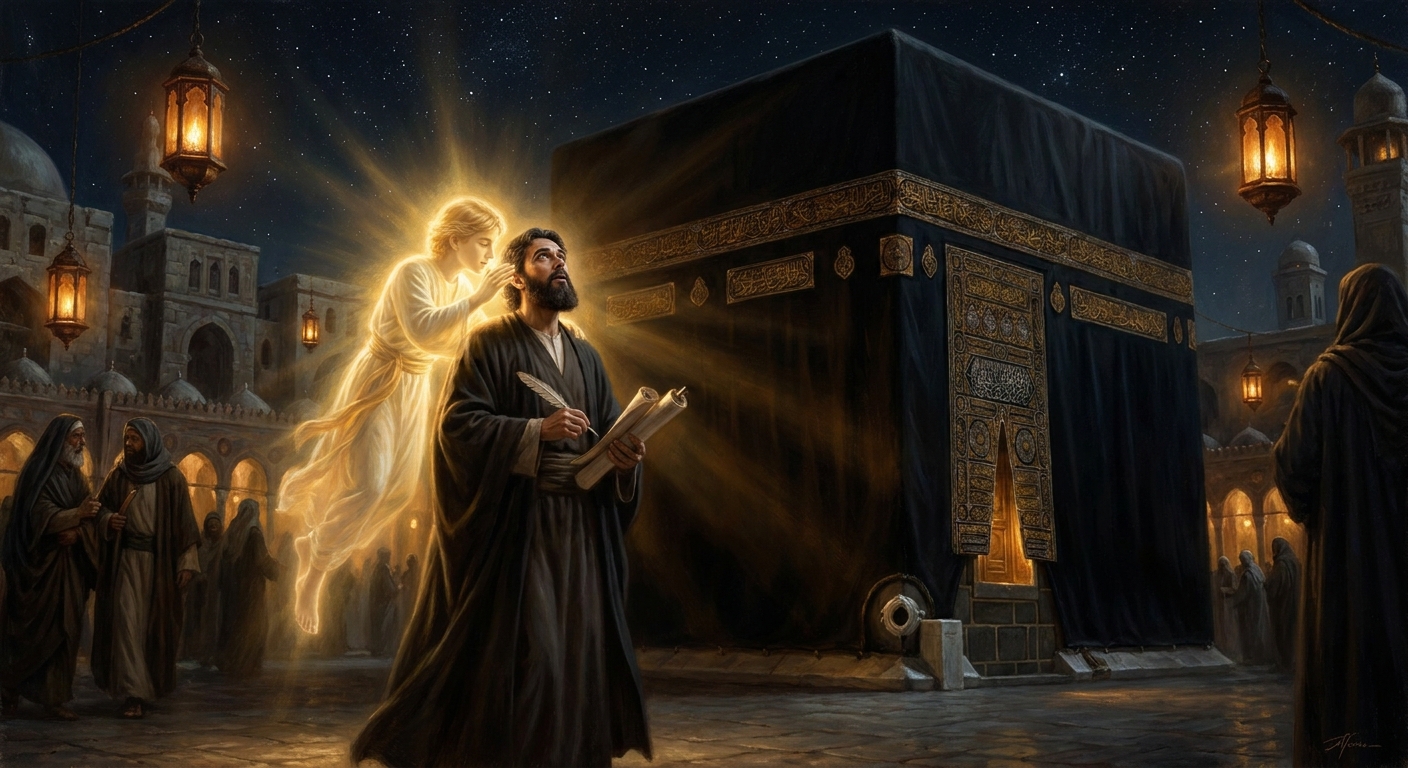
A fata — a youth, in the chivalric sense the Arabic carries: not boy but knight, not adolescent but the moment of pure unfallen masculine grace. He wears white. He casts no shadow even though the lamps are everywhere. His feet on the polished marble make a sound — Ibn ‘Arabi will be very precise about this — like wings folded against a body.
He has been there the whole circuit. Ibn ‘Arabi has only just noticed him.
The Youth speaks first. Look at the secret of the House before its construction was completed, he says, and you will see the men of God who are circumambulating it together with you. I will name them for you.
Ibn ‘Arabi looks. The empty courtyard is full. The dead, the saints, the prophets, the angels who have been circling this stone since the foundation of the world — all are walking with him. The Youth names them as they pass.
Who are you? Ibn ‘Arabi asks.
The Youth smiles. I am knowledge, the known, and the knower. I am wisdom, the worker of wisdom, and the wise. I am Mecca, and the pilgrim, and the One Whom the pilgrim seeks.
Are you the Prophet? Ibn ‘Arabi asks.
I am the spirit of his speech and the speech of his spirit.
Are you Gabriel?
I am the wing under his wing.
Are you me?
The Youth does not answer. He smiles again. He says: Write what I dictate to you. The pen is in your hand. The book is in your heart. We are here for as long as the House stands, and after that we are still here.
Ibn ‘Arabi sits down at the base of the Ka’ba — the law forbids it, but the law is suspended for him this once — and the dictation begins.
It does not stop for thirty years.
The book that issues from the Youth’s voice is the Futuhat al-Makkiyya — the Meccan Revelations. It will be five hundred and sixty chapters long. It will fill, in the Cairo edition, fourteen thick volumes. It will treat the science of letters, the mansions of the moon, the names of God, the architecture of the body, the arithmetic of paradise, the secrets of the Throne, the difference between fana (annihilation) and baqa (subsistence), the precise way the divine breath becomes the cosmos. It will quote no source. It will cite no master. The voice claims, throughout, to be its own authority.
He composes it in Mecca, in Konya, in Damascus. He composes it in caravanserais and in the gardens of patrons. He revises it once, near the end of his life, and the revised version is the one we have.
When he is asked by his disciples whether he wrote it, he says: I wrote nothing of it. The Youth dictated. I held the pen.
When he is asked whether the Youth was an angel, he says: He was the angel of my own being.
There is a woman in this story too.
Her name is Nizam. She is the daughter of a Persian sheikh resident in Mecca; she is fifteen, perhaps sixteen, when Ibn ‘Arabi meets her in the precinct. She is, the chroniclers and Ibn ‘Arabi himself say, the most beautiful soul he has ever encountered. She knows the Qur’an by heart. She speaks Arabic and Persian and the silent language that prophets speak.
He writes a cycle of love poems for her — the Tarjuman al-Ashwaq, the Interpreter of Desires — and the gazelles run, and the lover weeps in the abandoned campsite, and every classical Arabic image of erotic longing is deployed at full pitch.
The orthodox jurists are scandalized. A married Sufi shaykh writing love poems to a teenage girl? Ibn ‘Arabi answers them with a commentary on his own poems — line by line — proving that every image is a theological symbol. The dark hair is the multiplicity of created being. The mole is the point of the One. The kiss is the breath of the Merciful.
The jurists are not satisfied. They are never satisfied. But the commentary stands, and the doctrine stands: that the human beloved is the doorway, that the face of the woman in the precinct of the Ka’ba is one of the faces of God, and the lover who learns to see her clearly is learning to see the only thing there is to see.
This is the doctrine they will call wahdat al-wujud — the unity of Being.
He himself does not use the phrase. His students use it. They use it because it is, more or less, the conclusion the Futuhat is arguing across its fourteen volumes. There is one Being. The cosmos is its self-disclosure. Each thing in the cosmos — the Youth at the Ka’ba, the maiden Nizam, the black stone, the Andalusian pilgrim, the wing of the gnat, the Throne of God, the lice in a beggar’s hair — is a face that the One has turned toward itself in order to be known.
You and I are not, in the strict sense, other than God. We are names of God, particular configurations of the divine self-disclosure, each of us a unique angle from which the Being is contemplating itself.
This is the metaphysics that, after Ibn ‘Arabi, the Sufi orders absorb. Rumi has read the Futuhat by his last decade. The Mughal princes copy it in gold. The Yogyakartan court of Java studies it in the sixteenth century. The poet-king Bedil writes Persian commentaries on it in seventeenth-century Delhi. The Naqshbandi shaykhs in Central Asia argue with it for six hundred years.
Half of Islam thinks it is the ultimate flowering of monotheism. The other half thinks it is the most dangerous heresy ever permitted to exist inside the umma.
Ibn ‘Arabi is, for both halves, the same man: al-Shaykh al-Akbar, the Greatest Master.
He dies in Damascus in 1240, having walked at last out of every land he had been born to or exiled into. He is buried at the foot of Mount Qasiyun. The Ottoman sultan Selim I, three centuries later, will build the mosque that still stands over his tomb, after a vision in which Ibn ‘Arabi tells him: When the S enters the Sh, the tomb of Muhyi al-Din will appear — and Selim, conquering Damascus, recognizes himself as the S and Damascus as the Sh, and sets the masons to work.
The tomb is small. It is in a poor neighborhood. The pilgrims who come are mostly local, or Turkish, or Indonesian. They sit on the carpet. They read the Fusus al-Hikam, his shorter book, the one dictated by the Prophet himself in a different vision, in Damascus, near the end. They do not need to read the long one. The long one is in the universe.
Ibn ‘Arabi is the moment Sufism becomes a philosophy. Before him, it is poetry, biography, ethics, prayer. After him, it has a metaphysics that can argue with Avicenna and Aquinas on their own ground, in their own grammar of being and essence and existence.
The Youth at the Ka’ba is the angel of his own being — the celestial twin that Suhrawardi described in Persian and Ibn ‘Arabi describes in Arabic in the same decade. The vision that the Youth dictates is, in a sense Ibn ‘Arabi will not be embarrassed by, his own self speaking to him from the level above the level he has yet attained. The book is his own book read forward.
This is what Sufi epistemology eventually calls kashf — unveiling. You do not learn the truth. You stop being something opaque enough to block it.
The Youth is still circling the House. So are you. So is everything that has ever existed. The tawaf is the structure of the cosmos, and the cube at its center is the empty room from which the Beloved looks out at everything that is also Him.
Scenes
In the cool hour after midnight at the Ka'ba, a luminous Youth in white walks the *tawaf* beside the Andalusian pilgrim and begins the dictation that becomes the *Futuhat*
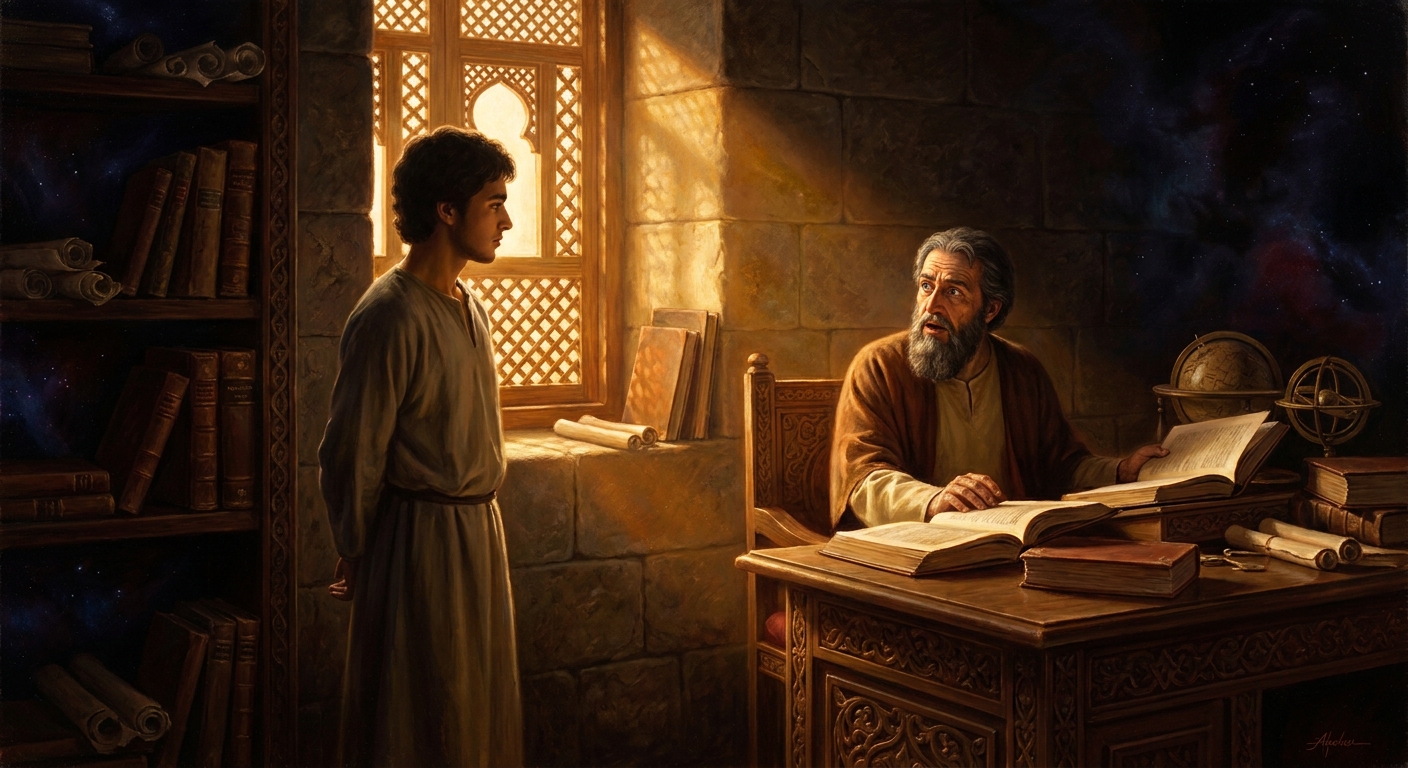
Generating art… A beardless boy enters the Cordoba study of the great Averroes and answers the philosopher's question with a single *yes and no* that leaves the old rationalist trembling
 Generating art…
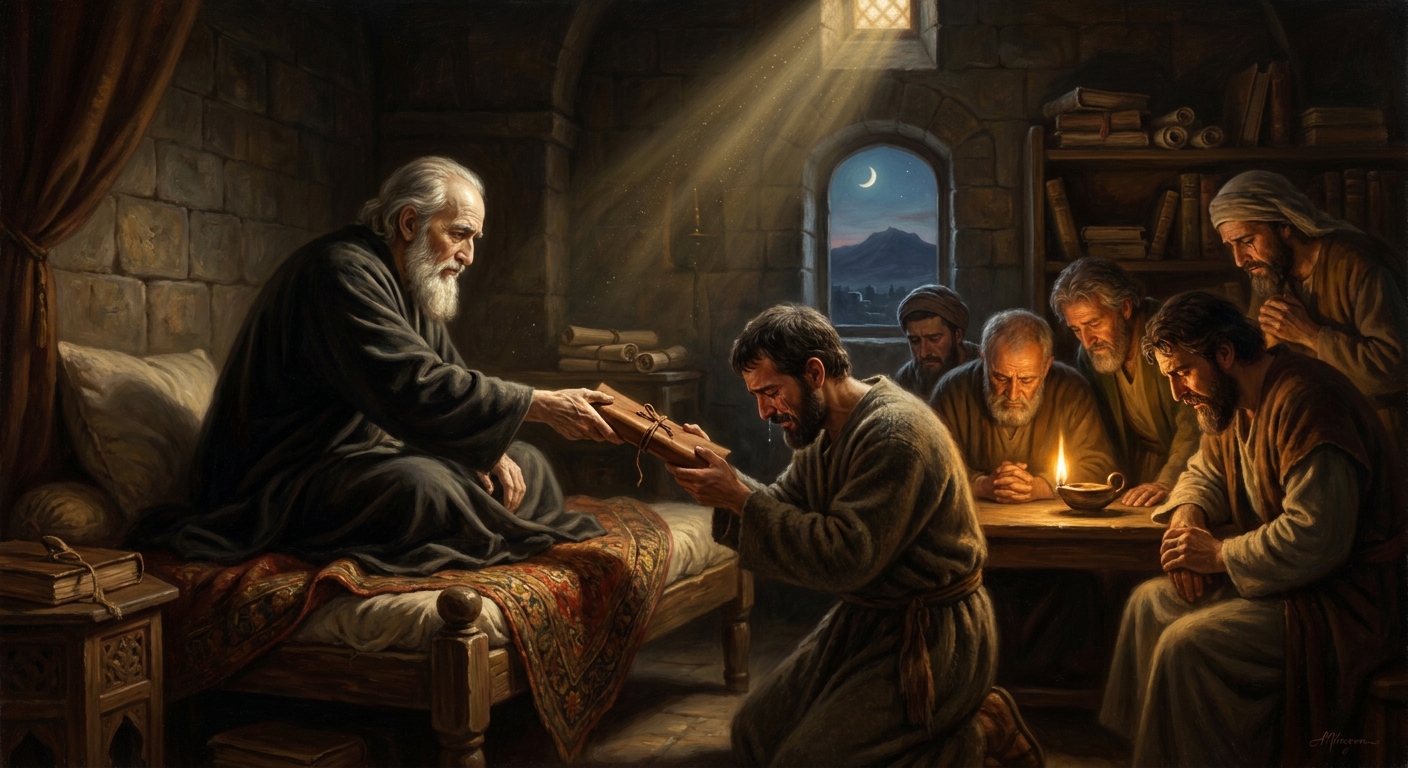
 On his Damascus deathbed in 1240, the Greatest Master passes the *Fusus al-Hikam* into the hands of weeping disciples gathered in the lamplight of Mount Qasiyun
 Generating art…
 Echoes Across Traditions
Entities
- Ibn 'Arabi (Muhyi al-Din)
- al-Fata (the Youth)
- Nizam (the maiden of Mecca)
- the Ka'ba
- the Pole (al-Qutb)
Sources
- Ibn 'Arabi, *al-Futuhat al-Makkiyya* (the *Meccan Revelations*), preface and ch. 1 (composed 1202-1238)
- Ibn 'Arabi, *Tarjuman al-Ashwaq* (the *Interpreter of Desires*) — the Mecca poems and his own commentary
- William Chittick, *The Sufi Path of Knowledge: Ibn al-'Arabi's Metaphysics of Imagination* (SUNY, 1989)
- Henry Corbin, *Creative Imagination in the Sufism of Ibn 'Arabi* (Princeton, 1969)
- Claude Addas, *Quest for the Red Sulphur: The Life of Ibn 'Arabi* (Islamic Texts Society, 1993)