The Historian Who Saved the Gods
c. 1220 CE — composition of the *Prose Edda* at Reykholt, Iceland · Reykholt, Iceland — Snorri's estate in the Borgarfjörður valley
Contents
It is 1220 CE and Iceland has been Christian for two centuries. The old gods survive only in skaldic poetry that no one can read anymore, because the kennings require knowing the myths and the myths are dying. Snorri Sturluson — chieftain, lawyer, the most powerful man in Iceland — sits down at Reykholt to write a manual for young poets. He frames the whole project as a deception. Under cover of euhemerism, he writes everything: creation, the death of Baldur, the binding of Loki, Ragnarok. He saves the Norse religion by pretending it is history. Twenty years later he is murdered in his own cellar by men sent by the Norwegian king.
- When
- c. 1220 CE — composition of the *Prose Edda* at Reykholt, Iceland
- Where
- Reykholt, Iceland — Snorri's estate in the Borgarfjörður valley
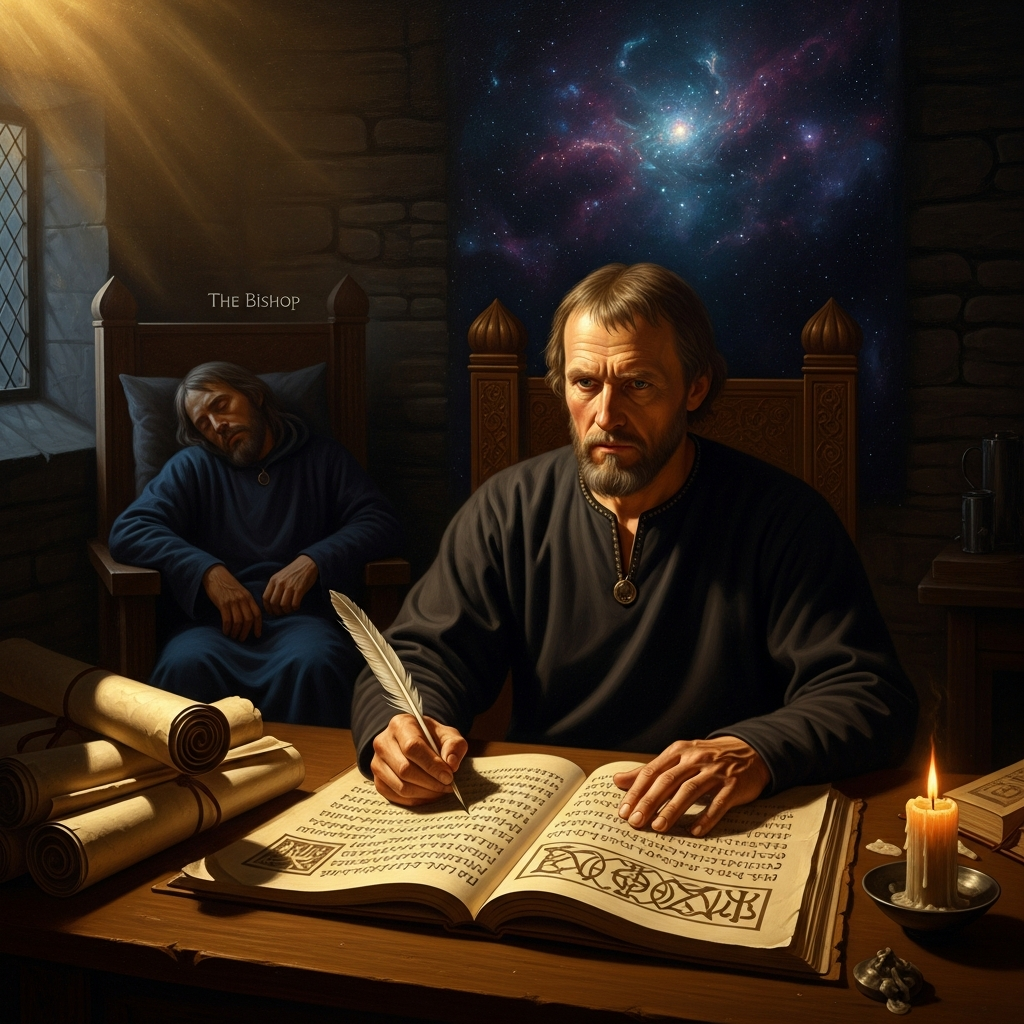
The candle has burned down to a stump and Snorri Sturluson has not slept.
It is the autumn of 1220 — perhaps 1222, the dating is contested — and the desk in the upper room at Reykholt is covered in vellum sheets and draft pages and the small careful writing of an Icelandic chieftain who was not, by any conventional metric, supposed to be the man who saved the Norse gods. Snorri is forty-one. He is enormously fat, the contemporary sources agree, and enormously rich, and enormously connected, and enormously hated by half his kinsmen. He has been Lawspeaker of Iceland twice. He owns more farms than any other private citizen of the island. He is at war with three of his cousins. He has been to Norway and charmed the king and the king’s regent and come home with titles he was not entitled to. He has, in short, every reason to be writing about politics, or law, or the kings of Norway whose praise he has been paid to compose. He is writing instead about Odin.
He should not be writing about Odin.
Iceland has been officially Christian since the year 1000, when the Alþingi — the parliament that meets every summer at Þingvellir — voted, on the recommendation of the Lawspeaker Þorgeirr Þorkelsson, to convert the entire island to Christianity in order to avoid civil war. The vote was political. It allowed private pagan worship in the home for a generation, then phased that out too. By Snorri’s lifetime, two centuries later, the Christianisation is complete on the surface. There are bishoprics at Skálholt and Hólar. There are tithes. There are cathedrals. There are monks. The old gods are not preached against because the old gods are no longer a threat; the old gods are folklore. They survive as ornaments in the speech of poets, and the speech of poets is a kind of fossil.
This is the problem.
Snorri’s day-job — the one he is paid for, the one that his royal patrons in Norway expect him to be expert in — is skaldic poetry. The skaldic verses written for medieval Norse kings are technically the most demanding poems in any European literature: each line obeys strict alliterative and syllabic rules, and at the heart of every poem are the kennings, compressed metaphorical phrases that substitute mythological references for ordinary nouns. Sea is Ymir’s blood. Battle is the storm of Odin. Gold is Sif’s hair. Poetry itself is the mead of Suttungr — and to understand why it is the mead of Suttungr, you have to know the entire myth of how Odin stole the mead of poetry from the giant Suttungr by transforming into a serpent, drilling through a mountain, seducing the giant’s daughter Gunnlöð, drinking the mead in three swallows, transforming into an eagle, and flying back to Ásgarðr with the giant in pursuit. If you do not know the myth, the kenning is gibberish.
The kennings are gibberish, increasingly, to Snorri’s contemporaries.
A whole generation of young poets has come up not knowing why gold is Sif’s hair. They are losing the trick. The skalds in Snorri’s hall — the old men who carry the verse-tradition in their heads — are dying, and the verses they recite are referring to myths that the listeners can no longer fully decode. A century from now no one will be able to read these poems at all. The myths are not just dying; they are taking the entire literary tradition with them.
Snorri sees this. He has been seeing it for years. And he decides, with the recklessness that runs in his family, to do something about it.
The decision is delicate. He cannot write a book of pagan myths, because that would be heresy and the bishop would burn it. He cannot write a manual of poetic technique without the myths, because the myths are the technique. He needs a frame. He needs a frame that will allow him to recount, in detail, the entire pagan cosmogony — Ginnungagap, the killing of Ymir, the building of Ásgarðr, the death of Baldur, Loki’s binding, Ragnarok — without any individual sentence committing him to belief in any of it.
He invents euhemerism.
Euhemerism is the doctrine, named after the 4th-century BCE Greek Euhemerus, that the gods of myth were originally distinguished mortals whose deeds, magnified by generations of retelling, came to be confused with divinity. It is a rationalist’s escape hatch. Snorri seizes it. He opens his book — the part now called Gylfaginning, “The Tricking of Gylfi” — with a Prologue that explains carefully and at length that the so-called Æsir were in fact a tribe of unusually impressive mortals from Troy. (The Trojan War having ended badly, certain refugees, Snorri claims, migrated north under the leadership of a man called Óðinn. Óðinn was so wise and so powerful that the people of the lands he passed through began to worship him as a god. Hence the confusion.)
This is a deception, and Snorri knows it is a deception, and his medieval readers know it is a deception, and the deception works. Under cover of euhemerism — under the pretense that he is merely explaining how a primitive people came to misidentify a clever king as the All-Father — Snorri proceeds to recount, in lavish and reverent detail, every major Norse myth. The frame is a fiction. The contents are the religion.
He writes through the autumn of 1220 and the winter and the spring after.
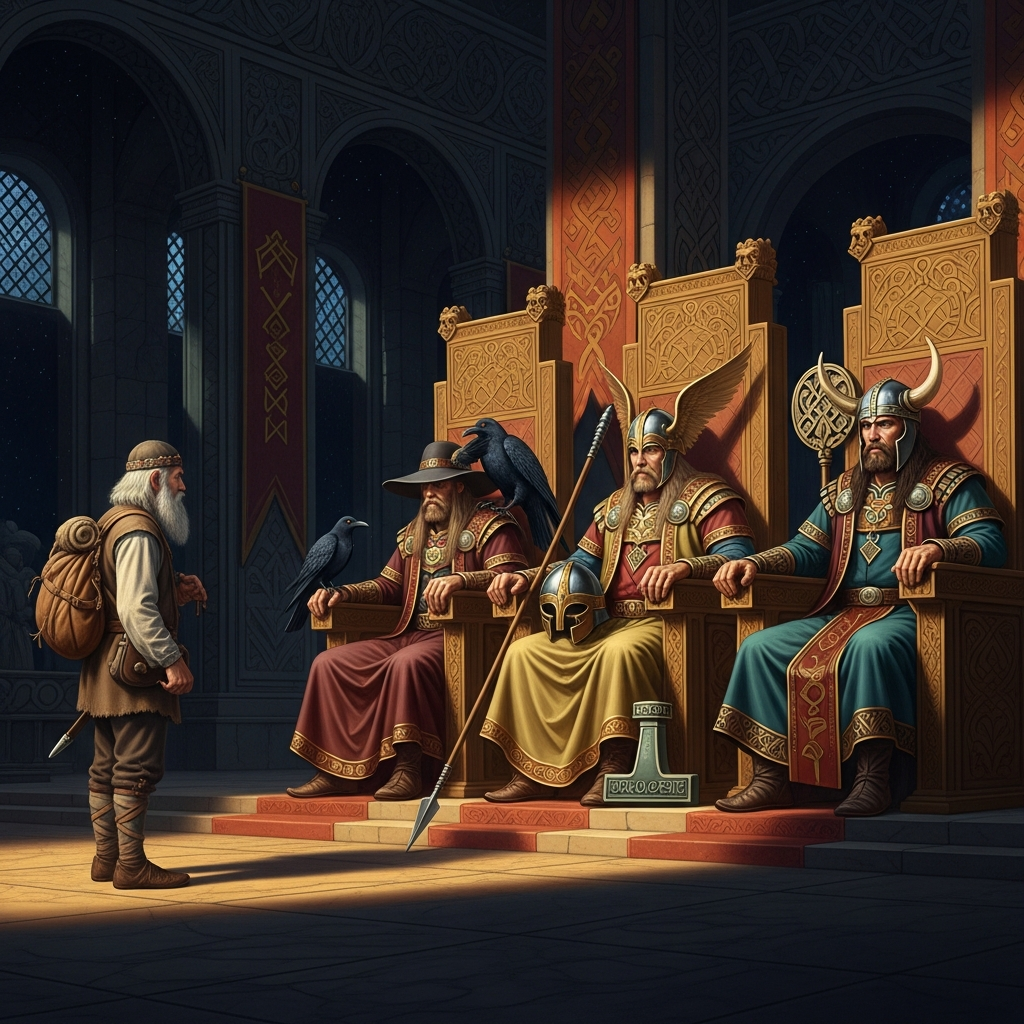
He invents another frame inside the first frame. Gylfaginning opens with a Swedish king named Gylfi, traveling in disguise (under the name Gangleri — Wanderer, one of Odin’s own names) to Ásgarðr to learn what the Æsir are really like. He arrives at a great hall. Inside the hall sit three figures on three thrones, called Hár (“High”), Jafnhár (“Just-As-High”), and Þriði (“Third”). They are not introduced as Odin. The medieval reader is meant to figure out that they are Odin. Gylfi asks them questions. They answer him. Their answers are the entire mythology. The whole pagan cosmos is delivered in the form of a courtroom-style interrogation by a fictional Swedish king of three thinly-veiled manifestations of the chief pagan god, framed as a lesson in the historical foolishness of the ancestors. It is one of the most elegant pieces of subterfuge in the entire history of medieval scholarship.
He writes by candlelight. He writes when the household is asleep. He writes to a soundtrack of geothermal water bubbling up at the spring in the meadow below — Snorralaug, Snorri’s pool, where archaeologists eight centuries later will find the foundations of the bath he liked to soak in while dictating to a scribe. He writes in winter, when the sun is up for four hours and the wind is so loud that the household servants joke that you cannot hear a man being murdered next door over the noise of the gables. He writes anyway.
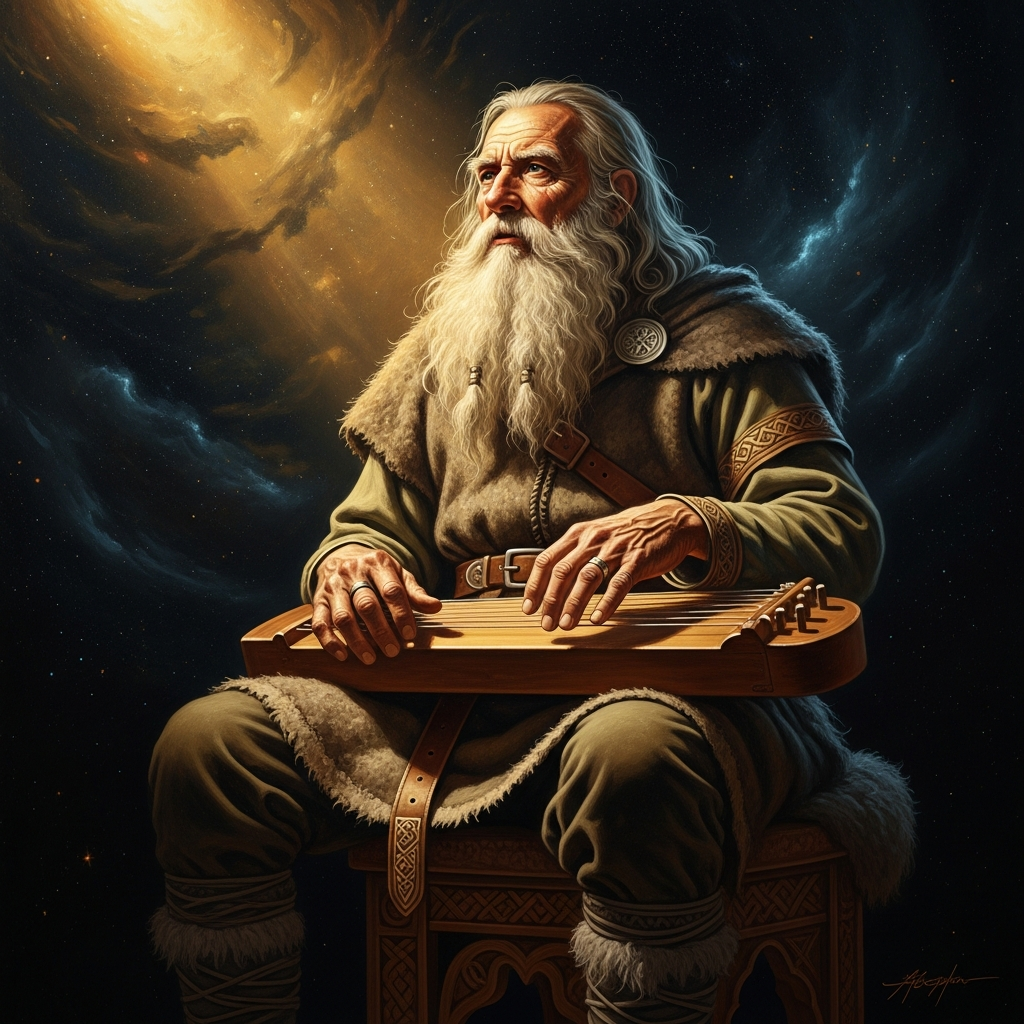
He hunts down the old skalds. He writes letters to farms in the East-fjords where men in their nineties are reputed to know verses no one else remembers. He brings them to Reykholt; he feeds them; he asks them to recite. He asks them what the kennings mean. Half the time they do not know — the verse has been passed down to them in a form that no longer contains its own explanation — but Snorri pieces things together. He cross-references. He triangulates. He guesses, sometimes, and admits in the manuscript that he is guessing. He does not invent; he transmits. That is his great claim, and modern scholarship by and large believes him.
The book grows. Gylfaginning covers the cosmogony and the major myths. Skáldskaparmál — “The Language of Poetry” — catalogs the kennings, organizes them by referent, and explains the underlying mythology behind each one. Háttatal — “Enumeration of Meters” — provides 102 stanzas Snorri composed himself, each demonstrating a different metrical form, with technical commentary. The entire Prose Edda is, on its surface, a manual for young poets. Underneath, it is the most thorough surviving record of the religion of Northern Europe before Christianisation. Both descriptions are true. Both were intended.
He finishes it. He puts it in the book-room at Reykholt. He goes back to politics.
Politics will kill him.
Snorri’s last twenty years are a blur of feuds, marriages, broken alliances, exile to Norway, return to Iceland, and increasingly bitter conflict with King Hákon Hákonarson, who has been trying for a generation to bring Iceland under Norwegian rule. Snorri will not help. Snorri keeps switching sides. Snorri makes promises he does not keep. By 1241 the king has decided that Snorri is a problem and that the problem requires a solution. The king sends a letter to Snorri’s nephew Gizurr Þorvaldsson — who is also Snorri’s enemy, after a marriage that ended badly — and the letter authorizes Gizurr to “send Snorri abroad or kill him.” Gizurr does not need to think long about which option is easier.
The night is 23 September 1241.
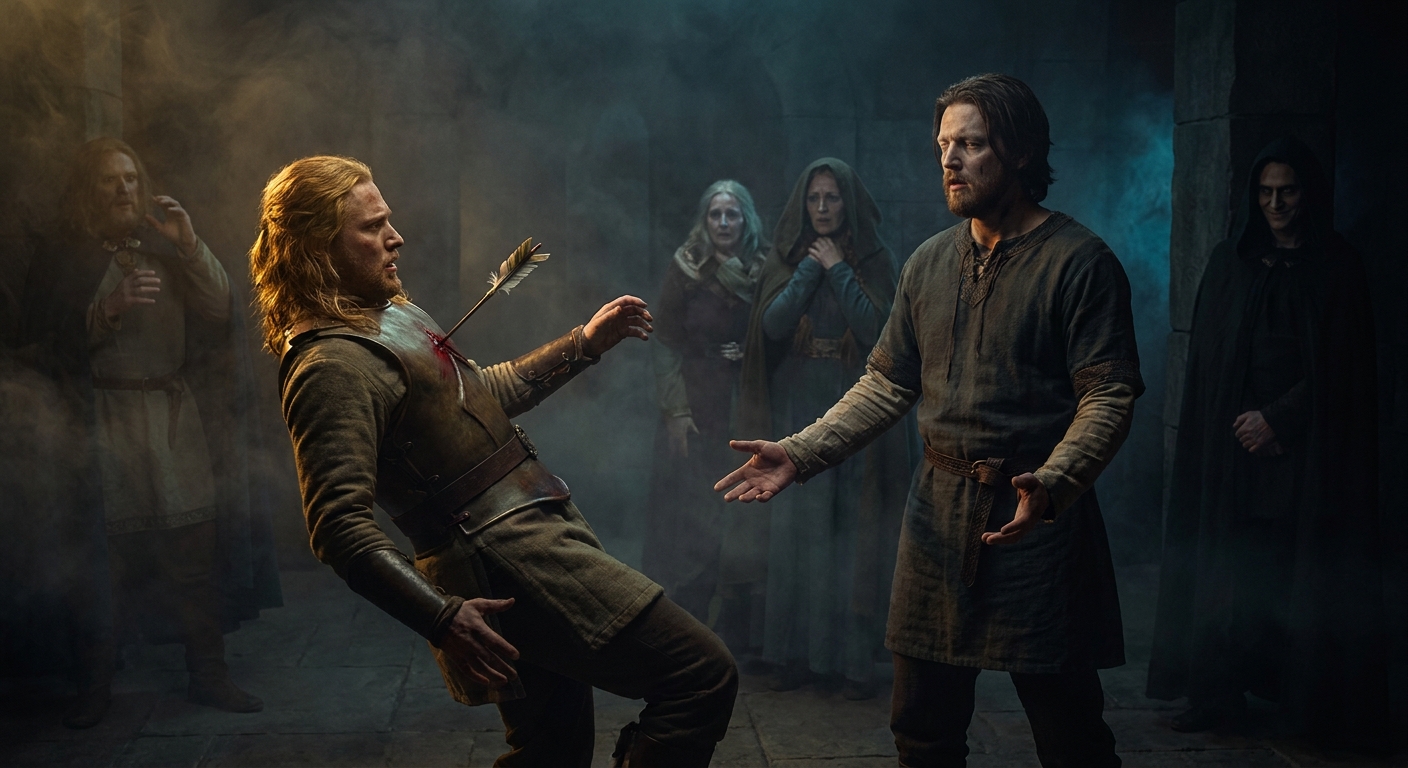
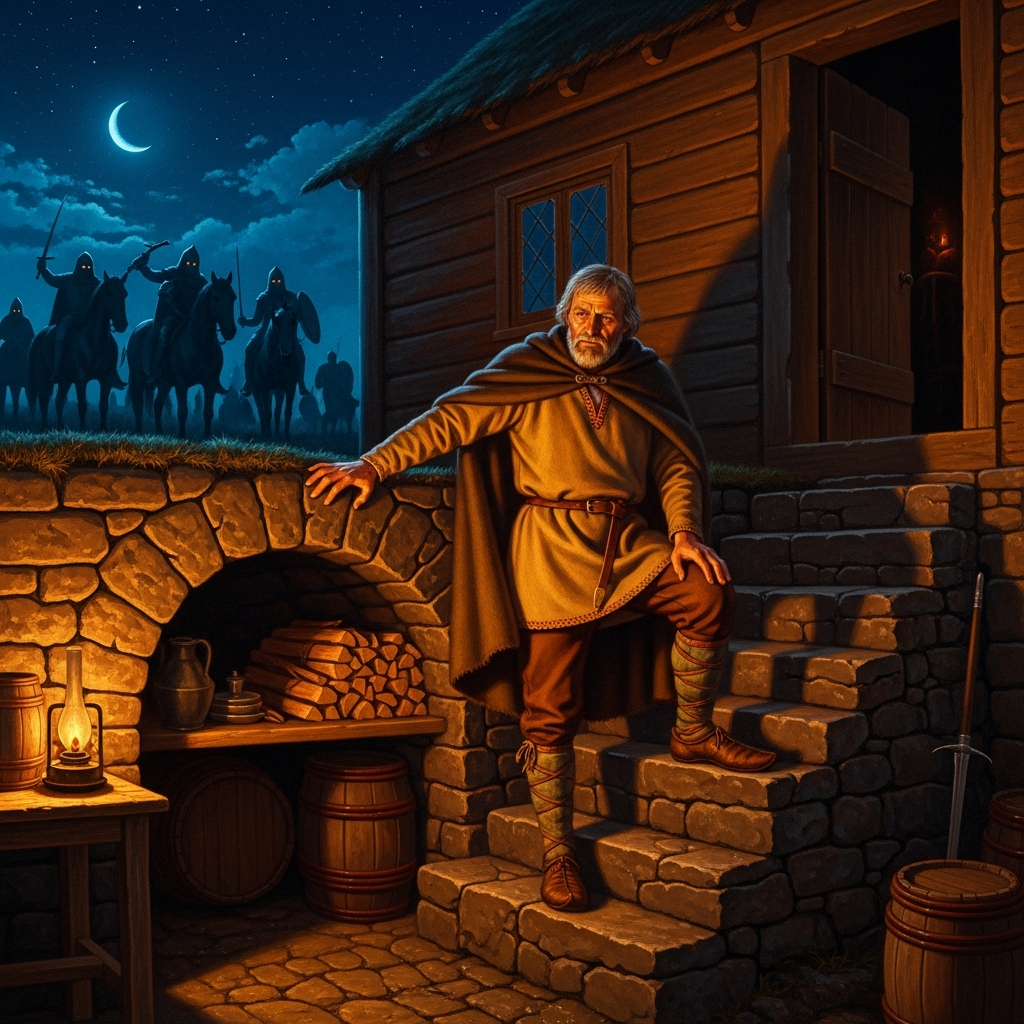
Reykholt is quiet. The household is asleep. Snorri is sixty-two years old. He has been hearing rumors for weeks that Gizurr is moving against him, but he has been hearing rumors like that for decades, and he is too tired and too grand and too vast to flee. He goes to bed. In the small hours he wakes to the sound of horses in the yard. He gets up. He puts on a nightshirt. He goes downstairs. He realizes, by the number of riders, what the visit means. He goes to the cellar.
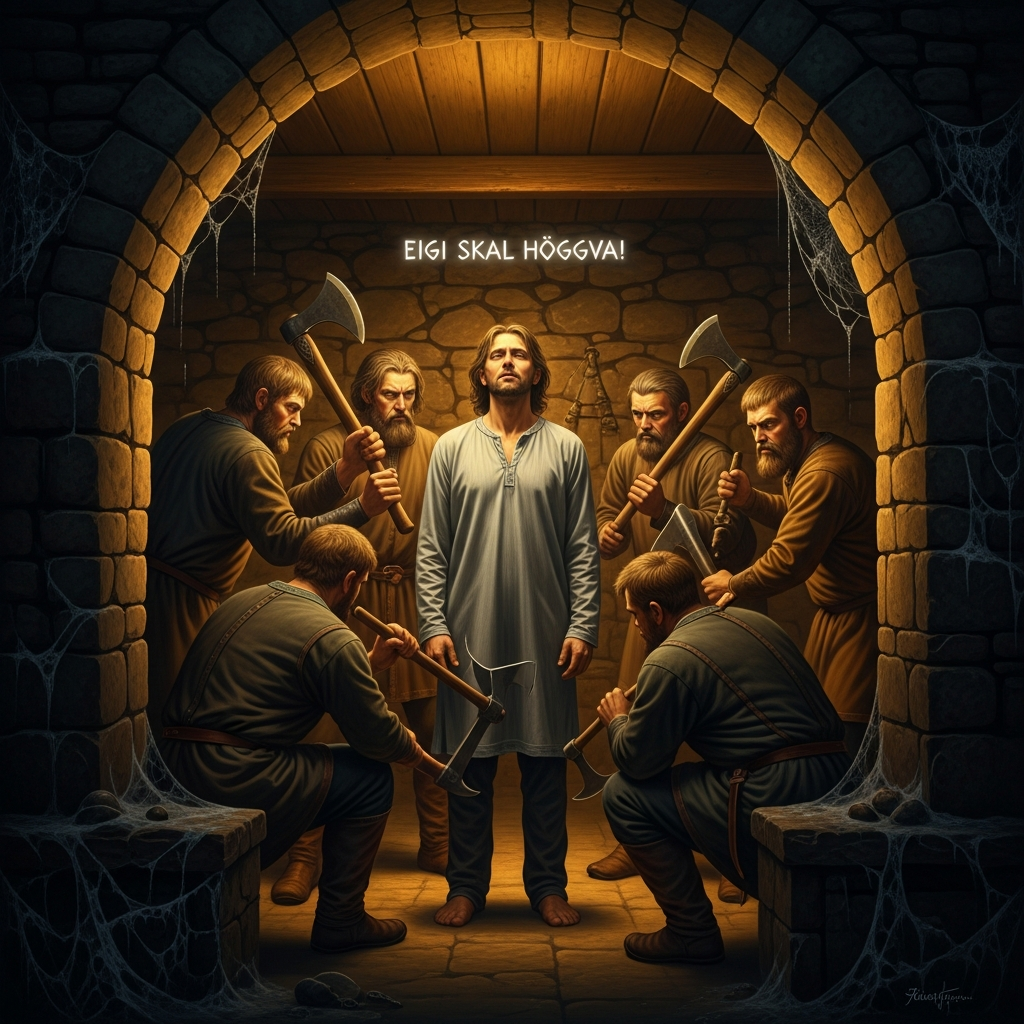
The cellar is a stone room beneath the house. It is not, particularly, a hiding place; it is the only room in the house that he can lock from the inside. The men outside the door are five: Gizurr’s man Símon Jörundarson, and four others, all with axes. They break the door.
The contemporary chronicle — Íslendinga saga, written by Snorri’s own nephew Sturla Þórðarson — records his last words.
Eigi skal höggva, says Snorri.
Strike not.
It is the imperative, in Old Norse, of the verb that means to hew. It is the word a man uses when he does not have a weapon and the men in front of him do. There is no record that the words contain any plea for mercy beyond the literal request. There is no record that the men listen. The chronicle gives the names of the five men and notes which of them struck the killing blow. It was Símon Jörundarson. The blow split Snorri’s head from crown to jaw. The body was buried at the church at Reykholt, and the church at Reykholt — restored in the twentieth century — still has a wooden floor that, the parish priests like to say, can be lifted to show the cellar where it happened.
The book survives.
This is the part the saga does not dwell on, because the saga is interested in the murder and the politics, but it is the part that matters most for the rest of human history. Snorri’s library at Reykholt is not destroyed. The vellum sheets of the Prose Edda are not burned. Manuscript copies have already begun to circulate among other Icelandic scholars, who recognize the importance of the work even if they disapprove of its author. Within a generation the book is being copied at every monastery in Iceland and at several in Norway. The earliest surviving manuscript, the Codex Upsaliensis, is from around 1300. The Codex Regius — which preserves the Poetic Edda, the older verse anthology that Snorri drew from — is also rediscovered, in a farmhouse, in 1643. The Bishop of Skálholt who finds it sends it to the King of Denmark, who keeps it in Copenhagen for three hundred years before returning it to Iceland in 1971 in a state ceremony that brought half the country out into the rain to greet the ferry.
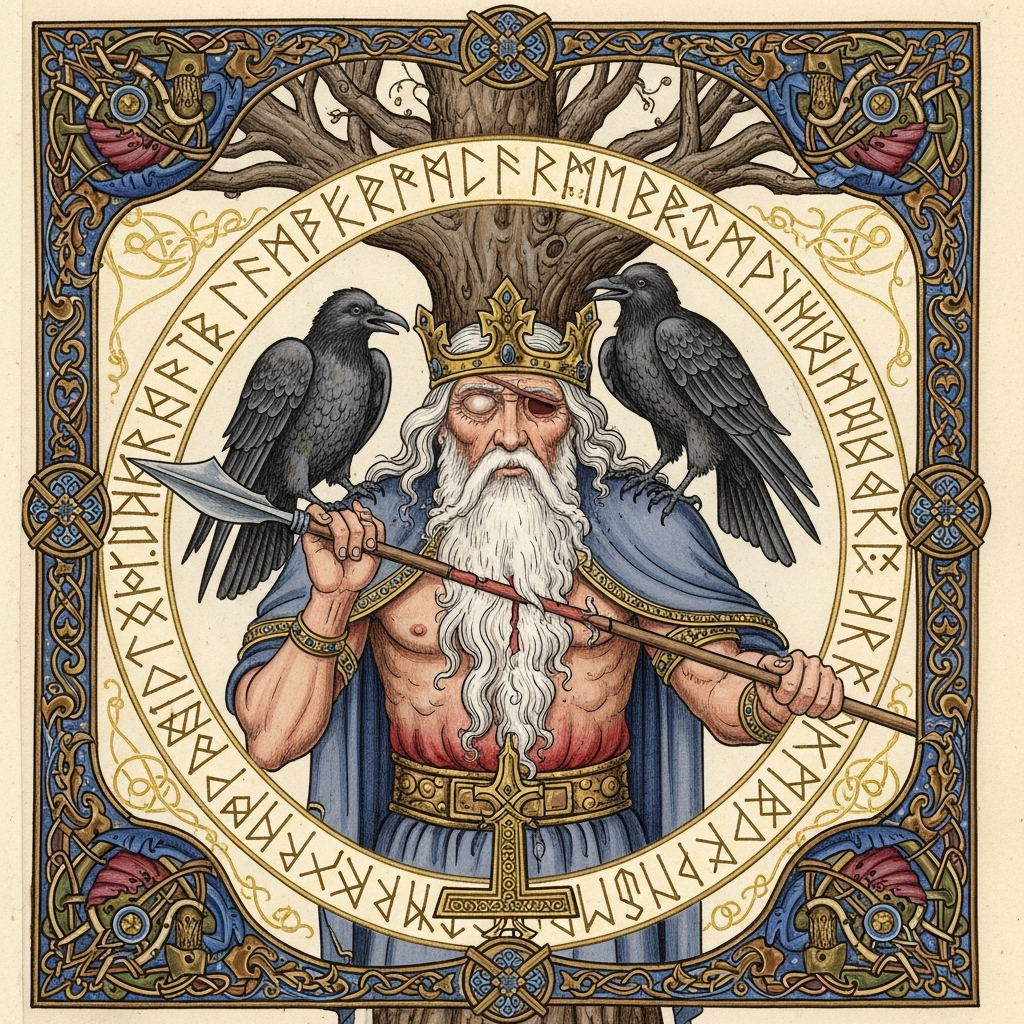
Without Snorri the kennings would have died, and without the kennings the skaldic verses would have become unreadable, and without the skaldic verses we would have only fragments — the Völuspá, perhaps, and some scraps of Hávamál, and a handful of inscriptions on stones. We would not have the killing of Ymir; we would not have the world made from a corpse. We would not have Thor at Útgarðaloki’s hall, the cup that drained the sea. We would not have Freya’s necklace. We would not have Odin’s nine-day hanging on the World-Tree, given for the runes — I know I hung on a wind-rocked tree, nine whole nights, with a spear wounded, and given to Odin, myself to myself. We would not have Ragnarok.
We would have, in their place, a hole in the literary record of Northern Europe.
Snorri put the book in the room. The men with the axes came down to the cellar. The book stayed in the room.
That is how cultural transmission works.
That is, almost always, how it has worked.
In Iceland today the church at Reykholt has been excavated, and the cellar is preserved, and a stone path leads from the church to the geothermal pool where the chieftain wrote his book. Children on school trips file along the path in small obedient lines. A guide stops them at the pool and explains that this is where Snorri Sturluson worked, and that he was murdered for his politics, and that we know almost everything we know about the Norse gods because of him.
The children listen for a moment. Then they look down into the steaming water. The pool is small. The water is hot. Beyond the pool the wind is coming down off the glacier as it has come down off the glacier for ten thousand years, cold and indifferent, the same wind that blew through the eyebrow-fence of Midgarðr the day the brothers walked away leaving Askr and Embla on the beach.
The wind does not care about books.
The books survive anyway.
Scenes
Snorri at his desk in Reykholt, late 1220
Generating art… An old skald in Snorri's hall recites a verse Snorri has been hunting for years
 Generating art…
 The framing fiction of Gylfaginning: King Gylfi, disguised as Gangleri, comes to a hall and is questioned by three figures called High, Just-As-High, and Third
 Generating art…
 Reykholt, the night of 23 September 1241
 Generating art…
 The cellar at Reykholt
 Generating art…
 Echoes Across Traditions
Entities
- Snorri Sturluson
- King Hákon Hákonarson
- Gizurr Þorvaldsson
- Odin
- the Bishop of Iceland

Sources
- Snorri Sturluson, *Prose Edda* (Gylfaginning, Skáldskaparmál, Háttatal), c. 1220 CE
- Snorri Sturluson, *Heimskringla* (kings' sagas), c. 1230 CE
- *Sturlunga saga* (contemporary record of the murder), 13th century
- Marlene Ciklamini, *Snorri Sturluson* (Twayne, 1978)
- Anthony Faulkes (trans.), *Edda* (Everyman, 1995)
- Óskar Guðmundsson, *Snorri: Ævisaga Snorra Sturlusonar* (2009)