
Francis and the Wolf of Gubbio
c. 1220 CE — recorded in *I Fioretti di San Francesco*, compiled c. 1390 from earlier oral and written sources of the Spiritual Franciscan tradition · Gubbio, Umbria, Italy — the Porta dei Calzolari, the road leading north into the hills, and the clearing in the woods where the wolf had its lair
Contents
A wolf has been killing the people of Gubbio for months. The townspeople are afraid to leave the walls. Francis of Assisi walks out the gate alone, into the hills, and finds the wolf in a clearing. He makes the sign of the cross. He calls it *Brother Wolf*. He negotiates a contract: if the town will feed the wolf, the wolf will stop killing. They walk back through the gate together, the wolf placing its paw in Francis's hand to seal the agreement. The wolf lives in Gubbio for two years, going door to door for food, and when it dies of old age the townspeople weep.
- When
- c. 1220 CE — recorded in *I Fioretti di San Francesco*, compiled c. 1390 from earlier oral and written sources of the Spiritual Franciscan tradition
- Where
- Gubbio, Umbria, Italy — the Porta dei Calzolari, the road leading north into the hills, and the clearing in the woods where the wolf had its lair
The wolf of Gubbio is, first of all, a real wolf.
The Fioretti — the Little Flowers, that fourteenth-century compilation of Franciscan stories drawn from the older oral memory of the Umbrian hills — refuses, throughout the chapter, to allegorize. The wolf is not a symbol of sin. It is not a metaphor for the human heart. It is an actual animal that has been killing actual livestock and actual people on the road outside an actual town. The townspeople have stopped going outside the walls. The shepherds have abandoned the high pastures. The road north toward Sansepolcro is empty because no one will travel it. Children have been taken from the very gate of the city. The town has tried to organize hunting parties; the parties have come back fewer than they went out. The wolf is not magical. It is starving and clever and large, and Gubbio in the early thirteenth century, ringed by wild forest in every direction, is not in a position to outlast it.
Francis is staying in the town. He is between hermitages — between La Verna in the north and the Carceri above Assisi to the south — and he has come to Gubbio because he has friends there, the same friends who took him in when he was first sleeping in caves above Assisi after his quarrel with his father, before he had a habit, before he had brothers, when he was just a young merchant’s son with a half-formed idea about following the Gospel literally. Gubbio is the town that knew Francis before anyone called him a saint.
He hears the news. He walks out of the inn. The townspeople try to stop him. They tell him about the hunters who did not come back. They tell him about the bones found in the snow last winter. They offer him weapons. He refuses everything. He takes only the rough brown habit he is already wearing and the rope cincture knotted three times for poverty, chastity, obedience. He makes the sign of the cross over himself at the gate. He walks out into the road.
The townspeople watch from the wall.
The Fioretti is specific about this: they climb up onto the parapet to see. They do not expect to see Francis come back. They expect to see the wolf come down the road in pursuit of something it has just eaten. The bishop is there. The Podestà — the chief magistrate of the commune — is there. The shepherds and the merchants and the women and the children, all crowded along the wall in the late autumn afternoon, watching the small brown figure walk into the trees and disappear.
Francis walks up the path. He does not run. He does not call. He walks the way a man walks who has decided already that whatever happens to him is the right thing. He has spent the last fifteen years rehearsing this walk — the walk into the leper colony at San Damiano when he was twenty-five and could not bring himself to touch a leper and made himself touch one anyway and felt his whole life invert; the walk across the Egyptian battlefield in 1219 to meet the Sultan al-Kamil at Damietta, alone and unarmed, when his own crusader companions had told him he would be killed; the walk up Mount La Verna in 1224 to keep the Lent of St. Michael in solitude. He has done this before. He does not bring weapons because he has decided not to be the kind of person who brings weapons.
He reaches the clearing where the wolf has its lair. The grass is matted. There are bones. The wolf rises from where it has been sleeping in a patch of sun.
It is large. The chronicler is precise: grande, with red eyes and yellow teeth and a black ridge along its back. It growls. It lowers its head. It moves toward Francis with the gait of an animal that has learned, in months of unopposed killing, that humans are food.
Francis raises his hand and makes the sign of the cross.
Frate lupo, he says. Vieni qua, in nome di Cristo, non far male a me né a alcuno. Brother Wolf, come here, in the name of Christ, do harm neither to me nor to anyone.
The wolf stops.
What happens in the next minutes is the whole story, and the chronicler tells it as if it were a court transcript.
The wolf closes its jaws. It walks the rest of the way toward Francis at a pace that the chronicler calls mansueto — meek. It stops at his feet. It lies down, the way a dog lies down before a master. It looks up.
Francis crouches. He addresses the wolf the way an Umbrian magistrate would address a defendant — formally, by title, with respect, and with the clear understanding that justice is being done here and not pity.
Brother Wolf, he says, you have done much harm in this region. You have destroyed and killed creatures of God without his permission. Not only have you killed and devoured beasts, but you have presumed to kill men, made in the image of God. For these things you deserve to be hanged like the worst kind of thief and murderer. All the people cry out against you. They are your enemies. But, Brother Wolf, I want to make peace between you and them. They will no longer be harmed by you, and you will be forgiven all your past offenses. Neither men nor dogs will pursue you. Do you agree to this peace?
The wolf, the Fioretti says, lowers its head and moves its body and its tail and its ears in a way that signifies — to anyone watching — assent. Francis presses the case. He explains the terms. The wolf will stop killing humans. The wolf will stop killing livestock. In exchange, the people of Gubbio will feed the wolf for as long as it lives. No more hunger. No more risk. The wolf will become a creature of the town the way the bell-ringer is a creature of the town, fed in exchange for service, accepted in exchange for restraint.
Do you agree, Brother Wolf?
The wolf bows its head a second time.
Brother Wolf, will you give me your pledge?
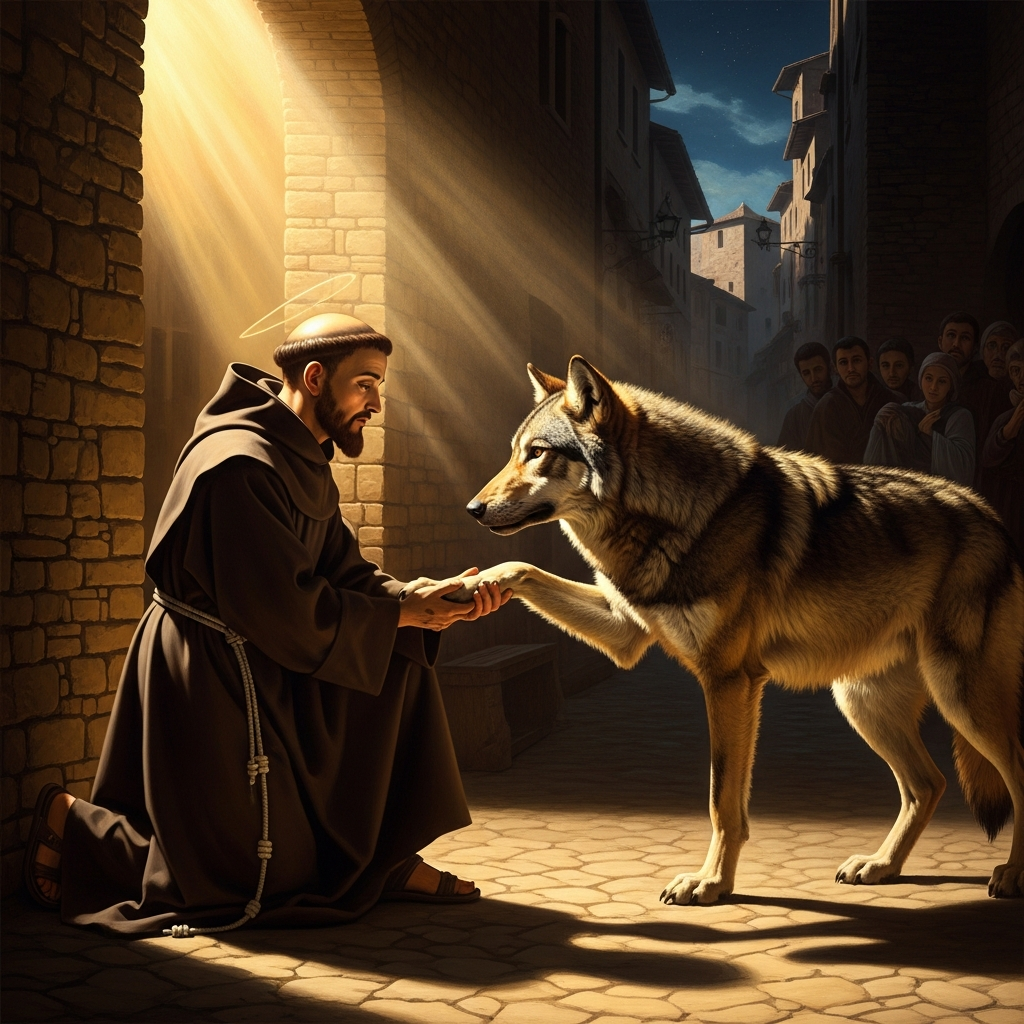
And then, the moment the chronicler insists you must believe even though you cannot — the moment the Fioretti refuses to soften — the wolf raises its right paw and places it in Francis’s open palm. Francis closes his fingers around it. The contract is sealed. The two of them stand. The wolf does not look back at the lair. They walk together down the path toward Gubbio.
The townspeople on the wall see them coming.
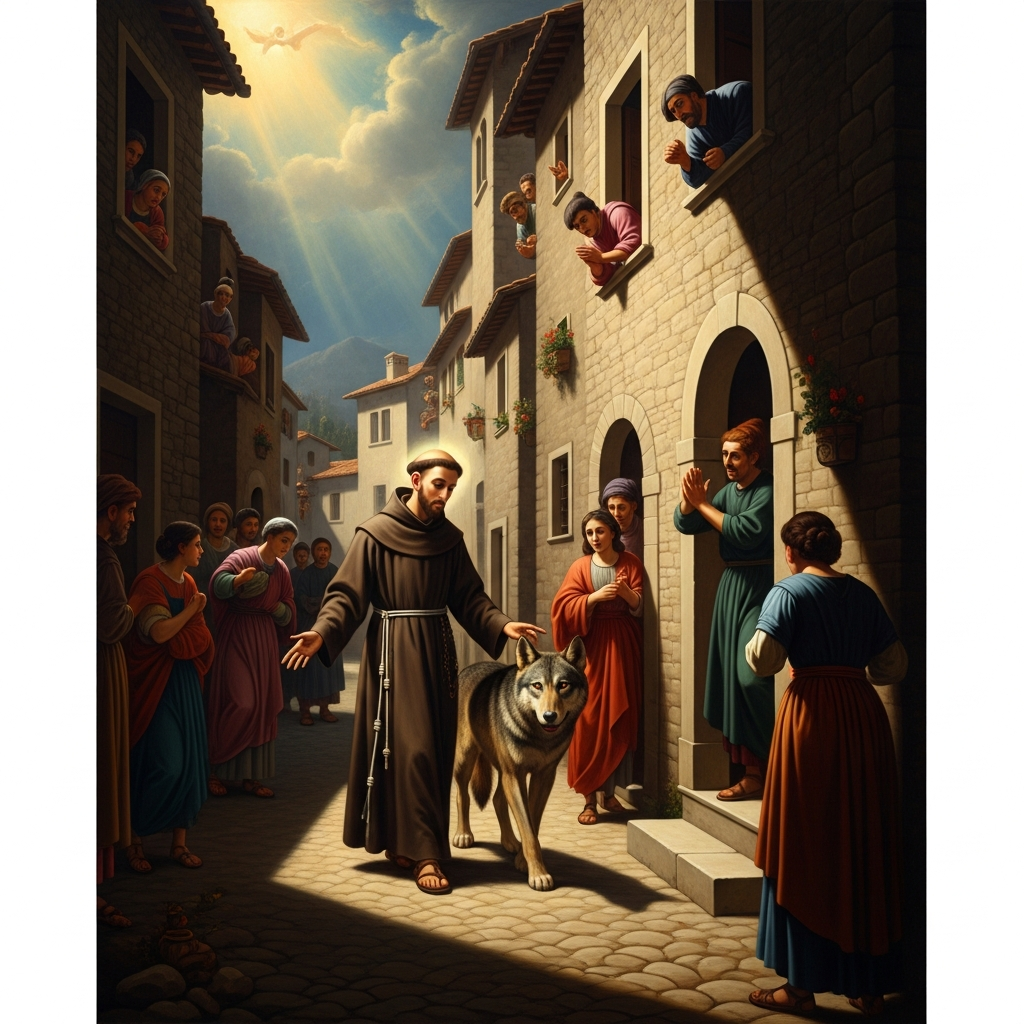
A small brown figure in a brown habit, walking down the road in the late afternoon light, and beside him a wolf the size of a calf, its head at the level of his hand, its tongue out, its eyes calm. The townspeople do not at first move. They do not believe what they are seeing. The bishop crosses himself. The children begin to cry. Francis walks through the gate and into the town square as if this were the most natural thing in the world. The wolf walks beside him. Francis stops in the square. He calls the townspeople down from the wall.
In the square he addresses them. He explains what has happened. He calls God to witness. He repeats the contract publicly, both terms — the wolf will not kill, the town will feed it — and then he asks the townspeople: Do you agree?
The townspeople agree, the chronicler says, in one voice.
Francis turns to the wolf. Brother Wolf, you must keep your part also.
The wolf again raises its paw. The wolf again places it in Francis’s hand. The townspeople watch this happen in the open square. The bishop weeps. The Podestà records the agreement formally in the city archive.
Francis goes back to the inn. The wolf goes — somewhere — into the town, to find a doorway, to lie down.
For the next two years, the Fioretti says, the wolf lives in Gubbio.
It goes door to door. It is fed at each house. The townspeople call it Brother Wolf in conscious imitation of Francis, and it answers — comes when called, lies down when told, will not approach those who do not wish to see it. The dogs of the town do not chase it. The sheep do not panic at its presence. The children, after a while, stop being afraid; they pull at its ears, and it tolerates them. It grows old in the town. It grows fat in the town. It dies of natural causes, in old age, two years after Francis brought it through the gate.
When it dies the townspeople weep. They weep, the chronicler says, not only because they had loved it, but because they had seen what could be done — what could happen — when a saint walked into a wood.
They bury it inside the city walls.
In the eighteenth century, restoration workers in the church of San Francesco della Pace in Gubbio — the church the Franciscans built on the site where, by tradition, the wolf was buried — uncover under the slab of the threshold the bones of a very large wolf. The bones are reinterred under the same slab. The slab is still there. Tourists step on it without knowing.
The wolf of Gubbio is not a parable about kindness to animals, though it is also that. It is a story about what Francis thought the world actually was. He thought every creature, including the dangerous ones, was a brother or a sister of his — frate, sorella — and that the appropriate response to a brother who had become dangerous was not violence but conversation. He thought you could walk into a clearing where a starving wolf was waiting and propose a contract, and the wolf would understand. He thought hunger was a legitimate complaint. He thought the town owed the wolf something.
This was not the medieval consensus. The medieval consensus was that the wolf was a sign of sin, an instrument of the devil, an enemy of human civilization to be hunted to extinction. Francis stepped outside the consensus the way he stepped outside the city wall: alone, unarmed, and confident that the consensus was wrong.
The Franciscans inherited the conviction. The Canticle of the Sun, composed by Francis in the dark cell at San Damiano four years after Gubbio, addresses the elements as kin: Brother Sun, Sister Moon, Brother Wind, Sister Water, Brother Fire, Mother Earth, and at the end Sister Bodily Death. The whole created order is a single family, and the work of the Christian is to walk into it openhanded and propose terms.
The Catholic ecological tradition — Laudato Si’, the Franciscan environmentalism that runs from the thirteenth century to the present — is, in essence, the wolf of Gubbio with the proper paperwork.
Scenes
Francis walks alone up the path from the Porta dei Calzolari, the townspeople watching from the wall
Generating art… *Frate lupo*, Francis says — Brother Wolf
 Generating art…
 For two years the wolf goes door to door in Gubbio, fed by the townspeople, growing tame
 Generating art…
 Echoes Across Traditions
Entities
- Francis of Assisi
- Brother Wolf
- the townspeople of Gubbio
- Bishop Guido of Assisi
- the Podestà of Gubbio

Sources
- *I Fioretti di San Francesco* (*The Little Flowers of St. Francis*, compiled c. 1390 from earlier sources), chapter 21
- *Actus Beati Francisci et Sociorum Eius* (Latin original of the Fioretti, c. 1325-1340)
- Lawrence Cunningham, *Francis of Assisi: Performing the Gospel Life* (Eerdmans, 2004)
- Augustine Thompson, *Francis of Assisi: A New Biography* (Cornell University Press, 2012)
- Chiara Frugoni, *Francis of Assisi: A Life* (Continuum, 1998)
- Donald Spoto, *Reluctant Saint: The Life of Francis of Assisi* (Penguin, 2002)