The Cripple's Mother and the Baobab
c. 1220 CE · The exile years preceding the Battle of Kirina (1235) · Old Mali · Niani — capital of the kingdom of Old Mali on the upper Niger, modern Guinea — and the courts of exile in the Sahel beyond
Contents
Sogolon weeps at the foot of the baobab. Her seven-year-old son still cannot walk. The other wives mock her. Then a neighbour insults her over a leaf she cannot reach — and her son drags himself to a heavy iron rod, takes hold of it, and stands.
- When
- c. 1220 CE · The exile years preceding the Battle of Kirina (1235) · Old Mali
- Where
- Niani — capital of the kingdom of Old Mali on the upper Niger, modern Guinea — and the courts of exile in the Sahel beyond
The boy is seven years old and he cannot walk.
His name is Sogolon Djata, which in the speech of the griots collapses into Sundiata. He is the son of Naré Maghan Kon Fatta, king of Niani, and of a woman called Sogolon Condé — the buffalo woman, the ugly one, the hunchbacked stranger the king married because a hunter brought her in chains and a djinn spoke in the night and said this woman carries Mali. Sundiata was born to fulfill a prophecy and was greeted at his birth by court diviners who said the same thing in different words: this is the lion. This is the king who will hold all the kingdoms together. Then time passed. The lion did not stand.
He crawls.
He crawls on his hands and his knees. He drags himself across the packed-earth floor of the king’s compound, weaving between the cooking fires and the millet pestles. He is strong from the chest up — his arms are thicker than other boys’ arms, the arms of a child who has had to do all his moving with them — but his legs are useless. They trail behind him. They do not bear weight. He has tried to stand a thousand times and he has fallen a thousand times, and the falls have begun to settle into something like a habit, and the habit has begun to feel, to everyone who watches him, like a fact.
The court watches. The court laughs.
His father the king is dying.
Naré Maghan was supposed to live long enough to put the boy on the throne. He has not. He has been ill for a year, and the kingdom knows what is coming. When the king dies, the council of elders will decide which of the king’s sons inherits the throne. They will not choose the boy who crawls. They will choose Sassouma Berété’s son, Dankaran Touman, the elder, the legitimate heir, the straight-limbed boy who can ride a horse and throw a spear and meet the gaze of a foreign ambassador without his mother having to wipe his chin first. The prophecy will, by all visible measure, have failed.
Sogolon knows this.
She is already the court’s joke. The hunchbacked wife. The ugly one. She is the second wife — Sassouma Berété is the first — and Sassouma has spent the last seven years engineering the slow social erasure of the woman the king dragged in from the bush. Sassouma sends her own son past the door of Sogolon’s hut to laugh where Sogolon can hear it. Sassouma sends gifts of meat to other compounds and skips Sogolon’s. Sassouma calls her women together and discusses, in voices loud enough to carry across the courtyard, the strange habits of the woman from the south.
But the cruelty Sassouma cannot quite get out of her own mouth is the cruelty her women say for her. Sogolon’s lion cannot even stand up to roar.
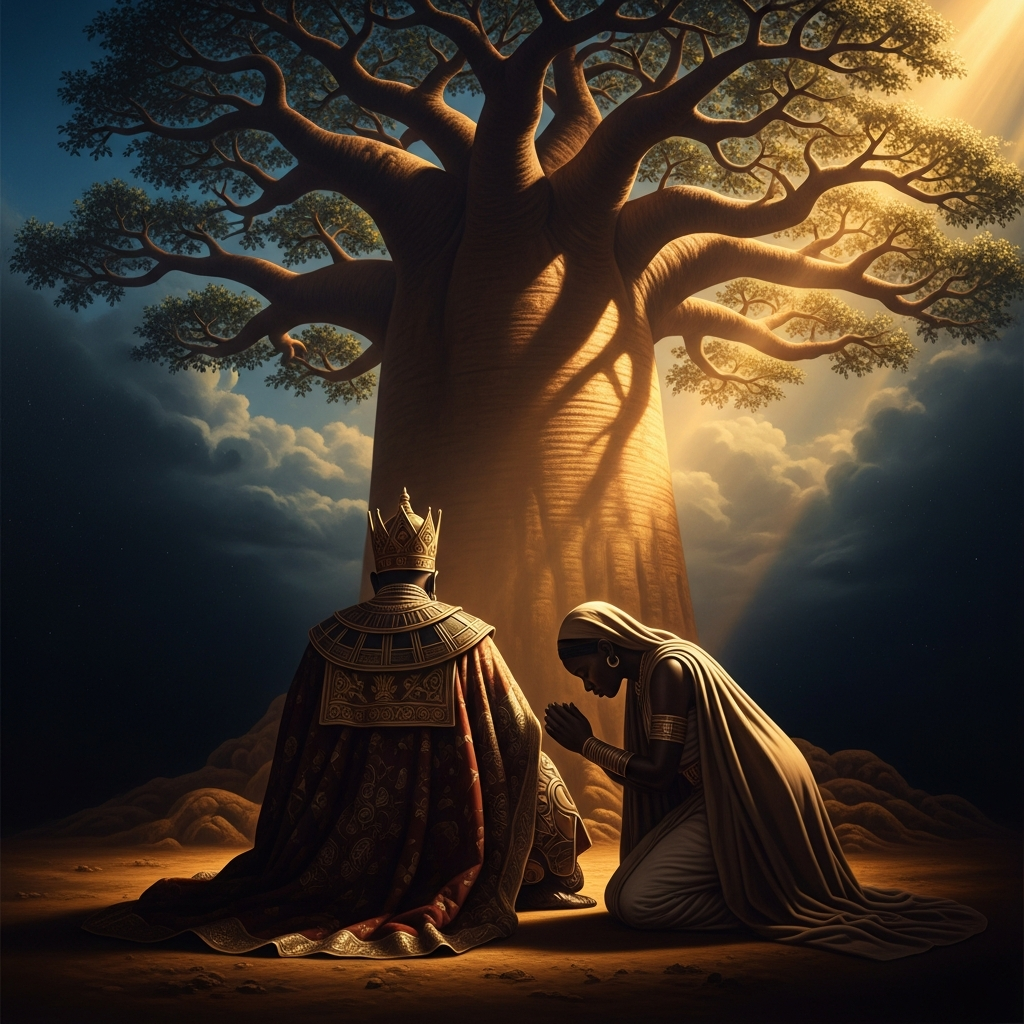
Sogolon walks to the great baobab at the back of the compound and kneels in the dirt and weeps.
She weeps in the way women weep when they have been weeping for years and the weeping has worn a channel in the body. She does not make much noise. She kneels at the foot of the tree, the way her mother knelt at the trees of her own homeland, and she presses her forehead against the cool grey bark of the baobab and she asks the djinn who brought her here what she did wrong. She has not done anything wrong. She knows she has not. The hunter brought her. The diviners spoke. The prophecy was sealed. And now her son crawls on his hands across a courtyard while another woman’s son rides past the door on a small horse.
Sundiata is somewhere behind her in the dust. He has dragged himself out of the compound to follow her, because he can hear that she is crying and he cannot bear it. He is too far away to comfort her. He is also too far away to stop hearing what is about to happen next.
The morning the story turns is not the morning of any battle. It is a small morning. Sassouma sends one of her women to Sogolon’s hut to ask, very politely, very sweetly, with the voice of someone borrowing sugar, whether Sogolon has any baobab leaves she could spare for the evening’s cooking. Baobab leaves — lalo, the dried leaves crushed into a powder — are the staple thickener of Mande cooking. Every household keeps a stock. To run out of baobab leaves is to be unable to feed your guests.
Sogolon has none.
She has none because she cannot climb the baobab to gather them. She has none because she has no son who can climb the baobab to gather them. She has none because her son crawls. The other wives know all of this. The request was not innocent. The request was an instrument.
Sogolon goes outside. She kneels in the dust again. She weeps again. But this time the weeping is different. This time the weeping is not at the prophecy or at the diviners or at the djinn. This time the weeping is the weeping of a woman whose own neighbour has reached down into the deepest, smallest place in her shame and twisted it for sport. She is, suddenly, furious. Furious at Sassouma. Furious at the women who came after Sassouma. Furious at her own body. Furious at the prophecy that was supposed to lift her up and that has only set her up higher to be knocked down from. She covers her face with her hands.
Sundiata, somewhere in the dust behind her, hears it.
He has heard her cry before. He has not heard her cry like this before. Something in his chest moves in a way it has not moved before. He drags himself toward her. He does not reach her. He is not yet close enough. But on the way, on the slow path across the compound, something happens inside him.
He stops crawling.
He sits up. He sits up the way a child sits up — bracing on his arms, looking around. He looks at his mother kneeling at the baobab. He looks at the other wives’ compounds, where the laughter has not stopped. He looks at his own legs, which are still useless, which have been useless for seven years, and he speaks.
Mother, he says.
She does not turn. She does not believe she has heard him.
Mother, he says again. I want to stand up today.
She turns. She wipes her face. She crawls toward him. She gathers him in her lap. She tells him not to torment her — not today, not after what just happened, not when she has nothing left in her body for any more disappointment.
He says: Send for the blacksmith. I want a heavy iron rod.
She looks at him.
Something in her — the part of her that has been kneeling at the baobab for seven years and refusing to give up the *djinn’*s promise — believes him. She gets up. She walks to the king’s blacksmith. She tells him what her son has asked for. The blacksmith, an old man named Farakourou who has known her since before her marriage, looks at her in the way men look at women who have been pushed too far. He nods. He goes to his forge and he beats out an iron rod thicker than a man’s arm, longer than a man’s height, heavier than any rod a child could possibly lift. He brings it to the compound himself. He drives it into the packed earth of the courtyard with a heavy mallet. He steps back.
The whole compound is watching now. Word has gone around. Sassouma is at her door. Her women are in the shade of their compound. The king’s officials are watching from the gallery. They do not know what is about to happen. They have come to see another humiliation. They are about to see the morning a kingdom turns over.
Sundiata drags himself across the dust toward the rod.
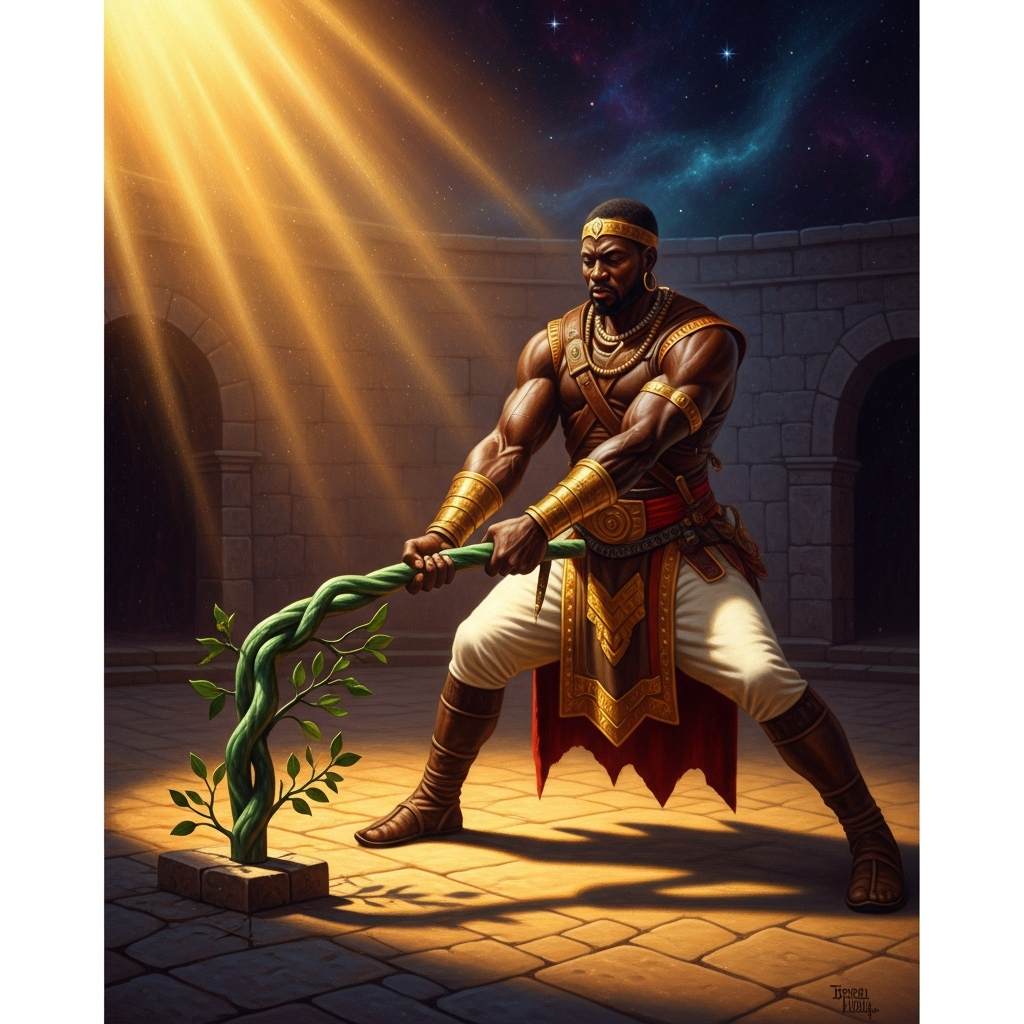
He arrives at the rod. He puts both his hands on the iron. He pulls.
His arms tremble. The cords of his neck stand out. His face turns the colour of the inside of a baobab fruit. He pulls. The iron rod, driven deep into the earth by the blacksmith’s mallet, begins to bend. It does not lift him. It does not hold him. It bends outward under his weight, slowly, the way a green stem bends under the weight of a fruit.
It bends until it is touching the ground in a smooth arc, and Sundiata is still on his knees beside it.
The compound is silent.
Sogolon makes a sound that is not quite a word.
Sundiata lets go of the bent rod. He looks at his mother. He looks at the courtyard. He looks at the great baobab at the back of the compound — the oldest tree in Niani, the tree his mother has been weeping at, the tree whose leaves she has been unable to reach.
He drags himself toward it.
The crowd does not move. No one says anything. Sassouma’s women have stopped breathing. The king’s officials have stopped breathing. Sogolon has stopped breathing. The whole compound is held in a silence so deep that the buzzing of the flies above the cooking fires sounds like an alarm.
Sundiata reaches the baobab. He sits up against its grey trunk. He puts his hands on the bark, low down, where the trunk swells out like the belly of a thing that is full. He pulls.
The first time he pulls, nothing happens.
The second time he pulls, the bark groans.
The third time he pulls, he stands.
He stands. The boy who has not stood in seven years stands up against the trunk of the baobab, and his legs hold him. They hold him the way legs are supposed to hold a person. They tremble, but they hold. The kingdom watches a child stand up at the foot of a tree, and the kingdom understands, dimly, what it is watching.
But he is not finished.
He keeps pulling.
He pulls outward. He pulls the way a man pulls a stake out of the ground. He pulls the way you pull a tooth. He pulls the way no living thing has ever pulled a baobab in the history of the savanna, because baobabs are not pulled, baobabs are immovable, baobabs are the deep slow thing the savanna is built on.
The baobab comes out of the ground.
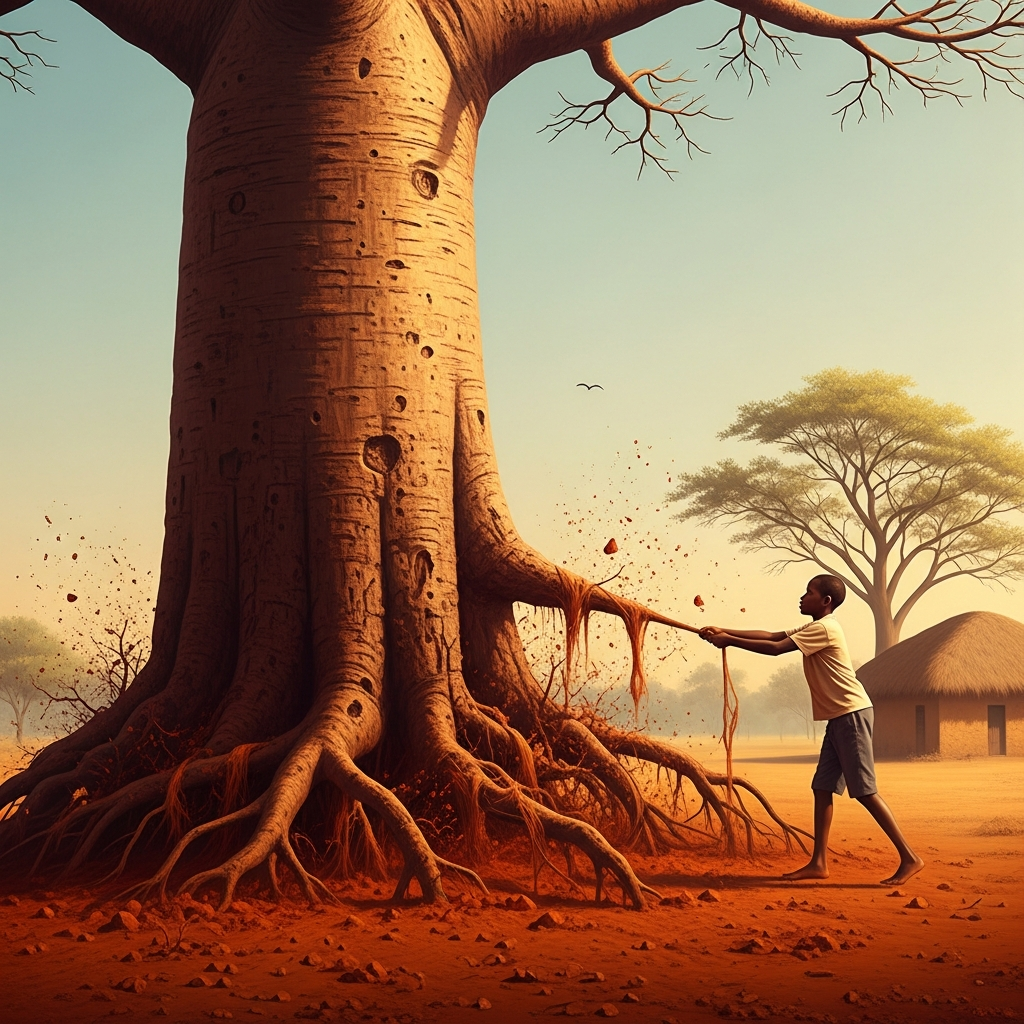
It comes up roots and all. The earth at its base ruptures. Red soil sprays outward. The great taproot tears free with a sound like a long and tired sigh. The lateral roots come up like a woman’s hair lifted away from her neck. The whole tree — fifteen, twenty metres tall, a thousand years old, the oldest living thing in Niani — lifts off the ground in the small brown hands of a seven-year-old boy.
He carries it.
He carries it across the compound. He carries it past the bent iron rod. He carries it past Sassouma Berété, who has come out into the open courtyard now, who is staring at him with the face of a woman who has just realized that the prophecy she spent seven years dismissing was not a joke. He carries the baobab to his mother.
He sets it down at her feet.
He says: Mother. Now you have all the leaves you will ever need.
Sogolon falls on her knees and screams. She screams with relief and with vindication and with a grief that has been seven years building. She presses her face into the bark of the tree her son has just torn out of the earth for her, and she stays there for a long time.
The court does not laugh that day.
The court will not laugh again for as long as any of them are alive.
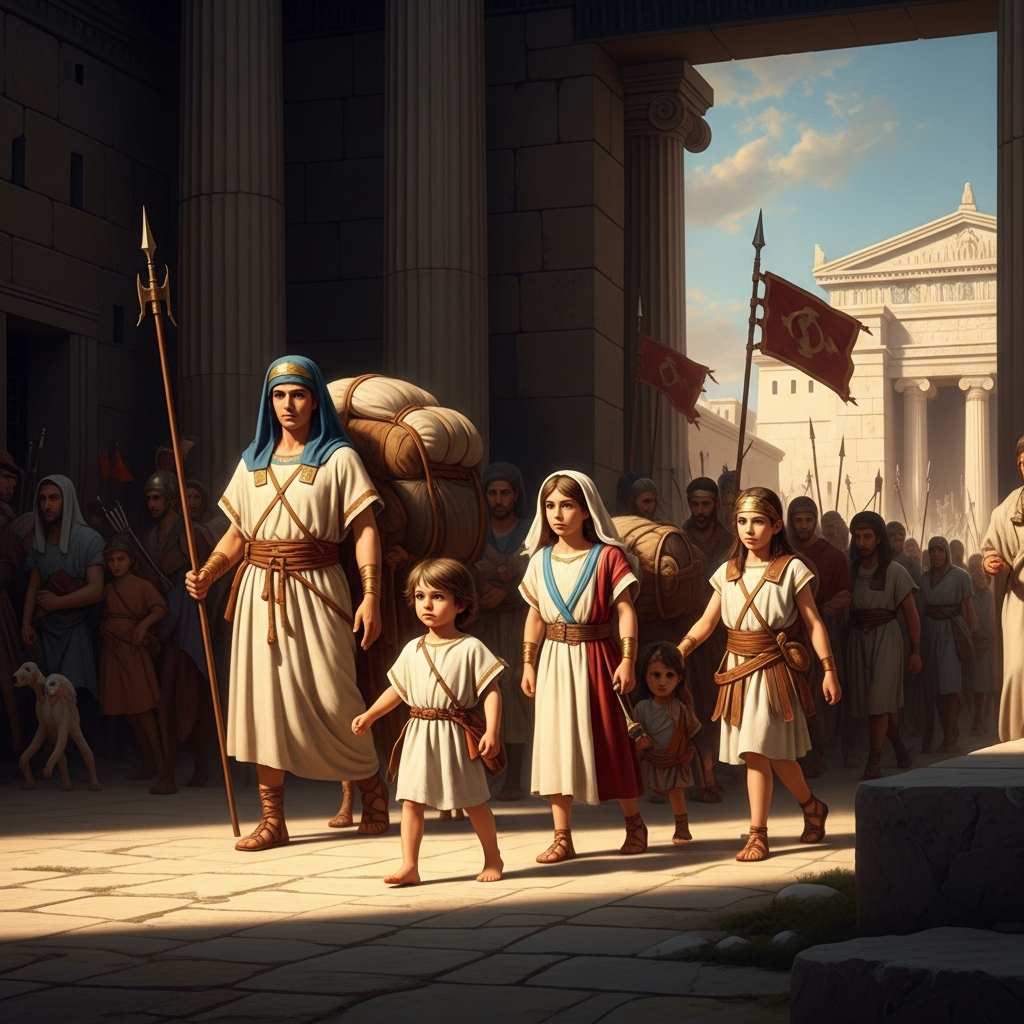
Sassouma understands what has happened. Sassouma understands that the boy whose existence she has been managing into invisibility has just become the most dangerous person in the kingdom. She begins, that very afternoon, to plot against him. Within months her plotting has driven Sogolon and her children into exile — out of Niani, across the Sahel, into the courts of foreign kings, where the boy who uprooted the baobab will spend the next decade learning the sword, the lance, the politics of rival kingdoms, and the patience that empires are built on.
He will return.
He will return at the head of an army. He will meet Soumaoro Kanté, the sorcerer-king of Sosso, on the plain of Kirina in 1235, and he will defeat him, because by then the boy who pulled the baobab out of the ground at seven will be a man, and the man will know that there is nothing in the world that cannot be lifted by the right pair of hands at the right moment.
The Mali Empire will be born from that battle. Mansa Musa, two generations later, will walk out of Mali and across the Sahara on a hajj so wealthy that he will single-handedly tank the Egyptian gold market for a decade. The empire will spread from the Atlantic to the bend of the Niger. Universities will rise at Timbuktu. Manuscripts in Arabic and in Songhay will be copied in scriptoria the size of small cities. The Mande language will become the spine of West African trade.
It all begins with a tree.
It begins with a tree that an old woman could not climb and a boy who had been told for seven years that his body was useless. It begins with a boy who heard his mother cry in a way she had never cried before, and decided that whatever was in him — whatever the djinn had promised, whatever the prophecy had sealed, whatever the lion had been crouching for — would not be crouching for one minute more.
The baobab still lies on its side in the imagination of every griot who tells this story.
The roots are still wet with the red earth of Niani.
The boy is still standing.
Scenes
Sogolon Condé kneels at the foot of the great baobab behind the king's compound at Niani
 Generating art…
 Sundiata grips the heavy iron rod the blacksmith has driven into the courtyard
 Generating art…
 He walks across the compound to the great baobab
Generating art… The caravan of Sogolon and her children leaves Niani by the western gate
 Generating art…
 Echoes Across Traditions
Entities
- Sundiata Keita (Son-Jara, Sogolon Djata)
- Sogolon Condé (his mother)
- Maghan Kon Fatta (his father, king of Niani)
- Sassouma Berété (the rival queen)
- Balla Fasséké (the griot)
- Soumaoro Kanté (the sorcerer-king he will eventually defeat)
Sources
- D.T. Niane, *Sundiata: An Epic of Old Mali,* trans. G.D. Pickett (1965, from the recitation of Mamadou Kouyaté)
- John William Johnson, ed. and trans., *The Epic of Son-Jara: A West African Tradition* (1986, from the recitation of Fa-Digi Sisòkò)
- Nehemia Levtzion, *Ancient Ghana and Mali* (1973)
- Ralph A. Austen, ed., *In Search of Sunjata: The Mande Oral Epic as History, Literature and Performance* (1999)
- Stephen P.D. Bulman, 'A Checklist of Published Versions of the Sunjata Epic,' *History in Africa* 24 (1997)