Thor at the Court of Utgard-Loki
Mythic time (recorded in Snorri Sturluson's *Prose Edda*, c. 1220 CE) · Jötunheimr — the realm of the giants, east of Midgard
Contents
Thor and Loki journey east into Jötunheimr and arrive at the impossible hall of Útgarðaloki, where Thor is humiliated in three contests — a drinking horn he cannot empty, a cat he cannot lift, an old woman he cannot throw down. Only on the road home does the giant reveal what each contest really was.
- When
- Mythic time (recorded in Snorri Sturluson's *Prose Edda*, c. 1220 CE)
- Where
- Jötunheimr — the realm of the giants, east of Midgard
The road east is long and the rain does not stop.
Thor and Loki travel together — which is itself a kind of warning, because Thor and Loki together always mean the world is about to learn something it did not want to know — and with them goes Þjálfi, the farmer’s boy who runs faster than any creature in the nine worlds. They have already crossed the boundary of Midgard. They are deep in Jötunheimr now, the country of the giants, where the mountains do not stay where you left them and the rivers run uphill if they feel like it. The goats are dead, eaten and resurrected and eaten again, and the farmer’s children are bound to Thor as servants for a clumsiness with a thigh-bone. Thor’s mood is not improved by the rain.
They walk for a day and a night and another day. Toward evening they come to a hall so vast that at first they take it for a hill. The door is open. They go in. They sleep. In the small hours of the morning the hall begins to shake — earthquake, Thor thinks, and grips Mjöllnir — and a noise begins from the deep distance like the breathing of a mountain. They take shelter in a side-chamber off the main hall. The shaking does not stop. It does not stop until dawn, when Thor steps outside and finds an enormous giant sleeping in the grass, and the hall they have spent the night in is the giant’s glove, and the side-chamber is the thumb. The giant introduces himself as Skrýmir. He says he is going their way. He offers to carry their provisions in his bag. They accept. He ties the bag with a knot Thor cannot loosen by evening, when they stop for supper, and so they eat nothing while the giant snores.
Three times that night Thor strikes Skrýmir on the head with the hammer. Three times Skrýmir wakes briefly and asks if a leaf has fallen on him, or perhaps an acorn, or possibly a bird. Three times Thor stares at the hammer and at the giant and at his own hand. In the morning Skrýmir bids them farewell and points toward the looming silhouette on the horizon — a fortress so tall its battlements vanish into cloud. Utgard, says the giant. The court of Útgarðaloki. You will find them less easily impressed than I have been. And he leaves.
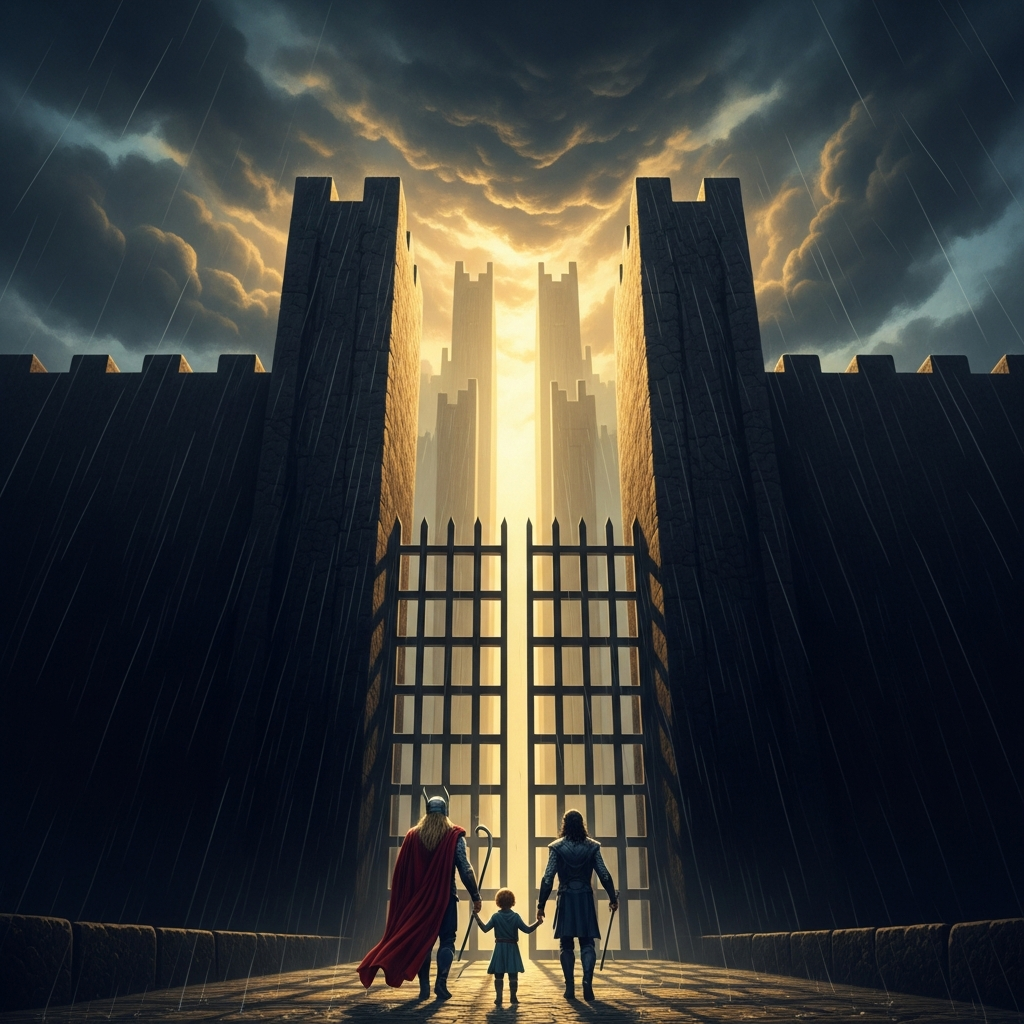
The gate of Utgard is so tall they walk between the bars of its lattice without stooping.
Inside the hall a giant sits on a high seat. His face is not unkind. He is amused, perhaps, in the way a man is amused by puppies. He greets them: the small one is Thor of Ásgarðr, I think, though he has been described as larger. He invites them to demonstrate whatever they are best at. We have a custom here, he says. Visitors must show some skill before they sit at meat.
Loki goes first. He says he can eat faster than any man in the hall. Útgarðaloki produces a wooden trough heaped with meat. He sets a pale, hungry-looking giant called Logi at the other end. They eat from opposite ends. They meet in the middle. Loki has eaten all the meat from the bones. Logi has eaten the meat, the bones, and the trough. Loki sits down.
Þjálfi goes next. He says he can outrun any runner in the hall. Útgarðaloki sets him against a small slim figure called Hugi. They run three races, on a level course outside the wall. Hugi is so far ahead at the end of the first race he is already turning back to meet Þjálfi at the line. The second is worse. The third is worse than the second. Þjálfi sits down.
Now Thor.
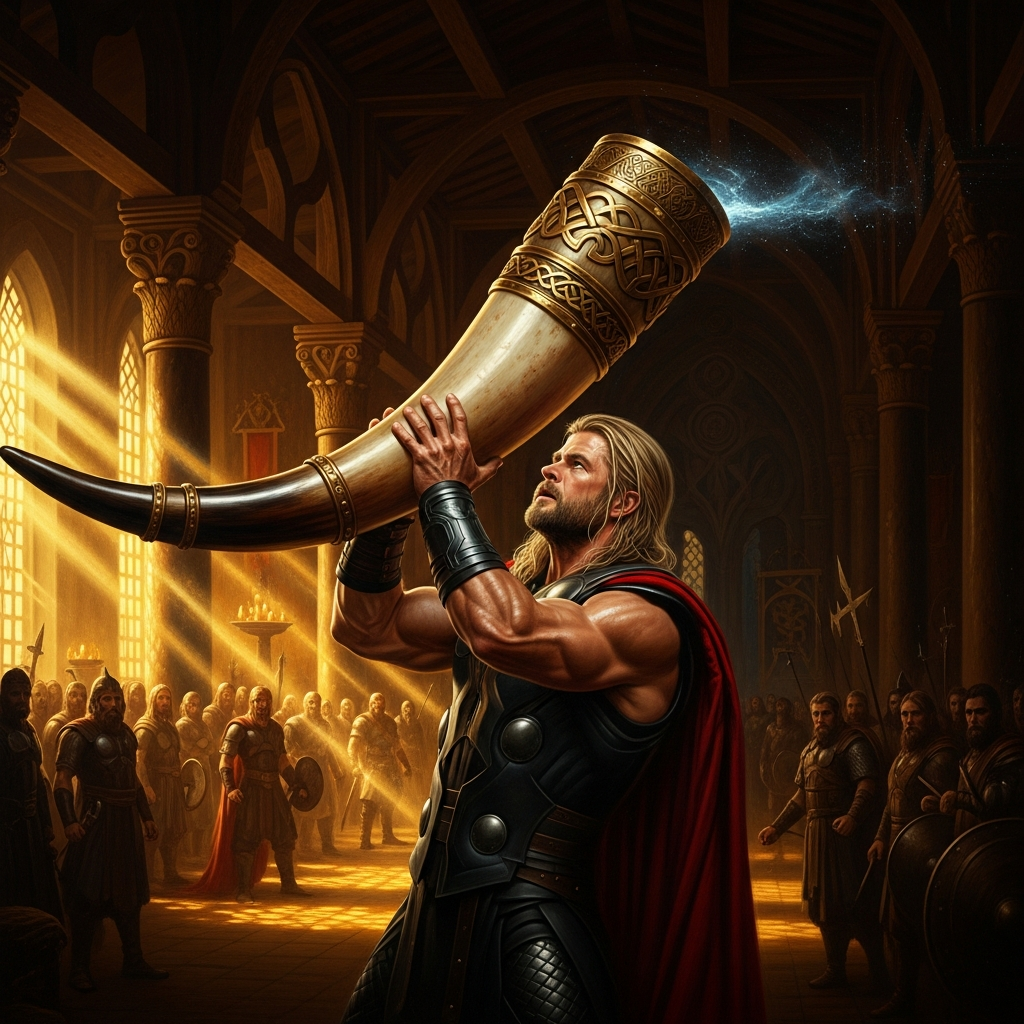
Drinking, says Útgarðaloki. Many of my men hold themselves great drinkers. Try the horn. A cup-bearer brings a long curved horn — long, but not absurdly so. Thor has drained larger horns than this in Ásgarðr at festivals where he did not even consider himself thirsty. He lifts it, drinks, drinks deep, sets it down, and the level inside has dropped only a finger’s width. He lifts it again. He drinks until his vision blurs. He sets it down. The level has dropped, perhaps, three fingers. He lifts it a third time, and now Thor of Ásgarðr is drinking with the desperation of a man bargaining with the universe, and when he sets the horn down he is sweating and shaking and the horn is still substantially full. The hall does not laugh. The hall watches. Útgarðaloki shrugs.
Try the cat, he says.
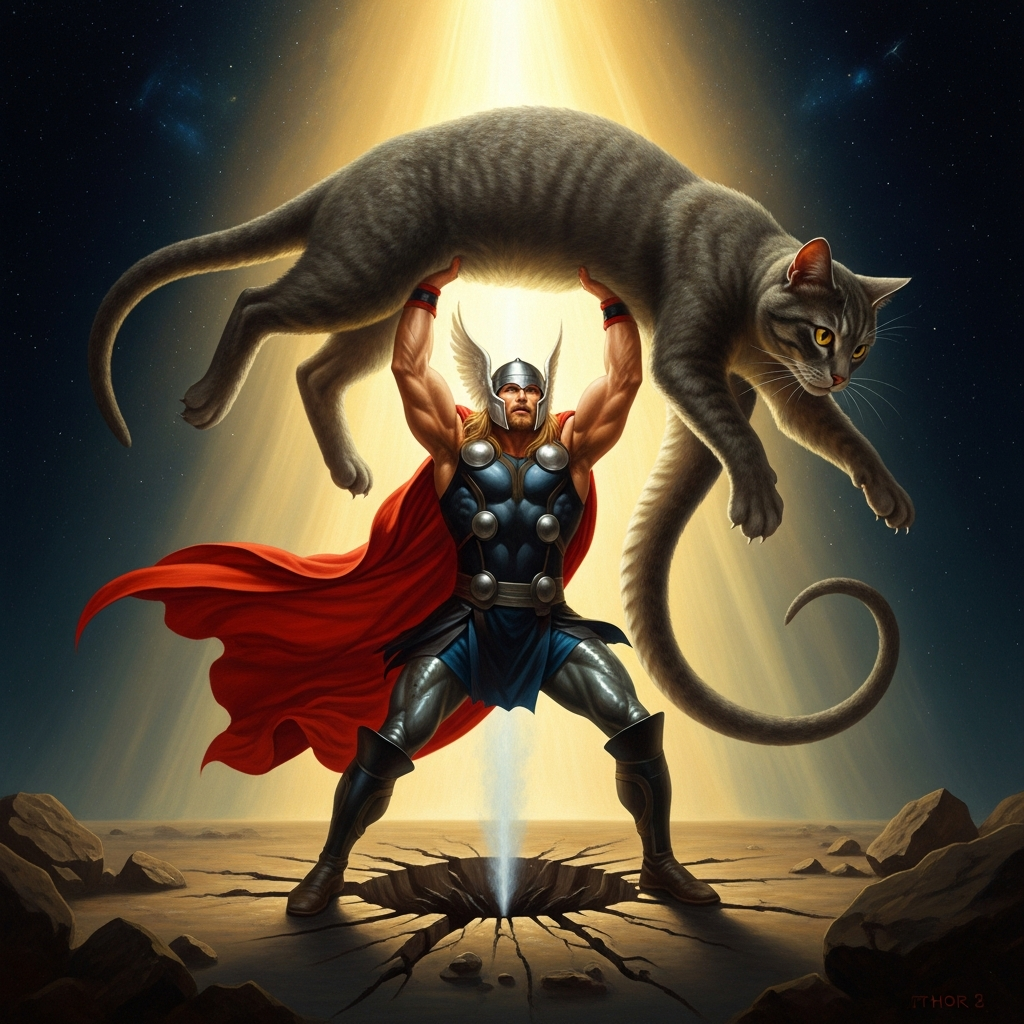
A grey cat slinks across the floor. Lift it, says Útgarðaloki, if you can. Thor reaches under its belly. He braces his legs and pulls. The cat arches its back. The cat does not move. Thor pulls harder; he pulls until his beard creaks and the muscles of his thighs make a sound like cracking wood. Three of the cat’s paws leave the floor. One paw remains. The hall is so quiet Thor can hear his own pulse. Far away, beyond the walls of Utgard, a deep oceanic shudder runs through the bedrock of the world; Thor does not notice it. He lets the cat go. The cat lands soundlessly and walks away.
Wrestle, says Útgarðaloki, almost gently. I will fetch a partner suited to your strength.
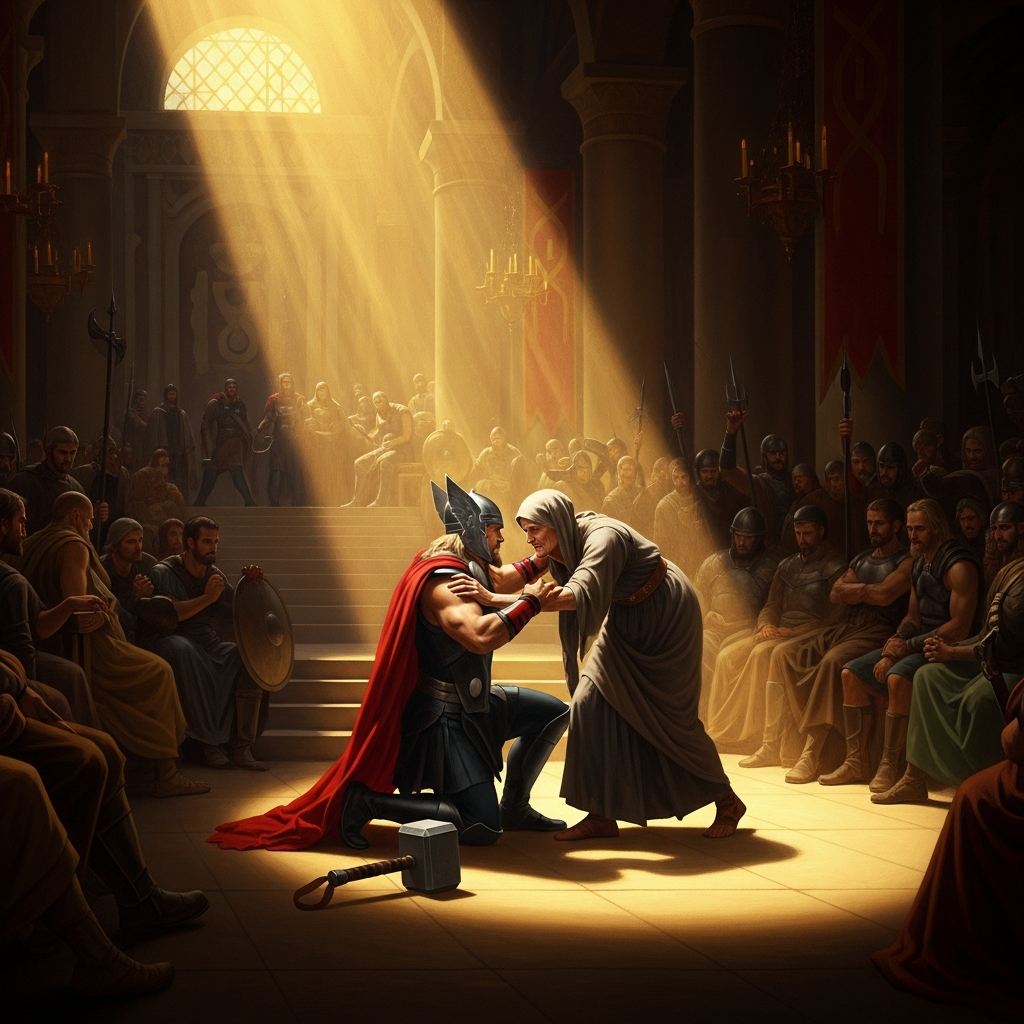
What he fetches is a stooped old woman. Her hair is white. Her eyes are watery. Her name is Elli, and she has been a serving-woman in this hall longer than anyone can remember. Here, says Útgarðaloki. Try her. Thor laughs once, the way men laugh when they think they are being insulted. He grips her shoulders. She grips his. He pushes. She does not move. He pushes harder. She begins, slowly, slowly, to push back — and the strength in her hands is not the strength of any old woman; it is something patient, something inevitable, something that does not strain because it does not need to. Thor’s knee touches the floor. The hall looks away. Útgarðaloki calls the bout.
That night they are fed. They are given beds. In the morning Útgarðaloki himself escorts them to the gate.
He walks them a little way along the road. The fortress is at their backs. The light is pale and grey and the rain has finally stopped.
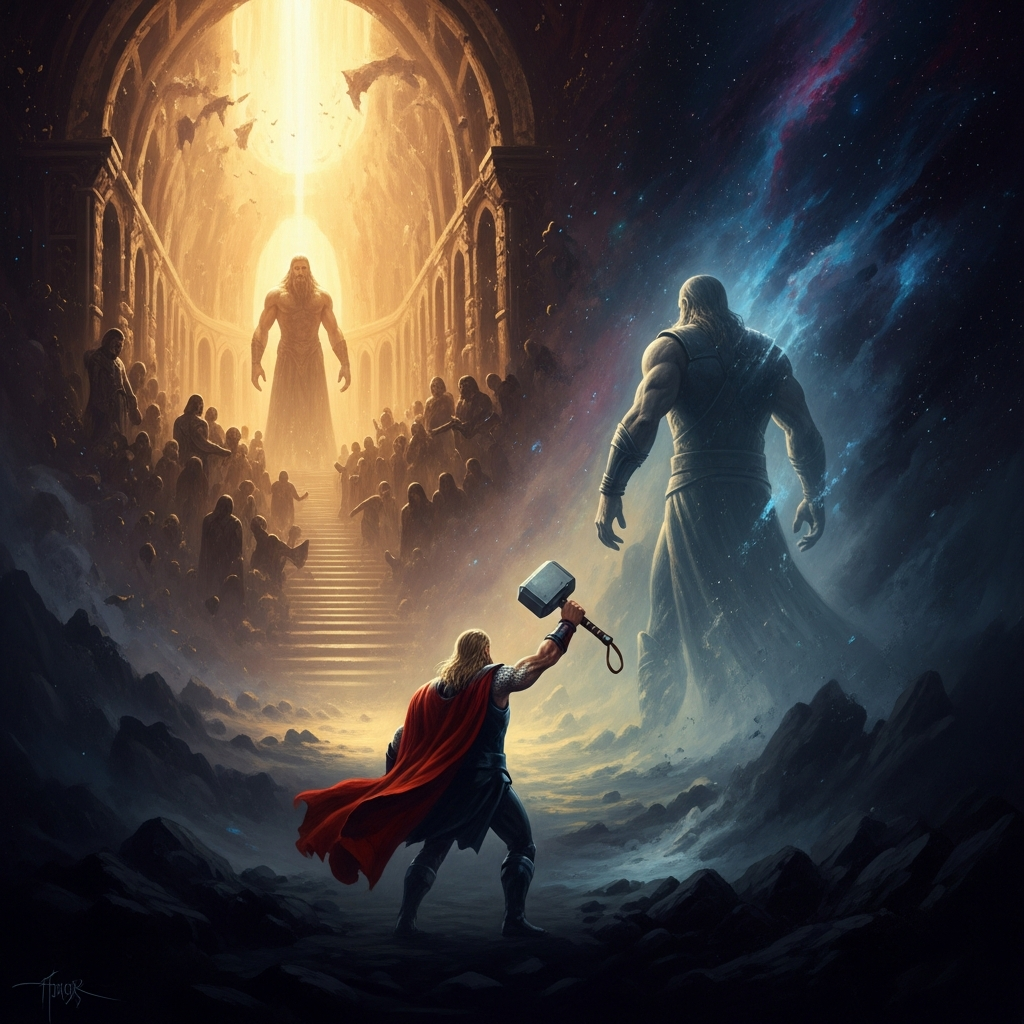
Now, he says, I will tell you the truth, because you are leaving my country and you cannot come back the way you came. The horn you drank from — its other end was in the sea. You did not empty it, no. But the tides will be lower from this day forward, and sailors will speak of an unaccountable shrinking of the ocean, and that is your work, Thor of Ásgarðr. You drank down the sea by three fingers. No one in the nine worlds will ever do as much again.
Thor stops walking.
The cat you tried to lift was the Midgard Serpent. He encircles the world; he bites his own tail in the abyss. When you raised him by even one paw the foundations of creation shook. We were terrified. I have not slept since.
Thor does not speak.
And Elli is Old Age. No one wrestles Old Age and stays standing. No one. That you held her at all is a thing I will not tell my grandchildren, because they would not believe me. You came nearer to undoing my country than any visitor in its history. That is why I deceived you — because if I had let you compete in truth I would have been compelled to kill you, and I do not think I could have killed you, and therefore I had no choice but to make you lose at things you had already won.
Thor’s hand goes to the hammer.
But Útgarðaloki is already gone — and behind Thor, when he turns, there is no fortress and no gate and no walls reaching into the cloud. There is only the long grey moor of Jötunheimr, and a wind, and the rain beginning again.
He stands there a long time.
The first thing the hammer is good for is breaking. The second thing the hammer is good for is being raised. The third thing the hammer is good for, the thing Thor has not yet learned and will spend the rest of the myth-cycle learning, is being lowered — being lowered slowly, deliberately, against the suspicion that the enemy was never the giant in the high seat but the act of measuring oneself in a hall whose walls were already a lie.
Loki, who has watched all of this with an expression Snorri does not describe, says nothing.
They walk west, back toward Midgard, in the rain.
Scenes
Thor, Loki, and the boy Þjálfi arrive at the gates of Utgard in the driving rain
Generating art… Thor lifts the drinking horn for the third time
 Generating art…
 Thor strains to lift what he believes is a grey housecat
 Generating art…
 Thor wrestles a stooped old woman named Elli
 Generating art…
 On the road home, Útgarðaloki turns at the edge of his realm and tells Thor the truth
 Generating art…
 Echoes Across Traditions
Entities


Sources
- Snorri Sturluson, *Prose Edda* (Gylfaginning ch. 44–47), c. 1220 CE
- John Lindow, *Norse Mythology: A Guide to Gods, Heroes, Rituals, and Beliefs* (Oxford, 2001)
- Carolyne Larrington, *The Norse Myths: A Guide to the Gods and Heroes* (Thames & Hudson, 2017)
- Anthony Faulkes (trans.), *Edda* (Everyman, 1995)