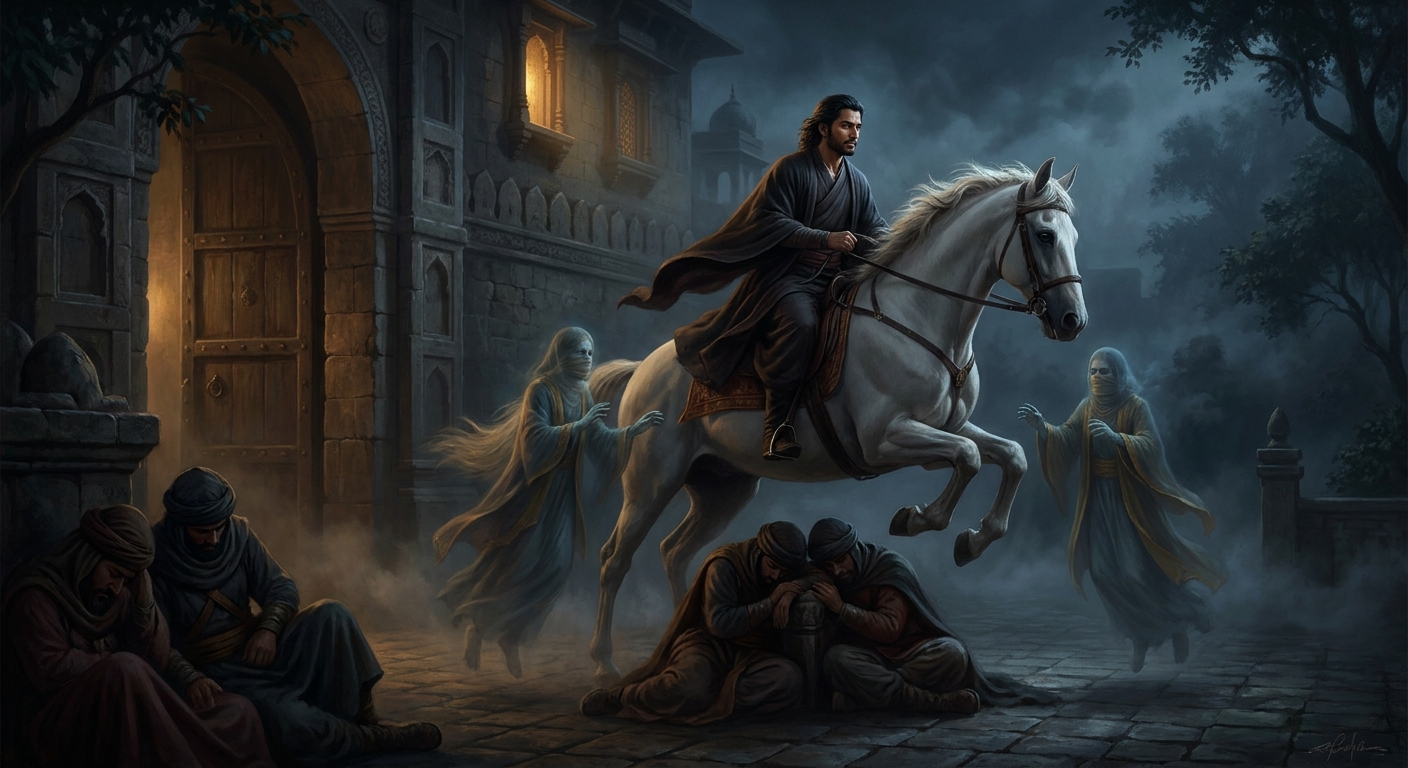
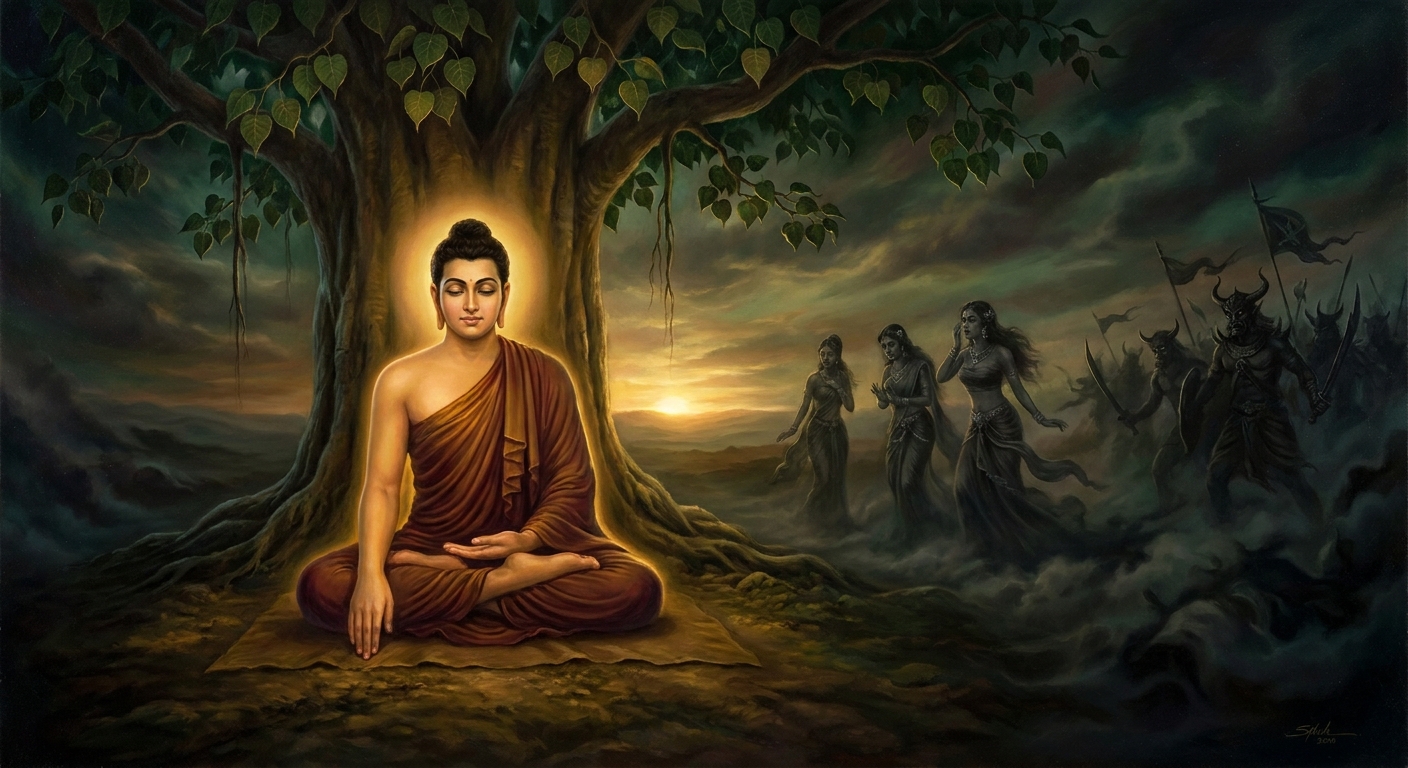
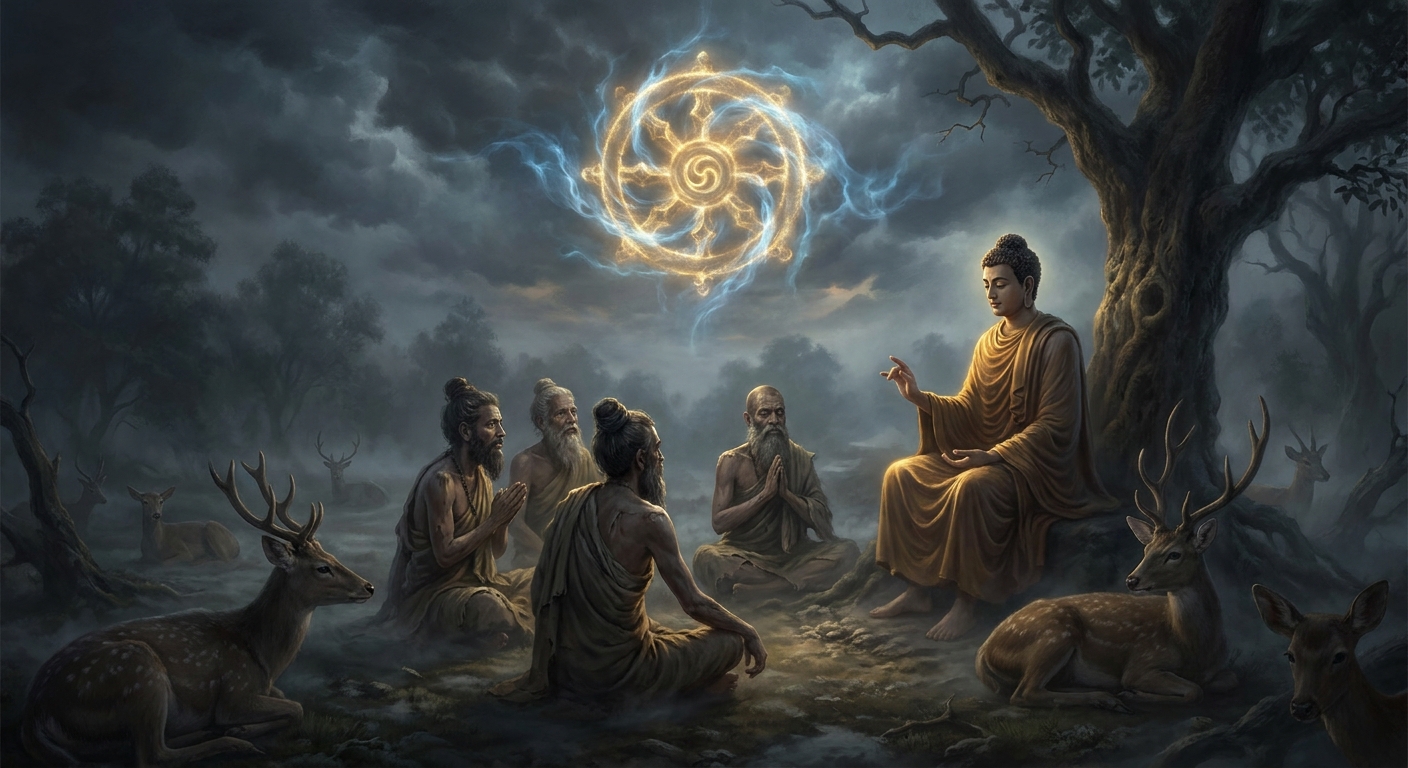
The Descent from Mount Hiei
1201 CE · Mount Hiei → Rokkaku-dō, Kyoto → Yoshimizu hermitage, Kyoto
Contents
A monk who has spent twenty years keeping the precepts perfectly walks down Mount Hiei at forty, admits he has failed at enlightenment, and finds a teacher who tells him that failure is the prerequisite. Shinran founds the largest Buddhist denomination in Japan on this admission.
- When
- 1201 CE
- Where
- Mount Hiei → Rokkaku-dō, Kyoto → Yoshimizu hermitage, Kyoto
He is a child on the mountain.
He enters Mount Hiei at nine years old, in 1181, the second year of the Yōwa era, in the middle of the civil war between the Taira and Minamoto clans that is destroying the old court world. He is sent there by his family — aristocratic but declining, the kind of family that sends sons to monasteries as a form of both piety and strategy. He is given the tonsure by the abbot Jichin. He becomes a monk of the Tendai school at the Mudō-ji compound, in a tradition that traces itself back to Saichō, the monk who brought Tendai from China four centuries earlier and built the first hall on Hiei in 788.
He is serious. He is gifted. He is miserable in the particular way of gifted serious people who have chosen the right path and cannot make it work.
Hiei is the center of Japanese Buddhist learning and the center of Japanese Buddhist ambition.
The monastery complex covers several peaks. The great Konpon Chū-dō hall houses the flame that Saichō lit and that has not gone out in four hundred years — the fumetsu no hōtō, the undying dharma lamp. The library contains everything that has been brought from China across five centuries of state-sponsored Buddhist importation. The Tendai training combines liturgy, esoteric ritual, doctrinal scholarship, and meditation in a curriculum designed to produce, at its apex, a practitioner capable of realizing the hongaku, the innate buddha-nature that Tendai doctrine asserts is present in every sentient being.
Shinran studies all of it. He keeps the precepts. He rises for the pre-dawn meditation. He observes the Tendai calendar with precision. He studies the Lotus Sutra and the Mahāparinirvāṇa Sūtra and the Awakening of Faith and the great commentaries of Zhiyi and Jizang. He advances through the monastic ranks.
He cannot produce the bodaishin — the awakened mind, the opening of the path. He does the practice. He waits. He continues the practice. He waits more. Twenty years pass this way.
By 1201 he is forty-eight years old — the records say twenty years since his ordination, which places his entry at twenty-eight rather than nine, but the tradition is disputed and the emotional truth is the same regardless of the arithmetic. He has been on the mountain long enough to know the mountain’s limits. He knows what the precepts produce in him: discipline. Rigor. Self-knowledge. He knows what they do not produce: enlightenment. He knows this not abstractly but as the most concrete fact in his life. He has checked. Many times. The bottom of the practice is not the buddha-nature. The bottom of the practice is him, still himself, still wanting, still afraid, still unable to generate a single moment of mind that is not contaminated by self-concern.
He considers this failure for some time. Then he goes down the mountain.
He does not go directly to Hōnen.
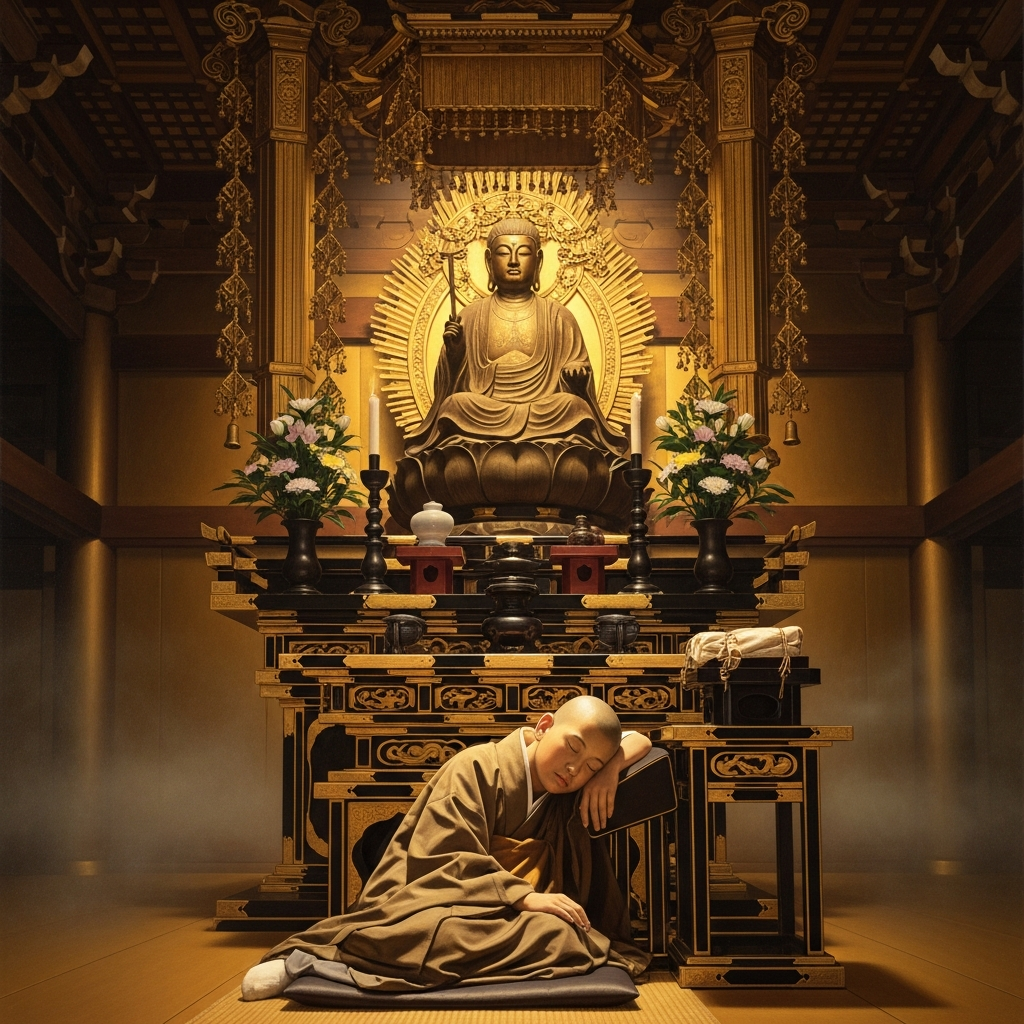
He goes first to Rokkaku-dō — the Hexagonal Hall, a small Shingon temple in the center of Kyoto associated with Prince Shōtoku, the seventh-century regent who had done more than anyone to establish Buddhism in Japan. Shinran sleeps before the altar for a hundred days. He is not sure what he is asking. He is asking the spirit of Shōtoku, or the bodhisattva Avalokiteśvara who is enshrined there, or whatever intelligence might be available in that cold hall, for some indication of where to go when you have failed the path.
On the ninety-fifth day, just before dawn, he receives it.
He dreams of Prince Shōtoku as a white-robed figure who speaks to him directly: if karmic obstacles prevent you from reaching a woman when you desire her, I will become a beautiful woman and be your companion in this life. At the time of death I will guide you to the Pure Land. The dream is strange — erotic in its surface content, eschatological in its meaning — and Shinran will spend years interpreting it. What it tells him, in the morning light of the ninety-sixth day, is clear enough: go to Hōnen.
He has heard of Hōnen. Everyone in Kyoto has heard of Hōnen — the Tendai scholar who walked down from Hiei twenty-six years before and set up a hermitage at Yoshimizu, in the hills east of the city, and began teaching the nembutsu to farmers and prostitutes and lepers. The established schools regard Hōnen with the mixture of respect and alarm that institutions reserve for people who have taken their central premise and followed it somewhere the institution cannot follow.
Shinran walks to Yoshimizu in the spring of 1201.
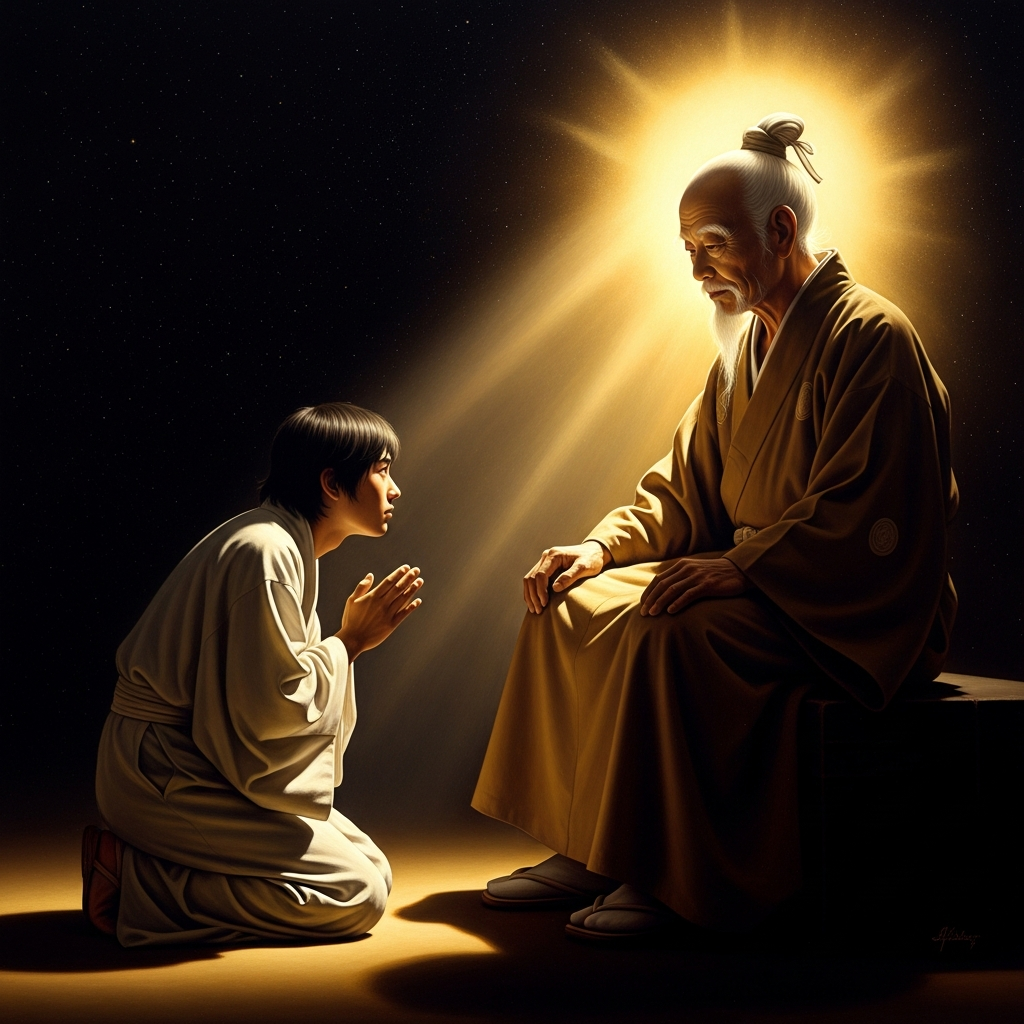
He is shown into the small hall where Hōnen receives students. The old teacher is sixty-eight. He has been teaching the nembutsu for twenty-six years. He has spent those years being warned, threatened, petitioned, and occasionally petitioned by the authorities to stop, and he has continued, because the logic of the nembutsu does not leave room for stopping. Amida Buddha vowed to save every being who calls his name. The vow is the prior condition; the practice is the response to what has already been promised.
Shinran prostrates himself before Hōnen and speaks plainly: I have kept the Tendai precepts for twenty years. I cannot produce the awakened mind. I am not capable of enlightenment by my own power. What is there for someone like me?
Hōnen looks at him for a moment. He is not surprised by this; it is more or less what he has been saying to everyone who comes to him. But Shinran is not a farmer or a prostitute or a soldier. He is a Tendai monk who has done everything correctly. His failure is not the failure of someone who lacked the resources to attempt the path. It is the failure of someone who had every resource and walked the path to its end and found no enlightenment there.
Say the name, Hōnen tells him. Namu Amida Butsu. Amida’s vow is the prior promise. Your failure does not disqualify you. Your failure is the very reason the vow was made.
Shinran becomes Hōnen’s student that day.
He stays at Yoshimizu for six years. He absorbs the nembutsu teaching completely. And then he does something no Tendai monk should do: he marries. He takes a wife — Eshinni, the daughter of a provincial official — and they have children. He eats meat. He abandons the precepts not carelessly but as a theological position: if salvation is the gift of Amida’s Other Power (tariki) and not the product of his own self-power (jiriki), then the monastic precepts are a kind of elaborate insistence on the self-power he no longer believes in. To keep them would be to suggest they mattered. He lets them go.
He is exiled from Kyoto in 1207, when the retired emperor Go-Toba cracks down on Hōnen’s movement. He goes to Echigo province, on the Sea of Japan coast, and lives among ordinary people for the next twenty years. He teaches them the nembutsu. He refers to himself not as a monk or a layman but as Gutoku — the foolish baldy, the shaved head who is too foolish for monastic virtue and too honest for lay life. He inhabits the categorical in-between as a theological demonstration: if the dharma is truly for everyone, it must be for the person who fits nowhere.
His key reversal — the line that will define Jōdo Shinshū and scandalize commentators for seven hundred years — comes in the Tannishō, compiled by his student Yuien from his oral teachings: Even a good person can attain birth in the Pure Land, so it goes without saying that an evil person will. The bad man is more qualified than the good man, because the bad man has no illusion that his own goodness is sufficient. He knows he needs Amida. The good man may still be secretly relying on himself.
He lives to eighty-nine. He returns to Kyoto in his sixties and continues to write and teach. His daughter Kakushinni preserves his grave and eventually founds the institution that will become Hongan-ji — the central temple of Jōdo Shinshū, which now has approximately 10 million members in Japan and missions across the world.
The theology that begins on Mount Hiei with a monk who cannot make the practice work, who goes down the mountain and says so, is still the largest Buddhist school in the country where it began.
Shinran’s revolution is the revolution of the man who fails honestly. He could have continued at Mount Hiei. He had the rank, the learning, the institutional standing to continue keeping the precepts and living the life of a successful Tendai monk, his inner desolation invisible to the outside. He chose not to. He chose to go down the mountain and say what was true: I cannot do this by myself.
The theology that follows is built entirely on that admission. The Other Power — tariki — is not the lazy option. It is the option that opens when the self-power option has been genuinely exhausted. You cannot fake your way into tariki. You have to actually fail at jiriki first, completely, with nowhere left to go.
He walked down the mountain. He admitted the failure. He married, ate meat, called himself the foolish baldy, and built the largest Buddhist denomination in Japan. The descent was the teaching.
Scenes
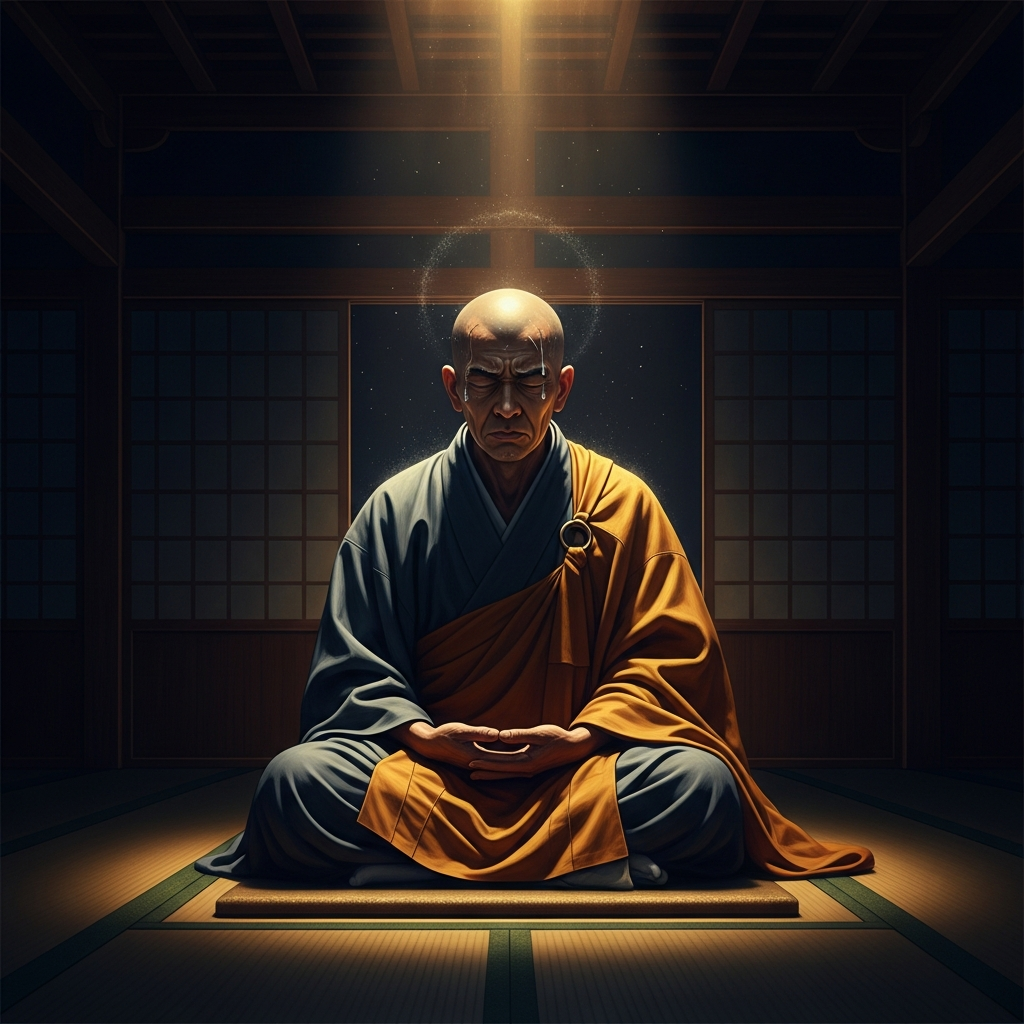
Mount Hiei
 Generating art…
 Rokkaku-dō, Kyoto
 Generating art…
 Yoshimizu, 1201
 Generating art…
 Echoes Across Traditions
Entities
- Shinran
- Hōnen
- Amida Buddha
Sources
- Shinran, *Tannishō* (compiled c. 1288 by Yuien)
- Shinran, *Kyōgyōshinshō* (1224)
- Dennis Hirota (trans.), *Tannishō: A Primer* (1982)
- Alfred Bloom, *Shinran's Gospel of Pure Grace* (1965)
- Mark Blum, *The Origins and Development of Pure Land Buddhism* (2002)