Tangaroa Expands Himself into the World
Before time — the primordial void before the world existed · Te Kore — the void; the darkness before darkness
Contents
In the absolute void before time, Tangaroa — the Polynesian god of the sea — exists alone inside a shell. He cracks it open from the inside and becomes the world: his shell becomes rock, his spine becomes the mountains, his flesh becomes earth and forest and the bodies of living things. The Samoan, Tongan, and Tahitian traditions each preserve a different account of what was inside the shell and what came out first.
- When
- Before time — the primordial void before the world existed
- Where
- Te Kore — the void; the darkness before darkness
There is no before in the usual sense.
There is no before because there is no time, and there is no time because there is no change, and there is no change because there is nothing to change. The Polynesian tradition names the levels of nothingness with the rigor that other traditions reserve for taxonomies of angels: Te Kore, the void; Te Kore-tua-kore, the void beyond the void; Te Kore-i-ai, the void in which there is nothing. There are nine or twelve or more layers of nothingness depending on which lineage of chanters you ask, because the people who thought about this seriously understood that nothing is not simple. Absence has gradations.
In this graduated nothing, there is Tangaroa.
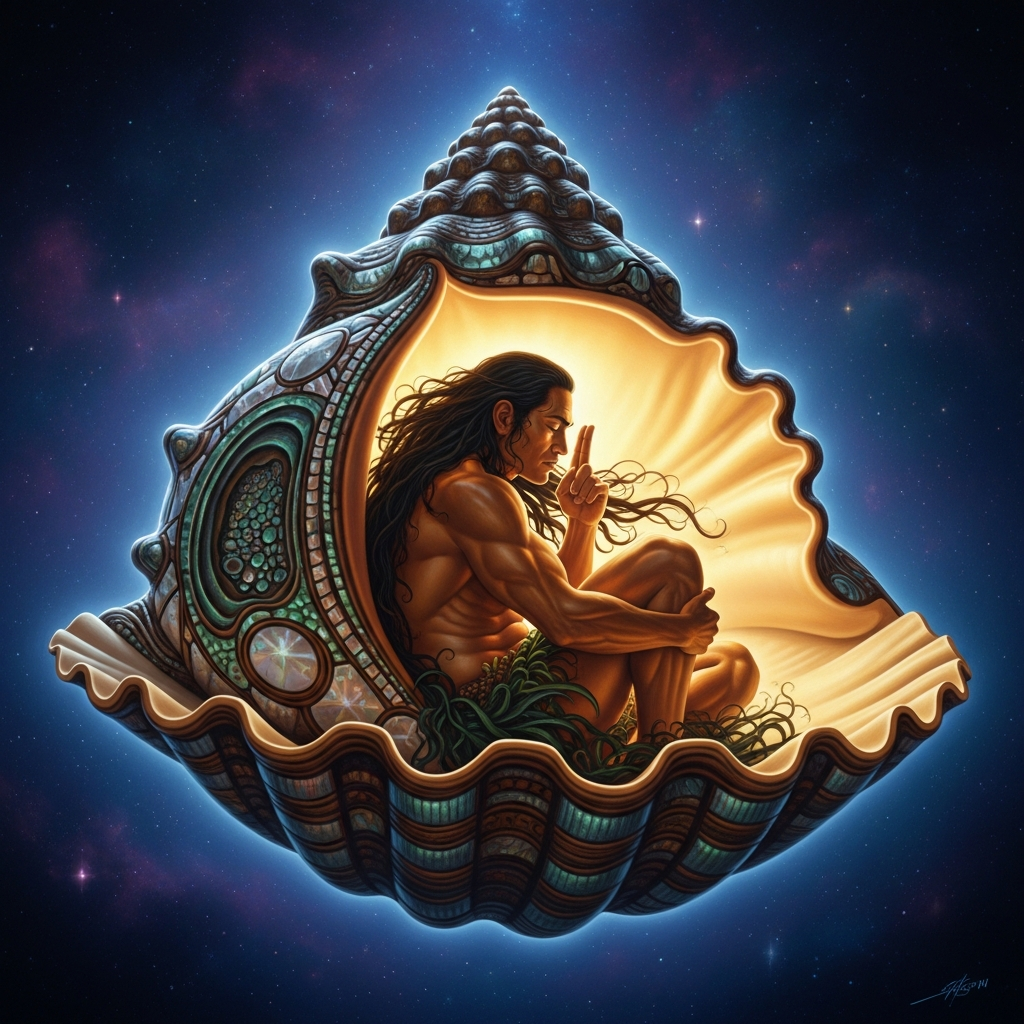
He is inside a shell. The shell is curved and closed and the only bounded space in all of what does not yet exist. He has been there for what would be a long time if time existed. He is not asleep. He is not bored. He simply is, the way a god who has not yet decided to create anything simply is — fully himself, fully present, with nothing outside him to be present to.
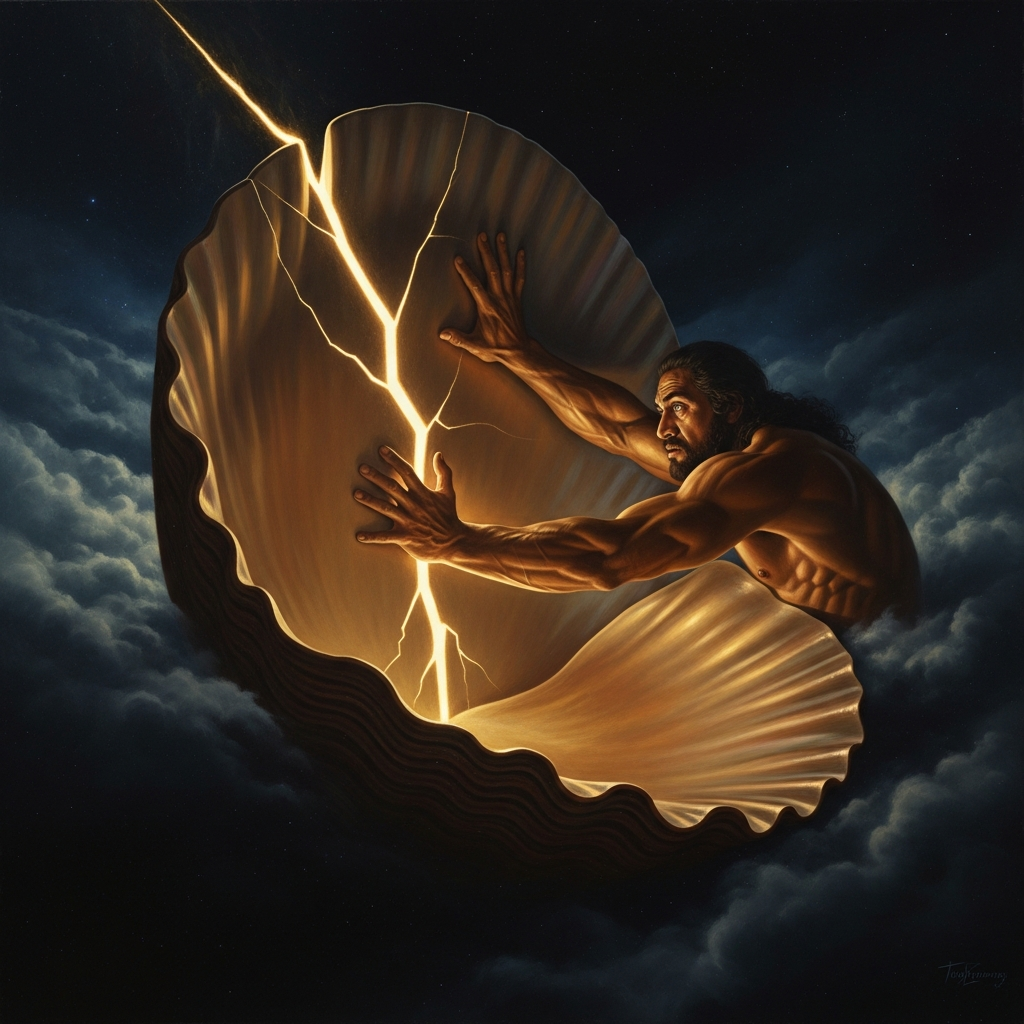
He listens. There is nothing to hear. He turns in the shell. He presses his hands against the interior wall and feels the curve of it.
He pushes.
The Tahitian tradition, recorded from the Raaiatea priestly lineage, is the most precise about what he finds when he pushes.
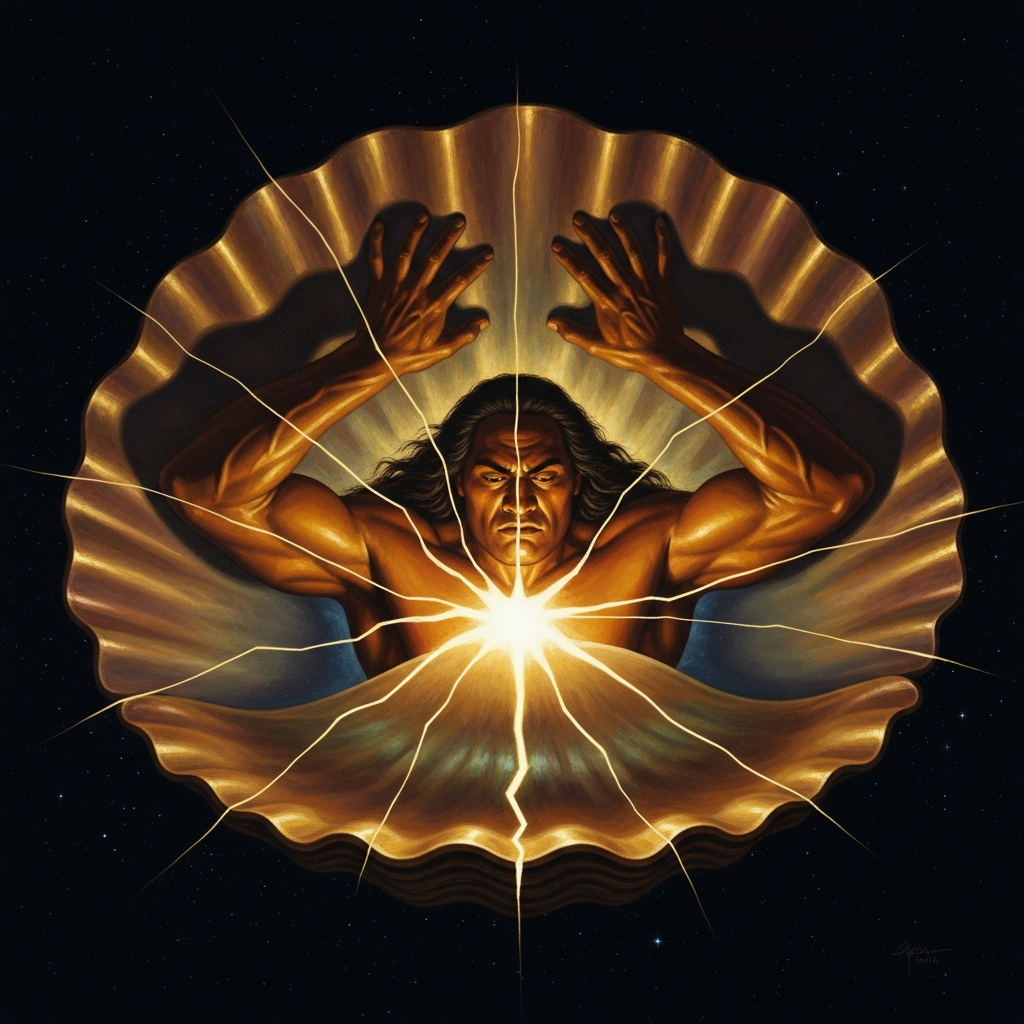
The shell cracks along a single line from one pole to the other. Light enters — not sunlight, not fire, but the light that is simply the opposite of the absolute dark of the inside of the shell, a light that comes from the crack itself, from the fact of an opening in what had been sealed. He holds the halves apart and looks out at what is there.
There is nothing out there. The shell has not been sitting on anything. It has been floating in the void the way an egg floats in still water, except without the water. But the pieces of shell that fall from his hands as he opens it — they do not float. They fall. And where they fall, they accumulate. They thicken. They press against each other and find that the void receives pressure and responds to weight by becoming denser, harder, a surface.
The shell-pieces become rock. This is the first geology. The largest shards become the foundations of islands; the smaller ones become rubble, gravel, sand. The finest dust settles into the low places and will one day mix with water to become soil. Tangaroa stands on a floor made of his own former skin and looks out at the void that still fills every other direction.
The Samoan tradition, in which Tangaroa is called Tagaloa, says that he stood on this rock and the rock was Te Fatu, the Rock, and before the rock there was nothing firm anywhere. It is a simpler story than the Tahitian one and perhaps older — the Samoans are among the earliest Polynesian peoples to have settled the Pacific, and their version may preserve something of the theology before it elaborated itself into the many-layered cosmology of later traditions.
The Tongan version says that Tagaloa sent a bird.
In this account, there is already water — the void has a different texture, already fluid — and Tagaloa sends a bird called Tuli to find something solid in it. The bird finds nothing, flies back, and Tagaloa throws worms into the water. The worms grow into earth. This is the least self-sufficient of the Tangaroa creation myths: the god uses external material, employs an agent, operates on the world from outside rather than becoming it. The Tongan version has its own elegance — the worm as the basic unit of soil, the mundane creature as the foundation of the physical world — but it lacks the philosophical radicalism of the Tahitian account.
The Tahitian account does not allow Tangaroa an outside perspective. He is not watching the world form. He is what the world is forming from.
Having used the shell, he reaches inside himself.
What remains after the shell is the interior of a god: the soft material, the flesh, the substance that was enclosed by what has now become rock. He draws it out with his hands. The Raaiatea texts say this with a directness that is difficult to paraphrase: he reaches in and takes out what is there, and what is there is the matter of a god, and he holds it in the light from the crack and it does not die.
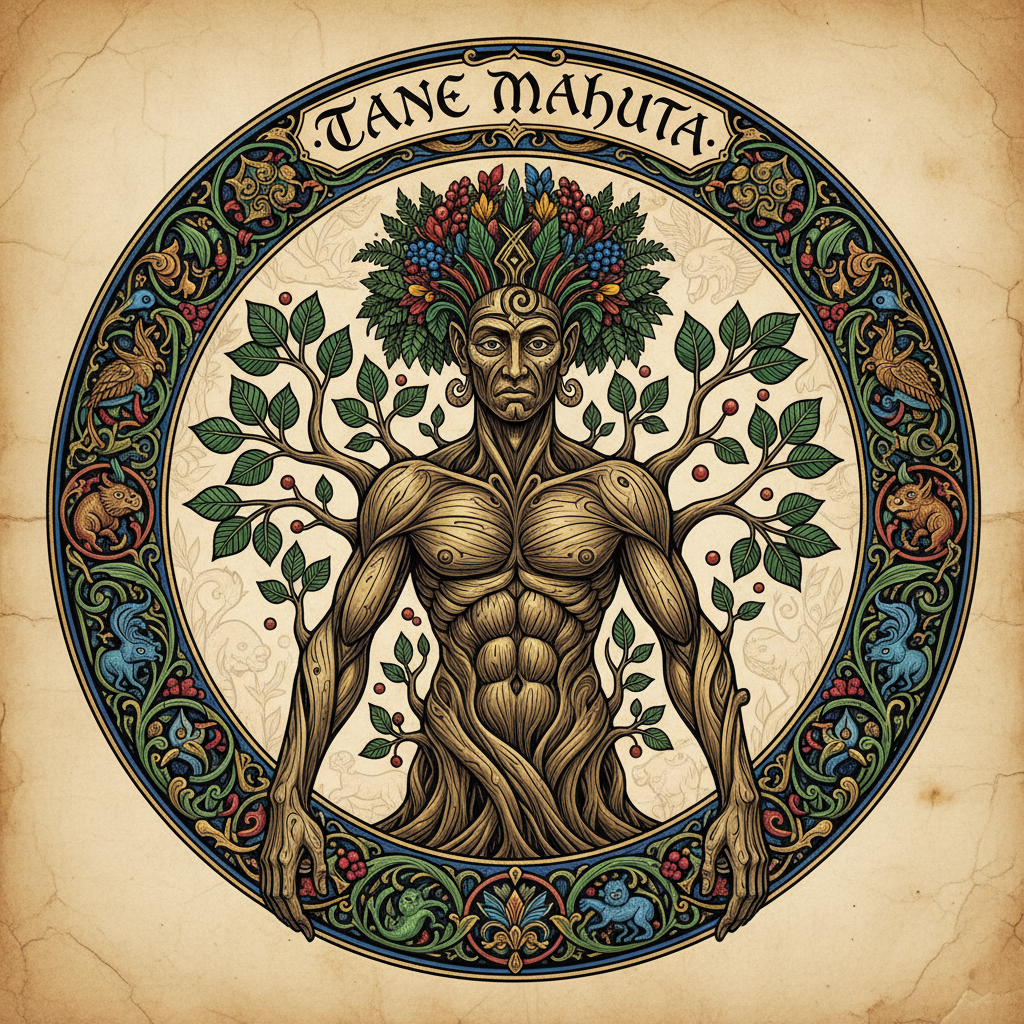
It grows instead. It reaches downward into the rock-floor as roots. It reaches upward toward the light as stems. The interior of Tangaroa differentiates as it grows: this part becomes the trunk of a breadfruit tree, this part the leaves of a taro plant, this part the first grass spreading across the flat rock where there is enough moisture to sustain it. Tane — the force of upward growth, the principle that makes things seek light — is in the flesh already, and Tane shapes it into the forest, into the specific forms of trees and the spaces between trees.
The flesh that moves sideways along the rock becomes lizards. The flesh that finds the water pooling in the low places becomes fish. The flesh that lifts into the air becomes birds — the first birds, with no forest yet to land in, circling the new rock in the morning light.
The gods come from the remainder.
After the forest and the birds and the fish, there is still something left — a divine surplus, a residue of consciousness that cannot become merely organic. Tane is already shaping the trees. Rongo is in the root-vegetables, the taro and yam, the foods that will sustain the human beings who do not yet exist. Tu is in the tension of sinew, in the density of bone.
They are not separate beings who emerge from Tangaroa. They are Tangaroa’s specializations — the parts of his interior that, once given to particular aspects of the world, developed their own names and characters and preferences. He did not create them as a craftsman creates objects. He became them as a body becomes its organs.
What remains after this total giving-away is the sea.
The sea is what Tangaroa is when everything else has been given. His blood, the Tahitian tradition says, became the water of the ocean. His breath became the vapor above it. He does not stand over the sea and command it. He is the sea, and the sea is what is left of him after the world has taken everything else. When the tide comes in, it comes in because Tangaroa is breathing. When a storm raises the swells, it is Tangaroa thinking about something.
The three major versions of the Tangaroa creation myth — Tahitian, Samoan, Tongan — probably reflect three stages of a single theology that developed as Polynesian peoples spread across the Pacific. The most philosophically elaborate version is Tahitian, recorded by Teuira Henry from Raaiatea priestly lineages in the late nineteenth century. The Samoan and Tongan versions preserve simpler frameworks that may be older.
What all three share is the primacy of Tangaroa and the identification of the sea-god with the generative void. In later Polynesian theology, Tane often becomes more prominent — he is the father of human beings in many traditions, the god who shapes them from earth — but Tane exists only because Tangaroa gave his flesh to the world. The god of trees and people is made from the body of the god of the sea.
The ocean is not, in this theology, a thing that Tangaroa rules. It is what he is. Polynesian navigators who spent weeks on the open water were not crossing the territory of a god. They were moving through the body of their ancestor, reading its moods the way a physician reads a patient’s breathing — carefully, respectfully, understanding that the body they depended on was under no obligation to keep them alive.
Scenes
Tangaroa inside his shell in the void — not darkness exactly but the absence of space itself, the god curled inside the only thing that exists, listening to nothing
 Generating art…
 The first fracture — Tangaroa pressing his hands against the inner wall of the shell, the crack splitting along the curved surface, light coming in from somewhere there was no somewhere before
 Generating art…
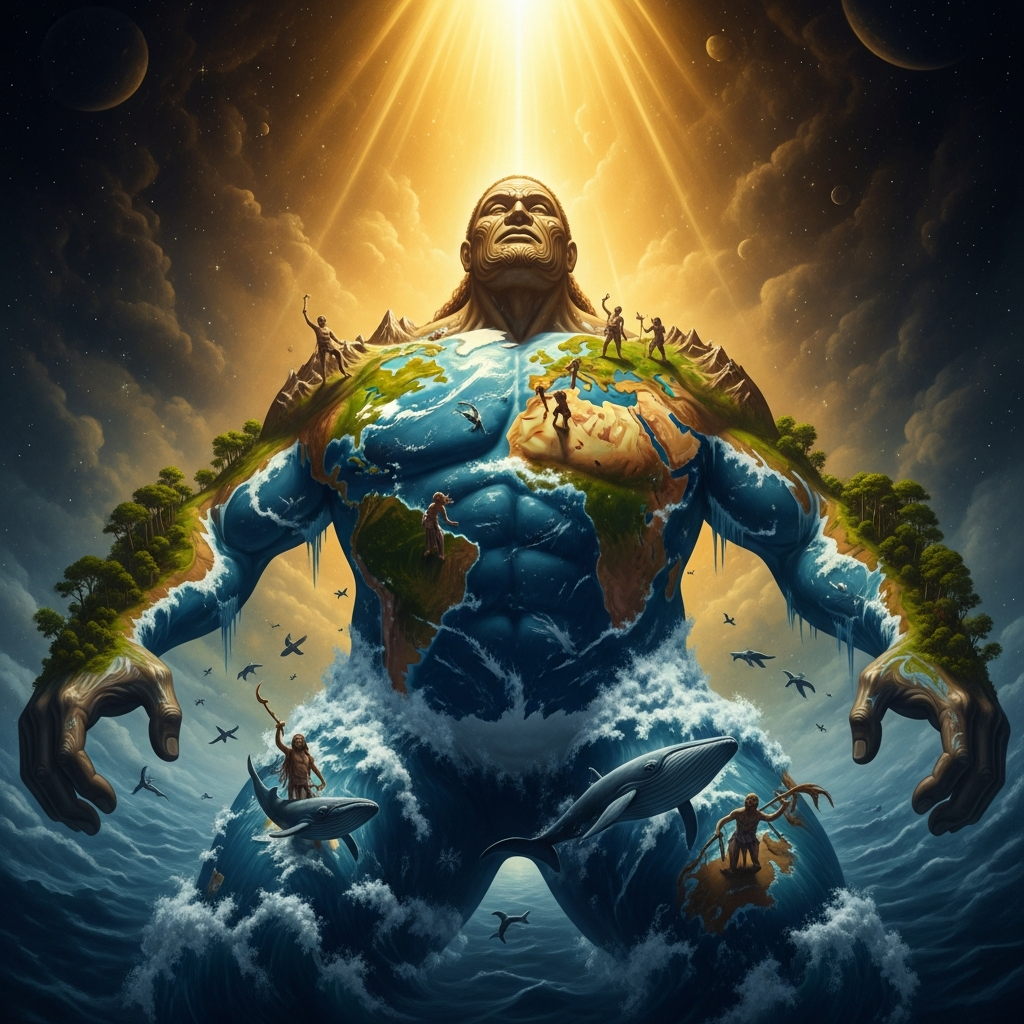
 The world assembled from Tangaroa's body — mountains where his spine was, forests where his flesh took root, the sea filling the low places with what was once his blood
 Generating art…
 Echoes Across Traditions
Entities
- Tangaroa
- Te Kore
- Tane
- Tagaloa
- Tangaloa

Sources
- Teuira Henry, *Ancient Tahiti* (1928) — the Raaiatea creation texts, the fullest surviving written record of Tangaroa's cosmogony
- E.S. Craighill Handy, *Polynesian Religion* (1927)
- George Turner, *Samoa: A Hundred Years Ago and Long Before* (1884) — Tagaloa traditions
- Patrick V. Kirch, *On the Road of the Winds: An Archaeological History of the Pacific Islands* (2000)
- Martha Beckwith, *Hawaiian Mythology* (1940), ch. 3 — comparative Polynesian creation accounts