Sigurd Kills the Dragon and Learns to Hear the Birds
Mythic time (recorded in *Völsunga saga* c. 1200–1270 CE; also in *Fáfnismál*, *Poetic Edda*) · Gnitaheiðr (the Gnita-heath) — the moorland where Fáfnir has coiled on his gold for generations
Contents
Sigurd, raised by the smith Regin to be the instrument of Regin's revenge, digs a pit on the Gnita-heath and waits beneath the path of the dragon Fáfnir. He drives the sword Gram up through the soft belly. Dying, the dragon tells him the gold is cursed and will be his death. Sigurd ignores the warning. He tastes the dragon's blood and suddenly hears the birds — and the birds are telling him that Regin is about to kill him for the gold. He kills Regin. He takes the gold. The doom the dragon named is already moving.
- When
- Mythic time (recorded in *Völsunga saga* c. 1200–1270 CE; also in *Fáfnismál*, *Poetic Edda*)
- Where
- Gnitaheiðr (the Gnita-heath) — the moorland where Fáfnir has coiled on his gold for generations
Before the dragon, there is the smith.
His name is Regin and he is older than he looks. Younger Sigurd does not yet know how much older. Regin runs the underground forge of King Hjálprek’s hall, where Sigurd has been raised since his father Sigmund died on the battlefield, and Regin’s hands are scarred from a thousand fires and his eyes are the strange yellow eyes that mortals do not have. He is the foster-father. He has been raising Sigurd carefully. He has been raising Sigurd for a purpose. Tonight, in the forge, Regin finally tells Sigurd what the purpose is.
I had two brothers, Regin says. Otr and Fáfnir. We were three sons of the wizard Hreidmar. Otr could shape-shift into an otter and fish in the waterfalls. One day Otr was killed by a careless god — Loki, you may have heard of him — and the gods had to ransom his life. They paid in gold. The gold they paid was Ándvari’s gold, taken from a dwarf who had hoarded it in a cave behind a waterfall, and Ándvari cursed every coin and ring of it as it left his hands.
The cursed gold killed my father, Regin says. Fáfnir killed him. Fáfnir killed our father in his sleep, with our father’s own knife, because the gold was that beautiful and the curse was that fast. Then Fáfnir took the gold to the heath at Gnitaheiðr and lay down on it. He lay down on it for a long time. He has been lying on it for years. He is no longer a man. He is something else now. The curse has changed him into the shape of his desire. He is a serpent. He is enormous. And he is my brother, and he stole what should have been mine, and I am too old to kill him myself.
Regin looks up from the anvil.
That is what you are for, he says.
Sigurd is twelve years old. Or fifteen. The sources disagree. He looks at the smith for a long time. Then he says: Reforge my father’s sword.
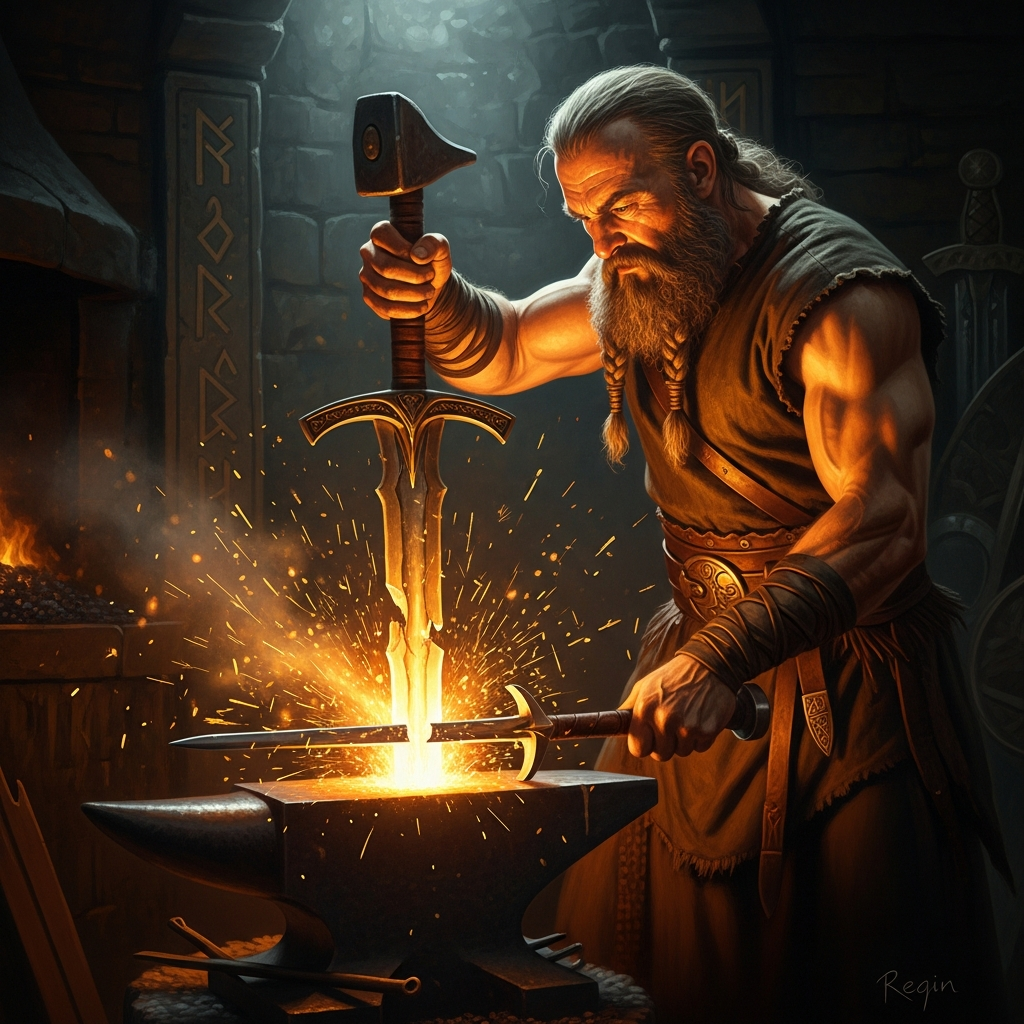
The reforging of Gram takes three days and three nights.
Sigmund’s sword had been shattered on the battlefield where Sigmund died, and the broken pieces had been carried home by his widow Hjördís, and Hjördís had given them to the smith with the understanding that one day they would be needed. The day has arrived. Regin lays the fragments on the anvil and works them. The first time he forges Gram, Sigurd takes the blade and strikes the anvil with it and the blade breaks. Regin sweats. He forges it again. Sigurd strikes the anvil. The blade breaks. Regin says nothing. He forges it a third time, and this time he draws on something he has not previously drawn on — perhaps the gold-knowledge he learned from his father before Fáfnir killed him, perhaps the wizardry that runs in his blood — and the third Gram is so sharp that when Sigurd lays a tuft of wool in the river and the current floats it onto the edge of the blade, the wool falls in two halves without resistance. The sword is finished. The smith has done his part.
The smith now requires the hero to do his.
Gnitaheiðr is grey and treeless and the wind never stops. Sigurd rides up onto the moor in the early morning. He has come alone — Regin has refused to come, because Regin does not want to face his brother and because Regin has another reason that Sigurd has not yet been told about. Sigurd ties his horse Grani to a stone and walks the heath.
He finds the path the dragon uses. Fáfnir leaves the gold every morning to drink at a hidden spring; the path is worn deep into the heather by centuries of the same passage. Sigurd takes a spade from his pack. He digs.
He digs a pit across the path, deep enough that he can lie in it on his back with his sword pointed up. The dragon will pass over the pit; the dragon’s soft belly will pass directly above his blade; the dragon’s own weight will drive Gram up through scale and gut and heart. It is not a strategy a hero of Greek song would have adopted. It is a strategy Sigurd adopts because Regin, who is a smith and not a poet, has explained that bravery is what you have for the parts of the plan that geometry cannot solve.
He lies down in the pit.
He waits.
The shadow comes first. Long before the sound, long before the smell, the daylight on the wall of the pit goes dim, then dimmer, then absolutely dark, and the moor above him is being eclipsed by something enormous moving slowly along its grooved path. He hears the breathing then, the slow steam-engine breathing of the great body, and he hears the scraping of belly-scales over flint, and the smell hits him — copper and meat and something else, something that smells like cursed gold smells, a smell that is also a sensation in the back of the throat. Above him passes a darkness so complete he cannot see his own hand on the hilt. He feels the soft underside slide over the lip of the pit. He drives Gram up.
He drives it up with everything in his body. The sword goes in to the hilt. The dragon’s weight pushes the blade in further than his arms could ever have pushed it. Hot blood pours into the pit. Sigurd lies in the dark in a flood of it and he cannot let go of the sword and he cannot move because the body has stopped directly above him and the body is shuddering and the body is collapsing.
He waits until the shuddering stops.
He climbs out of the pit covered in blood that is not his.
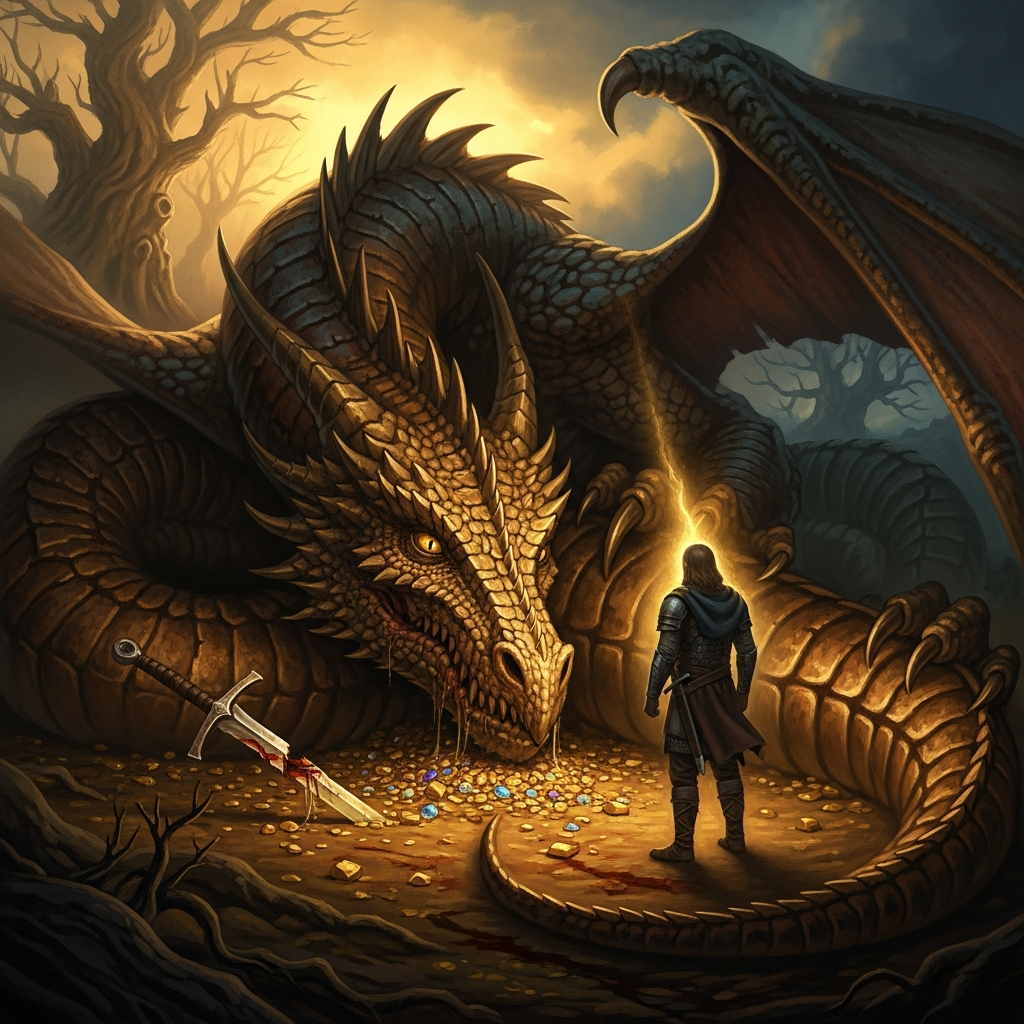
Fáfnir is dying on the heath.
His body is a long heaped ridge of dark coils. His head — his enormous slow head, scaled and antlered, jaws still working — has been laid on the ground. His eyes are open. His eyes are watching Sigurd, and his eyes are not the eyes of a beast. They are still, faintly, the eyes of his brother’s son’s foster-father’s brother. They are still, faintly, the eyes of a man who killed his father in his sleep and lay down on a pile of cursed gold and forgot how to leave it.
Who sent you? Fáfnir says. His voice is wet.
Sigurd does not answer at first. He is not sure why he does not answer. Then he answers: I came on my own.
The dragon’s eyes narrow. No. The boy who came on his own does not exist. You were sent. Was it Regin?
Yes.
Of course it was Regin. The dragon laughs, which is a sound Sigurd will remember for the rest of his life. Regin will kill you next. You know that. He has been raising you to kill me, and once I am dead he will kill you, because he wants the gold. The gold is cursed, boy. The dwarf Ándvari cursed every coin of it before he gave it up. It killed our father. It made me what I am. It will kill you if you take a single piece of it from this heath.
Sigurd does not speak.
Leave it, says Fáfnir. Leave it and ride.
But Sigurd is twelve, or fifteen, and Sigurd has come a long way, and Sigurd has lain in a pit under the weight of a god-killing carcass with the smell of cursed metal in his throat, and Sigurd is not going to leave the gold. Fáfnir sees him not move. Fáfnir closes his eyes.
Then you are already dead, says the dragon, and only the dates have not been fixed.
He dies.
Regin appears now, as if he has been watching from behind a stone the whole time, which he has been. Regin walks across the heath toward the carcass with an expression Sigurd cannot read. Regin says: Cut out the heart. Roast it for me. I will eat it. I am his brother and I have the right.
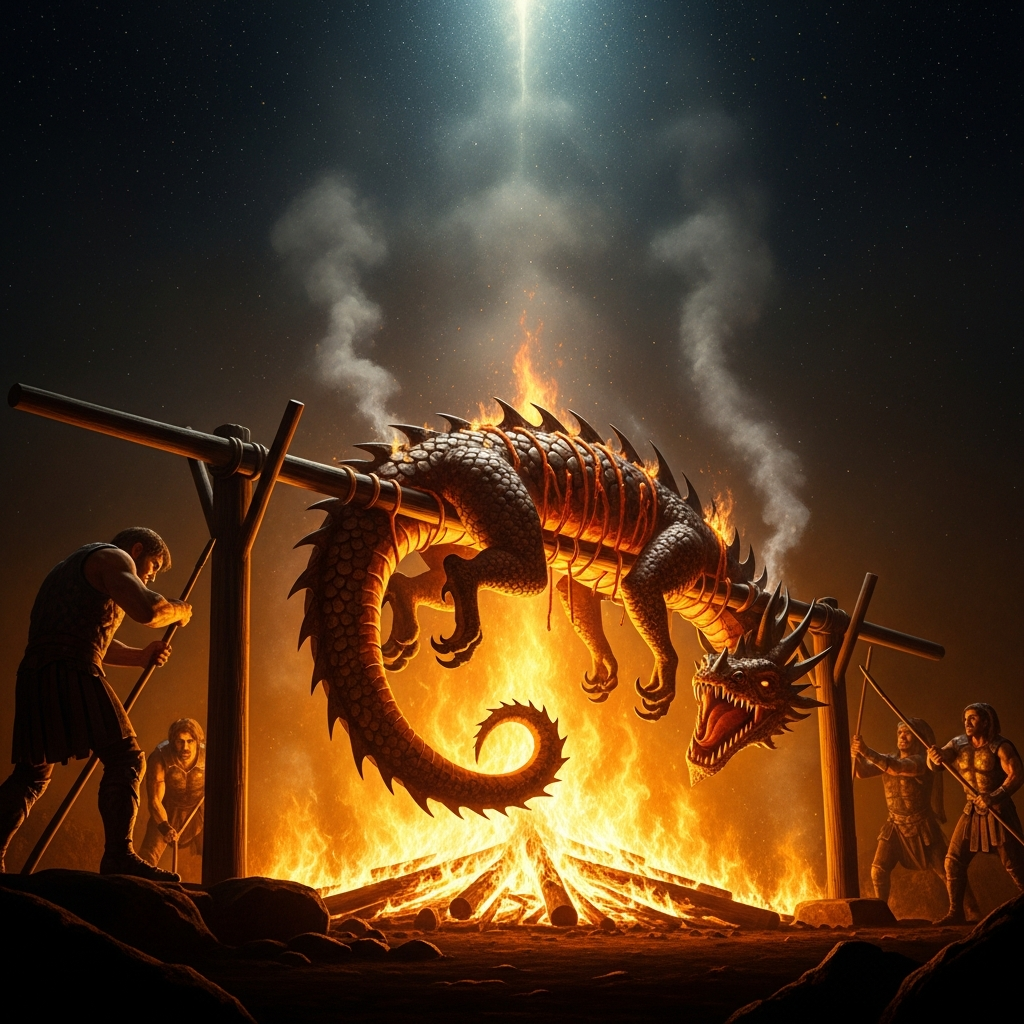
Sigurd, who is exhausted and covered in blood and not yet fully thinking, does what the smith says. He builds a fire. He cuts the great heart out of the dragon’s chest — the heart is the size of a small horse — and he spits it on a length of rowan-wood and he turns it over the fire. The fat begins to render. The smell is terrible and wonderful. He turns the spit. The juices begin to run.
He puts his thumb against the heart to test if it is cooked.
A drop of dragon-blood spits up and lands on the pad of his thumb. The pain is instantaneous. He puts his thumb in his mouth.
The world changes pitch.
The flames of the fire have not changed. The heath has not changed. The heap of the carcass behind him has not changed. But there are birds in the rowan-tree above the fire and the birds, suddenly, are speaking, and what they are speaking is intelligible. He hears them as clearly as he heard Fáfnir.
The boy is a fool, the first bird is saying. He is roasting the heart for the smith.
Regin will eat the heart and gain the dragon’s wisdom and then he will kill the boy in his sleep tonight.
The smith has been planning it for years. The whole forge of Gram was for this purpose. The boy is one meal away from death.
If the boy were not a fool he would eat the heart himself.
If the boy were not a fool he would kill the smith first.
Sigurd’s hand goes very still on the spit.
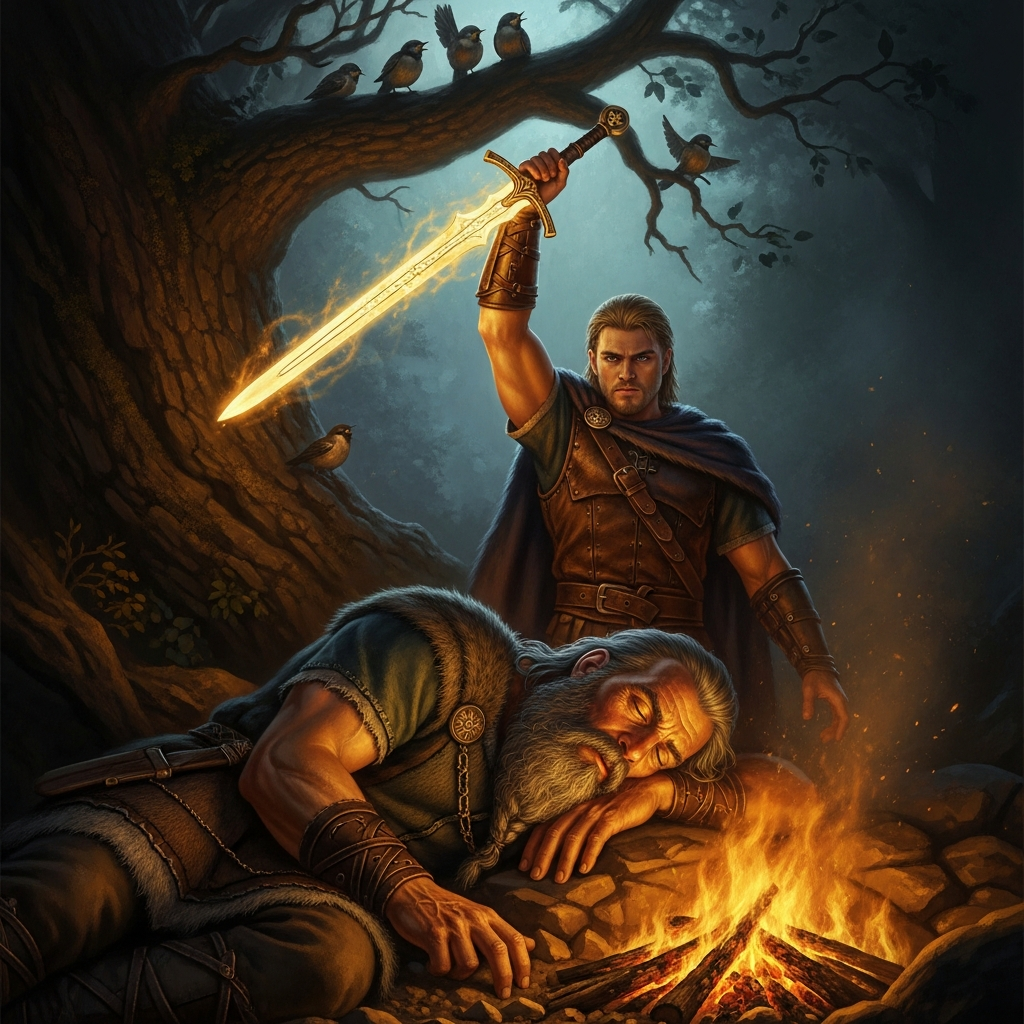
He turns his head, slowly, and Regin is sitting on a stone twenty paces from the fire. The smith’s eyes are closed. The smith is dozing in the warmth of the flames and the safety of the moor where he will, in a moment, ask Sigurd to bring him the heart.
Sigurd takes the heart off the spit. He eats some of it himself.
Then he gets up, walking very softly, and he draws Gram from the dragon’s body where he has left it stuck through the spine, and he walks across the heath, and he kills the smith with one stroke, and the smith dies dreaming of gold.
The birds in the rowan-tree go on singing.
Sigurd takes the gold.
He loads it onto Grani, who staggers under the weight — the great hoard of Ándvari, brought up from Svartalfheim, paid as ransom for the otter, hoarded by Fáfnir for generations on the heath. There is a ring among the gold called Andvaranaut, the ring the dwarf cursed first and most particularly. Sigurd takes the ring. He puts it on his finger.
The dragon was right. The smith was right. The birds were right.
Sigurd will ride south from this heath into the hall of the Niflungs, and he will give the ring to Brynhild, and the ring will pass through Brynhild to Gudrún, and Gudrún will marry Sigurd, and Brynhild will hate Gudrún, and Brynhild will arrange for Sigurd to be murdered in his bed by Gudrún’s brothers, and Gudrún will marry Brynhild’s brother to avenge Sigurd, and Gudrún will kill her own children and feed them to her second husband to avenge her brothers, and the curse of Ándvari will run through every generation of every house that touches the gold, and at the end the only thing that will be left is a heap of unmoving bodies and a ring that someone, somewhere, will pick up.
But that is the rest of the saga, and we are not yet there. Now, on the heath at Gnitaheiðr, Sigurd is loading gold onto a horse. The wind has not stopped. The birds are still in the rowan-tree. The smith is on the ground. The dragon is on the ground. The boy who has heard everything the birds and the dragon told him is doing what they told him not to do.
He always was going to.
That is the part of the myth that the Greek poets, with their belief in the educative power of warning, never quite understood. The Norse poets understood. They wrote it down without flinching. The hero hears the prophecy. The hero does not avoid the prophecy. The hero rides toward it. That is what makes him the hero. That is also what makes him a corpse in waiting.
Sigurd rides off the heath.
The gold rides with him.
Scenes
Regin reforges the broken pieces of Sigmund's sword Gram in the underground forge
 Generating art…
 Sigurd lies in the pit he has dug across the dragon's path
Generating art… Fáfnir dying on the heath
 Generating art…
 Roasting the dragon's heart
 Generating art…
 Regin sleeping by the fire, dreaming of the gold
 Generating art…
 Echoes Across Traditions
Entities
- Sigurd
- Fáfnir
- Regin
- Ándvari
- Odin

Sources
- *Völsunga saga* (c. 1200–1270 CE), ch. 13–20
- *Fáfnismál* (Poetic Edda), full sequence
- *Reginsmál* (Poetic Edda), on the cursing of the gold
- Jesse Byock (trans.), *The Saga of the Volsungs* (Penguin, 1990)
- H.R. Ellis Davidson, *The Road to Hel* (Cambridge, 1943)
- Richard Wagner, *Der Ring des Nibelungen* (1869–1876, modern reception)