Pele Flees Namaka Across the Pacific
Mythic time — the founding era of the Hawaiian islands · Kahiki (the ancestral homeland) across the Pacific to the Hawaiian archipelago — Kahoolawe, Maui, Molokai, Oahu, Kauai, Hawaii
Contents
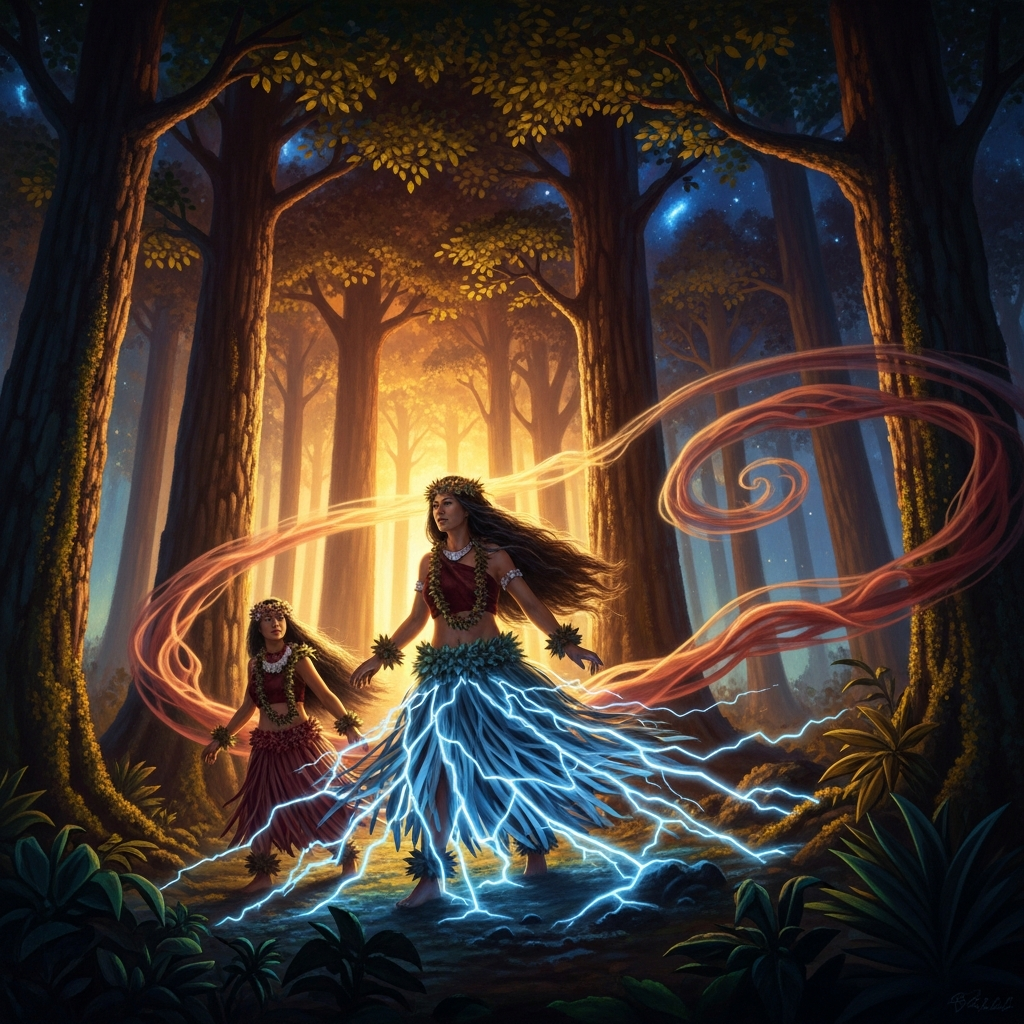
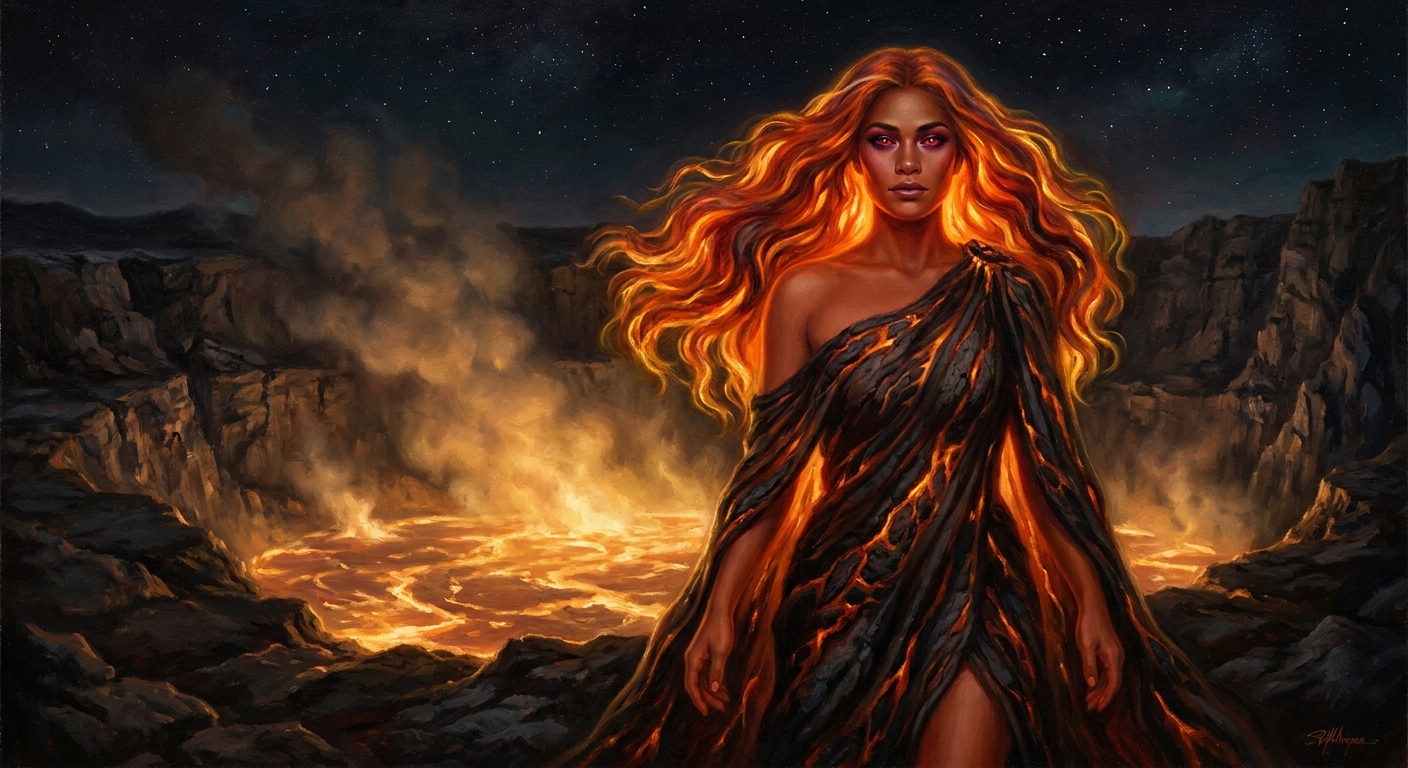
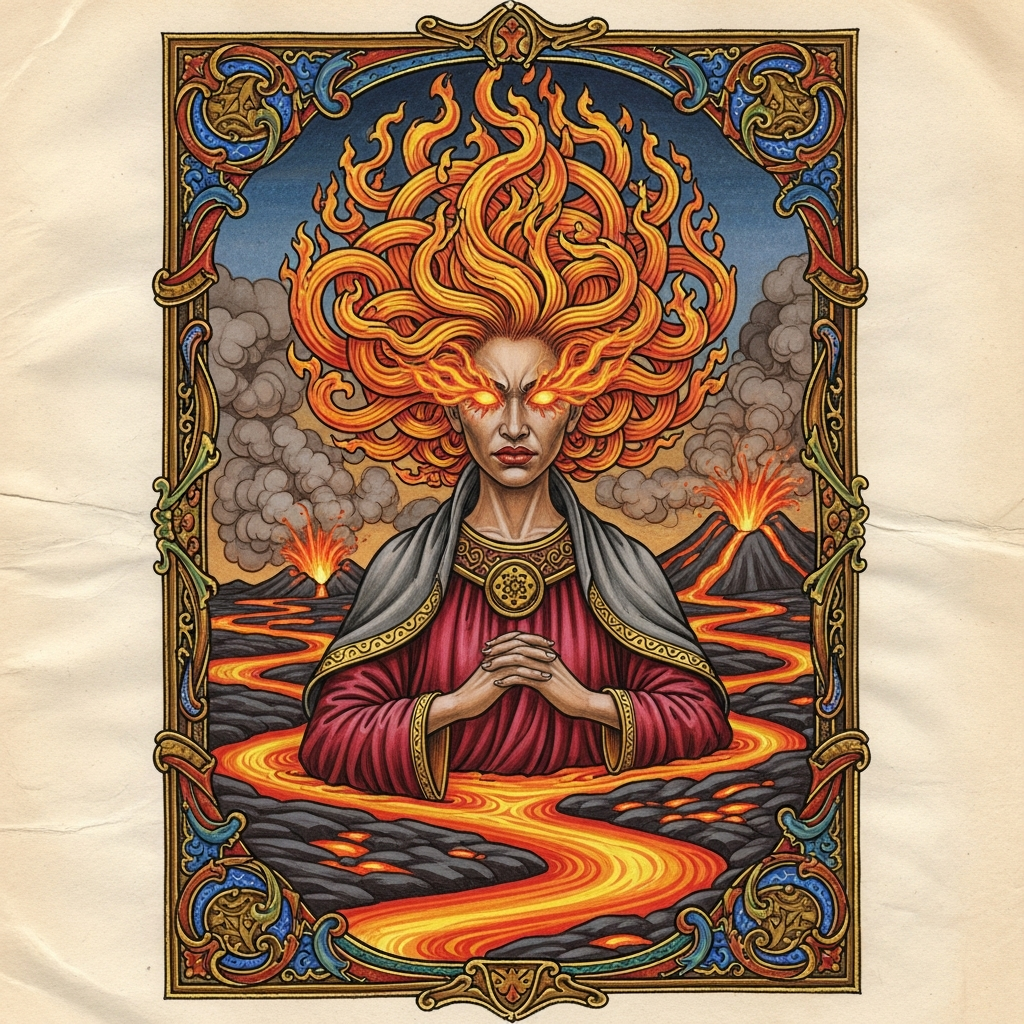
Pele, goddess of volcanic fire, flees her elder sister Namaka, goddess of the sea, across the breadth of the Pacific. Each island where Pele digs a fire-pit, Namaka floods and destroys. The chase moves steadily northwest — Kahoolawe, Maui, Molokai, Oahu, Kauai — and the geological sequence of the Hawaiian island chain is the record of every place Namaka won and every place Pele could not yet hold the ground.
- When
- Mythic time — the founding era of the Hawaiian islands
- Where
- Kahiki (the ancestral homeland) across the Pacific to the Hawaiian archipelago — Kahoolawe, Maui, Molokai, Oahu, Kauai, Hawaii
The quarrel begins before the islands exist.
Pele comes from Kahiki, the ancestral homeland that lies somewhere south and west in the direction that canoes travel when they are leaving — a real place and a mythological one at the same time, Tahiti perhaps, or a Tahiti that is also an idea of origin, the place that all departure comes from. She comes with her brothers and sisters: Ka-moho-ali’i, the shark-god; Kane-hoa-lani; the others whose names are the names of wind and rain and cloud. She carries her fire with her. She carries it in a gourd, or a digging stick, or simply in her hands, depending on which version you hear, and the fire is not metaphorical — it is volcanic fire, the deep heat of the earth, and it is looking for a place to live.
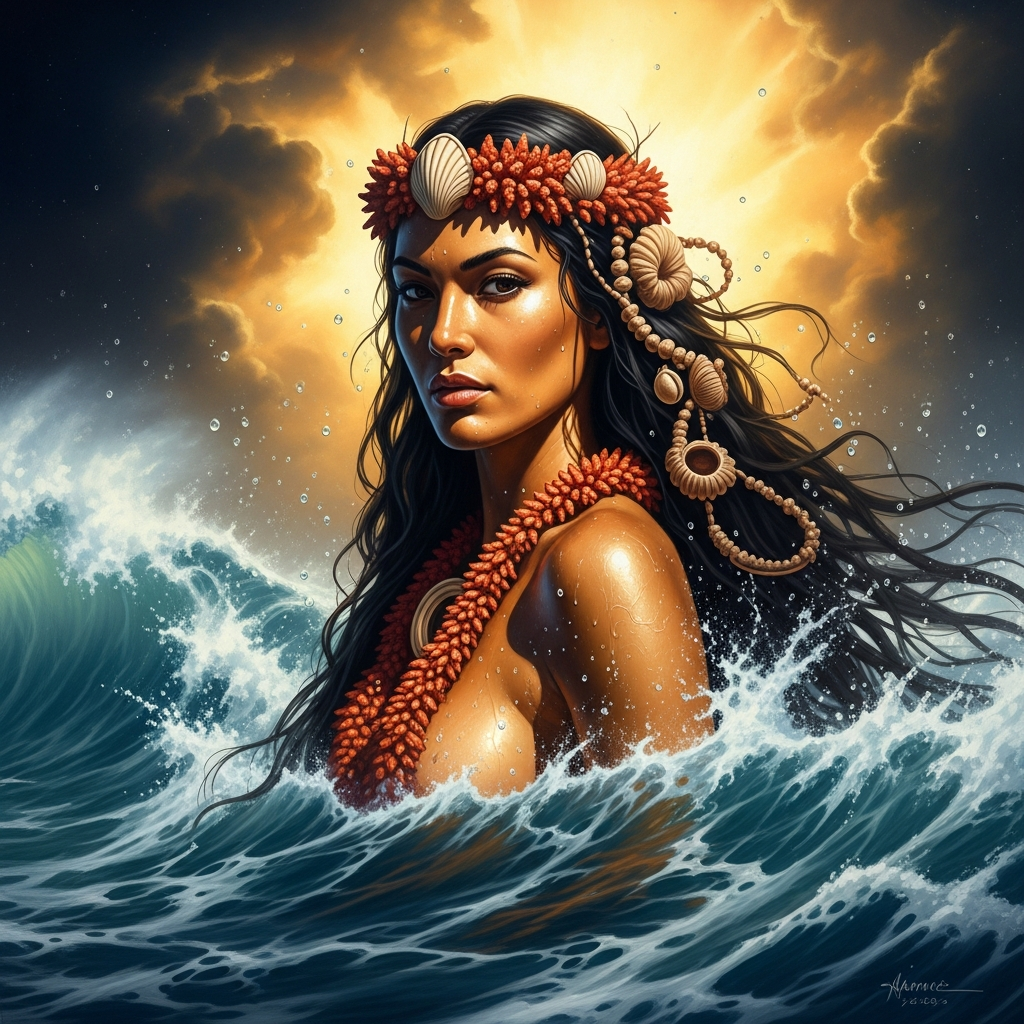
Namaka is already there. Namaka is the sea. She does not need a container because she is the container. She is the elder sister, and Pele has angered her — the sources are delicate about how, speaking of a husband, a betrayal, a desire that crossed a boundary it should not have crossed. The result is the same regardless of the specifics: Namaka wants Pele dead, and Namaka is the sea, and the sea is very large.
Pele runs.
She stops first at Nihoa, a rocky outcropping at the far northwestern edge of what will become the Hawaiian chain, and digs a fire-pit. The fire takes hold. The rock glows red. She digs deeper, following the heat down toward the true source, and the island smokes and lights and for a moment it looks like she has found a home.
Namaka finds her.
The sea rises around Nihoa from every direction at once — not a storm, not a wave, but the sea simply deciding to be higher. Namaka does not need weather. She pours over the island and fills the fire-pit and the steam is like a scream and Pele abandons the hole and runs again, northwest into the chain that will eventually bear her name as a collective noun: the Hawaiian islands, which are all her, all the places she stopped and dug and was driven out.
She stops at Mokumanamana. At Gardner Pinnacles. At French Frigate Shoals. Each time she digs. Each time Namaka finds her. The geological record agrees: these northwestern islands are old, eroded, nearly drowned, the traces of volcanoes that burned hot once and were then overwhelmed. They are the fire-pits Namaka filled.
At Maui she stays longest before Namaka arrives.
The mountain she digs on Maui is Haleakala — the House of the Sun, which will become important later, in the stories of her nephew Maui-the-trickster — and it is deeper than the others, more firmly rooted in the sea-floor beneath. She works her fire down through layers of rock and gets the lava running and the summit glows orange on clear nights, visible from the sea in every direction. Her sisters come to live with her there. Hi’iaka, the youngest, is born from the heat of the summit — some accounts say she was an egg that Pele carried in her armpit across the ocean, kept warm by her own body heat, and that Haleakala’s caldera was the first place warm enough to hatch her.
Namaka comes in the form of the highest tide that Maui has ever seen.
The fight between them on Maui is direct, physical, a grappling at the summit of Haleakala that shakes the mountain. Namaka tears Pele apart — this is not metaphor either; Namaka dismembers her sister and scatters the pieces across the slopes of the mountain, and the pieces are the lava-rock formations still visible on Haleakala’s slopes, where the Hawaiians say the bones of Pele lie. But Pele’s spirit escapes. She is not dead in the way that humans die. She is a goddess of the deep fire, and the deep fire does not go out when its surface is extinguished.
She reforms. She runs again. Namaka believes she has won.
The chain continues southeast, where the plate is newer and the volcanic activity is strongest. Molokai, Oahu, Kauai — each one a stopping place, each one eventually abandoned, each one older and lower and more worn by the sea than the one before it in the chain. The geological timeline runs in the same direction as Pele’s flight: northwest to southeast, oldest to youngest, most eroded to freshest lava.
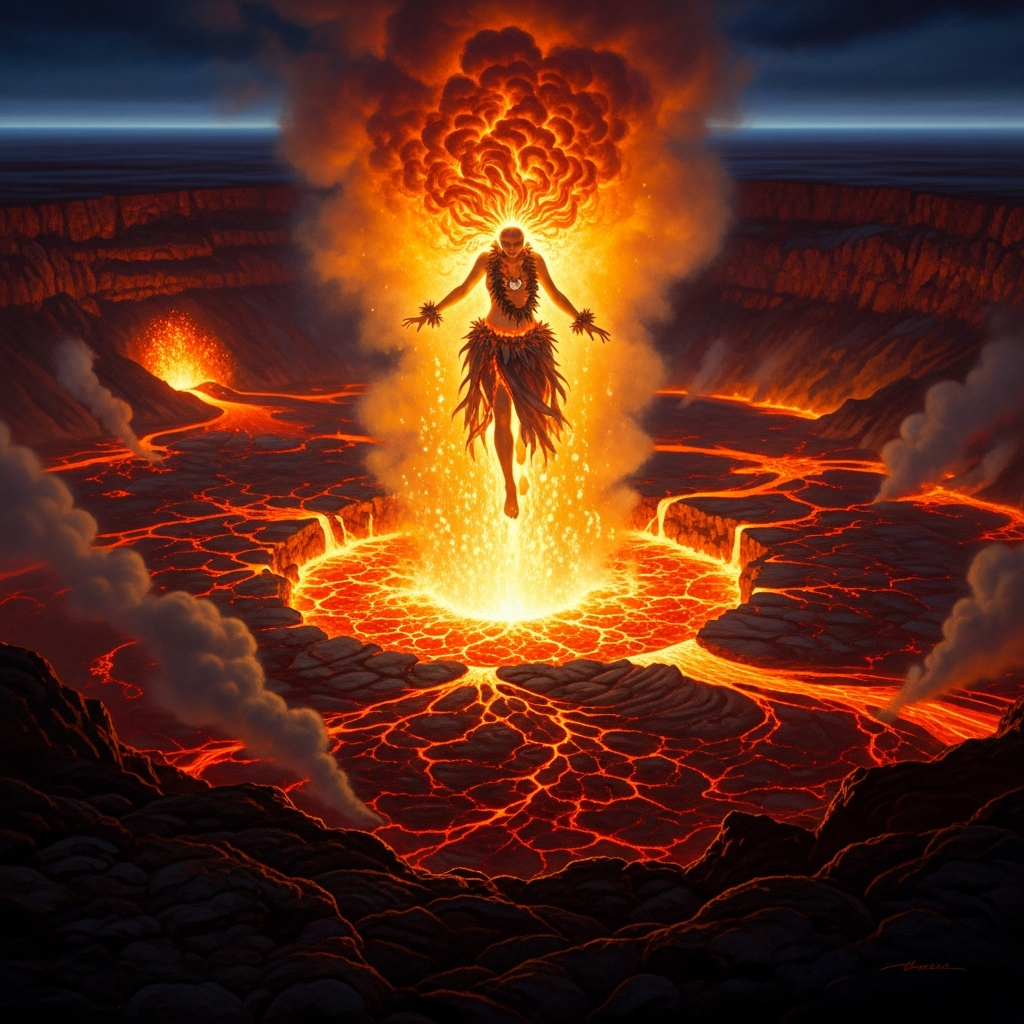
Pele arrives at the Big Island of Hawaii last and digs Kilauea.
Kilauea is different from the others. It sits at the southeastern end of the chain, directly above the hot spot that has been creating islands for millions of years, and it is deep — deep enough that its fire comes from below the sea-floor itself, from the mantle, from the heat that is older than any island. Pele digs down into it and the lava flows and the caldera glows and Namaka comes again, the sea rising against the flanks of the island, the waves crashing against new lava that hisses and sends steam into the sky.
But Kilauea is too deep. The fire there is too directly connected to the source. Namaka floods the lower slopes and fills the tide-pools and shapes the jagged black coastline where lava has met sea and hardened, but she cannot reach the caldera. She cannot get the elevation. The fire at Kilauea is not Pele’s stored fire, carried in a gourd from Kahiki; it is the fire of the earth itself, and neither sister nor sea can extinguish that.
Namaka concedes, in the way that the sea concedes — not by stopping, but by accepting the new boundary. The shoreline of the Big Island is the negotiated edge between them: exactly as far as lava can flow before it cools in the ocean, exactly as high as storm-surge can reach before it retreats. Pele expands the island with each eruption, adding new land at the edge, and Namaka shapes it with each wave, wearing the edges into black sand and sea-cliff.
They have been building and eroding the same coastline ever since.
Pele is still at Kilauea. The Hawaiians know her there as a heat in the rock underfoot, as the sulfur smell that rises from the caldera on still mornings, as the lava that flows to the sea in the night and lights the water red. Her moods govern the mountain: when she is restless, new fissures open; when she is angry, the lava flows move toward the inhabited slopes; when she sleeps, the volcano breathes quietly and the land that cooled last month begins its slow work of becoming soil.
Namaka is the surf at the lava coast, shaping what Pele makes. The two sisters are still doing what they have always done: one building, one wearing away, the island suspended between them in a permanent argument that looks, from the outside, like land.
The Hawaiian island chain extends for over 1,500 miles in a line oriented roughly southeast to northwest. The Big Island, at the southeastern end, is the youngest and most volcanically active; the northwestern islands are older, lower, and substantially eroded. This is exactly consistent with a tectonic plate moving northwest over a fixed hot spot. The Pele-Namaka myth encodes the spatial and directional reality of this geology with precision that was not confirmed by Western science until plate-tectonic theory was developed in the twentieth century.
Martha Beckwith collected more than twenty variants of the Pele legend in her 1940 synthesis and found the flight-narrative consistent across all of them. The sequence of islands — always moving in the same direction, always ending at Kilauea — was held with such stability across oral traditions from different islands that Beckwith concluded it represented a genuine deep-time memory of volcanic activity, transmitted across many generations of telling.
Namaka is not the villain of this story. She is the co-creator. Without her persistence, Pele would have stopped at Nihoa and the Hawaiian chain would be one island at the wrong end of the ocean. The volcano goddess needed to be pushed all the way southeast to find the deep fire. The sea chased her to exactly the right place.
Scenes
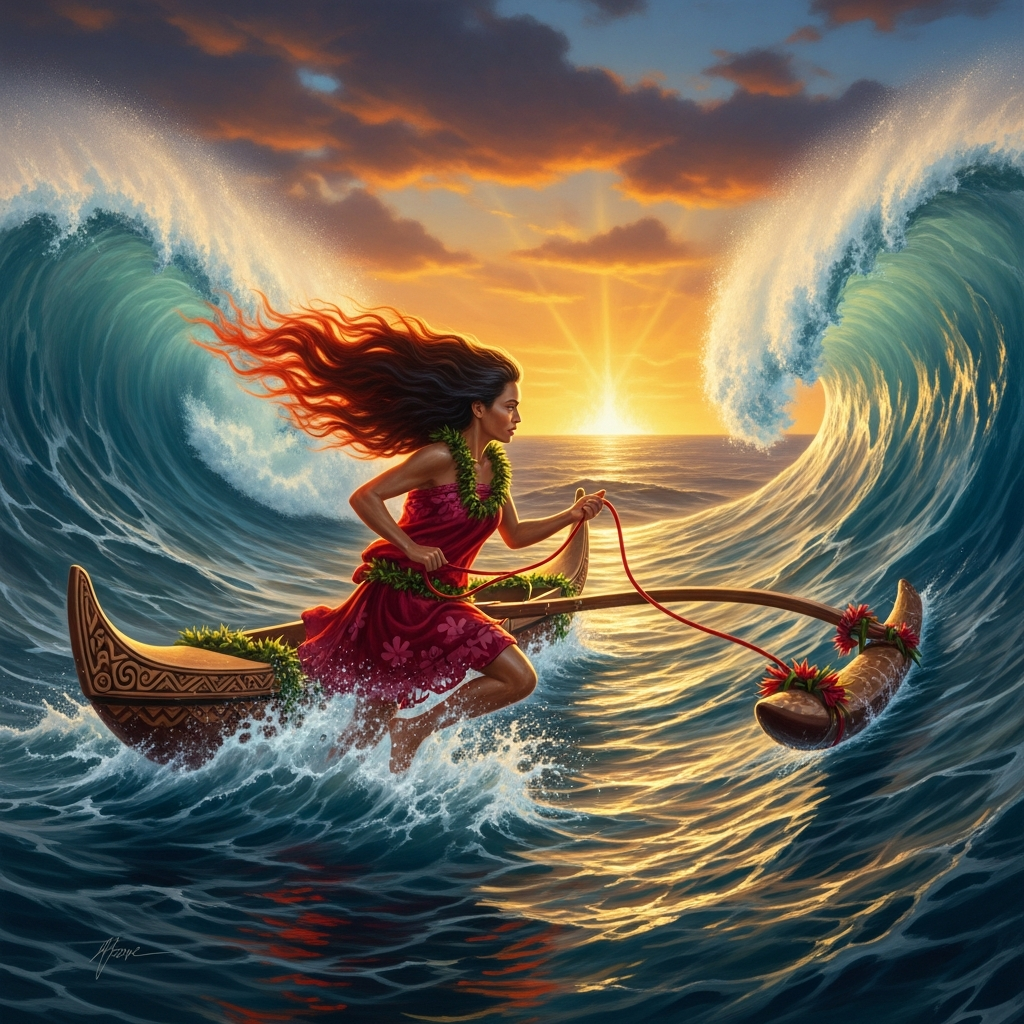
Pele running across the open Pacific — her hair streaming fire, the waves of Namaka rising on both sides of her canoe, the sky behind her lit with the glow of the fire-pit she just abandoned
 Generating art…
 Namaka's arms opening wide over a half-formed volcano on Maui — the sea pouring in from every direction, the crater hissing as fire meets water, the island sinking back toward the surface of the ocean
 Generating art…
 Pele descending into Kilauea — the caldera on the Big Island of Hawaii, deep enough that Namaka cannot reach it, the first place where fire has finally outlasted sea
 Generating art…
 Echoes Across Traditions
Entities
- Pele
- Namaka
- Hi'iaka
- Kane-hoa-lani

Sources
- Martha Beckwith, *Hawaiian Mythology* (1940), ch. 9 — the primary scholarly synthesis of Pele traditions
- Nathaniel B. Emerson, *Pele and Hiiaka: A Myth from Hawaii* (1915)
- E.S. Craighill Handy and Elizabeth Green Handy, *Native Planters in Old Hawaii* (1972)
- Patrick V. Kirch, *On the Road of the Winds: An Archaeological History of the Pacific Islands* (2000)
- Rubellite Kawena Johnson and John Kaipo Mahelona, *Na Inoa Hoku* (1975) — Hawaiian stellar and geographic naming traditions