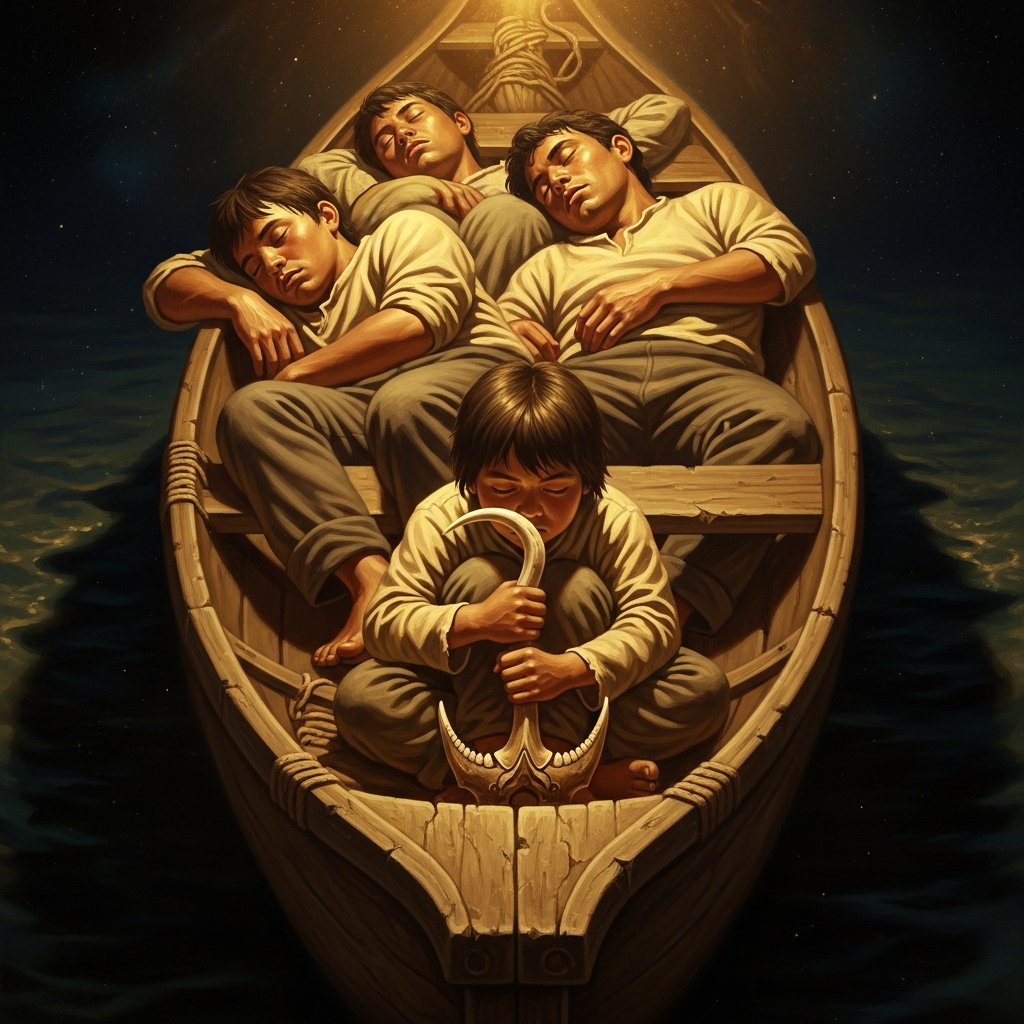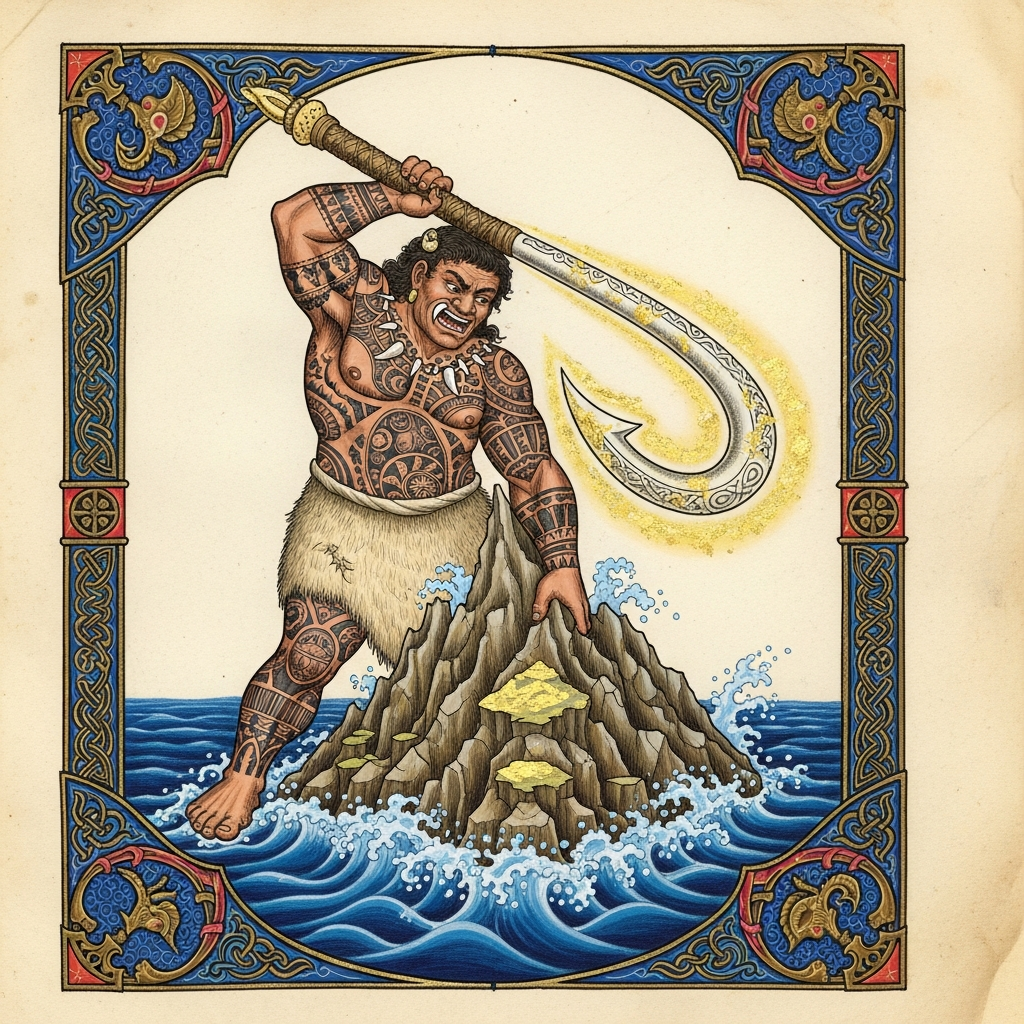
Maui Lassoes the Sun
Mythic time — the age of the demigods, pan-Polynesian oral tradition · Ka hikina o ka La — the rising of the sun, at Haleakala on Maui or at the eastern edge of the world depending on the tradition
Contents
The days are too short. Maui's mother cannot finish her weaving before dark falls. Maui braids a rope from his sister Hina's sacred hair, walks to the place where the sun rises, and waits in the dark. When La climbs out of his pit at dawn, Maui lassoes him with the rope of hair and beats him with his grandmother's jawbone until La agrees to travel slowly across the sky. The sun's crippled gait through the Hawaiian summer is the result of that morning's negotiation.
- When
- Mythic time — the age of the demigods, pan-Polynesian oral tradition
- Where
- Ka hikina o ka La — the rising of the sun, at Haleakala on Maui or at the eastern edge of the world depending on the tradition
The complaint comes from his mother.
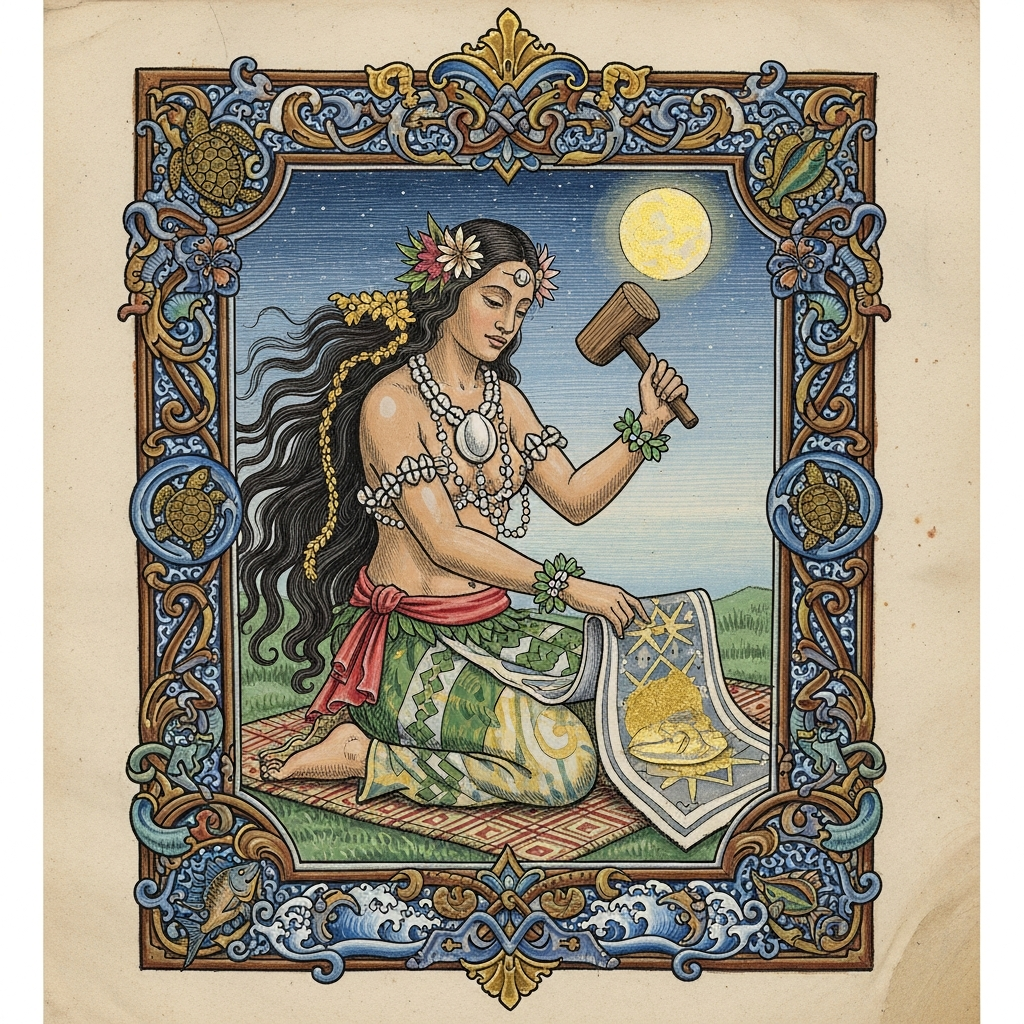
Taranga is weaving tapa cloth — kapa in the Hawaiian telling — and the days are too short to finish it. She lays the beaten bark in the sun to bleach and dry and the light withdraws before the cloth has dried properly, and she begins again the next morning, and the same thing happens. This has been happening her entire life, and her mother’s life, and every woman’s life since the beginning. The sun moves too fast. There is not enough day for the work that needs doing.
Maui’s mother does not say this expecting anyone to fix it. She says it the way people say things that cannot be helped — as a statement of the world’s arrangement, not a request. She does not know she is speaking to the one person in the Pacific who might take it personally.
Maui hears this as an engineering problem.
He goes to his sister Hina and asks for her hair.
Hina is holy in the way that the moon is holy — she is sometimes identified with the moon, or with the woman in the moon, or with the moon-principle that governs the tides and the growth of plants. Her hair is not ordinary hair. Maui knows this, which is why he asks for it specifically. The rope has to be stronger than any ordinary rope, and it has to have the right kind of authority — the authority of something sacred, something that has power over the sun the way the moon has power over the tides.
Hina gives him the hair without asking why. She has learned that Maui’s reasons are generally better experienced after the fact.
He braids the rope over many days, working the strands together with chants — the names of his ancestors, his grandmother Muri-ranga-whenua, his great-great-grandfather whose name binds the sky to the earth. He works in the obligation-names, the names of people the rope owes something to. The rope grows longer than the hair he started with. It grows longer than it should. He coils it over his shoulder.
He walks east.
He walks past the last gardens and the last fishing platforms and the last place where human habitation has any presence. He walks through the country that the birds don’t inhabit and the trees don’t grow in, where the ground is black and warm underfoot and smells of something older than any living thing.
He reaches the place where La sleeps.
The Hawaiian tradition is specific about this location: it is Haleakala, the great mountain on the island that will one day bear Maui’s name — which is to say, the island that Maui fished up from the sea-floor, his own creation, his own island. The summit of Haleakala is where La climbs from his pit each morning and begins his too-fast traverse of the sky. The summit caldera is still there. It is still warm. Hikers who camp at the rim in the dark before dawn can stand where Maui stood, in the cold above the clouds, watching the eastern horizon for the first light.
He arrives in darkness and waits.
He does not sleep. He holds the rope in both hands and sits at the edge of the pit and thinks about his mother’s cloth and the women in every village who cannot finish their work before dark. He thinks about the crops that ripen too slowly and the canoe-builders who lose the light before the hull is caulked. He thinks about the fish-net mending that must be done by feel, the navigation stars that appear too soon and the sun that gives up too early.
He holds the rope tighter.
La rises as he always rises — fast, confident, the way something that has never been stopped rises.
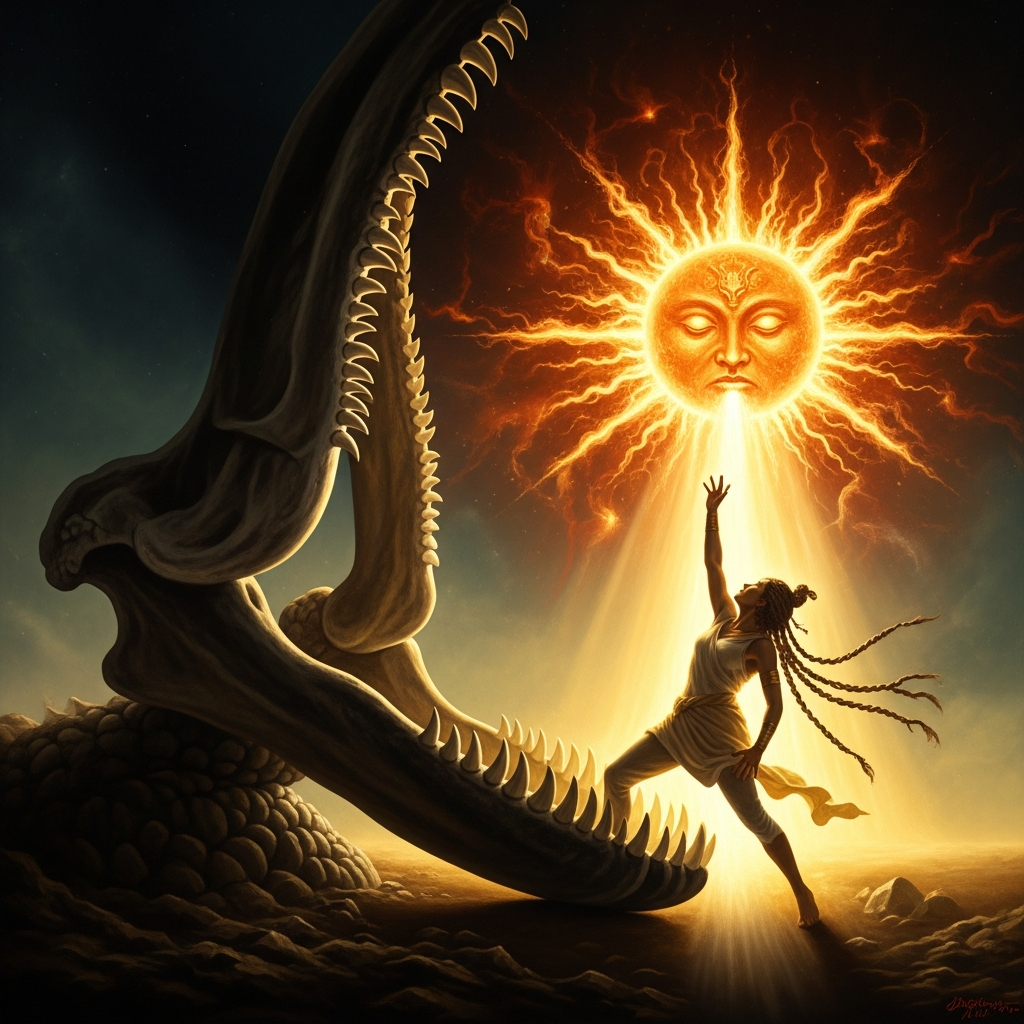
In the Maori version, La has legs, and it is the legs that appear first at the rim of the pit. In the Hawaiian version, La is a burning figure, climbing out of the east in a rush of heat and light that hits Maui like a wall. He squints against it and throws the rope at the same time — the braided hair uncoiling in the air, the noose dropping over La’s first leg, Maui yanking it tight with both hands and planting his feet against the rock.
La lurches forward. The rope goes taut. Maui digs his heels in and is dragged several feet across the summit rock before he finds purchase, and then it is a test of the rope — can Hina’s sacred hair hold a god who has never been slowed — and the rope holds. La thrashes against the snare and the light is blinding in every direction, the heat enormous, and Maui reaches for the weapon in his other hand.
His grandmother’s jawbone.
Muri-ranga-whenua gave him the jawbone when she died — the curved bone, the most sacred part of an ancestor’s body, carved into a hook by Maui’s own hands and used to pull up the islands from the sea-floor. Today it is a club. He swings it against La’s legs, where the rope has him tangled, and La screams in a way that has no sound — the light brightening impossibly, the temperature at the summit rising so fast that the rock itself begins to smoke.
Maui keeps swinging.
La cannot understand what is happening.
He is older than the islands. He has crossed the sky every day since the sky existed. He has never been held. He has never been slowed. He has never been hit by a man with a dead woman’s jawbone at the rim of his own sleeping-pit. He is a god and this is a hero and the distinction should be conclusive, but the rope is made of moon-woman’s hair and the hero has his grandmother’s skull and the rope is holding.
La begins to bargain.
The conversation goes several rounds, depending on the telling. La wants the rope removed. Maui wants a guarantee. In the end, La agrees: in summer, he will travel slowly — slowly enough that the cloth dries, the food cooks, the canoes are caulked, the women finish their weaving before the light fails. In winter, he may move as he likes. Maui accepts this. It is not everything — the short winter days are not resolved — but it is enough for the immediate purpose.
He takes the rope off La’s legs.
La is not undamaged. The Hawaiians say he walks with a crippled gait ever after — the long pauses in the afternoon sky, the moments when the sun seems to hang motionless in the northwest in high summer, those are La’s limp. The joints that took the jawbone did not heal cleanly. He keeps his agreement not just from his word but from his injury, which is more reliable than either.
The word for sun in Hawaiian is La. The island chain’s largest island is the Big Island, where Pele lives. But the island of Maui bears the demigod’s name, and Haleakala is his summit, and on the clearest mornings at the right season you can stand at the caldera’s edge two miles above the sea and watch the sun rise exactly as it has risen since Maui stood there with a rope made from his sister’s hair.
Taranga finished her cloth. The tradition does not record whether she acknowledged this. She was a woman who expected her sons to do extraordinary things, and she had thrown this one into the sea as a premature infant wrapped in a topknot of her own hair, which may explain his relationship with ropes.
The summer afternoon light on the Pacific — the hours when the sun hangs in the northwest and the sea catches the color of it and the air smells of warm stone and open water — is the sun keeping a promise made under duress at dawn, on a mountain, to a man with a dead woman’s bone.
Katherine Luomala’s 1949 analysis of Maui variants found the sun-snaring story in most of the 158 variants she catalogued, second only to the fish-hook narrative. The weapon varies across traditions — a jawbone in most Hawaiian and Maori accounts, an adze in some Marquesas versions, his own bones in one dramatic retelling. The rope varies from Hina’s hair to flax to coconut fibre to spider-web in a Maori variant.
What does not vary is the motivation. It is always, in every version, about the work that cannot be finished. The sun is not snared for glory or power or the hero’s aggrandizement. It is snared because someone’s mother could not complete a domestic task, and her son found this unacceptable.
This is unusual in world mythology, where heroes generally encounter the sun as a symbol of cosmic power and approach it accordingly — as Phaethon does, with hubris and catastrophe. Maui approaches it as a labor dispute. He wins because he comes with a specific complaint backed by a rope that has the right kind of authority, and because he is the kind of person who does not stop swinging until the other party agrees to terms.
Scenes
Maui braiding the rope from his sister Hina's hair — the long strands wound with chants and the names of his ancestors, the rope growing longer than the hair it came from
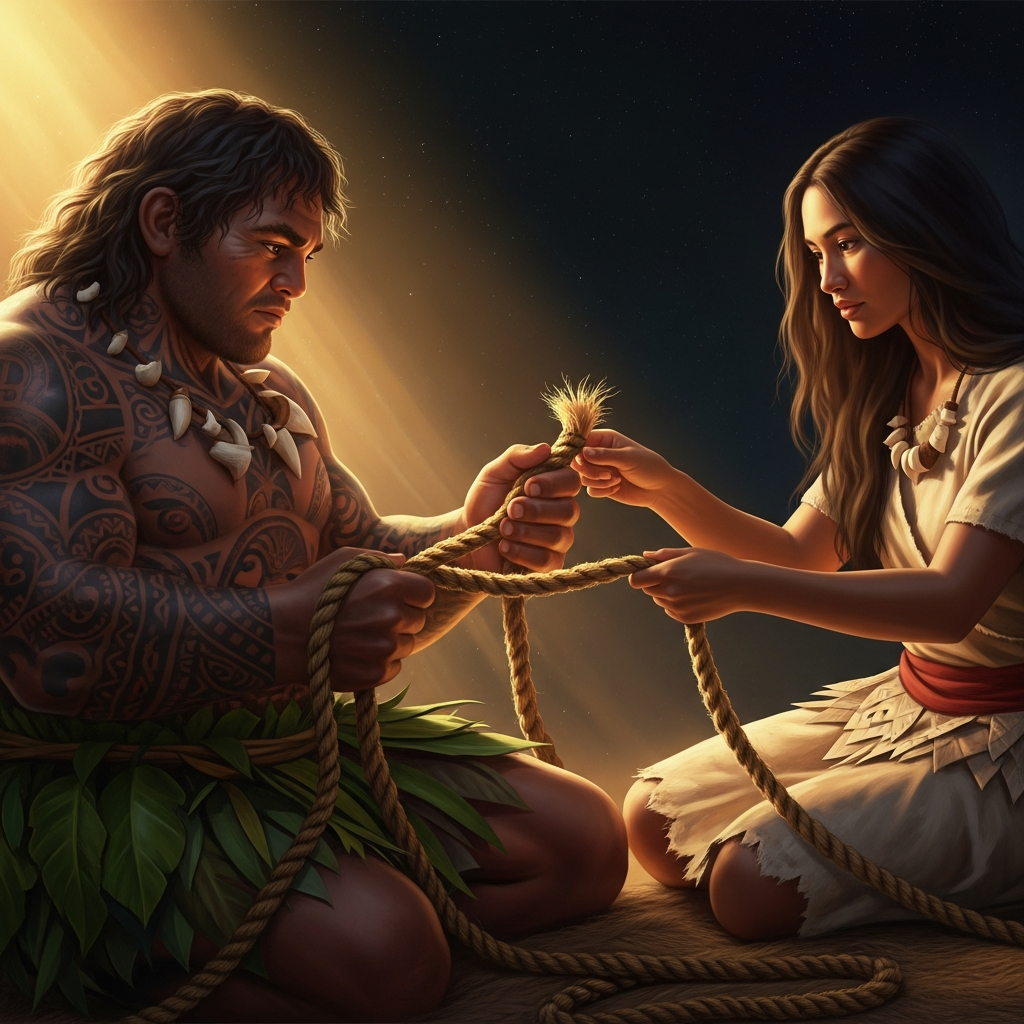 Generating art…
 Maui crouched at the edge of La's pit in the last dark before dawn — the rope coiled in both hands, the horizon beginning to pale, the stone underfoot warm from the sleeping sun below
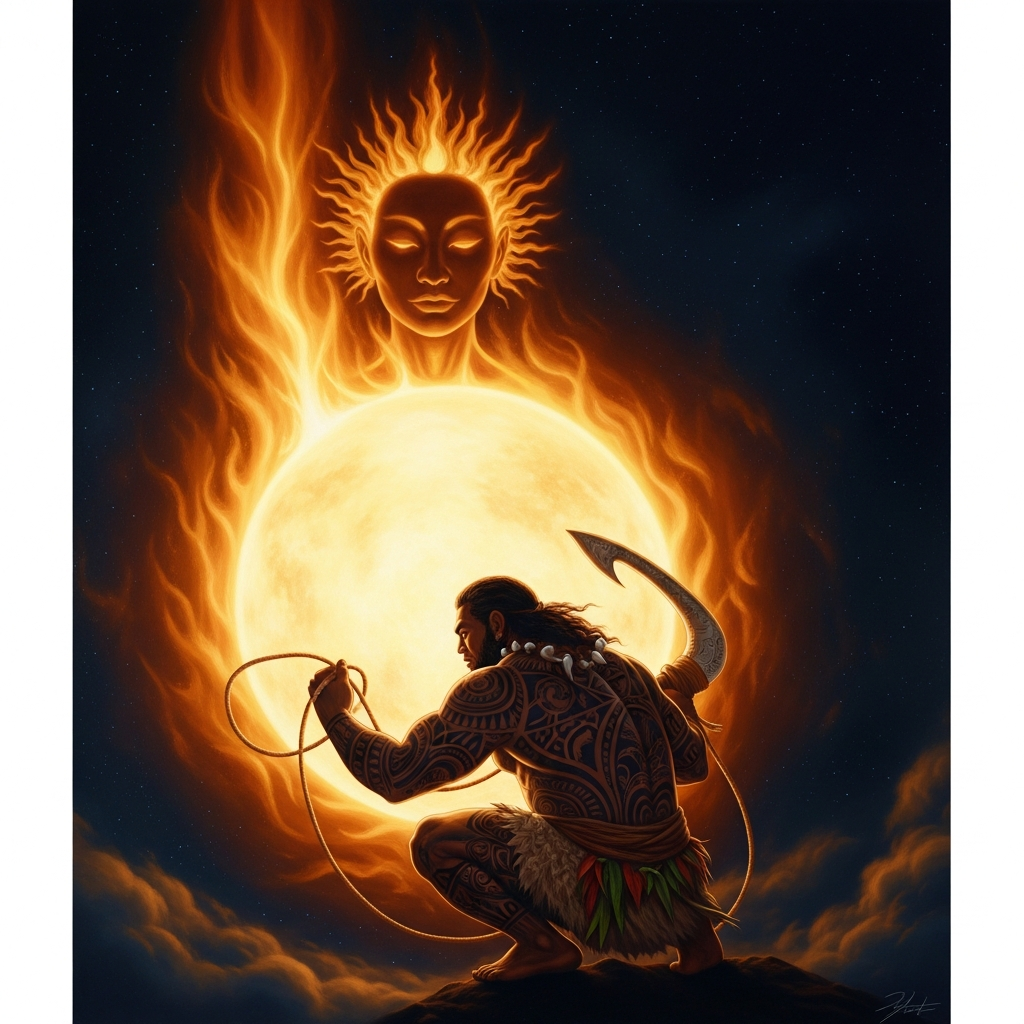 Generating art…
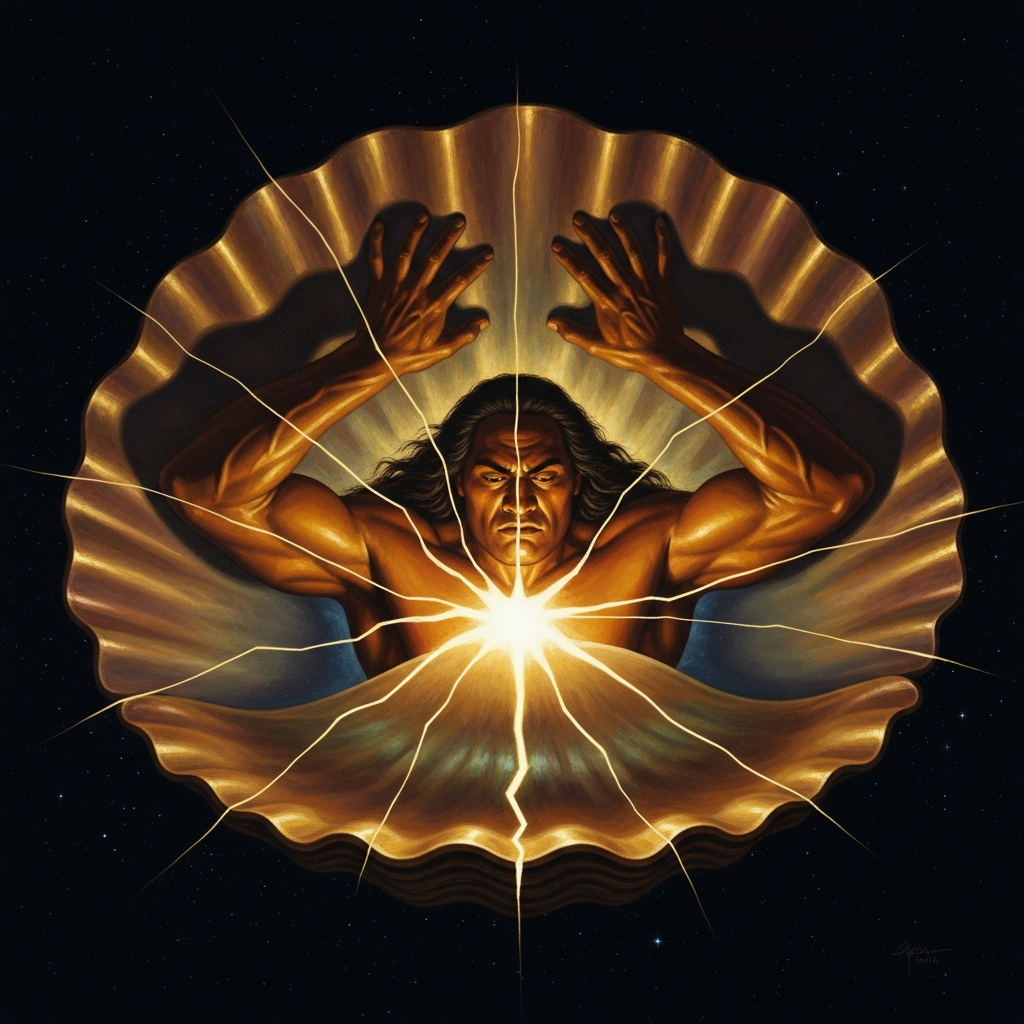
 The jawbone rising and falling against the legs of La — blinding light in every direction, the rope of hair taut, the sun thrashing and slowing and finally listening
 Generating art…
 Echoes Across Traditions
Entities
- Maui-tikitiki-a-Taranga
- La (the Sun)
- Hina
- Taranga


Sources
- Martha Beckwith, *Hawaiian Mythology* (1940), ch. 23 — the definitive scholarly synthesis of Hawaiian Maui traditions
- Katherine Luomala, *Maui-of-a-Thousand-Tricks* (1949) — comprehensive cross-Pacific analysis of 158 Maui variants
- Nathaniel B. Emerson, *Unwritten Literature of Hawaii* (1909)
- E.S. Craighill Handy, *Polynesian Religion* (1927)
- Patrick V. Kirch, *On the Road of the Winds: An Archaeological History of the Pacific Islands* (2000)