Hine-nui-te-po and the Death of Maui
Mythic time — the last act of the age of demigods · Te Po — the realm of night at the edge of the world, where the dead go
Contents
Maui, the trickster who lassoed the sun and fished up islands, attempts his final act: crawling through the sleeping body of Hine-nui-te-po, the Great Woman of Night and goddess of death, to win immortality for all of humanity. His companions — a company of birds — wait in silence. A fantail cannot contain its laughter. Hine-nui-te-po wakes. Maui is crushed. This is why humans die.
- When
- Mythic time — the last act of the age of demigods
- Where
- Te Po — the realm of night at the edge of the world, where the dead go
Before this night, Maui has never been wrong about his own capabilities.
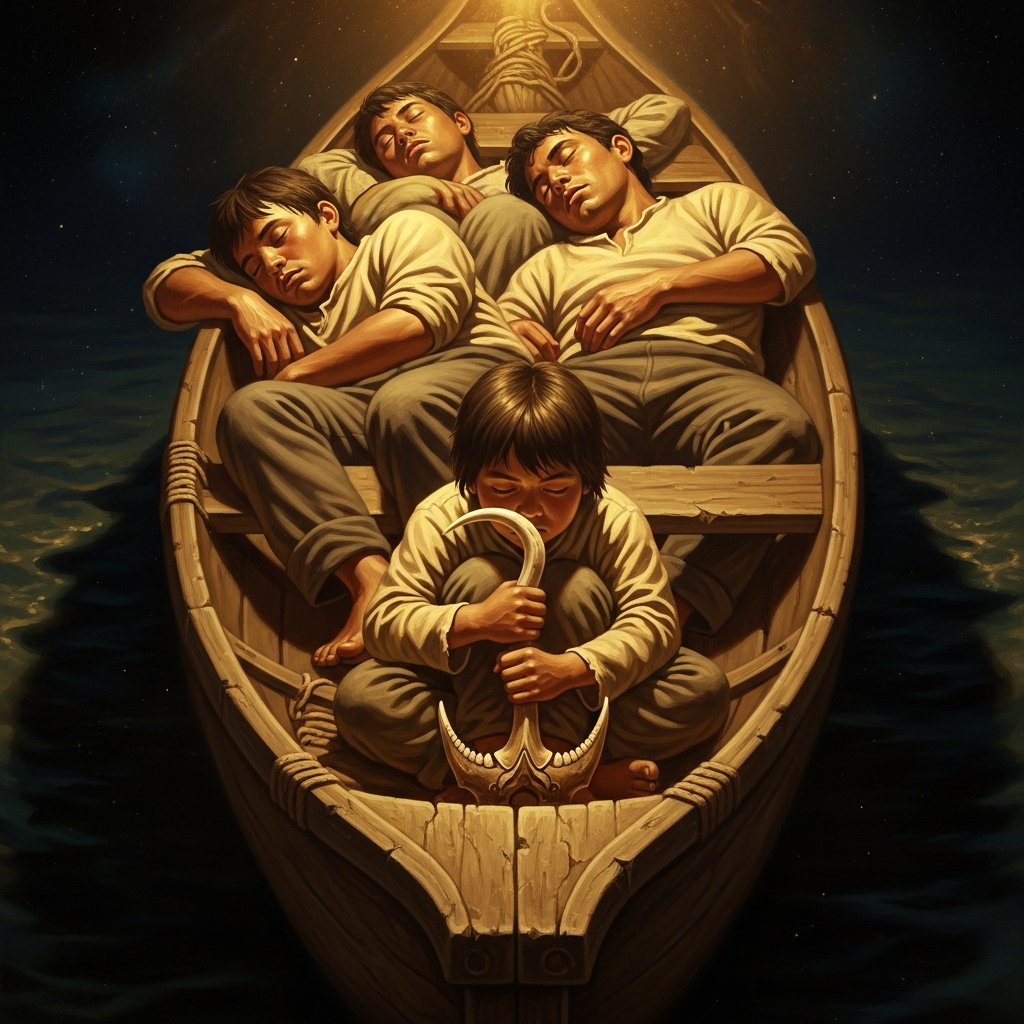
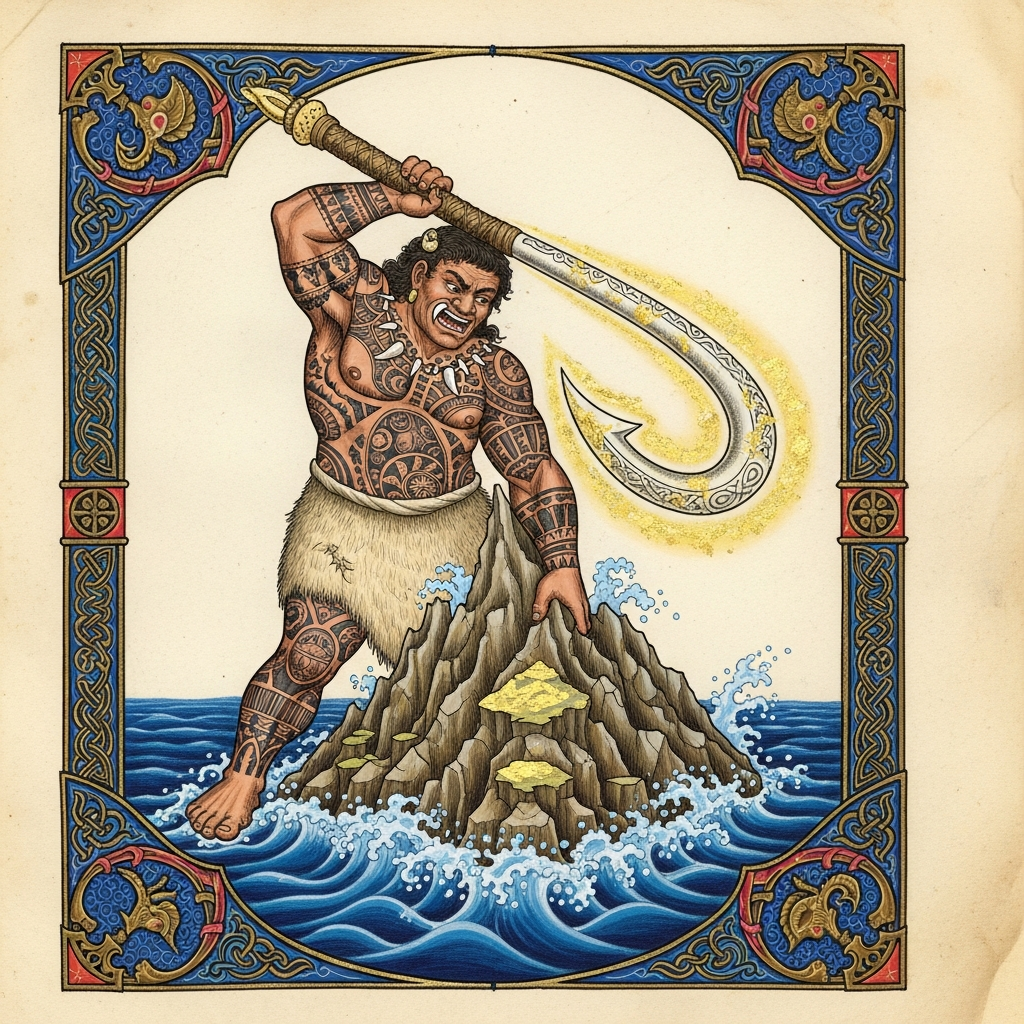
He was the one who punched himself in the nose for fish-bait. Who hid in the canoe when his brothers left without him. Who braided a rope from his sister’s sacred hair and lassoed the sun at dawn and beat it with his grandmother’s jawbone until it agreed to slow down. He fished up islands with that same jawbone, shaped into a hook — pulled Aotearoa and the island chain that carries his name up from the sea-floor by bracing against the hull of a canoe and hauling until the land appeared. He stole fire from Mahuika, the fire-goddess, letting her burn his arms one joint at a time before she relented and gave him the ember from her thumbnail.
He has never not finished a thing he started.
He feels something different tonight, standing at the edge of the world where the sea drops off into the dark. He does not know what to call it. He has no word for doubt because he has never experienced it. He stands with the feeling and looks at what is in front of him.
Hine-nui-te-po was not always death.
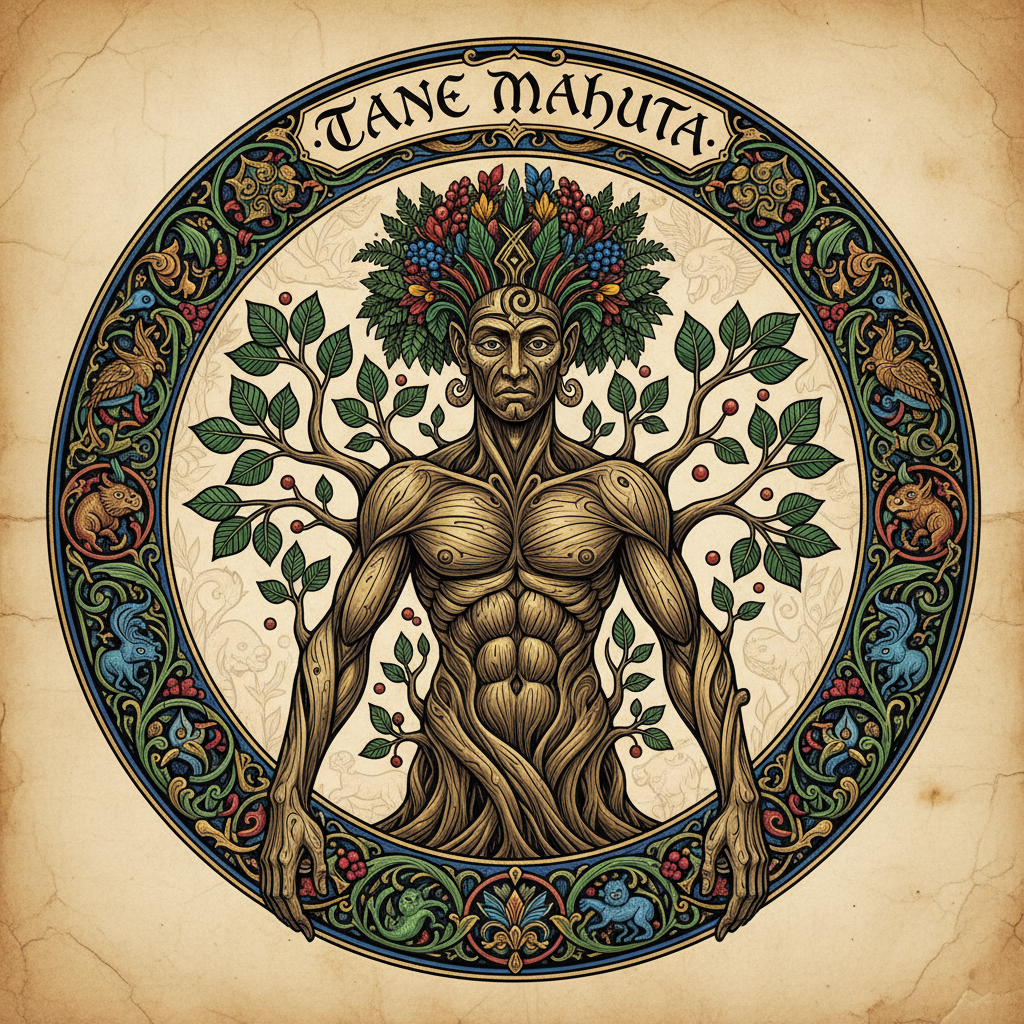
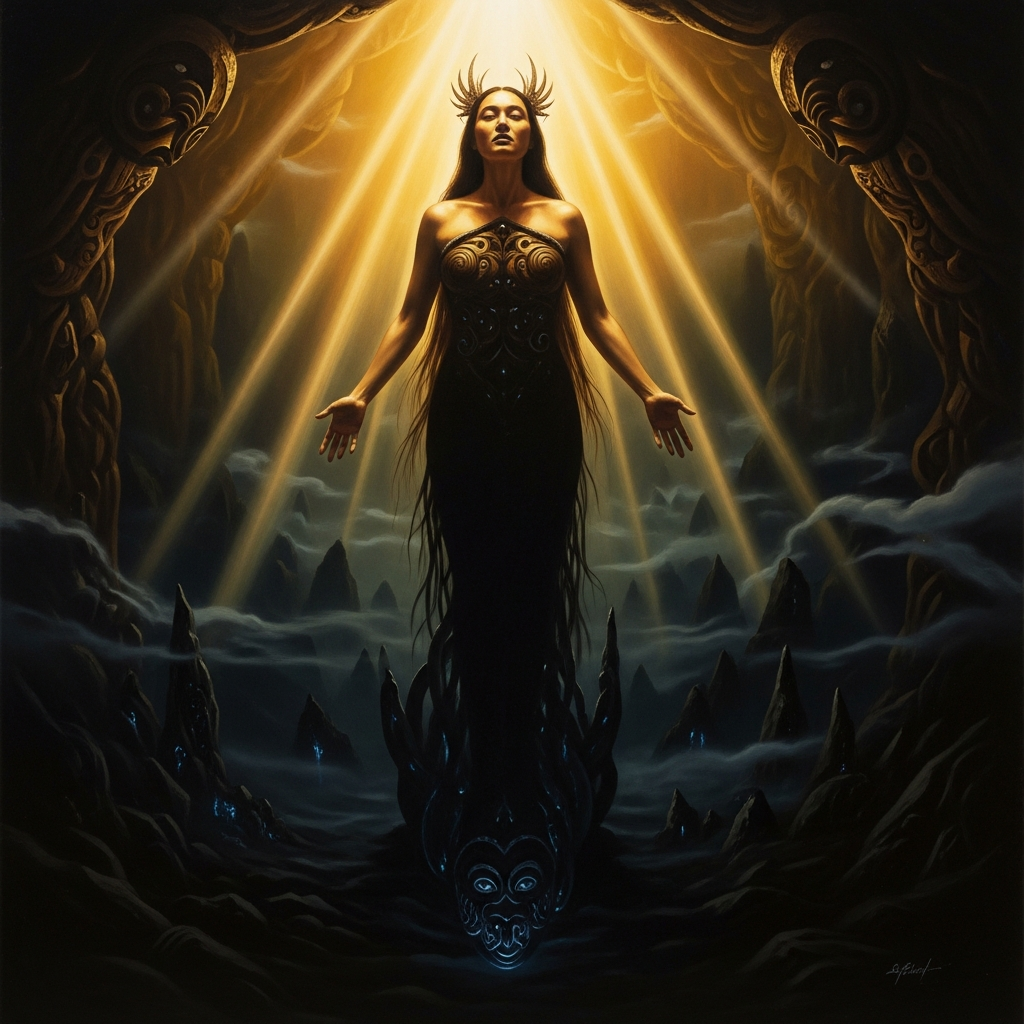
She was Hine-titama first — the Dawn Maiden, daughter of Tane, the god of forests and birds. She was beautiful in the way that dawn is beautiful: the first light, the clean color before the sun has height enough to bleach the sky white. She had a husband she loved. She went to ask her husband’s name and discovered that her husband was also her father. Tane, who had shaped her from earth and breathed life into her, had also married her.
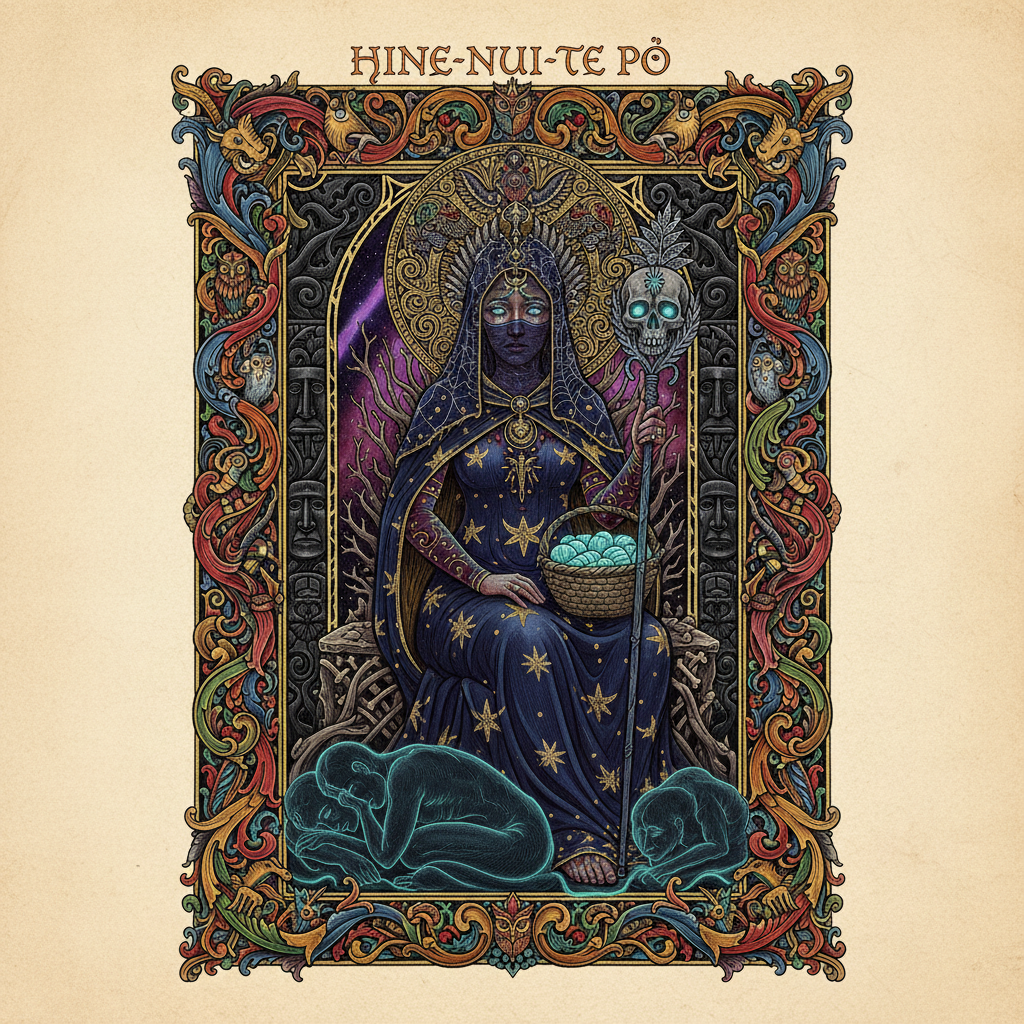
She descended into the underworld. Not as a punishment, not driven out — she went of her own will, because the alternative was to remain above-ground with the knowledge she now carried. She became Hine-nui-te-po. She made herself into death because death was the only place that had sufficient distance from what she had learned. She stands at the doorway of the night and receives the dead, all of them, as they come to her from the world above.
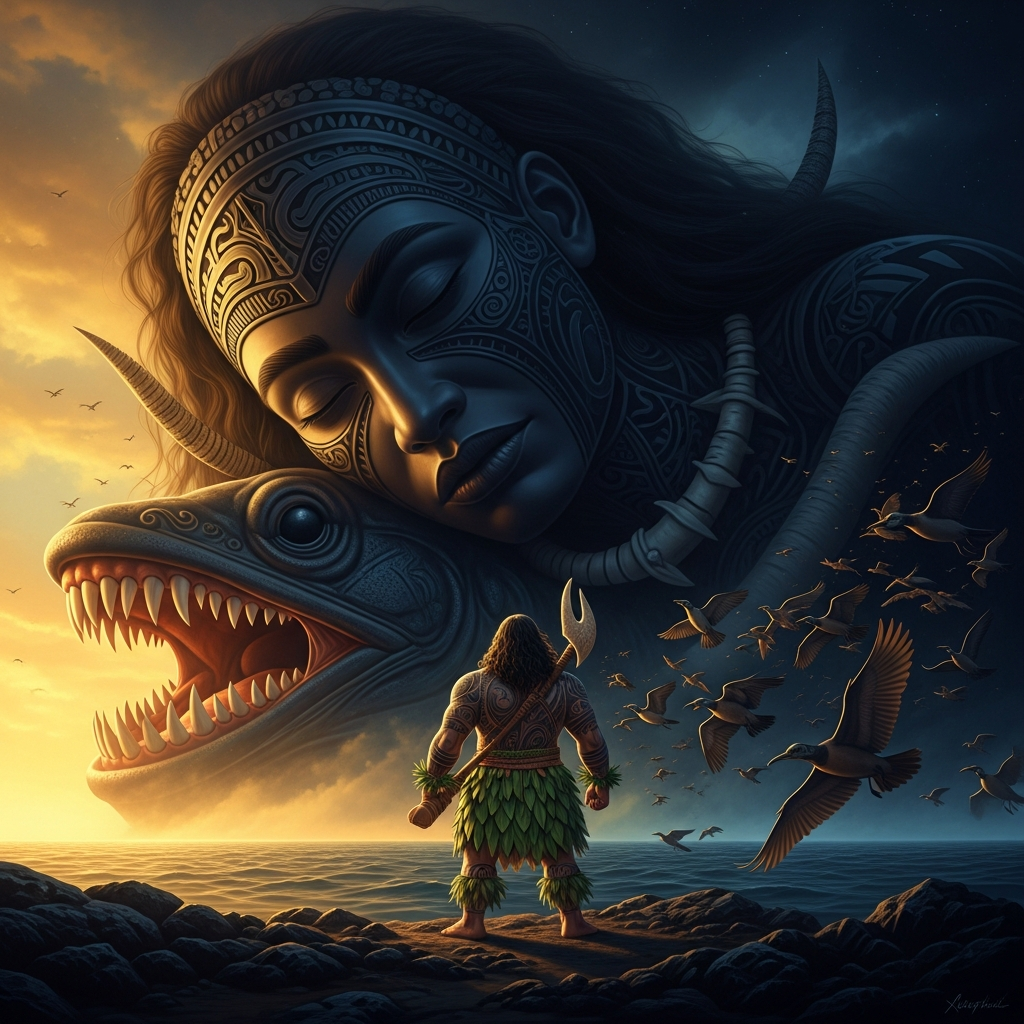
She is enormous. Vast as a cliff-face. Her hair spread across the horizon like cloud-cover. Her eyes, when they are closed, are obsidian. Her mouth is open in sleep, and the teeth inside it are barracuda-teeth: triangular, flint-edged, multiple rows.
Maui’s companions stand behind him. Mostly birds. The piwakawaka — the fantail — hops beside him on the ground, its tail fanning and folding and fanning again, the way it always does, a habit it cannot break.
Maui does not look at the fantail.
The plan is exact.
He will enter her body and pass through it. He will come out the other side — through her mouth, past the barracuda teeth — and when he does, death will be reversed. Not for him alone. For all of humanity. Every person alive on the islands he fished up, and their descendants, and every person those descendants will have — they will wake the morning after and the morning after that, and go on waking, and death will be a fact that belonged to the old world, before Maui fixed it.
He explains this to the birds. He is specific. He tells them that the entire success of the operation depends on silence — that Hine-nui-te-po must not wake until he has passed through her completely. Whatever you see, he says, whatever you think is funny, whatever impulse you have to make a sound: resist it. This is more important than any other instruction I have given you, which is all the instructions ever given to anyone.
The piwakawaka fans its tail. It does not speak.
Maui strips his garments. He breathes in through his nose, the held breath he uses before every impossible thing, and walks forward into the body of death.
In the dark of Hine-nui-te-po’s body there is no light at all.
He moves forward by the memory of the plan. He cannot see the exit but he knows it exists — the mouth, the barracuda teeth arranged in an arch above and below. He moves toward it. He is more than halfway through. He can see the distant grey of the sleeping mouth opening ahead of him, and beyond it, impossibly far but real, the faint outline of the sky before dawn.
The world beyond death. The world where mortality is a story told about the old time.
He is close enough to count the teeth.
The piwakawaka cannot help it.
This is the single fact on which everything turns. The bird sees Maui — a man’s body, bare, enormous from the perspective of a small bird — disappearing into the body of the goddess of night, with his legs still visible, kicking slightly as he moves forward, and there is no way the fantail can process this sight without laughing. It is too absurd. The most absurd thing the bird has ever seen, and it has been watching Maui for years, and Maui is never un-absurd. The laughter starts as a sound too small to hear, a pressure in its throat, and then it breaks open into the night air: bright, light, completely unstoppable.
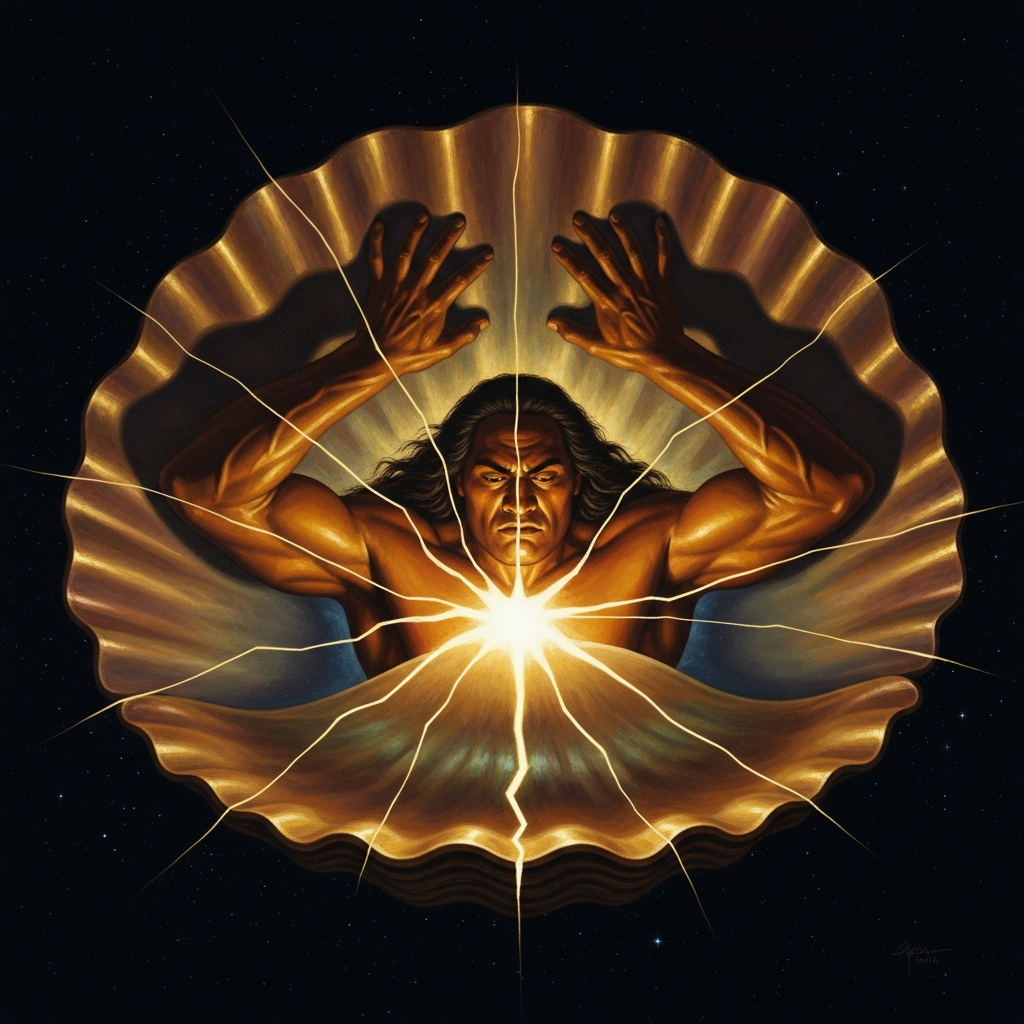
Hine-nui-te-po’s obsidian eyes open.
Her body closes.
The birds scatter. The companions run. The piwakawaka lifts into the dark air with its ridiculous fanning tail, carrying the laugh that ended the age of demigods.
Maui does not come out the other side.
He is the last of his kind. The trickster who tricked everything except a bird with no self-control. The demigod who pulled land from the sea and beat time itself into compliance, who sat across from the sun at dawn and made it promise to slow down, who stole fire from the fire-goddess and let his arms burn one joint at a time to prove he was serious — this man was five tooth-lengths from the exit of death when a fantail laughed.
He could not reach the mouth. The barracuda-teeth were already closing. He was crushed between the jaws of the woman who had made herself into death so that she would never have to face what she learned about her father, and Maui died of that, which is a complicated thing to die of — the accumulated grief of someone else’s wound closing on you in the dark.
In the morning, on every island he fished up, the people wake and find that death is still there. They have always known this. The story of what almost happened travels with the canoes across the Pacific: the attempt, the fantail, the absurdity. The ocean’s explanation for its own grief, light and small and impossible to catch.
The piwakawaka, the New Zealand fantail, is still considered a bird of ill omen. When one enters a house, some Maori elders say, it is bringing word of a death in the family. The bird has been carrying the guilt of that night ever since — flicking its tail at every human habitation, moving too quickly to be caught, too associated with what it did to ever entirely belong inside.
George Grey’s 1855 transcription of the Maui death-myth was among the earliest Polynesian texts to reach a Western academic audience, and its effect was immediate: it established that Polynesian tradition had a sophisticated account of the origin of death, comparable in philosophical ambition to anything in Greek or Near Eastern mythology. The fantail’s laughter as the pivot-point of human mortality struck Western readers as simultaneously absurd and devastating — the right combination, as it turns out, for a myth that tells the truth.
Maui’s failure is the Pacific’s gift to grief: the idea that mortality is not a decree. It is an interruption. We almost made it. The hero was five tooth-lengths from the answer. Something small and ridiculous got in the way, as something small and ridiculous always does, and now we die, and the fantail still cannot stop fanning its tail at the edge of every house it visits, as if it has somewhere important to be.
Scenes
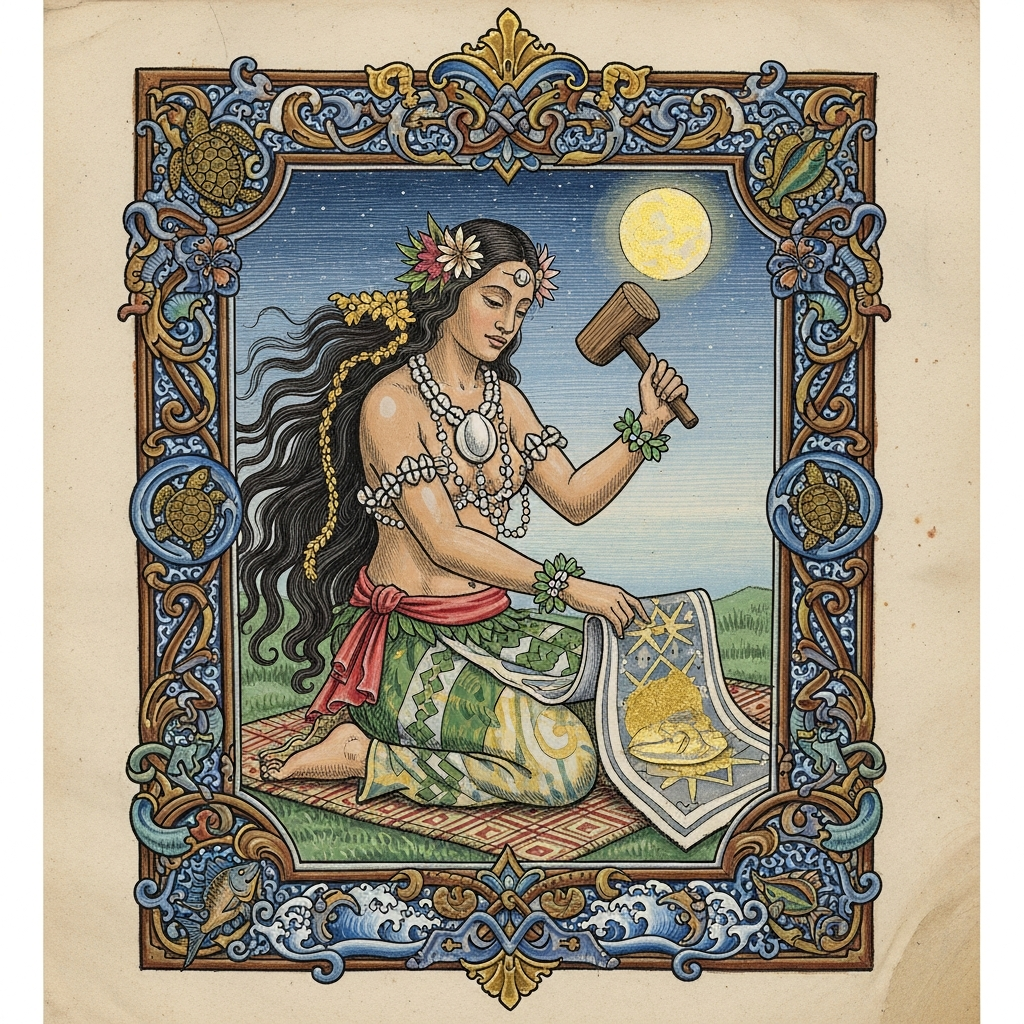
Hine-titama, the Dawn Maiden, descending into the underworld — her beauty becoming the absolute dark of Hine-nui-te-po as she transforms herself into death's guardian
 Generating art…
 Maui standing before the sleeping form of Hine-nui-te-po at the edge of the world — vast as a cliff-face, her obsidian eyes closed, her open mouth showing the barracuda teeth, the birds frozen behind him
 Generating art…
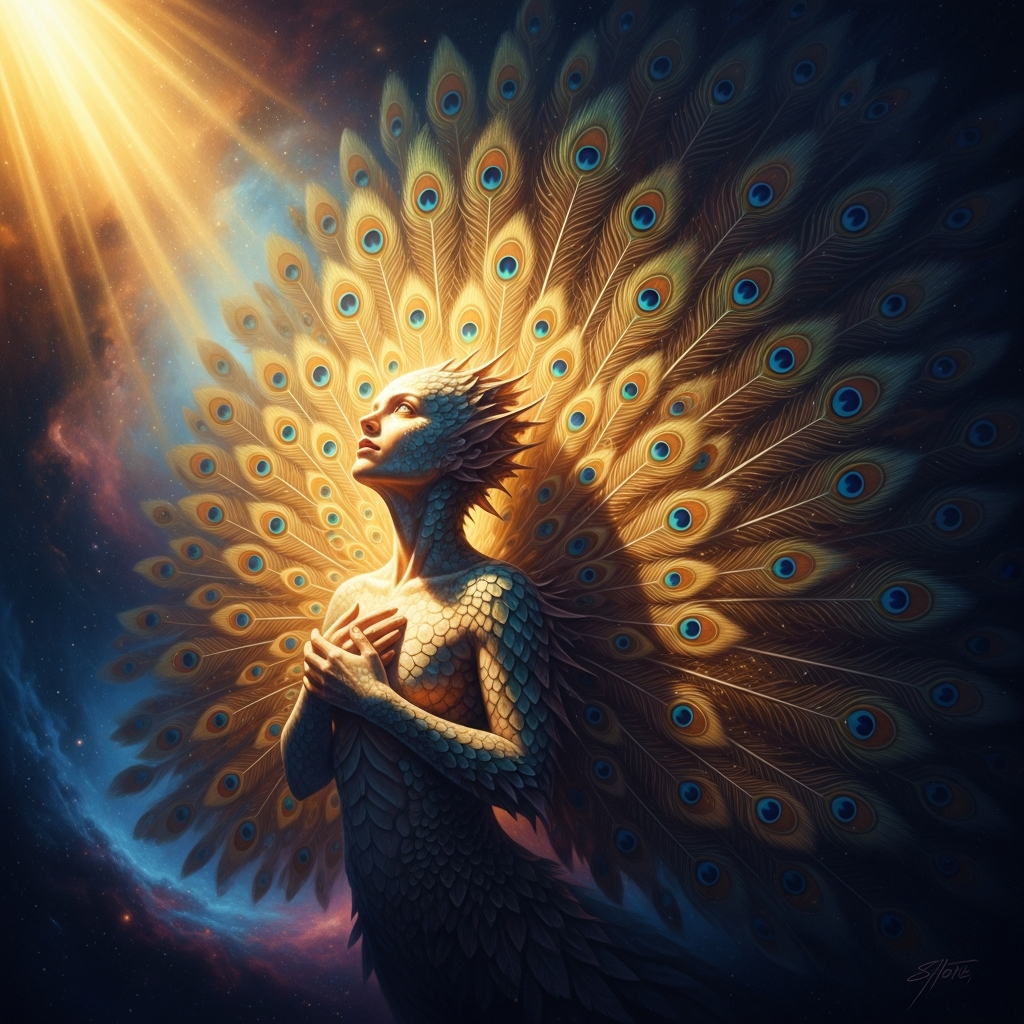
 The fantail's open beak at the moment of laughter — Hine-nui-te-po's eyes beginning to open, the grey light of a sky that will never be the same
 Generating art…
 Echoes Across Traditions
Entities
- Maui-tikitiki-a-Taranga
- Hine-nui-te-po
- Hine-titama
- Tane
- Piwakawaka

Sources
- George Grey, *Polynesian Mythology* (1855) — the earliest major written account of the Maui cycle in English
- Martha Beckwith, *Hawaiian Mythology* (1940) — comparative analysis of Polynesian death-of-Maui traditions
- Elsdon Best, *Maori Religion and Mythology* (1924)
- Katherine Luomala, *Maui-of-a-Thousand-Tricks* (1949)
- Margaret Orbell, *The Illustrated Encyclopedia of Maori Myth and Legend* (1995)