Averroes and the Burning
1195 CE · Seville and Lucena, Almohad Caliphate (al-Andalus)
Contents
In 1195 CE, the Almohad caliph burns the philosophical works of Ibn Rushd — the man whose commentaries on Aristotle had made him the most important philosopher in the medieval world — and exiles their author to house arrest at seventy-one. Ibn Rushd continues writing. The books survive him in Hebrew and Latin.
- When
- 1195 CE
- Where
- Seville and Lucena, Almohad Caliphate (al-Andalus)
The caliph’s problem is not philosophy. The caliph’s problem is the Berber tribal confederation that brought his family to power and now considers itself owed a more rigorous Islam than the cosmopolitan Andalusian scholars are providing.
This is the structural logic of the Almohad dynasty: founded on a reform movement that preached strict monotheism and the purging of anthropomorphic theology, it has been governing a population of Andalusian Arabs, Berbers, Jews, and Christians for three generations. The population is sophisticated, the intellectual culture is brilliant, and the ruling coalition’s religious base increasingly demands visible piety enforcement. The easiest target is always the philosopher.
Ibn Rushd is seventy in 1195. He has been writing for fifty years. He has produced thirty-eight commentaries on Aristotle — short, middle, and long, covering the Organon, the Physics, the Metaphysics, the De Anima, the Rhetoric, the Poetics, the Nicomachean Ethics. He has written a systematic response to al-Ghazali’s Incoherence of the Philosophers — the Tahafut al-Tahafut, the Incoherence of the Incoherence — arguing, methodically and with considerable edge, that al-Ghazali misread Aristotle and that the supposed contradiction between philosophy and Islam dissolves when the texts are read properly. He has served as court physician to the Almohad caliph, as a judge in Seville, as a legal scholar in Marrakesh.
He is, by any measure, one of the most prominent intellectuals in the Islamic world.
This is precisely why he is useful.
The decree comes in 1195.
The caliph al-Mansur — preparing a military campaign against the Spanish Christian kingdoms and needing the political support of the orthodox religious establishment — condemns the study of ancient philosophy, orders the collection and burning of philosophical texts, and exiles Ibn Rushd to the Jewish quarter of Lucena, a small town south of Córdoba, effectively under house arrest.
The edict is carefully worded to be maximally legible to the religious establishment and minimally costly to the caliph. It does not accuse Ibn Rushd of apostasy — that charge would have consequences the caliph does not want. It accuses him of leading young men astray with un-Islamic knowledge. It is the charge of the Athenians against Socrates, translated into twelfth-century Arabic: not heresy but corruption of the impressionable.
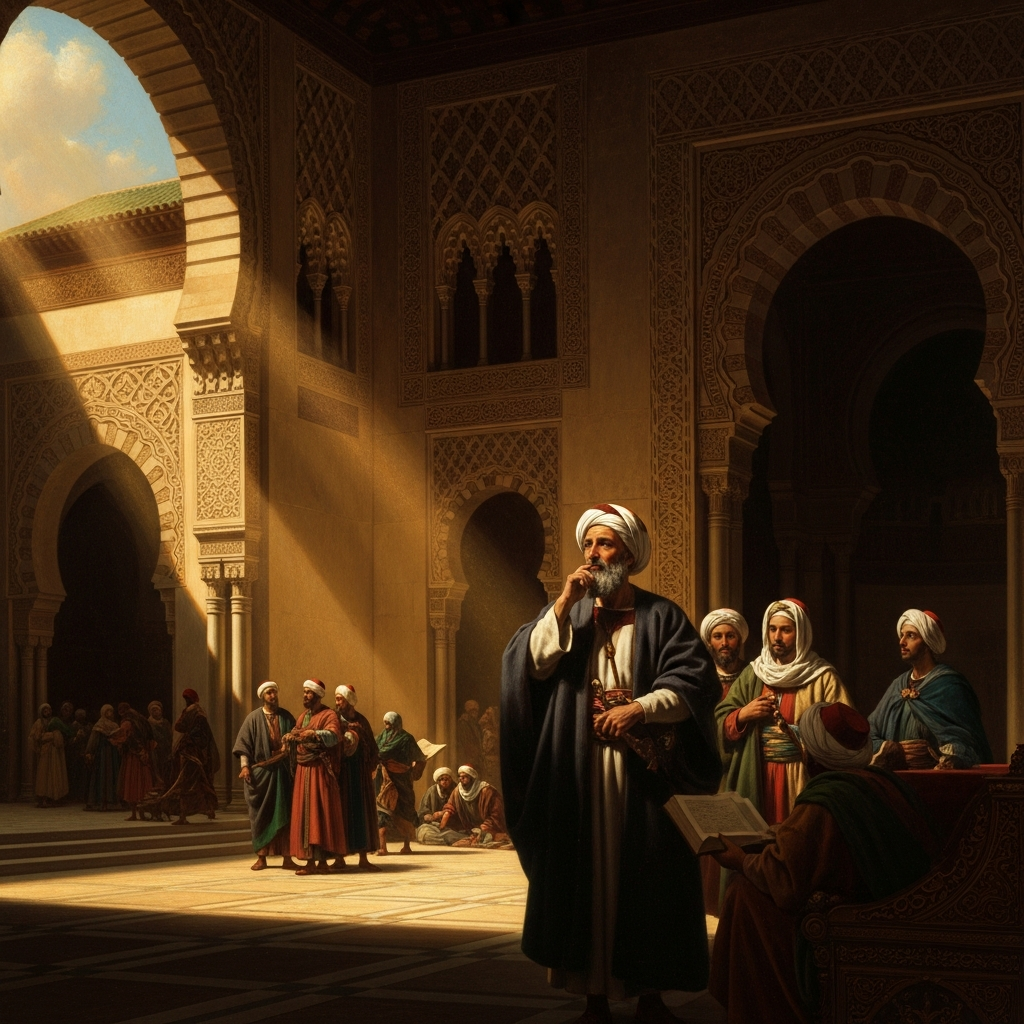
The physical books are collected in Seville — the philosophical ones, specifically. The medical texts are exempt (you cannot burn the textbooks your own physicians are using). The manuscripts are burned in the plaza. The event is public and deliberate. This is not a fire that got out of hand. It is a demonstration.
What burns in Seville is specific: the Arabic originals of Ibn Rushd’s philosophical commentaries.
What does not burn, because it is not in Seville, is everything that has already been copied.
The Jewish scholars of al-Andalus and North Africa have been reading Ibn Rushd for twenty years. His commentaries on Aristotle are not theological provocation to them — they are tools, the best tools available for the same project Jewish philosophers have been working on: making the Greek philosophical tradition legible to a community whose foundational texts are revelation rather than reason. Maimonides, writing in Cairo in the same decade, draws on Ibn Rushd without citing him — the influence is in the structure of the argument, the method, the way philosophical and revealed truth are put into relation.
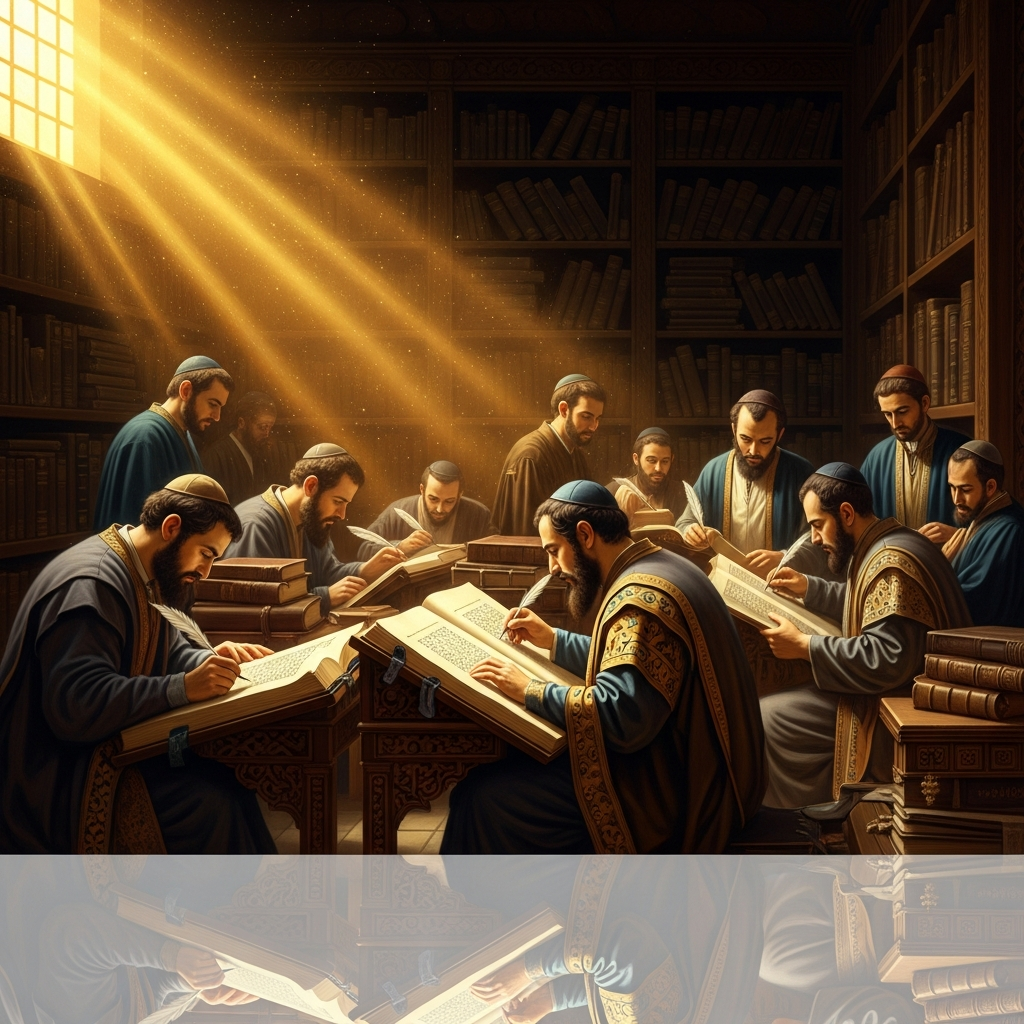
The Jewish translators begin moving the Arabic texts into Hebrew. The work is not coordinated; it is simply the obvious response to the obvious emergency. If these texts burn in Arabic, they must exist in another language.
Within a generation they are in Latin.
The Latin scholars who receive them — at the University of Paris, at Oxford, at Bologna — encounter Aristotle in a specific way: already commented on, already systematized, already read through the lens of a particular and sophisticated medieval intelligence. They call the author of that intelligence the Commentator — no other designation needed, because there is only one. Aristotle is the Philosopher; the man who made Aristotle accessible is the Commentator. This is not a title his patrons gave him. It is what the recipients of the transmission called him because no other title fit.
In Lucena, the Commentator continues to write.
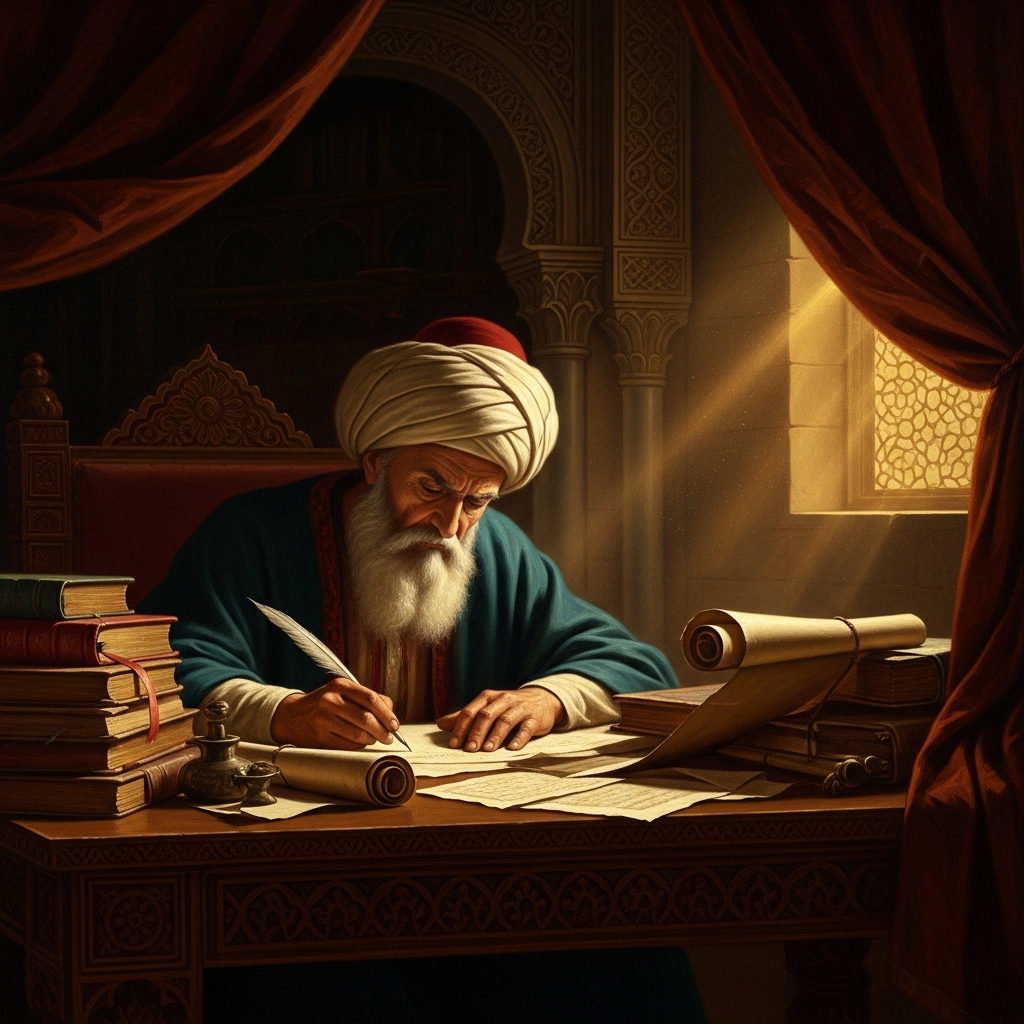
He is under house arrest, but house arrest in the twelfth century is a different condition than the cells that the phrase conjures now. He has his library — the books that survived the burning are the ones in his possession, which he has evidently been strategic about. He has students who come to him. He has the capacity to write.
He writes.
He completes commentaries he had not finished. He revises earlier work. He writes a medical encyclopedia. He produces, in these last years, a series of shorter philosophical texts that are more personal than the systematic commentaries — texts that deal with the question he has been living for decades: whether a rational human being, reading revelation carefully and reading Aristotle carefully, can hold both without contradiction, or whether one must eventually give way to the other.
His answer, sustained across fifty years of writing and now confirmed by the experience of persecution: neither gives way. They are not competitors. They address the same reality from different angles of approach, and the man who understands both is better positioned to understand either. The sharia governs action; philosophy governs understanding. The ulama who ban philosophy are not defending Islam — they are impoverishing it.
This is the argument the caliph’s edict called dangerous. Ibn Rushd does not revise it.
He is recalled from exile in 1197. The military campaign is over; the political pressure has eased; the caliph has what he needed from the performance of orthodoxy and no longer needs to maintain the exile of his most prominent intellectual. Ibn Rushd returns to Marrakesh.
He dies there in December 1198, nine months after the recall.
He is seventy-two. The books that were burned in Seville in 1195 are already, in that same year of his death, being translated in Toledo. The translation movement that moves through the Jewish scholars into the Latin scholars is in full operation. The texts the burning was meant to erase are moving through every channel the burning failed to close.
Thomas Aquinas will be born thirty years later. He will read Ibn Rushd in Latin throughout his education. He will structure the Summa Theologica partly as a response to the Commentator’s doctrine of the unity of the active intellect — the controversial claim that all human beings share one intellect, which Aquinas finds theologically intolerable and must dismantle. To dismantle it he must engage it in detail. To engage it in detail he must inhabit Ibn Rushd’s framework from the inside.
The burning did not end the influence. It redirected it into the civilization that would carry it furthest.
The historians of Islamic thought return to 1195 with the same recurring question: what would Islamic intellectual culture have looked like if the Almohad caliph had not needed the tribal coalition’s approval that autumn? Ibn Rushd had students. He was working within a tradition of Andalusian philosophy that was alive and productive. Under different political conditions, the systematic Aristotelian project might have continued in Arabic, through an unbroken Islamic chain, and the story of Western philosophy’s recovery of the Greek tradition might have been an Islamic story as much as a Jewish and Christian one.
Instead it became a story of loss and displacement: the Arabic originals largely gone, the transmission running through Hebrew, the arrival in Latin coming secondhand. Dante puts Ibn Rushd in Limbo — not in hell, but in the place reserved for virtuous pagans who came before Christ. Among the philosophers in Dante’s Limbo, Ibn Rushd alone is a monotheist who had access to revelation. Dante knows this. He puts him there anyway. The geography of Dante’s afterlife is always also a map of his intellectual debts.
The Commentator sits in Limbo and has presumably read the Aquinas that built on him. The argument continues.
Scenes
In the plaza before the Almohad court, Ibn Rushd's philosophical manuscripts are committed to fire — the Arabic originals of the texts that will remake European thought, destroyed to satisfy a political moment
 Generating art…
 Under house arrest in Lucena at seventy-one, Ibn Rushd continues his commentaries — he has been writing for fifty years and does not stop because the audience has been narrowed by decree
 Generating art…
 Jewish scholars in Lucena and Toledo copy Ibn Rushd's Arabic commentaries into Hebrew — the texts that will survive the burning and reach Aquinas, Dante, and the university schools of Paris
 Generating art…
 Echoes Across Traditions
Entities
- Ibn Rushd (Averroes)
- Caliph al-Mansur
- Ibn Tufayl
- Maimonides
Sources
- Ibn Rushd, *Tahafut al-Tahafut* (The Incoherence of the Incoherence), trans. Simon van den Bergh (1954)
- Dominique Urvoy, *Ibn Rushd (Averroes)*, trans. Olivia Stewart (1991)
- Majid Fakhry, *Averroes: His Life, Works and Influence* (2001)
- Roger Arnaldez, *Averroes: A Rationalist in Islam* (2000)
- Herbert Davidson, *Alfarabi, Avicenna, and Averroes on Intellect* (Oxford, 1992)