The Philosopher of Light, Killed at Thirty-Eight
1154-1191 CE — born in Suhraward, Iran; killed in Aleppo at thirty-six or thirty-eight · Maragheh and Isfahan (Iran), then Aleppo (Syria) — the Citadel of Aleppo where he is imprisoned and executed
Contents
In four years at Aleppo, Suhrawardi writes twenty books proving that the universe is a hierarchy of luminous angels descending from the Light of Lights — and the orthodox jurists, reading him in horror, persuade Saladin's son to execute him in the citadel before he turns forty.
- When
- 1154-1191 CE — born in Suhraward, Iran; killed in Aleppo at thirty-six or thirty-eight
- Where
- Maragheh and Isfahan (Iran), then Aleppo (Syria) — the Citadel of Aleppo where he is imprisoned and executed
He is thirty-six.
Some sources say thirty-eight. The discrepancy is small enough that it does not change the meaning, which is: he is young. He is younger than Jesus when Jesus died. He is younger than Mansur al-Hallaj when Hallaj died. He is younger than the senior jurists who, having read his books, are at this moment writing a letter to the governor.
The letter says: This man is a heretic. This man is a danger to the faith. This man teaches that the universe is light, that the angels are degrees of light, that the soul ascends by becoming light. He uses the names of the Zoroastrian angels in books that he gives to Muslim princes. He has the ear of your son. He must be silenced.
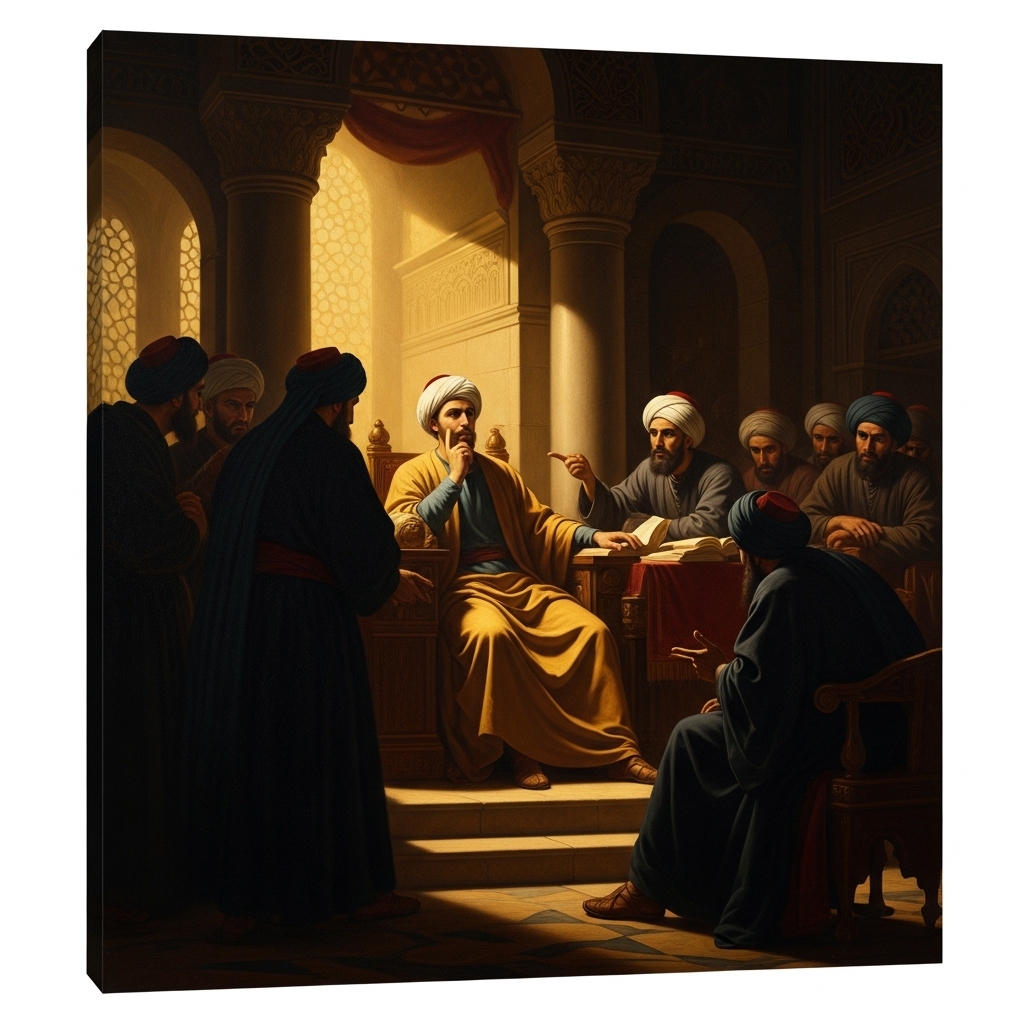
The governor’s son is twenty-one years old. His name is al-Malik al-Zahir Ghazi. He is the son of Saladin — the Saladin, the conqueror of Jerusalem, the man whose name is at this moment becoming legend across Christendom and Islam alike. Al-Zahir Ghazi has been given Aleppo to govern as his apprenticeship in rule. He is bookish. He has surrounded himself with poets and philosophers. He has read the philosopher’s Hayakil al-Nur — The Temples of Light — and he has been so impressed that he has installed the philosopher at his court.
The letter from the jurists arrives. The young governor reads it. He puts it aside.
The jurists write again.
They write to Saladin.
The philosopher’s full name is Shihab al-Din Yahya ibn Habash al-Suhrawardi. He was born in 1154 in the small town of Suhraward, in northwestern Iran, near the modern Iraqi border. His parents were locally prominent. He was a precocious child. He memorized texts at a rate that exhausted his teachers. By eighteen he had moved to Maragheh, then to Isfahan, studying philosophy under the masters of the falsafa tradition — the inheritors of Avicenna, who in turn was the inheritor of al-Farabi, who in turn was the inheritor of the Greek philosophical corpus that had been translated into Arabic at the House of Wisdom in Baghdad three centuries earlier.
He absorbed all of it.
Then he started to think it was not enough.
The Aristotelian tradition — the mashsha’i, the Peripatetic — had taught him that being is divided into substance and accident, into matter and form, into potency and act. He found these categories cold. He found them lifeless. He found them unable to account for the thing he himself had experienced, repeatedly, in solitary retreat: the direct cognition of luminous presences that did not fit into any of Aristotle’s categories. He had seen them. He had — and this is the move that breaks his philosophy from everything before it — been seen by them.
He set out to build a system that could hold this experience.
He went to Anatolia. He went to Syria. He spent years in the company of the Sufi shaykhs and the Hermetic and Sabian inheritors of late antiquity. He read the Zoroastrian texts that the Persian intellectuals had quietly preserved. He read the Corpus Hermeticum in its Arabic transmission. He read Plato — through the Neoplatonists, through Plotinus, through Proclus — and saw something the Aristotelians had missed: the Forms were not abstract universals. They were luminous beings.
He reached Aleppo around 1183. He was twenty-nine.
In four years he wrote twenty books.
The system he constructed, Hikmat al-Ishraq — the Wisdom or Philosophy of Illumination — has a single first principle and a precise architecture.
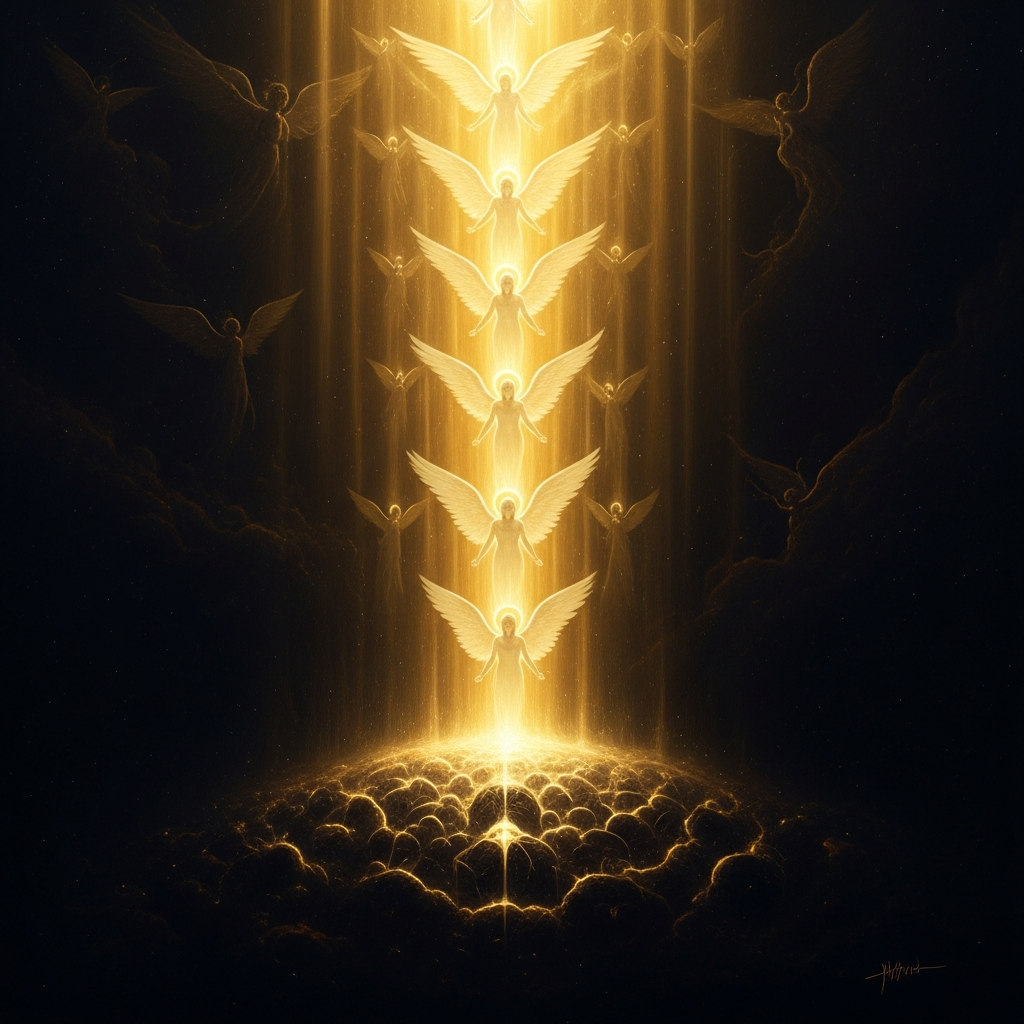
The first principle is Nur al-Anwar — the Light of Lights. The Light of Lights is not a thing that has the property of light. It is light, with no further qualification, the source of all that is. It is what other traditions have called God, but Suhrawardi insists on the term light because light is the one phenomenon that is self-evident: nothing illumines light. Light illumines itself, and then it illumines everything else.
From the Light of Lights proceed, in descending hierarchy, the Anwar al-Qahira — the Dominating Lights. These are pure intellects, immaterial luminous beings, whom Suhrawardi identifies with the angels of the Qur’an and also — and this is the move the jurists will not forgive — with the Amesha Spentas of Zoroastrian tradition: Vohu Manah, Asha, Khshathra, Spenta Armaiti. He uses their Pahlavi names. He says these are the same beings the Greeks called Forms, the same beings the Persians called Yazatas, the same beings the Qur’an calls mala’ika. The names differ. The realities are continuous.
Below the Dominating Lights come the Anwar al-Mudabbira — the Managing Lights — who govern the celestial spheres and the species of the world. Below these come the human souls, the Anwar al-Isfahbadiyya, who are the same kind of light as the angels but trapped in the dimness of bodies. The body itself, and matter generally, is barzakh — interstice — what Suhrawardi calls zulma, darkness. Darkness is not, in this system, an opposing principle. It is the absence of light. It is light that has receded so far from its source that it has forgotten itself. To be saved is to remember.
The mystical experience that Sufism had been pursuing for centuries — the fana, the annihilation of the self in God, the rising of the soul through the stations of love — Suhrawardi recasts as a return up the ladder of light. The seeker, by ascetic discipline and by the cognitive discipline of philosophy, separates from the body’s darkness and remembers what kind of light he is.
This is Hikmat al-Ishraq.
It is the most ambitious philosophical synthesis in the medieval Islamic world. It is also, the jurists notice, suspicious in nearly every direction. It uses pre-Islamic angel names. It identifies God with light, which can be read as making God a body. It teaches a doctrine of self-knowledge that bypasses the prophetic mediation. It tells princes that they can attain divine wisdom directly, by retreat and meditation, without the supervision of the religious scholars whose authority depends on being the gatekeepers of revelation.
The jurists write the letter.
Saladin is in the field. He has just retaken Jerusalem from the Crusaders, in 1187. He is dealing with the counter-attack — Richard the Lionheart is on his way, and the Third Crusade is beginning. He does not want to deal with a metaphysical dispute in Aleppo. He wants his son to govern competently and not to be embroiled in scandal.
He sends a letter to al-Zahir Ghazi.
The letter, in some versions of the story, is brief: Execute him. In other versions it is more elaborate, urging the young governor to consider how the philosopher’s continued presence threatens the political legitimacy of the Ayyubid dynasty in a city full of competing religious factions. In all versions, the result is the same.
Al-Zahir Ghazi delays. He does not want to do it. He has come to love the philosopher. They have spent nights talking about the structure of the celestial hierarchy. The young governor has felt something open in himself that no other teacher has been able to open.
He delays for weeks. The jurists petition again. Saladin writes again.
He gives the order.
The philosopher is imprisoned in the Citadel of Aleppo. The Citadel is a stone fortress on a hill above the city, the kind of place from which no prisoner is rescued. He is held there for some weeks. The accounts disagree on the method of execution. Some say strangulation. Some say starvation — the philosopher refuses food and dies of voluntary fasting before the executioner can reach him. Some say he is left in a cell without food or water. Some say poison. The discrepancy is itself a clue: the dynasty did not want a public execution. The dynasty wanted him to disappear quietly.
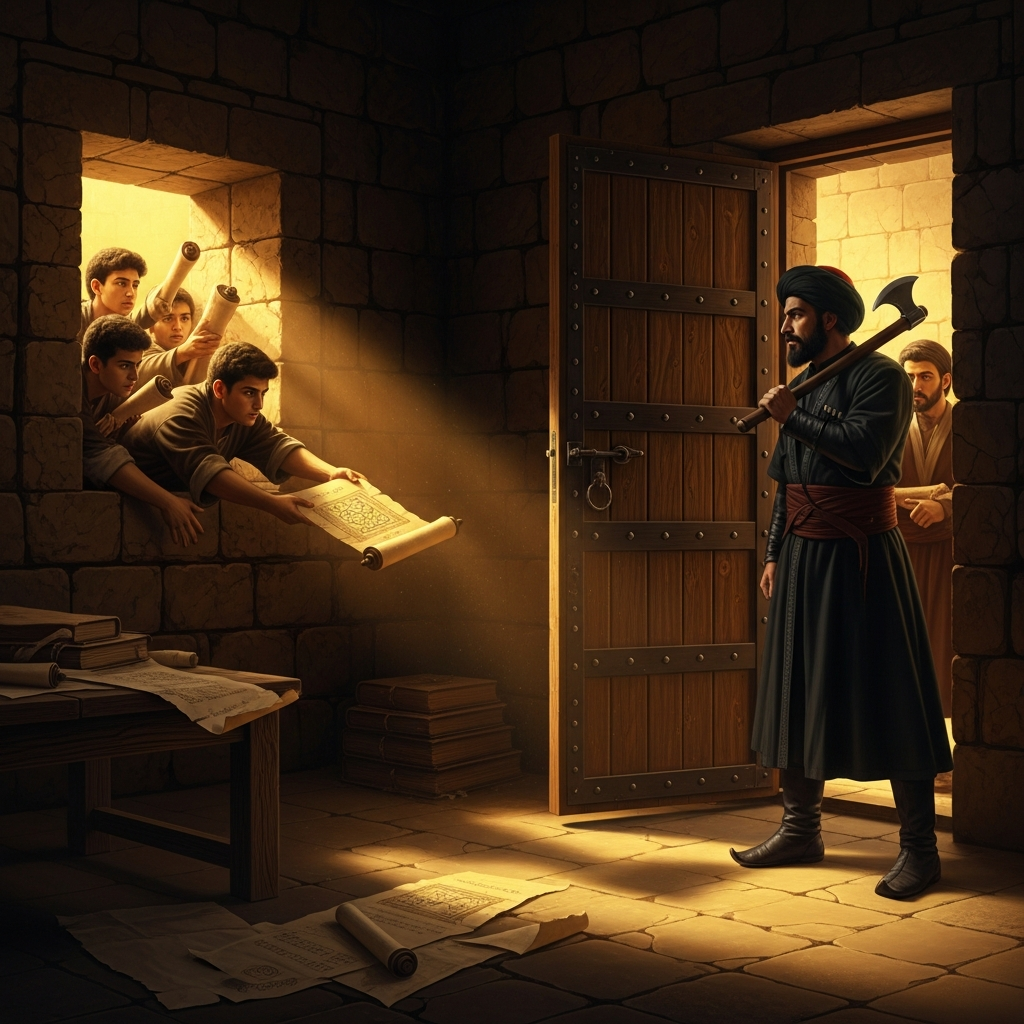
He is buried in an unmarked place in the Citadel. The students who have followed him from Iran — and there are several, young men who attached themselves to him as he traveled — are present in the city but not at the death. They wait. Once the dynasty’s attention is elsewhere, they collect the manuscripts.
The manuscripts survive because of them.
The dynasty’s calculation has failed.
Within a generation, Hikmat al-Ishraq is being copied across Iran and Iraq. Within two generations, the commentators have begun: Shahrazuri in the late thirteenth century, Qutb al-Din Shirazi in the early fourteenth. By the seventeenth century, in Safavid Isfahan, Mulla Sadra is constructing the synthesis of Avicenna and Suhrawardi that will dominate Iranian philosophy until the present day. By the twentieth century, the French Orientalist Henry Corbin is in Tehran, working with Iranian scholars to produce critical editions of all of Suhrawardi’s surviving works.
The orthodox tradition that ordered his execution has not produced a single thinker of his stature in the eight centuries since.
He is called, by the tradition that follows him, al-Maqtul — The Slain. The honorific is also a verdict. He is the philosopher whose method — the synthesis of inherited reason and inherited mystical experience, organized around a single luminous principle — is now read as the method, and his death is read as the price the institution paid to discover it could not erase him.
The jurists who wrote the letter are not remembered.
The Citadel still stands.
The light, in the system he built, has not stopped descending.
Scenes
Suhrawardi sees the cosmos as graded illumination — pure light descending through hierarchies of luminous angels until matter, which is light that has forgotten itself
Generating art… At the court of al-Malik al-Zahir Ghazi in Aleppo, the young philosopher debates the senior jurists who will soon petition for his death
 Generating art…
 In a cell of the Citadel of Aleppo, the manuscripts are smuggled out by his students while the executioner waits at the door — he is thirty-eight
 Generating art…
 Echoes Across Traditions
Entities
- Suhrawardi (Shihab al-Din Yahya ibn Habash)
- al-Malik al-Zahir Ghazi
- Saladin (Salah al-Din)
- the jurists of Aleppo
- Mulla Sadra
Sources
- Suhrawardi, *The Philosophy of Illumination* (*Hikmat al-Ishraq*), trans. John Walbridge and Hossein Ziai (Brigham Young, 1999)
- Henry Corbin, *Spiritual Body and Celestial Earth* (Princeton, 1960)
- Seyyed Hossein Nasr, *Islamic Philosophy from Its Origin to the Present* (SUNY, 2006)
- John Walbridge, *The Leaven of the Ancients: Suhrawardi and the Heritage of the Greeks* (SUNY, 2000)
- Hossein Ziai, *Knowledge and Illumination: A Study of Suhrawardi's Hikmat al-Ishraq* (Scholars Press, 1990)