Maimonides and the God Who Cannot Be Described
Mediterranean world · 1138–1204 CE; the *Guide for the Perplexed* completed c. 1190 in Fustat (Old Cairo) · Córdoba (birthplace) → Fez under the Almohads → briefly the Land of Israel → Fustat, Egypt — the harbor district of Old Cairo where the Jewish community has its synagogue, its court, and the Geniza in which Maimonides's own letters will lie undisturbed for seven centuries
Contents
In Cairo, in the spare hours between consultations as court physician to Saladin's vizier, Moses ben Maimon writes a book for Jews who have studied Aristotle and cannot reconcile him with their Scripture — and arrives at a God who has no attributes, of whom every positive statement is false.
- When
- Mediterranean world · 1138–1204 CE; the *Guide for the Perplexed* completed c. 1190 in Fustat (Old Cairo)
- Where
- Córdoba (birthplace) → Fez under the Almohads → briefly the Land of Israel → Fustat, Egypt — the harbor district of Old Cairo where the Jewish community has its synagogue, its court, and the Geniza in which Maimonides's own letters will lie undisturbed for seven centuries
The boy is born in Córdoba on the night of Passover, 1138.
This is the high noon of Andalusi civilization. Córdoba in the twelfth century is the largest city in western Europe, home to the great mosque whose forest of columns is one of the wonders of the medieval world, home to libraries that contain everything ancient Greek learning preserved in Arabic translation. The Jewish community of Córdoba is integrated into this culture in a way that will not exist again for many centuries: Jewish scholars write in Arabic, study Aristotle in Arabic, debate philosophy with Muslim and Christian colleagues, hold positions at the courts of the Andalusi rulers. The boy’s father, Maimon ben Joseph, is a dayyan — a rabbinical judge — and a respected scholar. The boy is named Moses.
He grows up in this world. He learns Hebrew and Arabic and the philosophical Greek that has come to him through Arabic. He studies Talmud with his father. He absorbs, by the time he is in his teens, the entire intellectual apparatus of Andalusi Judaism — the philosophy, the poetry, the science, the medicine.
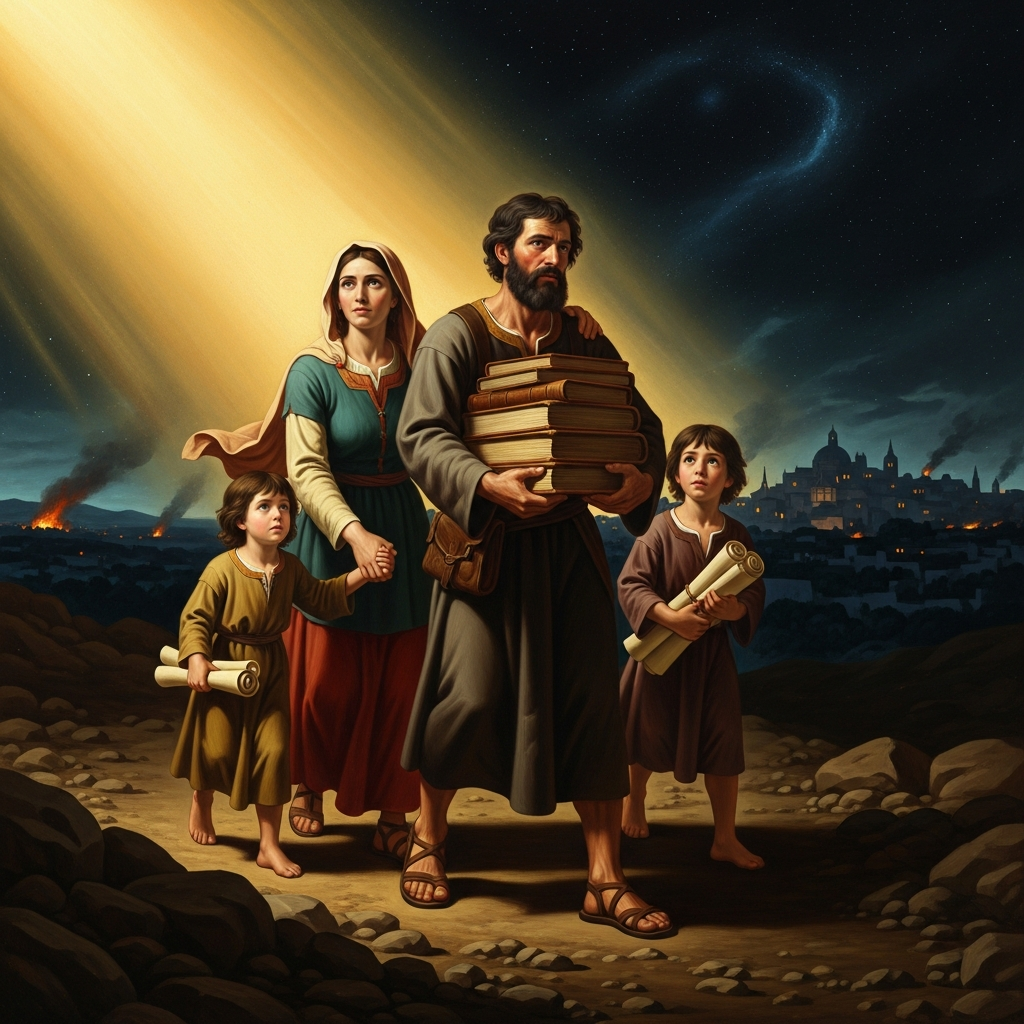
In 1148 the Almohads conquer Córdoba.
The Almohads are a Berber dynasty from North Africa — fundamentalist by the standards of the Andalusi Islam that preceded them, intolerant by the standards of any era. They give the Jews of their territories three options: convert to Islam, leave, or die. The Maimon family chooses the obvious complication: they pretend to convert. They live as outwardly observant Muslims while remaining, in the household, observant Jews. They do this in Córdoba briefly. They do this in various Iberian and North African cities for nearly twenty years. They are refugees. They are concealed Jews. The boy who will become Maimonides spends his entire adolescence and early adulthood in this precarious posture.
In 1165 the family reaches Egypt — finally, after the long detour through Fez and Acre, finally a land where Jews can be Jews openly — and in Egypt, in Fustat (Old Cairo, the harbor district below the new Fatimid foundation), Maimonides will spend the rest of his life.
His brother is the merchant.
David ben Maimon — younger, ambitious, the practical man of the family — runs the family’s trade in precious stones. He travels to India by way of the Indian Ocean spice routes, the long Egyptian-Yemeni-Indian trade circuit that connects Cairo to Calicut. The wealth from David’s voyages supports the household, including Moses, who has chosen the scholar’s life and produces nothing in cash.
In 1169 David’s ship is lost in the Indian Ocean.
Moses receives the news. The grief flattens him. He writes, in a letter preserved in the Cairo Geniza eight centuries later, that for nearly a year he could not study, could not work, could not function. I have lost my brother, my friend, who was raised on my knees, who studied Torah with me, who was the best of the family. The letter is one of the most personal documents we have from any medieval rabbi. It is also, quietly, the moment that turned Maimonides into a working physician. With David gone, the family had no income. Maimonides had to earn money. He had medical training. He took it up as a profession. He became, eventually, the most distinguished physician in Cairo.
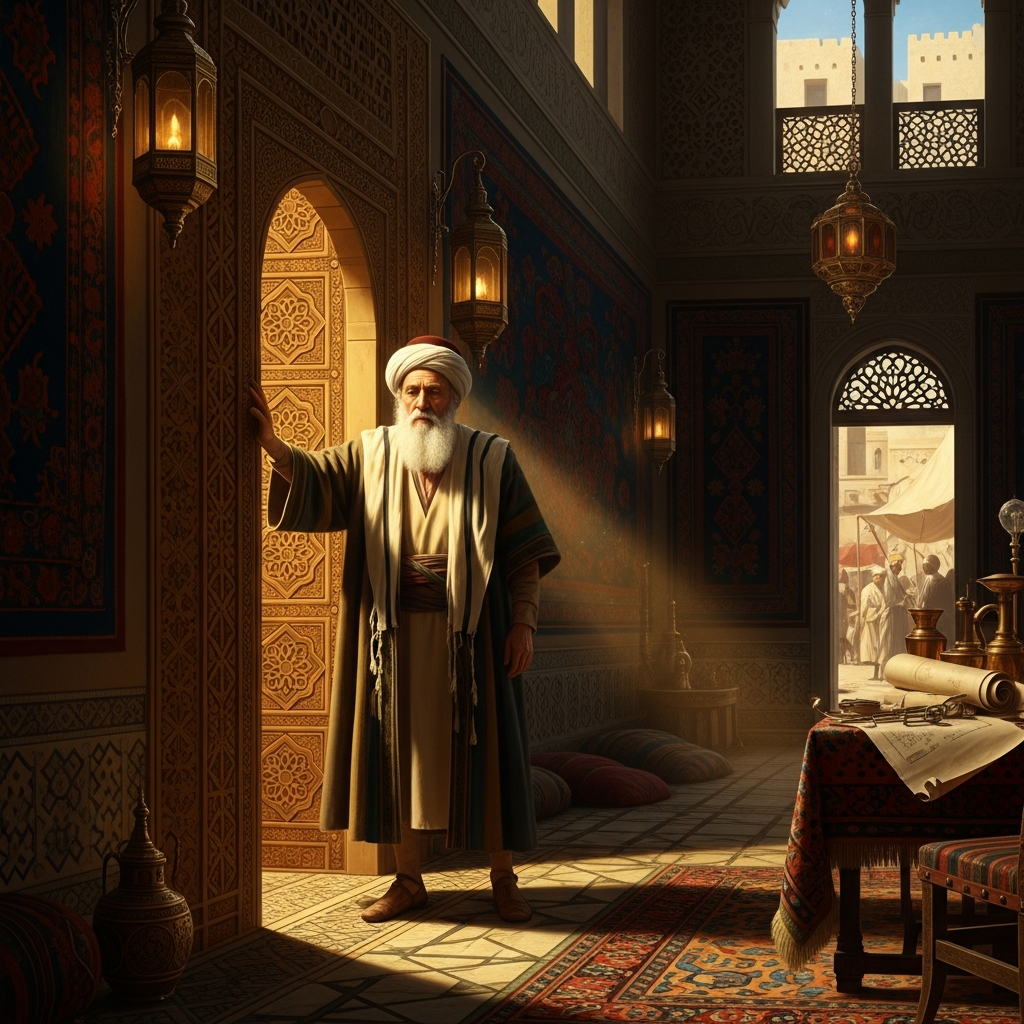
By the late 1180s he is court physician to al-Qadi al-Fadil, the brilliant vizier of Saladin — the same Saladin who will retake Jerusalem from the Crusaders in 1187 and become the most famous Muslim ruler of the Middle Ages. Maimonides treats the vizier and his household. He treats other Egyptian notables. He treats the Jewish community, free of charge, in his off-hours. The medical practice consumes most of every day.
The philosophy he writes in the hours that remain.
The Guide for the Perplexed is structured as a letter.
It is written for one reader: a young man named Joseph ben Judah, a former student of Maimonides who has moved away. Joseph has studied the standard rabbinic curriculum. He has also read Aristotle — meaning, in 1185, the Aristotelian corpus as transmitted through Arabic translation and the commentaries of al-Farabi, Avicenna, and Averroes. Joseph has noticed the problem: Aristotle says the world is eternal; the Torah says God created it. Aristotle says God is impersonal, unchanging, perfect actuality; the Torah says God spoke to Moses, was angry with the golden calf, hardened Pharaoh’s heart. The descriptions are not compatible. Joseph wants to know what to do.
Maimonides writes him a book that takes most of a decade to complete. The Guide runs to three volumes, in Judeo-Arabic — Arabic written in Hebrew letters, the language of educated Jews in the Cairo of his time. It is structured as if it were addressed to Joseph but it is meant for any reader who can pass through the same gates Joseph passed.
The argument is intricate, but its central move is this: the apparent contradictions between Aristotle and Scripture are not real contradictions. They are surface effects of the fact that Scripture speaks in human language to human readers, while the underlying truth is philosophical. When the Torah says God speaks, it does not mean God has vocal cords. When the Torah says God is angry, it does not mean God has the emotion of anger. These are anthropomorphisms — accommodations to human limitation — and the philosophically educated reader is required to read past them to the truth they conceal.
What is the truth they conceal?
Maimonides’s answer is staggering. The truth is that no positive statement about God is true. To say God is wise is false, because God is not the kind of being that can have an attribute called wisdom in the way a human has wisdom. To say God is good is false. To say God exists is even false, in the sense that exists means for the things we know about. The only legitimate theological language is negative: God is not ignorant. God is not malicious. God is not subject to time or change. We can say what God is not with some accuracy. What God is lies on the other side of language.
This is negative theology. Apophatic theology, the Christian mystics will call it later. The God of Maimonides is the God of whom one can only stammer.
The proposition is rigorous, and it is also unbearable.
The Jew on the street believes, when he prays, that he is addressing a being who hears. The Torah portrays such a being. The liturgy depends on such a being. Maimonides, by demonstrating that strict philosophical thought arrives at a God of whom no positive predicate can be truthfully spoken, is potentially evacuating the religious life of its addressable object.
He is aware of this. He spends much of the Guide qualifying the negative theology: God’s actions in the world produce effects we can describe, even if God himself remains beyond description. The biblical anthropomorphisms are pedagogically necessary, even if they are technically false. The masses must continue to pray in the language of the Psalms, even if the philosopher knows the language is approximate. There is a hierarchy of understanding. Most people will live their religious lives without ever needing to climb the philosophical ladder. The Guide is for those who have been forced onto the ladder by their own reading and need help climbing without falling off.
This is the elitist dimension of the project, and it is not concealed. Maimonides believes that genuine religious truth is hard, that most people will not pursue it, and that the Torah is structured precisely to give different readers different levels of access. The peshat, the plain meaning, is for everyone. The deeper philosophical reading is for the few. The few have an obligation to climb. The Torah, properly read, is the ladder.
The Mishneh Torah is the other half of the project.
While the Guide is the philosophical statement for the elite, the Mishneh Torah is the legal code for everyone. It is fourteen volumes. It systematizes the entirety of Jewish law — every ruling from the Mishnah, every Talmudic discussion, every later opinion — into a single coherent code, organized by topic, written in classical Hebrew (not Aramaic, not Judeo-Arabic, but the Hebrew that any educated Jew anywhere in the world can read), without footnotes or citations. Maimonides intends it to be the practical guide that every Jew can use to know what the law requires without having to wade through the entire Talmudic corpus.
The omission of citations is controversial. Without footnotes, the reader cannot check Maimonides’s reasoning. The objection is raised even in his lifetime. Maimonides defends the choice: the work is not for scholars who want to verify each step; it is for ordinary Jews who need to know how to live. The scholar can reconstruct the sources from the rulings.
The two works — the Mishneh Torah and the Guide — are designed to function together. The Mishneh Torah tells the Jew what to do. The Guide tells the philosopher what the doing means. They are written for different audiences and they assume different things, but they are produced by the same mind, and the mind has a unified vision: a Jewish life that is fully obedient to halakha at the level of practice and fully informed by Aristotelian philosophy at the level of understanding.
In Cairo, the working day is long.
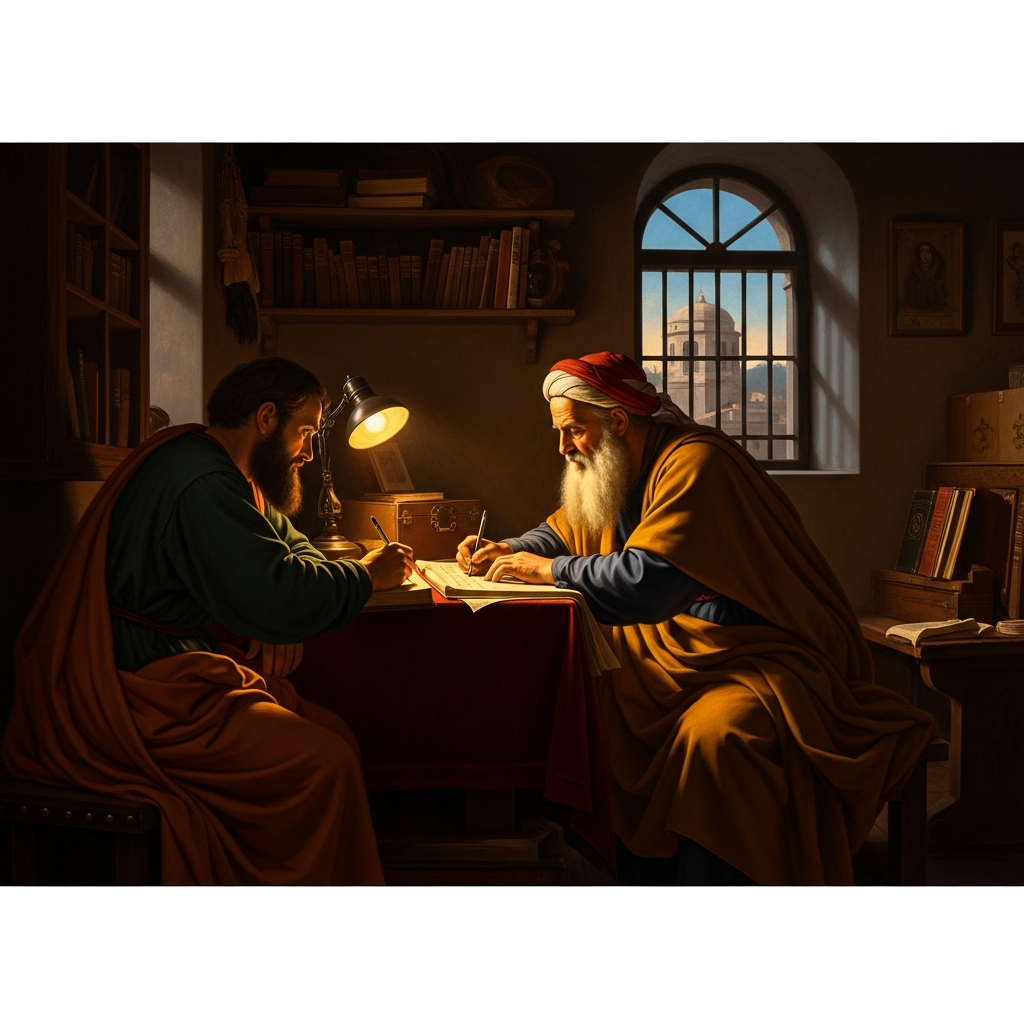
The Geniza letters preserve a description of his schedule, written by Maimonides himself to a translator of the Guide who had asked when they could meet. Maimonides explains: he rises at dawn. He rides to Saladin’s palace where the vizier and the household must be seen first. He returns to Fustat by early afternoon, exhausted, and finds his own clinic full — Jews and Muslims and Christians waiting for him on the steps and in the street. He sees them until evening. He eats once a day, in the late evening, often the only meal. After dinner he turns to his correspondence — letters from Yemen asking about messianic claims, letters from Provence asking about astrology, letters from his fellow rabbis asking about points of law — and answers them. Only then, when the night is deep, does he turn to the Guide.
He is exhausted. He says so, in the same letter: I am too tired to receive visitors. I cannot speak with anyone in private about Torah matters during the week, because my time is consumed. He is the busiest physician in Cairo and the busiest legal authority in world Jewry and the most ambitious philosopher of his generation, and he is doing all three jobs in the same week, and the philosophy is the part he writes after midnight.
He dies in 1204, at sixty-six. Egypt mourns. The Jewish community of Fustat declares public mourning; the Egyptian state declares public mourning; even the Muslim chronicler ibn al-Qifti, who knew him, writes that the city was shaken. His body is taken to Tiberias for burial, in the Galilee, the Land of Israel he had visited briefly forty years earlier and never been able to return to.
The Guide for the Perplexed leaves Cairo.
It is translated into Hebrew in the year of Maimonides’s death by Samuel ibn Tibbon, a translator in Provence, and it spreads through the Jewish communities of Christian Europe with extraordinary rapidity. Within fifty years it has provoked the Maimonidean controversy — the bitter intellectual quarrel between Jewish philosophers, who treat the Guide as the foundation of legitimate Jewish thought, and traditionalists, who regard it as a Trojan horse that will smuggle Aristotelianism into the Torah and corrupt the unwary. In 1232 the rabbis of northern France ban the study of the Guide. In 1234 — the report is preserved in several sources, though contested by some scholars — the Dominicans of Montpellier burn copies in the public square, possibly with the cooperation of the anti-Maimonidean rabbis. The book becomes the focal point of an intra-Jewish quarrel that runs for more than a century.
It also reaches Christian readers. Albertus Magnus reads it. Thomas Aquinas reads it. The references in the Summa Theologica are unmistakable: Aquinas cites Rabbi Moses repeatedly on the question of the world’s eternity, on negative theology, on the philosophical analysis of biblical anthropomorphism. The Christian-Jewish-Muslim triangle of twelfth-century Aristotelianism — Aquinas, Maimonides, Averroes — produces, in three different theological idioms, three closely related solutions to the same problem. Each one acknowledges, with varying degrees of explicitness, the work of the others.
By the seventeenth century, Spinoza in Amsterdam is reading Maimonides as the foundation of his own philosophy. Spinoza will conclude — and Maimonides would have been horrified by the conclusion — that the negative theology, pursued rigorously, leads not to the orthodox God of Israel but to Deus sive natura, God-or-nature, an immanent divine substance with no special covenantal relation to any people. Spinoza’s Theological-Political Treatise (1670) is, structurally, what happens when the Maimonidean allegorical method is applied without the brakes Maimonides had installed. The brakes are theological loyalty. Spinoza removes them. The car goes off the road in a particular direction Maimonides did not intend, and modernity as we know it begins.
The Geniza of the Ben Ezra synagogue in Fustat — the storeroom where for nine hundred years the Jewish community of Old Cairo deposited every piece of paper too sacred to throw away because it might bear the divine name — preserved Maimonides’s own letters, his own marginal notes, his own draft pages. The discovery of the Geniza in the late nineteenth century by Solomon Schechter delivered, to the modern world, the man behind the philosophy: the working physician, the harassed correspondent, the grieving brother, the patient legal counselor, the irritable scholar with too much to do.
He did the philosophy late at night, when everyone else had gone to bed.
He wrote a book to demonstrate that nothing positive can be said about God, and he wrote it for one young friend who could not reconcile his Aristotle with his Torah. The book outlasted him by eight centuries. Aquinas read it. Spinoza read it. Every Jewish philosopher since has had to position himself for or against it. The God it describes — the God of whom one can only say what He is not — is the God medieval Christianity, medieval Judaism, and medieval Islam jointly arrived at, in Latin and Hebrew and Arabic, in three traditions that did not fully trust one another and yet found, in the same Greek philosophy and the same monotheistic premise, the same answer. Maimonides did the work in the quiet hours after the patients had gone. The work is still being read.
Scenes
In a small room in Fustat after the medical consultations are over, Maimonides writes the *Guide for the Perplexed* in Judeo-Arabic by lamplight — the language of the streets outside, written in Hebrew letters for the Jewish reader who cannot afford to be seen reading philosophy
Generating art… In 1148, Córdoba falls to the Almohads
 Generating art…
 In Saladin's Cairo, Maimonides arrives at the vizier's chambers exhausted from the morning's clinic — performs the diagnoses, prescribes the regimens, and then walks home through the market to the room where the Guide waits
 Generating art…
 Echoes Across Traditions
Entities
- Maimonides (Moses ben Maimon, Rambam)
- Saladin (Salah ad-Din)
- Al-Qadi al-Fadil (Saladin's vizier)
- Abraham Maimonides (his son and successor)
- Thomas Aquinas (the Christian who cites him as 'Rabbi Moses')
Sources
- Maimonides, *Guide for the Perplexed*, trans. Shlomo Pines (University of Chicago, 1963)
- Maimonides, *Mishneh Torah* (the legal code, 1170–1180); *Commentary on the Mishnah* (1168)
- Joel L. Kraemer, *Maimonides: The Life and World of One of Civilization's Greatest Minds* (Doubleday, 2008)
- Herbert A. Davidson, *Moses Maimonides: The Man and His Works* (Oxford, 2005)
- Isadore Twersky, *A Maimonides Reader* (Behrman House, 1972)
- Sarah Stroumsa, *Maimonides in His World: Portrait of a Mediterranean Thinker* (Princeton, 2009)