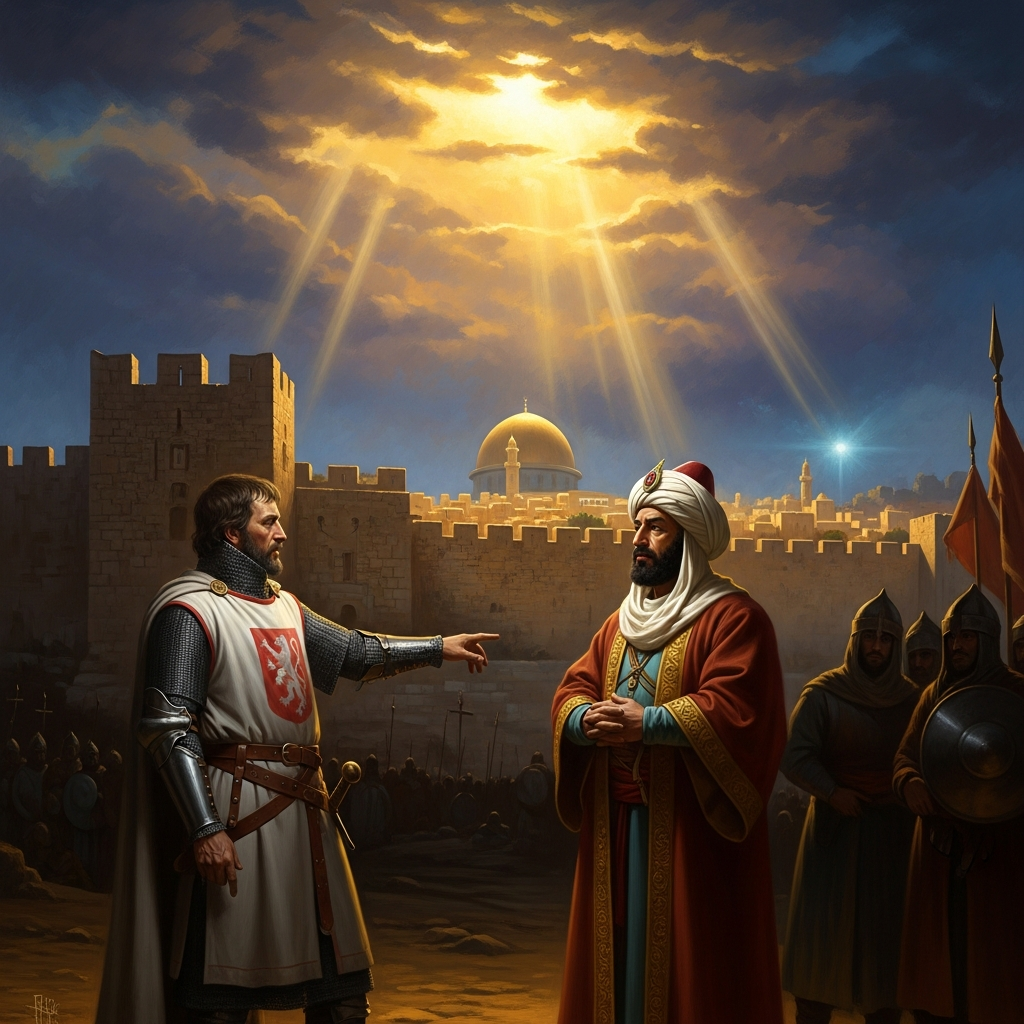
Saladin at the Gates of Jerusalem
October 2, 1187 CE · Jerusalem — the Theodosian gates, the Temple Mount (al-Haram al-Sharif), the Dome of the Rock, the Aqsa Mosque, the Church of the Holy Sepulchre
Contents
October 2, 1187. Saladin's army stands at the walls of Jerusalem after eighty-eight years of Crusader rule. The terms are exact: ransom or slavery. When the ransoms fall short, Saladin frees ten thousand captives without payment. He does not sack the city. He washes the Dome of the Rock with rosewater. The contrast with 1099 — when the Crusaders waded through blood to the Holy Sepulchre — is total.
- When
- October 2, 1187 CE
- Where
- Jerusalem — the Theodosian gates, the Temple Mount (al-Haram al-Sharif), the Dome of the Rock, the Aqsa Mosque, the Church of the Holy Sepulchre
It is the third of October, 1187, and the King of Jerusalem is a prisoner of war.
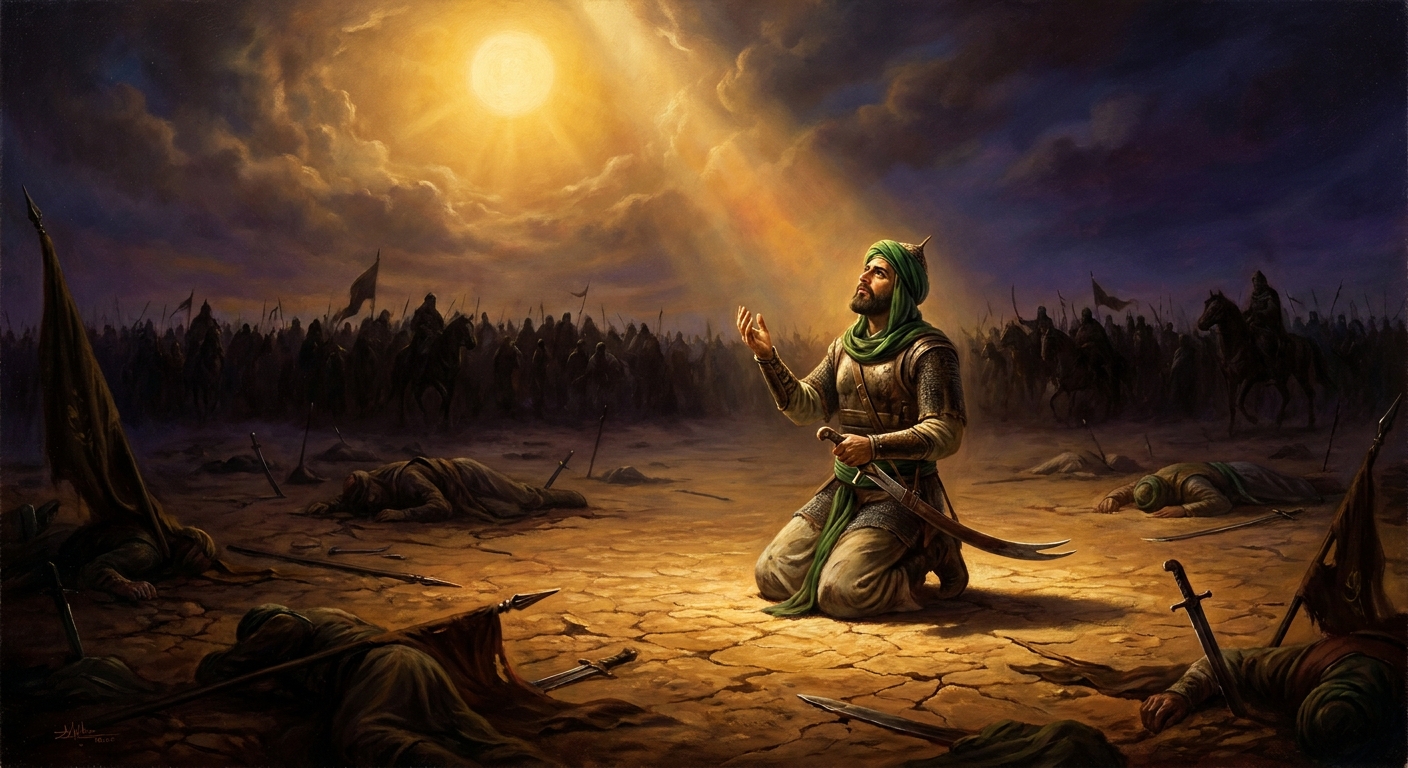
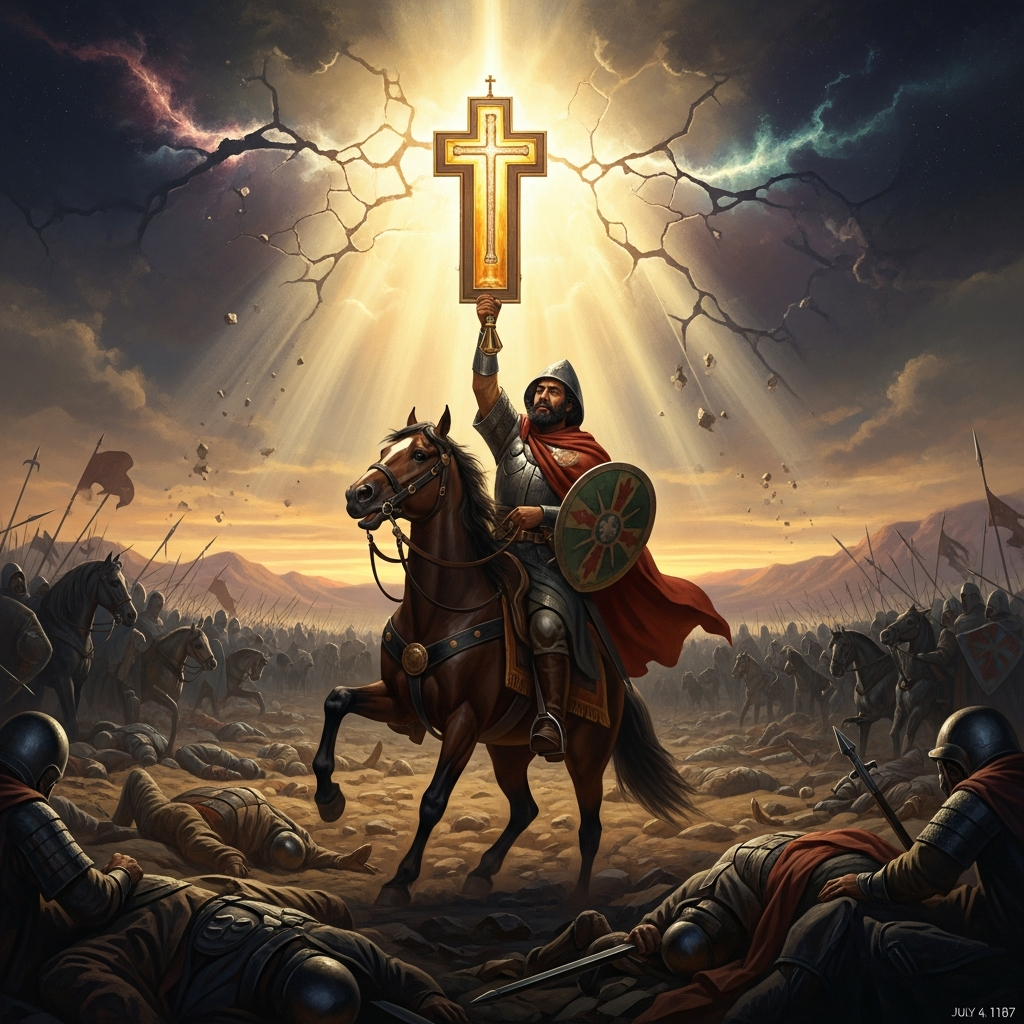
Three months ago, on the fourth of July, Saladin’s army destroyed the field forces of the Crusader Kingdom at a place called the Horns of Hattin — a double-peaked hill above the Sea of Galilee where the Christian army died of thirst before it could die of swords. The True Cross, which the Crusaders carried into battle as a battlefield standard, is now in Saladin’s tent. King Guy of Lusignan is now in Saladin’s tent. Reynald of Châtillon — the brigand baron who has spent ten years raiding hajj caravans, who once attempted to sack Mecca itself, who broke a truce that triggered this entire war — Reynald of Châtillon is dead, beheaded personally by Saladin in revenge for the slaughtered pilgrims.
Without its army, the Kingdom of Jerusalem cannot defend itself. Saladin has spent the late summer collecting the cities of the coast: Acre, Jaffa, Sidon, Beirut, Ascalon. The garrisons surrender. The countryside surrenders. By September the Holy City is the only major prize that has not yet fallen.
Saladin’s army arrives at the walls on the twentieth of September.
Inside the city is a knight named Balian of Ibelin.
Balian was at Hattin. He survived because he was in Raymond of Tripoli’s vanguard, which broke through the Muslim lines and escaped before the encirclement closed. He fled north, regrouped, and was given safe-conduct by Saladin to enter Jerusalem on a single condition: that he stay only one night, collect his wife and children, and ride out.
When Balian enters Jerusalem he finds chaos. The city has perhaps sixty thousand Christians inside it, swollen by refugees from every coastal town. The garrison consists of two knights, the rest having died at Hattin. Patriarch Heraclius — the senior Christian cleric, technically in command — is a corrupt and incompetent ecclesiastic whose authority commands no respect. The women weep. The children weep. There is no one to defend the walls.
The people beg Balian to stay.
Balian sends a messenger to Saladin asking to be released from his oath. He explains the situation. He explains that Jerusalem will fall in days without leadership, that thousands of Christians will die, that he needs to organize a defense. Saladin — and this is one of those facts about the sultan that his enemies could never quite reconcile with their image of him — Saladin grants the release. He also sends an escort to take Balian’s family safely to Tyre.
Balian stays. He knights every boy of noble birth above sixteen. He knights thirty burghers. He strips the silver from the roofs of the churches and mints emergency coinage to pay troops. He requisitions food. He organizes the women to repair walls. He prepares to die.
The siege begins on the twentieth of September. Saladin’s engineers raise mangonels against the northern wall — the wall by which the Crusaders themselves entered the city in 1099, the weakest section, where the Tower of David’s defensive geometry runs out. The bombardment is constant. By the twenty-ninth Saladin’s miners have undermined a section near the Damascus Gate and the wall has cracked.
Balian asks for a parley.
He rides out under safe-conduct. He meets Saladin in the sultan’s command tent. He proposes terms: the city surrenders in exchange for the lives and liberty of every Christian inside.
Saladin refuses. He has sworn an oath, he says, to take Jerusalem by storm. He has sworn it precisely because of 1099 — because when the Crusaders took this city eighty-eight years ago they massacred the Muslim and Jewish populations down to children at the breast, because the chronicler Raymond of Aguilers wrote with satisfaction that the conquerors rode in blood up to their bridles in the Temple precinct, because the Aqsa Mosque was a slaughterhouse where seventy thousand died according to the Muslim chroniclers’ count. Saladin has sworn to take Jerusalem the same way the Crusaders did, and to leave the same way they left, and to balance the books on a debt that has been owed for nearly a century.
Balian listens. Then Balian speaks.
If you refuse to negotiate, he says, we will kill our own families before we surrender. We will kill the five thousand Muslim slaves and prisoners inside the city. We will burn every Christian holy place in Jerusalem. We will tear down the Dome of the Rock and demolish the Aqsa Mosque. We will profane the rocks themselves. We will leave you nothing but an empty city stinking of corpses, and we will ride out and die on your swords with no families to mourn us and no wealth to plunder.
Saladin’s commanders watch him. The negotiation has reached the point where pride and policy diverge.
Saladin chooses policy.
He sets terms. Every Christian in the city may ransom himself: ten gold dinars for a man, five for a woman, one for a child. Those who cannot pay become slaves under standard Islamic law. The ransom must be paid within forty days. The city itself — the buildings, the walls, the holy places — passes intact to Muslim control.
Balian agrees. He returns to the city. The garrison surrenders the keys.
Jerusalem falls without a sack.
But the ransoms are short.
There is not enough money in Jerusalem to ransom everyone. The Crusader kingdom is bankrupt. The Templar treasury — which could have ransomed every Christian in the city — has been carried away to Tyre by the Templars themselves. The Hospitallers’ treasury is similar. Patriarch Heraclius, the senior cleric, marches out of the city with his own gold loaded on twenty pack mules and refuses to spend a single dinar on the poor.
Some seven thousand poor Christians cannot pay. They will be enslaved. Saladin’s brother al-Adil sees them being sorted at the gate and goes to the sultan. Brother, he says, I have served you in this campaign and I have asked nothing. Give me one thousand of these slaves as my reward. Saladin grants it. Al-Adil immediately frees them.
A senior emir steps forward. Give me five hundred, he says. He frees them.
Patriarch Heraclius — who has just refused to ransom his own poor — asks Saladin for seven hundred slaves to take with him in his personal retinue. Saladin grants it; the slaves are released the moment they pass the gate. Balian asks for five hundred; Saladin grants. Imad ad-Din al-Isfahani, who is keeping the official record, watches in disgust as the Patriarch loads his pack mules with church plate and rides away from a city he refused to defend.
Saladin himself frees every old man, every old woman, and every Greek and Syrian Christian in the city — these are not Crusaders, he says, these are the people of the land, and they are not to be sold.
The combined releases come to roughly fifteen thousand people freed without payment. Imad ad-Din notes the sum bitterly: We could have had a hundred thousand dinars from these heads, and the sultan let them go.
The sultan let them go.
On the second of October, 1187, on the twenty-seventh of Rajab — the night Muslim tradition holds to be the anniversary of Muhammad’s Mi’raj, the Night Journey from Mecca to Jerusalem and from Jerusalem to heaven — Saladin enters the city.
He goes first to the Temple Mount. The Crusaders have used the Dome of the Rock as a church, the Templum Domini. They have built an altar on the sacred stone. They have hung crosses from the cupola. They have used the Aqsa Mosque as the headquarters of the Knights Templar — and in places, as a stable.
Saladin orders the cross on the dome torn down. The crowd watches. When the cross falls there is a roar that the chroniclers say is heard a mile away.
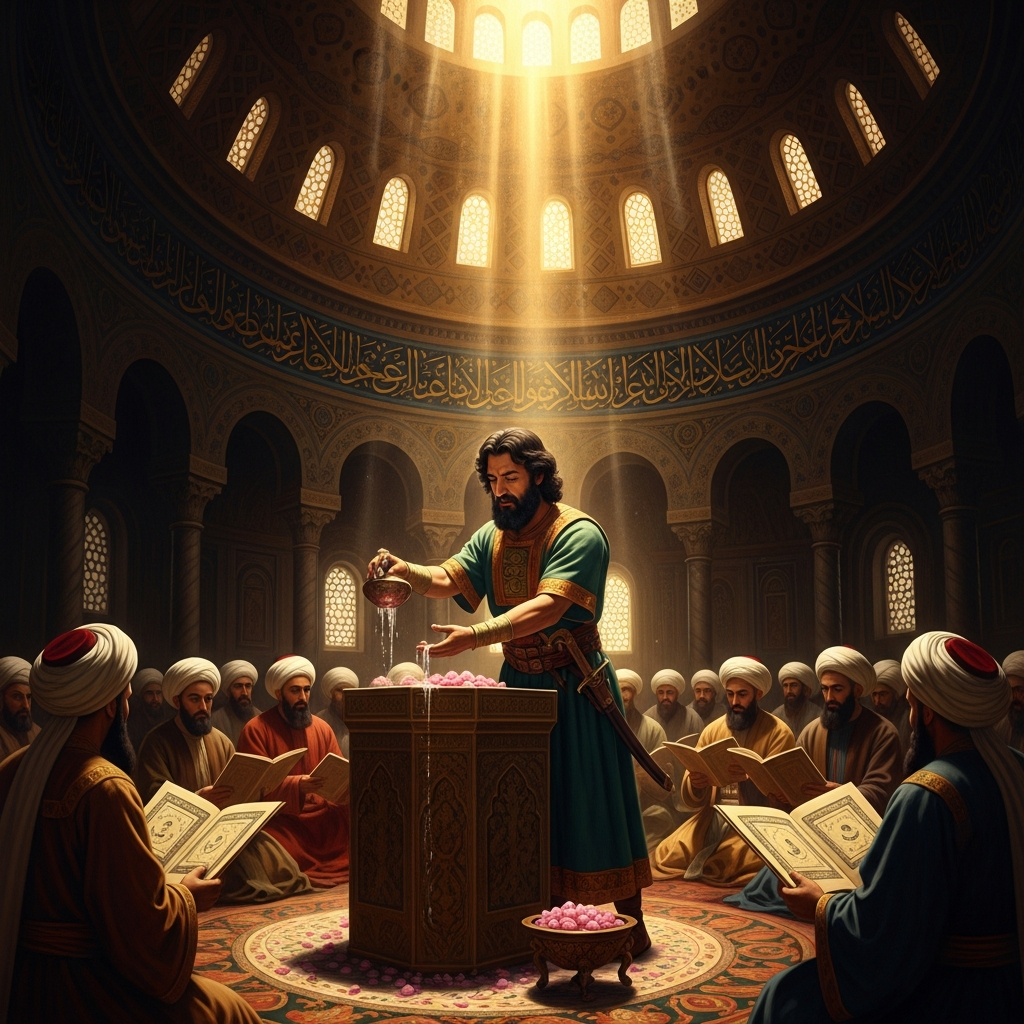
Then the sultan rolls up his sleeves and washes the rock himself. Imams bring rosewater from Damascus — the chroniclers specify the quantity: five camel-loads. Saladin pours the water over the stone, and over the floor, and over the walls. He works for hours. Other emirs join him. The Aqsa Mosque is cleansed. The Friday sermon is restored. A pulpit commissioned twenty years earlier by Nur ad-Din — Saladin’s predecessor and patron, who had ordered the minbar built specifically for the day Jerusalem would be retaken, who died before the day came — is brought from Aleppo and installed.
Saladin does not enter the Church of the Holy Sepulchre. He guarantees its operation. He confirms the Eastern Christian clergy in their offices. He arranges for Christian pilgrims to continue to visit. He restores the Greek Orthodox Patriarch, displaced by the Latins for eighty-eight years, to the church his community had originally held.
The Latin clergy leaves. The Eastern Christian clergy stays. The Muslims return. The Jews — expelled by the Crusaders, who killed every Jew they could catch in 1099 and forbade Jewish residence thereafter — the Jews are invited back. Saladin issues a public proclamation that Jews may return to Jerusalem and live there, and they begin to return: from Yemen, from North Africa, from Iraq.
The news reaches Europe. It reaches Pope Urban III, who, the chroniclers say, dies of grief on hearing it. It reaches Henry II of England, who takes the cross. It reaches Frederick Barbarossa and Philip Augustus and Richard the Lionheart, all of whom mobilize for a Third Crusade that will recapture Acre but never recover Jerusalem.
In the Islamic world the news produces poetry. Imad ad-Din writes that the moon has returned to its proper sky. Al-Fadil writes a victory letter to the Caliph in Baghdad that announces the conquest in language deliberately echoing Muhammad’s entry into Mecca: the city has been opened, he writes, not taken; its people have been forgiven, not punished.
Saladin himself, who survives the conquest by only six years and dies in 1193, leaves behind a personal estate of one gold dinar and forty-seven silver dirhams. He has spent everything on the army, on ransoms, on the poor, on the rebuilding of cities. He has lived the conduct his chroniclers describe.
Eight centuries later he is the Muslim figure most Western readers can name. He is the figure Crusader-era Christians invented chivalry to flatter. He is the only Saracen knight Dante places in the virtuous pagans’ circle of Limbo, alongside Plato and Saladin alone of the post-classical world.
He earned it on a single day, the second of October, 1187, when the city that had not been taken without massacre in any of the four conquests of its recorded history was taken without one — because the man at the gate had read the Qur’an’s instructions on mercy as a strategy and not merely a virtue, and decided to find out whether the Prophet had been right.
The Prophet was right.
The city is still there.
Scenes
July 4, 1187
 Generating art…
 October 2, 1187
Generating art… Inside the Dome of the Rock
 Generating art…
 Echoes Across Traditions
Entities
- Salah ad-Din Yusuf ibn Ayyub (Saladin)
- Balian of Ibelin (commander of the Jerusalem garrison)
- Patriarch Heraclius of Jerusalem
- al-Adil Sayf ad-Din (Saladin's brother)
- the Crusader captives of Jerusalem
Sources
- Bahā ad-Dīn ibn Shaddād, *al-Nawādir al-Sulṭāniyya* (*The Rare and Excellent History of Saladin*) — translated by D.S. Richards (Ashgate, 2002); the eyewitness biography by Saladin's qadi
- Imad ad-Din al-Isfahani, *al-Fath al-Qussi fi al-Fath al-Qudsi* — the official court historian's account of the conquest of Jerusalem (1187-1192)
- Ibn al-Athir, *al-Kamil fi al-Tarikh* — translated by D.S. Richards as *The Chronicle of Ibn al-Athir for the Crusading Period*, vol. 2 (Ashgate, 2007)
- Malcolm Cameron Lyons and D.E.P. Jackson, *Saladin: The Politics of the Holy War* (Cambridge University Press, 1982) — still the standard scholarly biography
- Jonathan Phillips, *The Life and Legend of the Sultan Saladin* (Yale University Press, 2019)
- Carole Hillenbrand, *The Crusades: Islamic Perspectives* (Edinburgh University Press, 1999) — the necessary corrective to Western narratives