Shankara and the Cave of Non-Duality
c. 788-820 CE · Kaladi, Kerala (birthplace) → Badrinath → Varanasi → Prayag → Sringeri → Dwarka → Puri → Kedarnath
Contents
He lives thirty-two years. In that time he walks the length of India, defeats every major school of philosophy on its own terms, writes the foundational commentaries on the Upanishads, the Brahma Sutras, and the Bhagavad Gita, and founds four cardinal monasteries at the four directions of the subcontinent. The doctrine he leaves behind is one sentence: the world is not two things. The rope is not the snake. Atman is Brahman. He disappears at thirty-two behind a temple in the Himalayas and the argument about where his body lies has not stopped.
- When
- c. 788-820 CE
- Where
- Kaladi, Kerala (birthplace) → Badrinath → Varanasi → Prayag → Sringeri → Dwarka → Puri → Kedarnath
The boy is eight years old when he asks his mother for permission to renounce the world.
She refuses. He is her only son. Her husband is dead. She cannot afford the loss of him to the wandering life of a sannyasin — the orange robe, the begging bowl, the renunciation of family that means in practical terms that he will never come back to perform her funeral rites.
He goes to the river anyway.
The story preserved by his disciples is that a crocodile catches him by the leg as he steps into the water. He calls to his mother on the bank. He says: the crocodile will release me if you give me permission to renounce. Otherwise I will die here. She gives the permission, and the crocodile — which the texts insist was real, was a god in disguise testing the resolve, was the situation itself — releases him.
He walks out of the water already a renunciant.
This is the legend Vidyaranya records seven centuries later, when he writes the standard biography. The historians cannot verify the crocodile. They can verify that Shankara left Kerala very young, with his mother’s reluctant blessing and a promise that he would return for her death rites — a promise the orthodox said he should not have made, since renunciants are not supposed to perform funeral rites for anyone, having symbolically died to the world themselves.
He kept the promise. Years later, when the time came, he came back from the north and burned her body in the courtyard of their house in Kaladi. The Brahmins of the village refused to help. He carried the wood himself.
This is the first of his refusals to be one thing.
He walks north.
The journey is several thousand kilometers across a subcontinent that has no roads in the modern sense — only the trade routes, the pilgrimage paths, the rivers. He walks barefoot in the orange robe of a renunciant. He stops at every center of learning along the way and listens. He is not yet teaching. He is gathering the arguments.
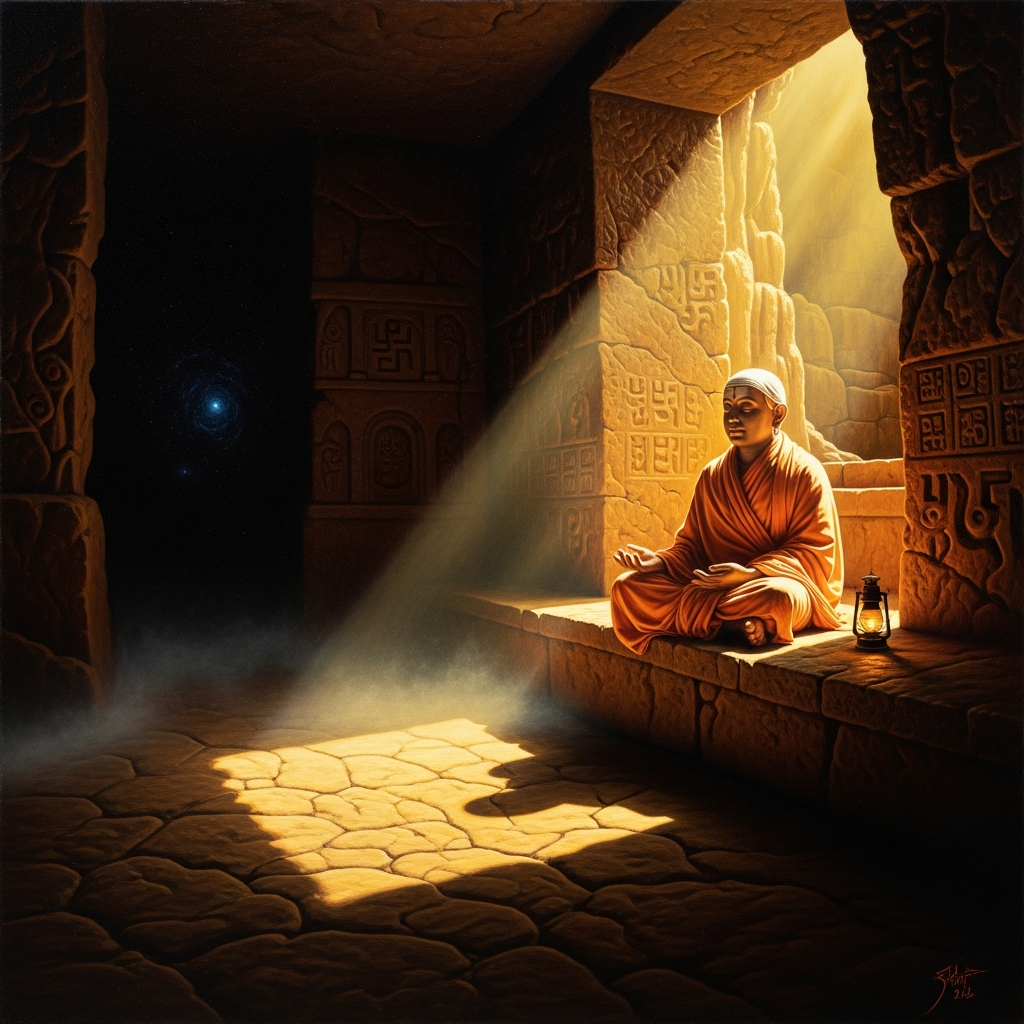
He reaches the Narmada River and finds the cave of Govinda Bhagavatpada — the disciple of Gaudapada, the disciple of Suka, the disciple of Vyasa, the line of teachers that runs back through the Mandukya Upanishad and its commentary on the four states of consciousness: waking, dreaming, deep sleep, and the fourth — turiya — which is the witness of the other three.
Shankara studies in the cave for an unspecified period. The texts give him the standard mystical training but do not dwell on it. What matters to the biography is what comes out of the cave.
What comes out of the cave is a young man with a position.
The position is one sentence: Brahman is real. The world is unreal. The individual self is identical with Brahman.
Each clause is a war.
He goes to Varanasi.
In the eighth century Varanasi is what it has always been — the city of Shiva, the city of cremation, the city where every philosophical school in India keeps a residence and every philosophical school in India is publicly arguing with every other school in the lanes around the ghats. The Mimamsa ritualists argue with the Buddhists. The Buddhists argue with the Jains. The Naiyayikas argue with the Vaisheshikas about the nature of substance. The Samkhya dualists argue with the Yoga school about whether purusha is one or many.
Shankara settles on the ghats and begins to teach.
He attracts disciples. The first is Sanandana, who will become Padmapada — the lotus-foot, named because the Ganga rose to support him with lotuses when Shankara called him across the river. The second and third and fourth follow. They begin to write the bhashyas — the commentaries — that will become the canonical texts of Advaita.
The commentary on the Brahma Sutras is the project that defines him. Badarayana’s sutras are aphoristic, deliberately incomplete, written to be unpacked. Every Vedanta school commentaries them. Shankara’s commentary is the one that locks the doors against every other reading.
He argues against the Buddhists by name — Nagarjuna, Vasubandhu, Dignaga. He argues against the Mimamsa by name — Kumarila Bhatta, who has just died, and Kumarila’s living disciple Mandana Misra, who is the man Shankara now needs to defeat in person.
The reason is institutional. Mimamsa is the orthodox school of Vedic ritual interpretation, and as long as Mimamsa holds the field, the philosophical claim that the Upanishads (the speculative end of the Veda) supersede the ritual portion (the practical body of the Veda) cannot be made publicly. Mandana is the most powerful Mimamsa philosopher alive. If Shankara cannot defeat him in open debate, the project of Advaita will not have an audience.
Shankara walks to Mahishmati on the Narmada to find him.
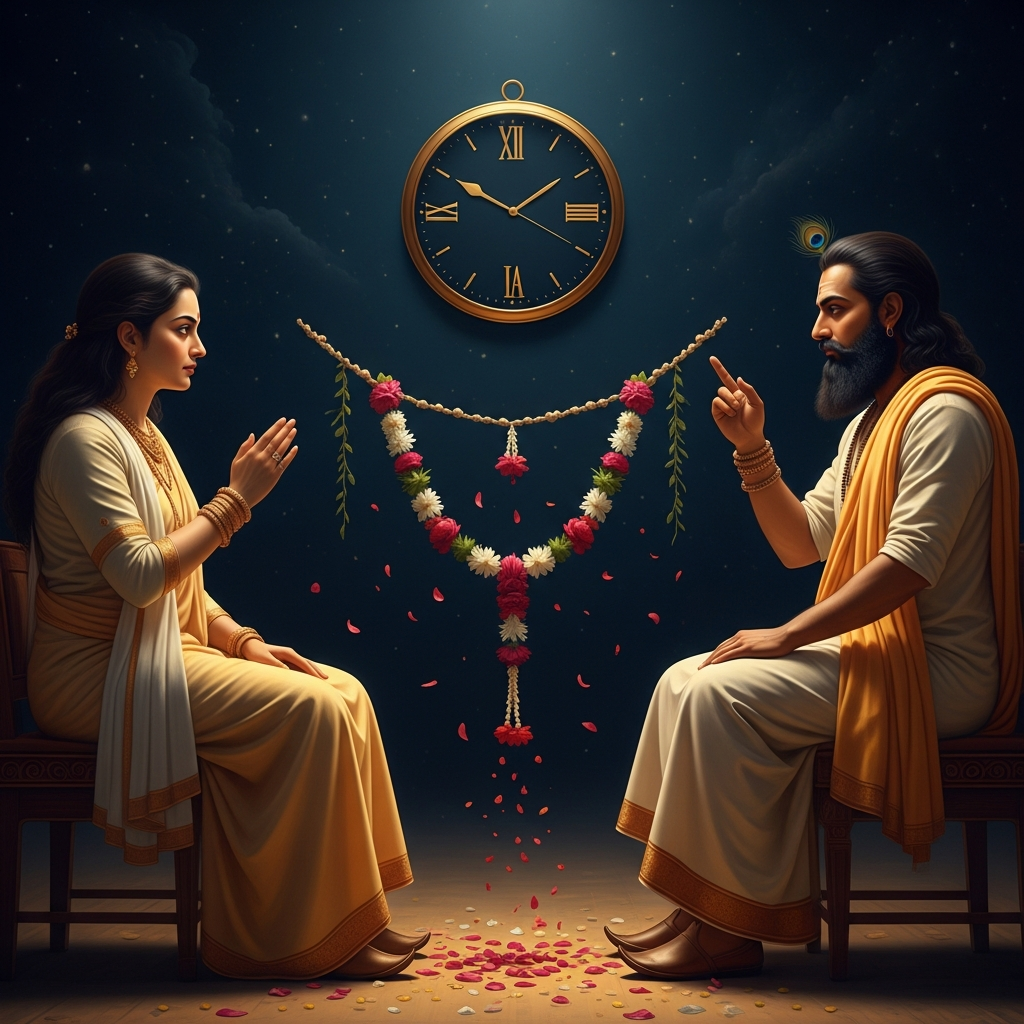
The debate at Mandana’s house lasts seventeen days.
The arrangement is the standard one for philosophical combat in eighth-century India. Both men sit on prepared seats. A judge presides — and the judge in this case is Mandana’s wife, Ubhaya Bharati, herself an accomplished philosopher, considered by some accounts a manifestation of Saraswati. A garland of fresh flowers is placed between the two men. The flowers are the clock: when one man’s argument is failing, the petals on his side begin to wilt. The judge watches the garland.
Shankara argues that the Upanishads are the supreme portion of the Veda and that ritual action is preparatory only — that the goal is jnana, knowledge, not karma, action. Mandana argues that ritual is the path itself, that knowledge without action is empty, that the householder’s yajna is not subordinate to the renunciant’s silence.
For seventeen days the garland holds.
On the morning of the eighteenth day Ubhaya Bharati looks at the flowers. The petals on Mandana’s side have turned. She announces the result.
Mandana accepts. He removes the householder’s clothes and takes the orange robe. But Ubhaya Bharati raises an objection that the texts treat as the most serious of the entire encounter: she is half of her husband, by the marriage rites that joined them. Shankara has not defeated her. He must debate her too.
He debates her. She asks him about the science of erotic love — the one branch of human knowledge in which a celibate renunciant has, by his vows, no standing. Shankara asks for a recess. He uses the powers of yoga to enter the body of a recently deceased king for the duration needed to acquire the missing knowledge. He returns. He answers her questions.
She accepts the result. Mandana becomes Sureshvara, one of his four chief disciples. The Mimamsa school does not recover.
He walks the country.
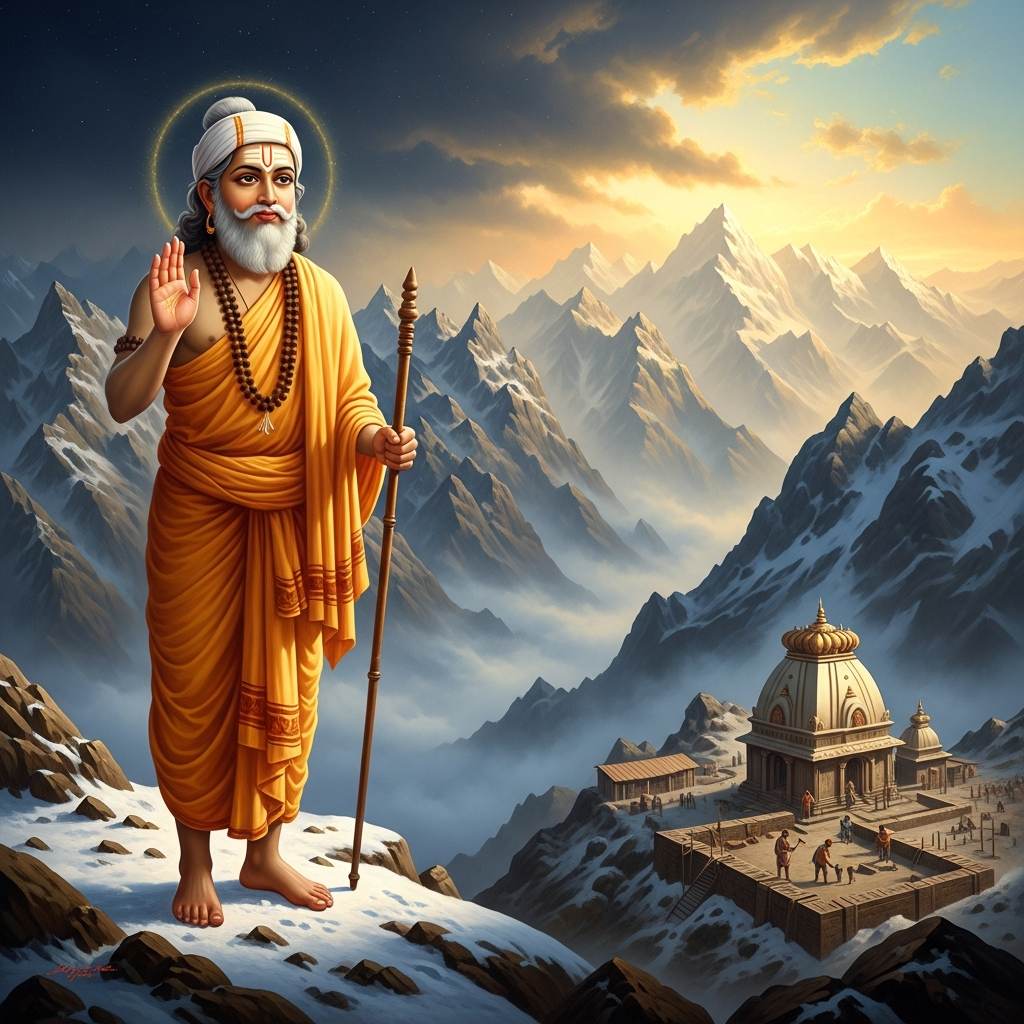
In the years that remain — perhaps a decade, perhaps less — he establishes four monasteries at the four cardinal points of the subcontinent: Sringeri in the south, Dwarka in the west, Puri in the east, Badrinath in the north. Each is given to one of his four chief disciples. Each is given a portion of the Vedas and a Mahavakya — a great utterance from the Upanishads — to preserve.
Sringeri receives aham brahmasmi — I am Brahman.
Dwarka receives tat tvam asi — thou art that.
Puri receives prajnanam brahma — consciousness is Brahman.
Badrinath receives ayam atma brahma — this self is Brahman.
The four utterances are not four propositions. They are one proposition stated in four grammatical persons — first, second, third, indexical. The point of the institutional arrangement is that the same claim is being made simultaneously at the four edges of India, in the four directions, in four different inflections. The geometry is theological.
He composes the great hymns — the Bhaja Govindam, the Saundarya Lahari, the Nirvana Shatakam. He writes the Vivekachudamani, the crest-jewel of discrimination — the manual for the seeker that distinguishes the real from the apparent, the witness from the witnessed, the rope from the snake.
The example he uses is the example everyone after him will use. You walk along a forest path at dusk. You see a snake on the ground in front of you and you freeze. Your heart pounds. The fear is real. The body’s response is real. The snake is not. When the light returns, you see the rope.
The world, he says, is the snake. Brahman is the rope. The fear was real and was based on nothing. The discipline of jnana is the discipline of the returning light.
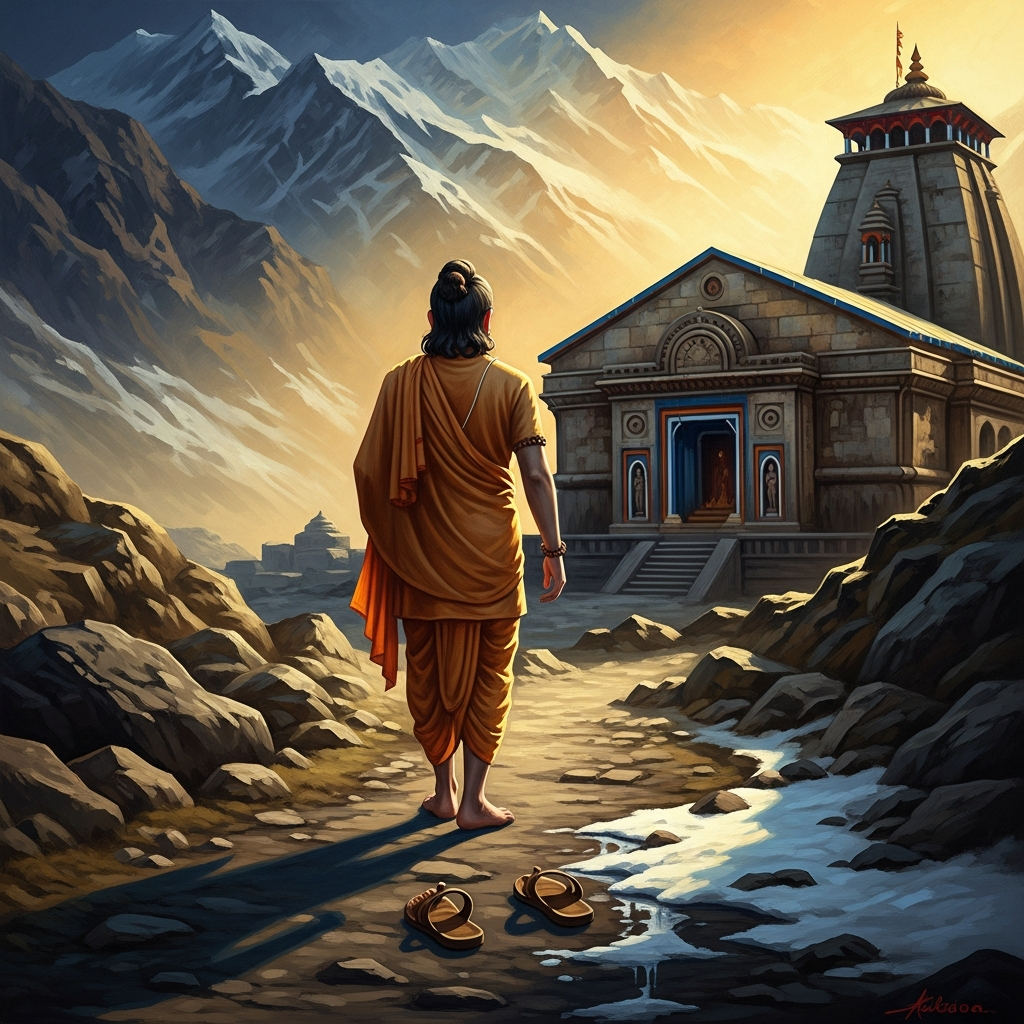
He reaches Kedarnath in the upper Himalayas in his thirty-second year.
The accounts of his death disagree. The southern tradition says he died at Kanchipuram in Tamil Nadu, after establishing a fifth monastery there. The northern tradition says he walked behind the Kedarnath temple and did not return — that the disciples found only his sandals, that he was taken up bodily, that he never died in the ordinary sense.
The disagreement is itself Advaitic. The location of the body is what Advaita calls vyavaharika — empirical, conventional, real at the level of relative truth. From the paramarthika level — the absolute — the question of where the body lies has no traction. Shankara was never the body. The body was the rope mistaken for the snake.
He left behind a vast textual corpus, four monasteries that have continued in unbroken succession for twelve centuries, and one sentence.
The sentence is: brahma satyam jagan mithya jivo brahmaiva naparah.
Brahman is real. The world is illusion. The individual self is no other than Brahman.
Every subsequent Indian philosopher has had to answer this sentence. Ramanuja, two centuries later, will argue that the world is real and the self is qualified by attributes that distinguish it from Brahman — the Vishishtadvaita response. Madhva, four centuries later, will argue full dualism, the absolute distinction of God and soul. The Buddhists will continue arguing emptiness against fullness. The Sufis arriving in India centuries later will discover that someone has already mapped the territory in Sanskrit.
The argument has not finished. It continues every time someone in a yoga class hears the phrase we are all one, every time a Sanskrit professor lectures on the Upanishads, every time a young person in any tradition realizes that the teacher who said the kingdom of heaven is within you meant something more literal than they were prepared to hear.
Shankara is the systematizer of that literal meaning. The cosmos is one thing. The appearance of two is the snake at dusk.
He died at thirty-two, possibly at Kedarnath, possibly at Kanchipuram, possibly nowhere — the body being, as he had argued, the rope.
The sandals remained.
Scenes
Shankara reaches Badrinath in the high Himalayas and establishes the northern monastery — one of the four cardinal mathas at the four corners of the subcontinent
 Generating art…
 The debate with Mandana Misra runs seventeen days
 Generating art…
 At thirty-two he walks behind the Kedarnath temple and does not return
 Generating art…
 Echoes Across Traditions
Entities
- Adi Shankaracharya
- Mandana Misra
- Govinda Bhagavatpada
- Vidyaranya
- Ubhaya Bharati
Sources
- Shankara, *Vivekachudamani — The Crest-Jewel of Discrimination* (trans. Swami Madhavananda, 1921)
- Shankara, *Brahmasutra Bhashya* (trans. Swami Gambhirananda, 1965)
- Shankara, *Upadesha Sahasri — A Thousand Teachings* (trans. Sengaku Mayeda, 1979)
- Karl Potter, *Encyclopedia of Indian Philosophies Vol. III: Advaita Vedanta up to Samkara and His Pupils* (1981)
- T.M.P. Mahadevan, *The Philosophy of Advaita* (1938)
- David Loy, *Non-Duality: A Study in Comparative Philosophy* (1988)
- Madhava-Vidyaranya, *Shankara-Digvijaya — The Traditional Life of Sri Sankaracharya* (trans. Swami Tapasyananda, 1978)