The Sword that Shattered at Tatsunokuchi
12 September 1271 CE · Tatsunokuchi execution ground, Kamakura coast, Japan
Contents
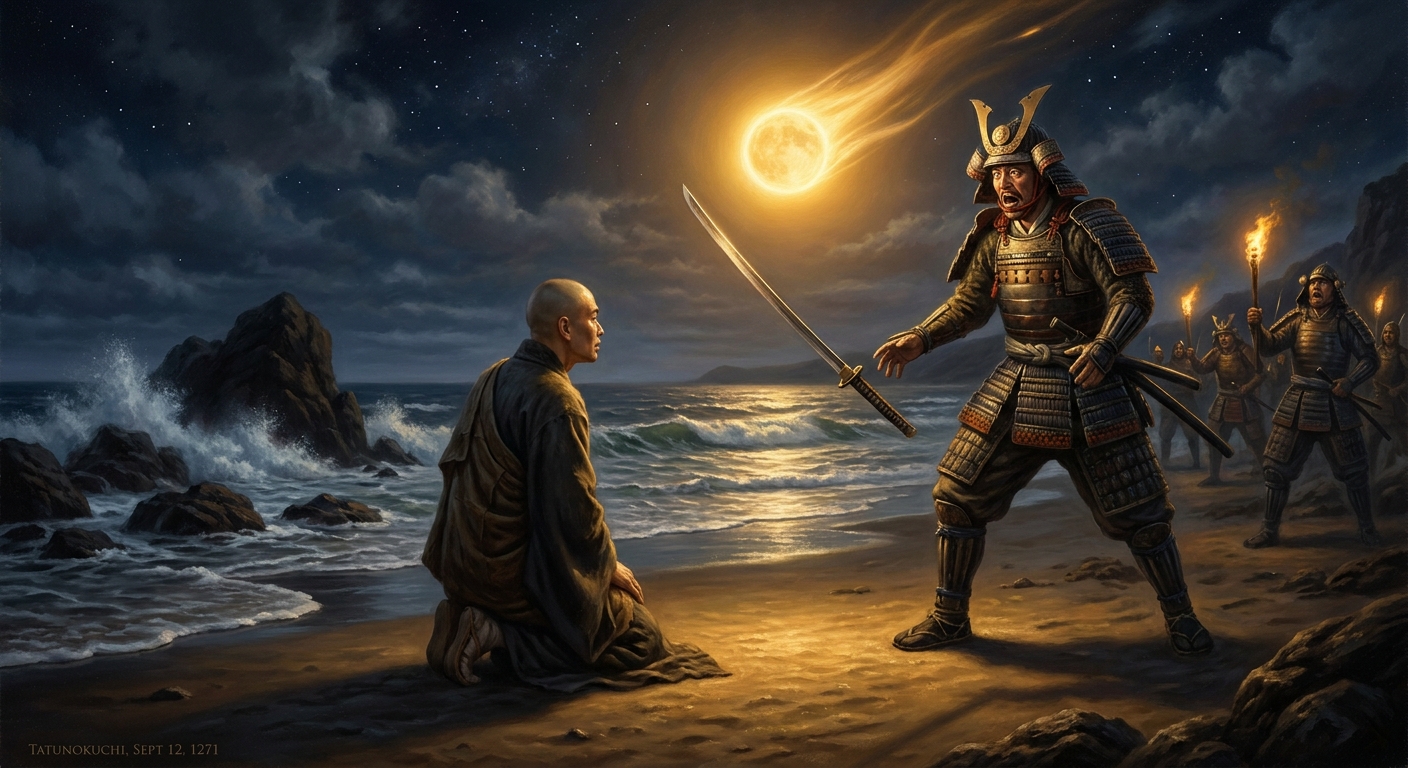
A Japanese monk kneels in the surf at midnight to be beheaded. The executioner raises his blade. A light comes down from the sky brighter than the moon, and the sword breaks in his hand.
- When
- 12 September 1271 CE
- Where
- Tatsunokuchi execution ground, Kamakura coast, Japan
He has been warning them for eleven years.
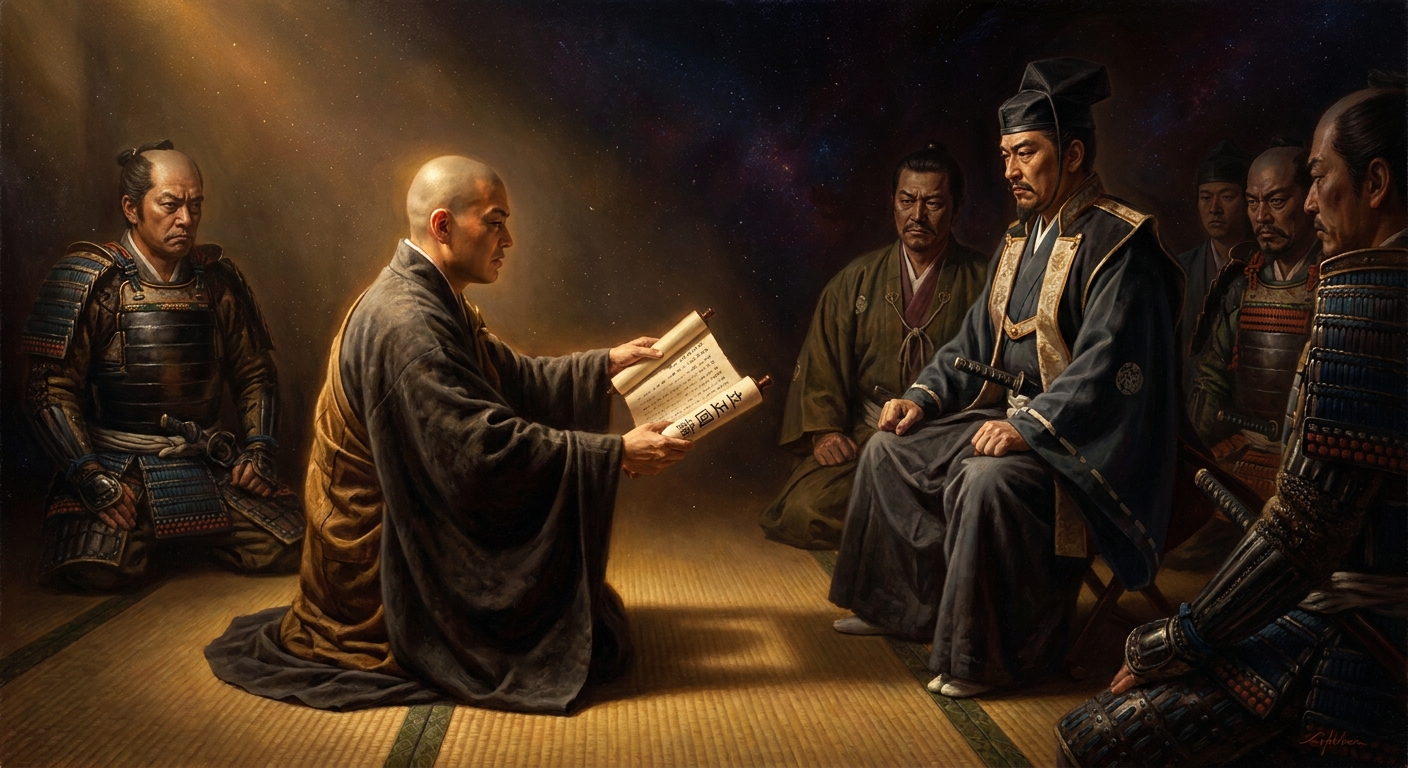
In 1260 he hands the shogunate a document called Risshō Ankoku Ron, On Establishing the Correct Teaching for the Peace of the Land. Its argument is simple and impolite: Japan is honoring the wrong sutras. Pure Land devotion to Amida, Zen reliance on private intuition, the esoteric machinery of Shingon — all of it, in Nichiren’s reading, has displaced the Lotus Sutra, the only teaching adequate to the degenerate age called Mappō. The country is in famine, plague, earthquake. He tells the regent: this will continue, and worse will come — foreign invasion — unless the Lotus is restored to its proper place.
The shogunate burns his hut. Mobs throw stones at him in the street. Other monks denounce him. He keeps writing.
Then, in 1268, a letter arrives from Khubilai Khan demanding tribute.
The court does not credit his prediction. The court arrests him.
On the night of 12 September 1271, Hei no Saemon — deputy to the regent Hōjō Tokimune — orders Nichiren brought from his hut at Matsubagayatsu and conveyed under armed escort to Tatsunokuchi, an execution ground on the beach south of Kamakura. The decision has not been made through proper channels. The decision is the kind of thing a regime does when it has decided a man is more inconvenient alive than the law’s inconvenience of killing him.
They march him through the night. He is fifty years old. He chants as he walks.
Namu Myōhō Renge Kyō. Namu Myōhō Renge Kyō.
The escort tells him to stop. He does not stop.
They reach the beach.
The sand is wet. The tide is going out. A straw mat is laid down for him to kneel on. The executioner, a swordsman named Yorimasa, draws his blade and tests its weight in the moonlight. The other soldiers form a half-circle behind him. The sea is at their backs.
Nichiren kneels. He places his hands together. He raises his voice — not a scream, not a sob — to a clean shout that carries down the beach and into the cliff faces:
Namu Myōhō Renge Kyō.
Yorimasa raises the sword above his head with both hands.
And the sky tears open.
Nichiren’s own account, written years later from exile, is plain. A round shining object, brighter than the moon, came shooting from the south-east toward the north-west. Modern scholars guess at meteor, at ball lightning. The soldiers on the beach saw what they saw. The executioner staggered backward. The sword fell out of his hand. Some accounts say the blade struck a rock and shattered into three pieces; others say it broke in his hand mid-swing.
The horses scream. Two soldiers fall to the sand. Another, looking into the sky, drops his torch into the wet ground and the flame goes out. Hei no Saemon’s deputy on the scene, paralyzed, cannot give the order to try again. Nobody in the half-circle is willing to be the second man to raise a blade against this monk on this night.
The execution is suspended. The order is sent back up the chain. By dawn it has been quietly converted into a sentence of exile to Sado Island, in the snow country across the Sea of Japan, on the assumption — the regime’s last hope — that the cold will finish what the sword would not.
It does not finish him.
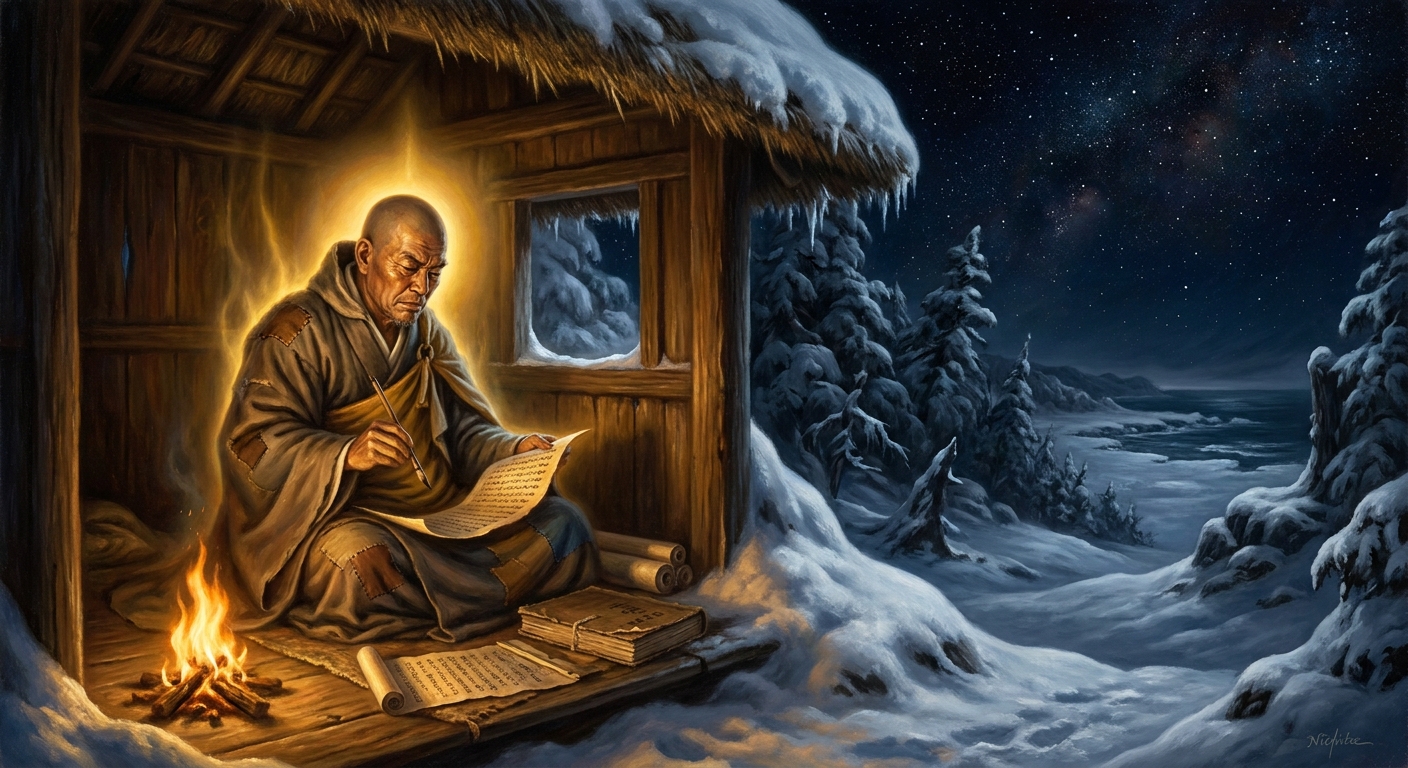
For three years on Sado he lives in a graveyard hut called Tsukahara, sleeping among the bones of the unburied dead, eating what villagers bring or do not bring, writing letters in a hand that grows steadier the colder it gets. He writes Kaimoku Shō (The Opening of the Eyes) and Kanjin no Honzon Shō (The Object of Devotion for Observing the Mind) — the two treatises that become the doctrinal core of Nichiren Buddhism. He inscribes the Gohonzon, the calligraphic mandala of the Lotus Sutra’s assembly, that every Nichiren-school household will hang on its altar for the next seven hundred years.
In 1274, the year the Mongol fleet first appears off the coast of Kyushu and the regime suddenly remembers his prediction, he is pardoned. He walks back across the snow to Kamakura.
He does not stay in the capital.
He retires to Mount Minobu, builds a hut at the foot of the mountain, and teaches the disciples who follow him there. The chant goes with them when they leave. Namu Myōhō Renge Kyō — devotion to the Lotus Sutra of the Wonderful Dharma — becomes the only practice his school requires. Not meditation. Not sutra-study. Not the rope of monastic regulations. The chant. Six syllables a peasant can learn in a morning and an old woman can carry to her grave.
He dies in 1282 at the age of sixty-one, surrounded by disciples, on a journey toward the hot springs he had hoped would ease his last illness. His last words were the chant. They placed his ashes at Mount Minobu. The temple there, Kuon-ji, still stands.
The sword broke. That is the load-bearing claim of the Nichiren tradition. Whether the night sky on 12 September 1271 was meteorology or miracle is a question that does not change what was built on the answer.
Nichiren read the broken blade as the Lotus Sutra defending its prophet — proof that the sutra he had staked his life on was the one alive enough to act. From that reading flow the seven hundred years of Nichiren Buddhism: the daimoku chant, the Gohonzon mandala, the conviction that in the Final Age all the elaborate paths of older Buddhism are obsolete and only one straight line remains.
The Mongols came as he had predicted. They did not finish Japan; the kamikaze finished them. He had said that too. The court, which had sent him to a beach to be killed at midnight, found itself writing letters of apology while the typhoon was still settling.
The chant outlived all of them. It is still being chanted.
Scenes
He hands the regent a treatise predicting Mongol invasion if the wrong sutras are honored
 Generating art…
 Midnight on the beach at Tatsunokuchi
Generating art… Exiled to Sado Island in the snow, writing letters in a graveyard hut
 Generating art…
 Echoes Across Traditions
Entities
- Nichiren
- Hōjō Tokimune
- Hei no Saemon
Sources
- Nichiren, *Shuju Onfurumai Gosho* (*The Selection of the Time and Personal Conduct*, autobiographical letter, c. 1276)
- *Risshō Ankoku Ron* (*On Establishing the Correct Teaching for the Peace of the Land*, 1260)
- Burton Watson (trans.), *Selected Writings of Nichiren* (1990)
- Jacqueline I. Stone, *Original Enlightenment and the Transformation of Medieval Japanese Buddhism* (1999)
- Ruben L. F. Habito, *Experiencing Buddhism: Ways of Wisdom and Compassion* (2005)