Thomas Aquinas Puts Down the Pen
December 6, 1273 CE — the experience that stops him writing; March 7, 1274 CE — his death at Fossanova on the road to the Council of Lyon · The Chapel of Saint Nicholas of Myra, in the Dominican Convent of San Domenico Maggiore, Naples; later the Cistercian Abbey of Fossanova, in the Pontine Marshes south of Rome
Contents
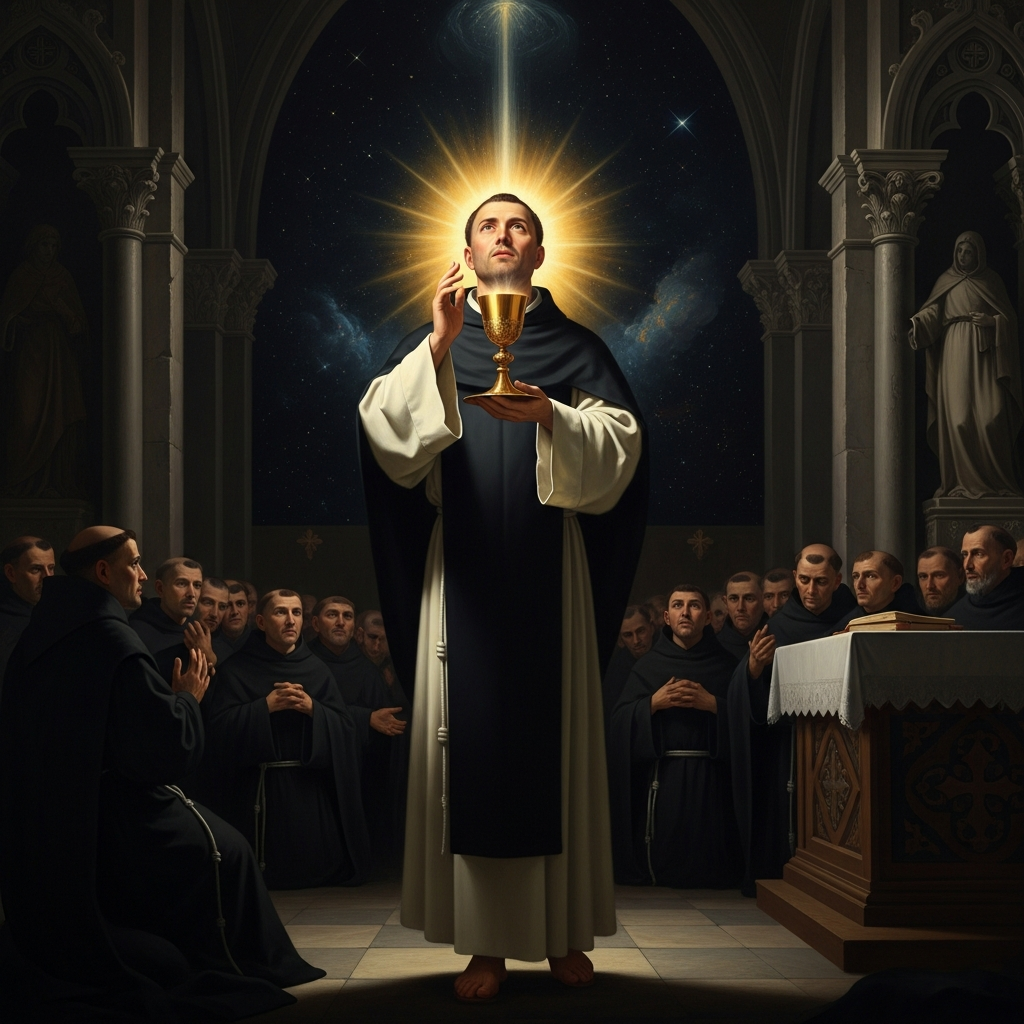
December 6, 1273. Thomas Aquinas is saying Mass at the Chapel of Saint Nicholas in Naples when something happens. He goes still. Afterward he will not write again. He has been working on the *Summa Theologica* for seven years — three thousand articles, ten thousand objections, the most systematic attempt in Christian history to unite Aristotelian reason with Christian faith — and he is in the middle of the third part, on the sacraments, when he stops. His secretary Brother Reginald begs him to continue. Aquinas says: *I cannot. All that I have written seems to me like straw compared to what I have seen.* He dies four months later. The *Summa* is left unfinished. It becomes the most influential theological text in Western Christianity.
- When
- December 6, 1273 CE — the experience that stops him writing; March 7, 1274 CE — his death at Fossanova on the road to the Council of Lyon
- Where
- The Chapel of Saint Nicholas of Myra, in the Dominican Convent of San Domenico Maggiore, Naples; later the Cistercian Abbey of Fossanova, in the Pontine Marshes south of Rome
He has been working on the Summa for seven years.
He started in 1265, in Rome, when his Dominican superiors gave him the unusual freedom to design his own teaching curriculum. The existing textbook of theology, Peter Lombard’s Sentences, was a four-volume thicket of patristic citations that students had to disentangle on their own. Aquinas had taught from it for years and had grown frustrated. He proposed a new structure — not citations but argument, not a thicket but a tree, organized around the order of being itself: God, then creation, then humanity’s return to God through Christ. He proposed to write it himself.
The Summa Theologica takes the form he had pioneered in earlier works: the quaestio — a question — divided into articles, each article presenting a thesis, three or four objections, an authoritative quotation from Scripture or a Father, the respondeo (the master’s answer), and replies to each objection. The form is brutal in its honesty. The objections are stated as strongly as he can state them. The respondent does not avoid the difficulty; he meets it. Aquinas’s reputation in the schools rests partly on this — that his objections are often stronger than the objections actually raised by his contemporaries, because he is willing to imagine the strongest possible counter-argument and answer it. He fights fair.
He works at extraordinary speed. He dictates standing up, often to several scribes simultaneously, going from one to another in different rooms of the same convent, dictating different works on different topics in different rooms at the same time, each scribe writing as fast as he can. The friars who serve him as secretaries describe his sentences arriving fully formed: he does not pause, does not revise, does not hesitate. Some of the friars say he sees the answers visually before he speaks them, the way a chess master sees the board.
By December 1273 the First Part — the treatise on God and creation — is complete. The Second Part — the treatise on the moral life, divided into general principles and detailed application — is complete. The Third Part — the treatise on Christ, the sacraments, and the Last Things — is in progress. He has written sixty articles on the Eucharist. He is working on the article on Penance.
He is forty-eight. He has been a Dominican for thirty-three years.
He had been born to nobility — the youngest son of the Count of Aquino, related to the Holy Roman Emperor on his mother’s side, raised in the Castle of Roccasecca in the hills between Rome and Naples — and his family had assumed he would enter the Benedictine abbey of Monte Cassino, where one of his uncles was already abbot, and would in due course become abbot himself, a respectable and remunerative ecclesiastical career suitable for a younger son of the nobility.
He was sent to the new University of Naples at fifteen. There he met the Dominicans. The Dominicans were the new order — founded only thirty years earlier, mendicant rather than monastic, dedicated to preaching and to learning, dedicated to poverty — and Aquinas joined them. His family was horrified. His older brothers kidnapped him on the road and locked him in the family castle for over a year. They sent a prostitute into his cell to seduce him out of his vocation; he chased her out with a flaming brand from the fireplace. He read the Bible through. He read Peter Lombard’s Sentences through. They eventually let him go.
He went to Paris. He studied under Albertus Magnus — Albert the Great, the brilliant German Dominican who was the first to take Aristotle seriously in the Latin schools, who had read the entire Aristotelian corpus in the new Latin translations and had decided that the Christian tradition needed to absorb it. Aquinas absorbed it through Albert. By the time he was thirty he was lecturing on the Sentences at Paris. By the time he was thirty-five he was the leading systematic theologian of the Dominican order. By the time he is forty-eight, in 1273, in Naples, he has produced the Summa Contra Gentiles (a four-volume Christian apologetic addressed to Muslim and Jewish philosophers), commentaries on most of Aristotle, commentaries on Job and on the Gospels and on the Pauline epistles, and the partly-finished Summa Theologica — and the world considers him the greatest mind of the age.
He prays. The friars who live with him notice this. He prays before he writes. He prays during the small hours. He prays in front of the crucifix in the chapel — sometimes for hours, often weeping, sometimes seen levitating, according to the testimony given at his canonization process. The man who writes the most logically rigorous theology of the medieval period spends most of his prayer time silent in front of an image, weeping.
The morning of December 6, 1273 begins like any other.
It is the Feast of Saint Nicholas. The Dominican convent of San Domenico Maggiore, in Naples, has its main chapel dedicated to Saint Nicholas of Myra. Aquinas, the senior Dominican in residence, is to celebrate the morning Mass. He vests as usual. He processes to the altar. He begins.
What happens at some point during the Mass — exactly when, the chronicles do not say; perhaps at the consecration, perhaps after communion, perhaps during the silence after the Agnus Dei — is observed by Brother Reginald and by the other friars present, but not understood. Aquinas goes still. His hands, which have been moving through the gestures of the Mass with the practiced fluency of decades, simply stop. He stands at the altar without moving. The Mass cannot continue. The friars do not know what to do. They wait.
Eventually he completes the Mass — slowly, like a man performing a task in a language he is half-remembering — and goes back to his cell. He says nothing for the rest of the day. He writes nothing for the rest of the day.
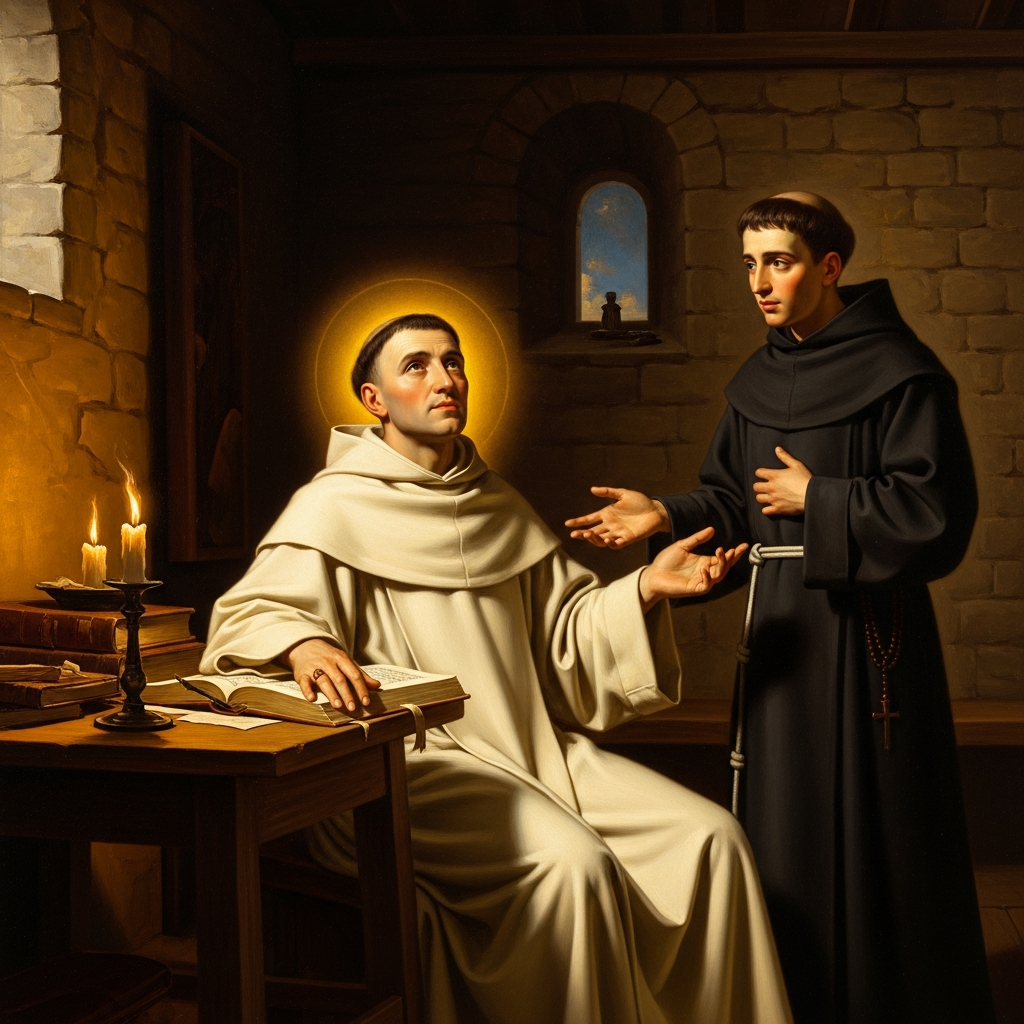
The next morning, Brother Reginald — Reginald of Piperno, his secretary and constant companion for many years, the friar who knows him better than anyone — comes to him. Master, why have you stopped working? You are so close to the end. We need the rest of the Third Part. The Penance treatise is not finished. The work on the Last Things is not begun.
Aquinas looks at him for a long time before answering. Reginald, in the testimony he gives later, will say he had never seen this expression on his master’s face. It was, he says, the look of a man who has just come back from somewhere very far.
Reginald, he says, I cannot. I cannot do any more. Such things have been revealed to me that all I have written now seems to me of small value — straw.
Reginald argues. Aquinas does not argue back. The conversation is short. Aquinas does not write another word of the Summa after this morning. He does not write another word of anything except a brief commentary on the Song of Songs dictated to a friar in the last weeks of his life — a final, lyrical, unsystematic gloss on the love poetry of the Old Testament, the most poetic thing he ever wrote. The systematic project is over.
In January 1274, Pope Gregory X summons him to the Council of Lyon.
The Council is intended to discuss reunion with the Greek Orthodox church and to organize a new crusade. Aquinas is to attend as a theological consultant. He sets out in late January, riding a donkey north from Naples, accompanied by Brother Reginald and a few other friars. He is not well. The seven years of writing have used him up. The experience at the altar in Naples has changed something in him that the friars cannot identify but that they can see — he is gentler, slower, more silent.
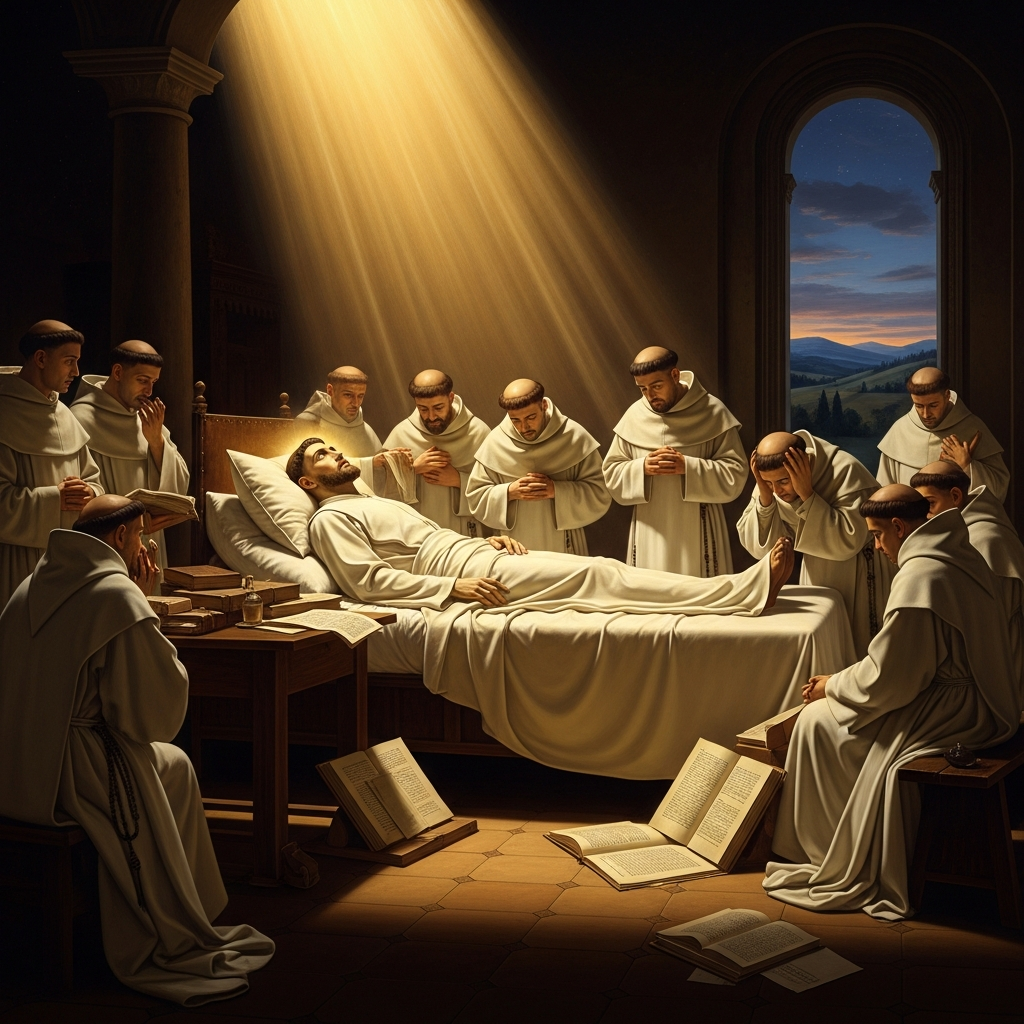
On the road north, near the Cistercian Abbey of Fossanova, in the marshes south of Rome, Aquinas strikes his head on the low branch of a tree. He is concussed. He is brought to the abbey. The Cistercians, surprised and honored to have the most famous theologian in Europe in their infirmary, take him in. He does not recover. He grows steadily weaker. He receives the last sacraments.
On his deathbed, the Cistercians ask him to dictate a brief commentary on the Song of Songs for them. He does. It is the last work he composes. The text, as we have it, is fragmentary, lyrical, focused entirely on the soul’s marriage with Christ. There is no Aristotle in it. There are almost no syllogisms. It is the work of a man whose theological grammar has been overtaken by something that does not fit grammar.
He dies on the morning of March 7, 1274. He is forty-nine years old. His last words, to the abbot who has heard his confession, are reported as: I receive thee, Price of my redemption, Viaticum of my pilgrimage, for whose love I have studied, watched, labored. Thee have I preached. Thee have I taught.
The Summa remains unfinished.
His brother Dominicans, in the years after his death, take the unfinished Third Part and add to it a Supplementum — a supplement assembled from his earlier writings on the same topics. The supplement is not by him; it is by them, working from his marginal notes and his Sentences commentary. They publish it as if the Summa were complete.
In 1277, three years after his death, the Bishop of Paris, Étienne Tempier, condemns 219 propositions, several of which are Aquinas’s own. The Augustinians and Franciscans see his Aristotelian project as dangerous. The condemnation is not lifted for fifty years.
In 1323, John XXII canonizes him. The Dominican order pushes the Summa into the center of its theological curriculum. The Council of Trent, two centuries later, will set it on the altar next to the Bible and the papal decrees during its sessions, and will use it as the framework for its own decrees on grace, justification, and the sacraments. Leo XIII in 1879 will declare Thomism the official philosophy of Catholic seminary education for the next hundred years. The Summa — the unfinished, set-aside-as-straw Summa — will become the most influential theological text in the Western tradition after the Bible itself.
The Thomists, century after century, will write commentaries on the Summa, defend it against critics, organize courses around its structure. They will treat it as if Aquinas had finished it. They will not, mostly, dwell on the stopping at Naples.
The mystics, century after century, will dwell on the stopping. John of the Cross will know the story. Teresa of Ávila will know the story. The eighteenth-century English mystic William Law will know it. The Thomist revival of the twentieth century will rediscover it — Chenu, McCabe, Pieper, all of them noting that Aquinas’s last word about his own work is that the work is straw, and that this is the necessary completion of the work, not its disavowal.
The completion of theology, Aquinas teaches by his stopping, is the recognition that theology is straw. The straw is not nothing. Straw is the right material for the manger; the manger holds the Word. The straw is what the Word lies on. But the straw is not the Word. The greatest theologian of the medieval West built the most magnificent straw structure in the history of theology and then, on a December morning in Naples, looked up from the altar and saw the Word, and put down the pen.
Scenes
December 6, 1273
Generating art… *Master, why do you not write?* Brother Reginald asks
 Generating art…
 March 7, 1274
 Generating art…
 Echoes Across Traditions
Entities
- Thomas Aquinas
- Brother Reginald of Piperno
- Pope Gregory X
- Aristotle
- Albertus Magnus
- Bonaventure

Sources
- William of Tocco, *Vita S. Thomae Aquinatis* (c. 1323) — the primary medieval biography, written for the canonization process
- Bernard Gui, *Vita Thomae Aquinatis* (c. 1320s) — second early biography, drawing on the same eyewitness sources
- M.-D. Chenu, *Toward Understanding St. Thomas* (Henry Regnery, 1964)
- Herbert McCabe, *God Matters* (Geoffrey Chapman, 1987)
- Denys Turner, *Thomas Aquinas: A Portrait* (Yale University Press, 2013)
- Jean-Pierre Torrell, *Saint Thomas Aquinas: The Person and His Work* (Catholic University of America Press, 1996)
- G.K. Chesterton, *St. Thomas Aquinas: The Dumb Ox* (Hodder & Stoughton, 1933)