Combat Profile
Five Ways
Thomas marshals five irrefutable logical proofs of God's existence, granting allies unwavering certainty and shielding them from doubt
Scholastic Synthesis
All allies gain bonus accuracy when combining reason with faith, and Thomas's presence purifies philosophical confusion into clarity
His *Summa Theologica* is unfinished -- after a mystical experience in December 1273 he stopped writing, saying "all that I have written seems like straw to me compared to what has been revealed"
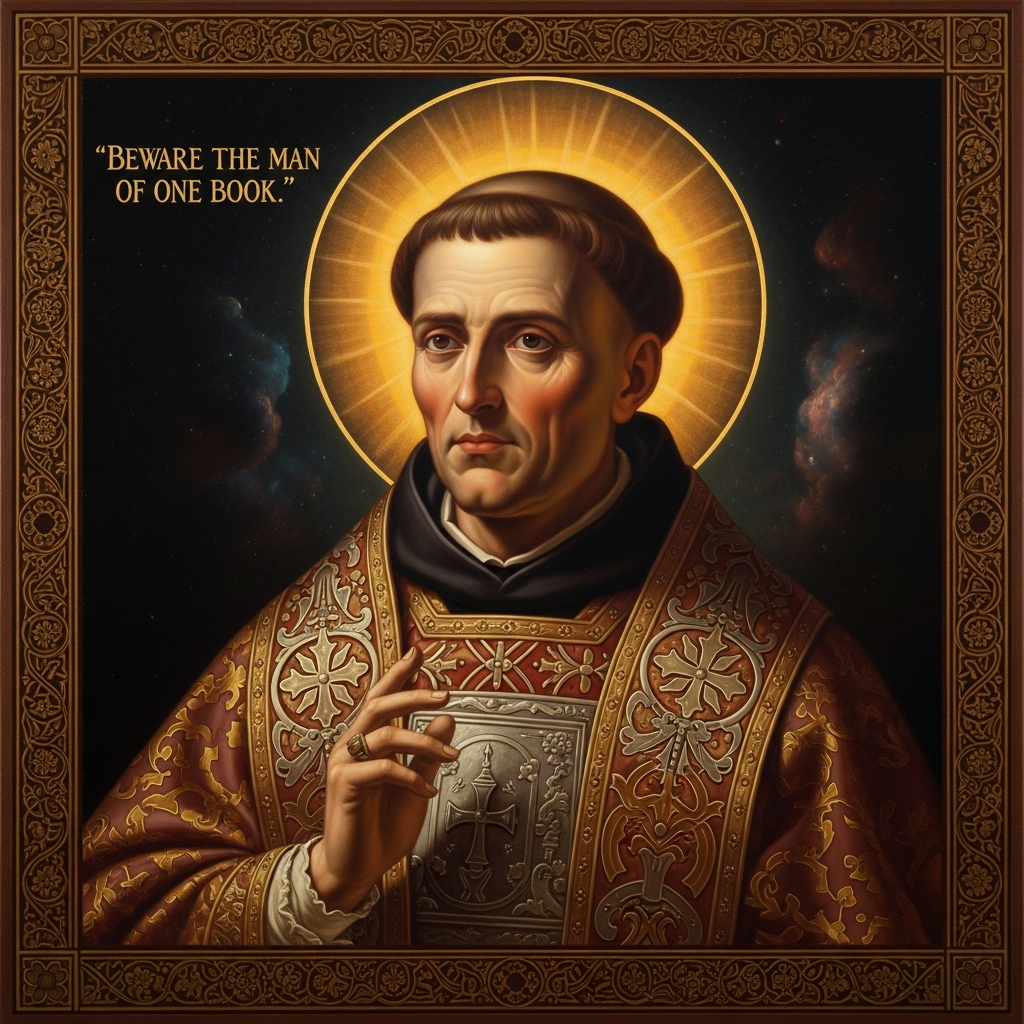
“Beware the man of one book.” — attributed to Aquinas
The architect of scholastic theology. Born to Italian nobility (~1225), kidnapped by his family to prevent him joining the new Dominican order (they failed — he escaped), he studied under Albertus Magnus in Cologne and Paris and produced what is still the most ambitious systematic theology ever attempted in the Western tradition. The Summa Theologica is structured as objections, “on the contrary,” answer, and reply to objections — the very shape of medieval intellectual argument. Canonized 1323, declared a Doctor of the Church 1567. Pope Leo XIII’s encyclical Aeterni Patris (1879) made Thomism the standard Catholic philosophical and theological framework — a status it largely retained until Vatican II opened up methodological pluralism.
1 min read
his own works; also entered in [Saints.md](Saints.md#st-thomas-aquinas)