The Story
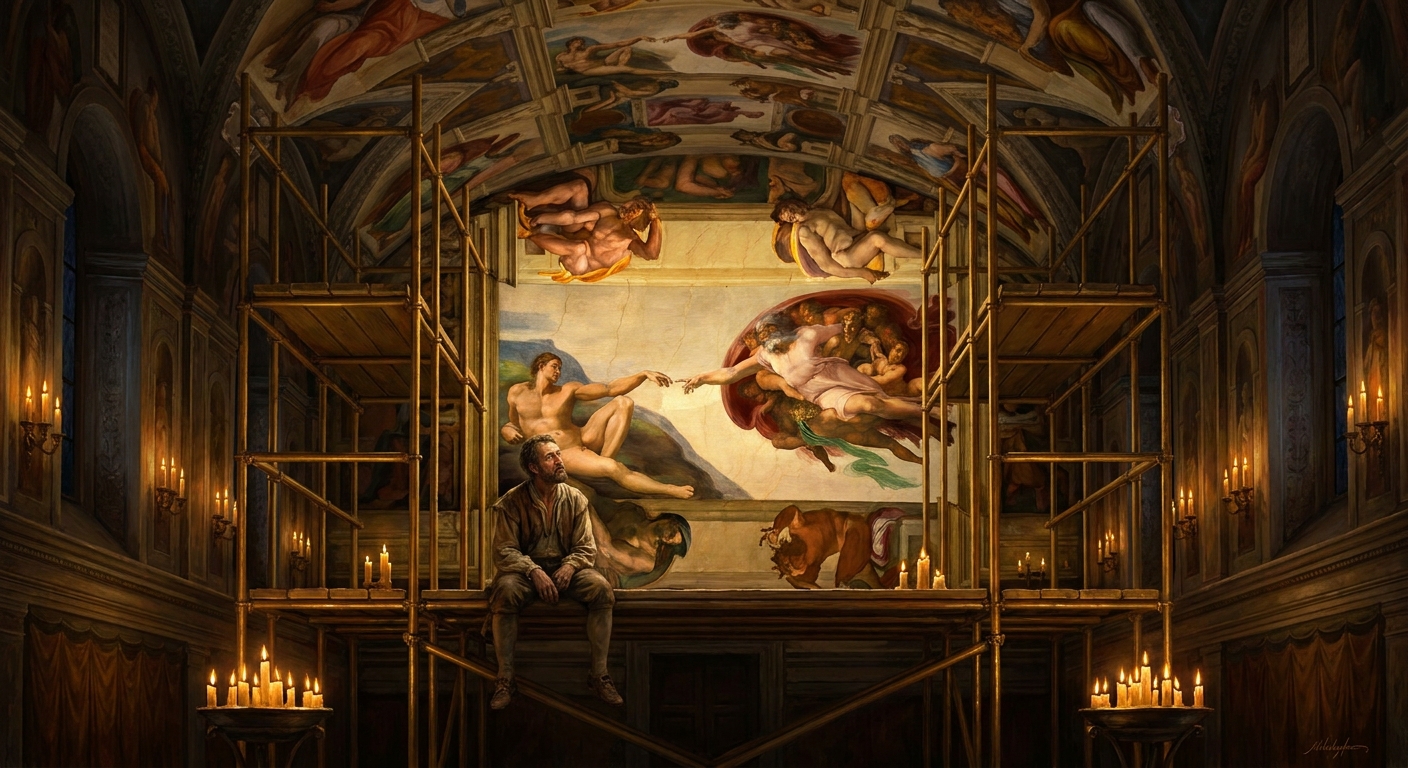
The Catholic Church is the largest single religious institution on earth: roughly 1.4 billion baptized members, an unbroken (or nearly unbroken — it depends) institutional memory stretching to the first century, mystics and philosophers and hospitals and scandals and art. This file treats it as a living tradition, not a punching bag. Where claims are contested — and several central ones are — the contest gets named.
The narrative arc, with appropriate hedges:
The Apostolic Age (~30-100 CE): A small Jewish messianic movement around Jesus of Nazareth survives the crucifixion, expands under Peter and Paul, and reaches Rome within a generation. Catholic tradition: Peter served as first Bishop of Rome, martyred under Nero (~64-67 CE) (1 Clement, Epistles), his authority inherited by the Roman bishopric (the “Petrine succession”). The historical evidence for Peter in Rome is decent; evidence for a self-conscious “papal” office in the first century is thin. Non-Catholic historians date papal primacy to the second-fifth centuries, a later development. Catholics hedge: the office develops, but the authority is original (Matthew 16:18-19).
Persecution and Catacombs (100-313 CE): Roman authorities cycle through periodic persecutions (Nero, Domitian, Decius, Diocletian) (Eusebius, Ecclesiastical History). Christians worship underground, develop a theology of martyrdom, and the church grows anyway. By 300 CE perhaps a tenth of the empire is Christian.
Constantine and the Edict of Milan (313 CE): Emperor Constantine, after seeing a cross in the sky before the Battle of the Milvian Bridge (312), legalizes Christianity in 313 (Edict of Milan). Within a generation it moves from persecuted minority to favored religion to (under Theodosius, 380) state religion (Edict of Thessalonica, 380). Triumph or corruption? Christians have argued ever since. Both readings have merit.
The Council of Nicaea (325 CE): Constantine convenes the first ecumenical council to settle the Arian controversy (Council of Nicaea, 325). The Nicene Creed (“true God from true God, begotten not made, of one substance with the Father”) emerges and becomes the Christian doctrinal baseline for Catholics, Orthodox, Protestants, and most other branches. Six more councils follow over four centuries (Constantinople, Ephesus, Chalcedon), defining Trinitarian and Christological doctrine.
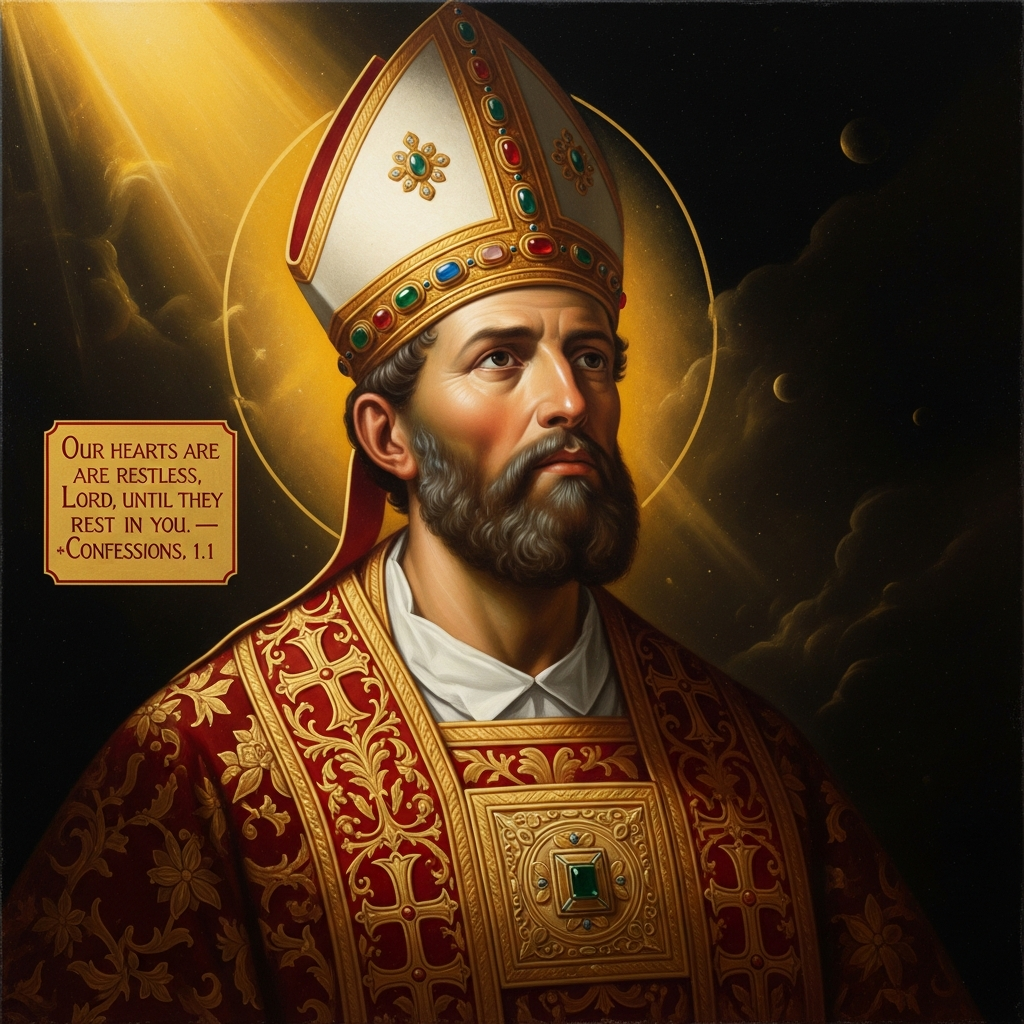
The Patristic Era (300-600 CE): Church Fathers — Augustine of Hippo, Jerome (translating the Latin Vulgate), the Cappadocians, Gregory the Great — establish Western theology. Monasticism emerges (Anthony, Benedict; Rule of St. Benedict, ~530) and becomes the engine of Christian intellectual and agricultural life through the early Middle Ages.
The East-West Schism (1054): A long drift (linguistic, theological, liturgical, political) cracks open when papal legates and the Patriarch of Constantinople mutually excommunicate (1054). The East becomes Eastern Orthodoxy; the mutual excommunications stand until 1965 (Joint Declaration, December 7, 1965).
The High Middle Ages (1100-1300): The Crusades (1095 onward) produce military orders (Templars, Hospitallers, Teutonic Knights), centuries of Christian-Muslim conflict, and the catastrophic Fourth Crusade’s sacking of Christian Constantinople (1204). Inside Europe: scholasticism flowers with Thomas Aquinas; Francis of Assisi reinvents apostolic poverty; Gothic cathedrals rise.
The Reformation Crisis (1517-1600s): Martin Luther protests indulgence sales (95 Theses, 1517). Within a generation the Western church fragments: Lutheran, Reformed, Anglican, Anabaptist streams break off. Catholicism responds with the Council of Trent (1545-1563): doctrine clarified, abuses reformed, a post-Tridentine identity defined that lasts roughly four hundred years (Council of Trent, Canons and Decrees). New orders — especially the Jesuits under Ignatius of Loyola (Regimini Militantis Ecclesiae, 1540) — carry the Counter-Reformation worldwide.
The Modern Crisis (1789-1900): The French Revolution, secular nationalism, and Italian unification strip the papacy of the Papal States (1870). In response, Vatican I (1869-1870, Pastor Aeternus) defines papal infallibility: the pope speaking ex cathedra on faith or morals cannot err. Hotly contested. Old Catholics break away; Protestants and Orthodox reject it; even Catholic theologians narrow its scope (invoked perhaps twice).
Vatican II (1962-1965): Pope John XXIII opens the windows (Vatican II, 1962-1965). The council reforms the liturgy (vernacular Mass, priest facing the people; Sacrosanctum Concilium §41), reframes relations with non-Christian religions (Nostra Aetate, 1965), affirms religious liberty (Dignitatis Humanae, 1965), recovers a biblical and pastoral tone (Lumen Gentium, 1964). Faithful development or rupture? Catholics are still arguing.
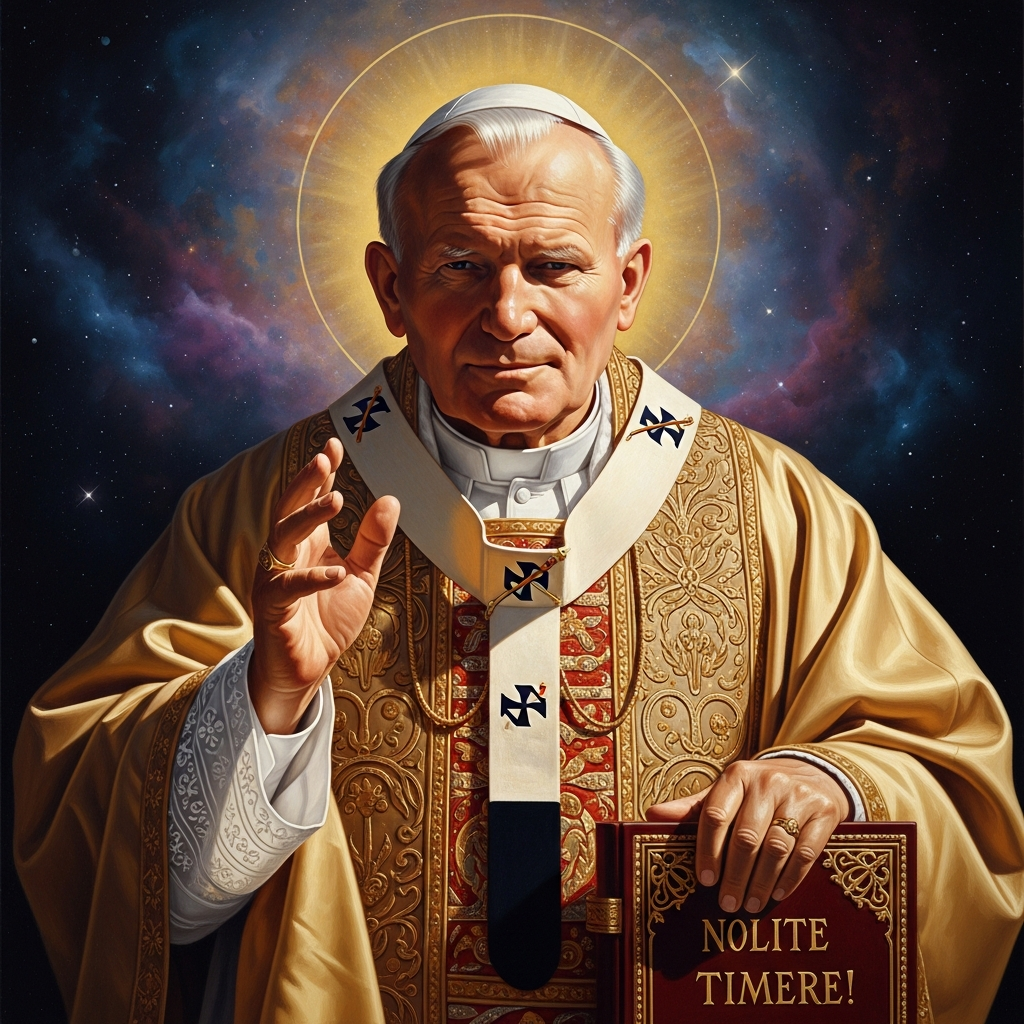
Today (2026): John Paul II (1978-2005) helped end communism, globalized the papacy. Benedict XVI resigned in 2013 (first papal resignation in six centuries). Francis (2013-) is the first Jesuit pope, first from the Americas, a polarizing reformer. The church grapples, often badly, with the clergy abuse crisis — court records, cover-ups, grand jury reports across continents. It is also the largest provider of healthcare and education on earth outside governments. Both things are true.
Pivotal Events
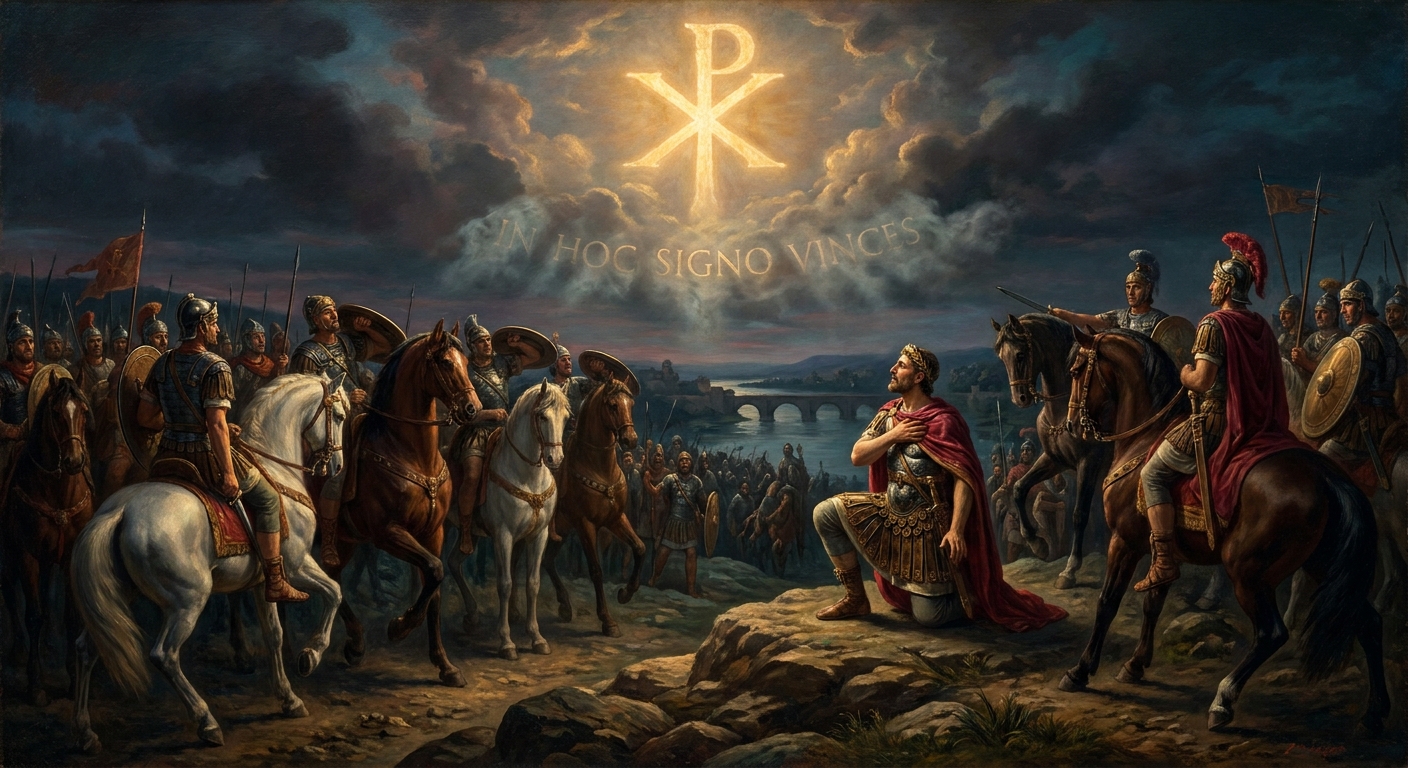
Before the Battle of the Milvian Bridge (312), Constantine sees a cross of light with the words In hoc signo vinces (“In this sign you shall conquer”). He wins. The next year he and Licinius issue the Edict of Milan: legal toleration for Christianity across the empire. Within a human lifetime Christianity moves from periodically persecuted minority to favored religion to (under Theodosius, 380) state religion. Benefits were obvious: no catacombs, no arenas, imperial basilicas. Costs were less obvious and are still argued: did the church convert the empire, or did the empire convert the church? Both readings have defenders. Undisputed: the Edict is the moment Christianity acquires the wealth and political entanglements that define the next seventeen centuries.
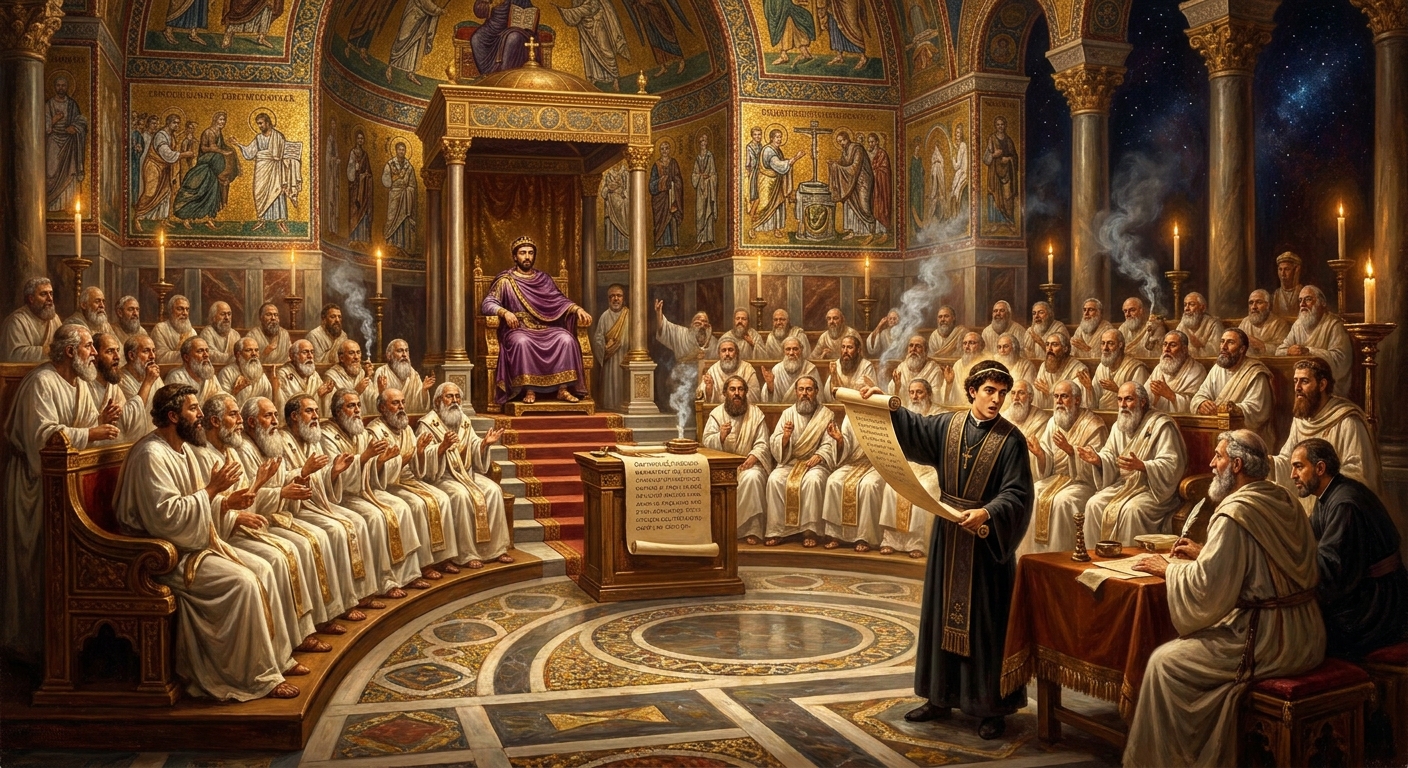
Constantine summoned roughly three hundred bishops to Nicaea to settle Arius’s teaching: the Son was created, subordinate to the Father. The council rejected Arius and produced the Nicene Creed — the first ecumenical doctrinal statement, affirming the Son as homoousios (of one substance) with the Father. As expanded at Constantinople (381), it remains the doctrinal floor for Catholics, Orthodox, Anglicans, Lutherans, Reformed, and most other Christian traditions. Conspiracy theories (see Conspiracies #10) claim Nicaea “invented” Christianity, decided the biblical canon, or voted on Christ’s divinity. None of this is historical. The canon wasn’t on the agenda; Christ’s divinity was consensus before the council; the vote was on doctrinal language, not theological invention. What Nicaea did: set the precedent that doctrine could be defined ecumenically.
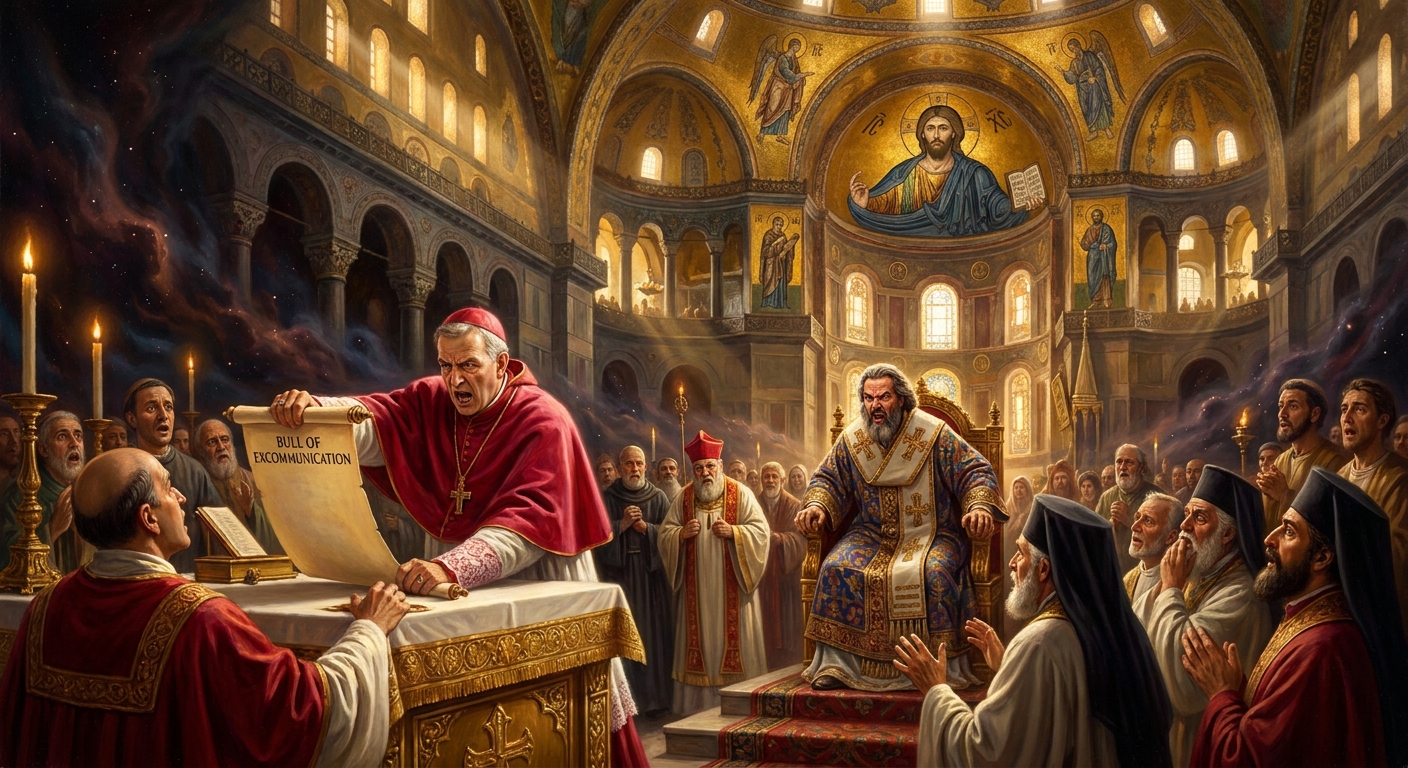
The split was a slow-motion divorce with a date. On July 16, 1054, Cardinal Humbert, papal legate, marched into the Hagia Sophia during divine liturgy and laid a bull of excommunication on the altar. Patriarch Michael Cerularius excommunicated him back. Proximate causes: the filioque (whether the Spirit proceeds from Father “and the Son”), papal primacy, leavened versus unleavened bread, celibacy. Deeper cause: five centuries of drift (Greek East/Latin West, Constantinople/Rome, Caesaropapist/papalist church-state models). The mutual excommunications stood until December 7, 1965, when Pope Paul VI and Patriarch Athenagoras issued a Joint Declaration. Reunion has not followed. The schism continues, though increasingly cordial.
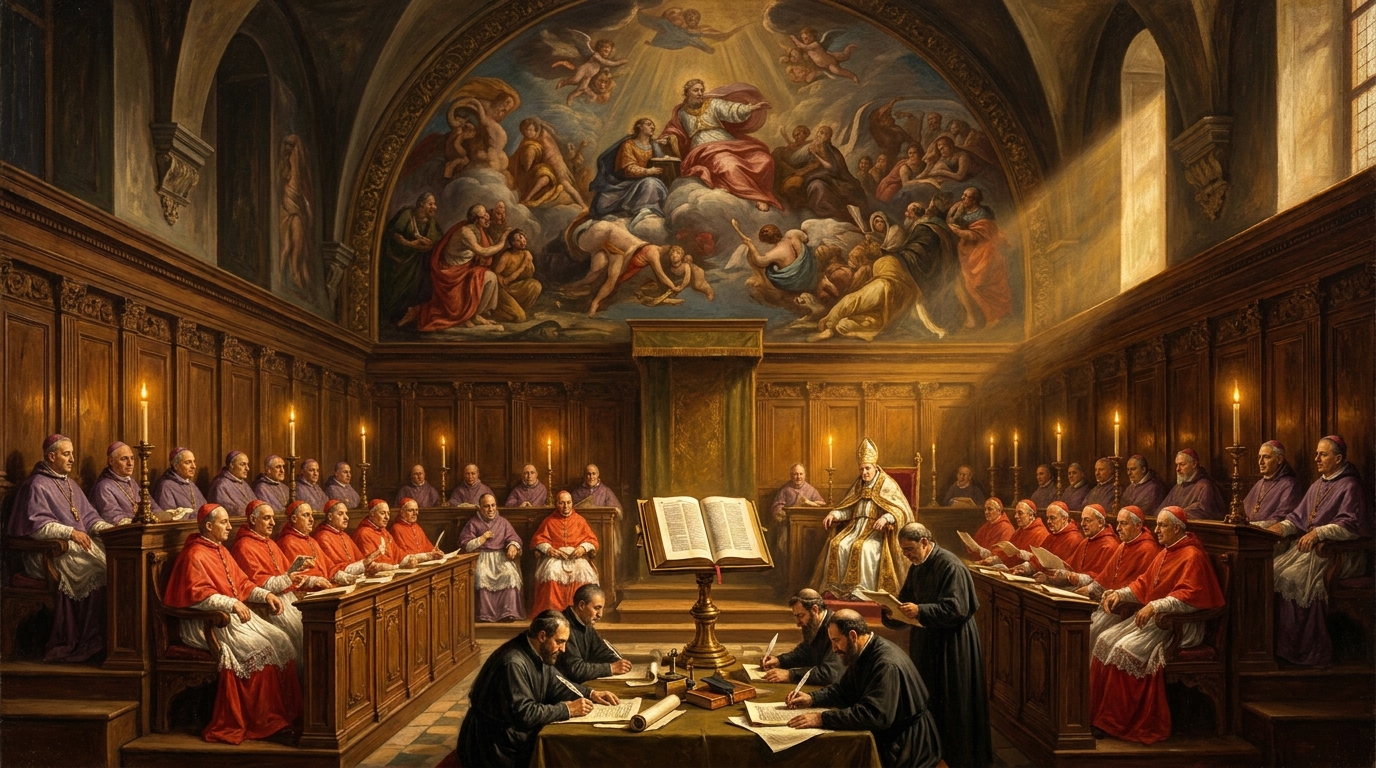
Luther’s 95 Theses (1517) protested indulgence sales; no one expected permanent fragmentation of Western Christianity. Within decades, Lutheran, Reformed, Anglican, Anabaptist movements broke with Rome. Catholic response: the Council of Trent (1545-1563, three sessions). Trent defined doctrine (faith and works, scripture and tradition, seven sacraments, transubstantiation, purgatory), cracked down on abuses (absentee bishops, ignorant priests), and standardized the Roman Mass in a form lasting until Vatican II. Trent created “Tridentine Catholicism” — muscular, defined, globally uniform — that conducted the Counter-Reformation, evangelized the Americas and Asia, and produced Ignatius of Loyola, Teresa of Avila, and John of the Cross.
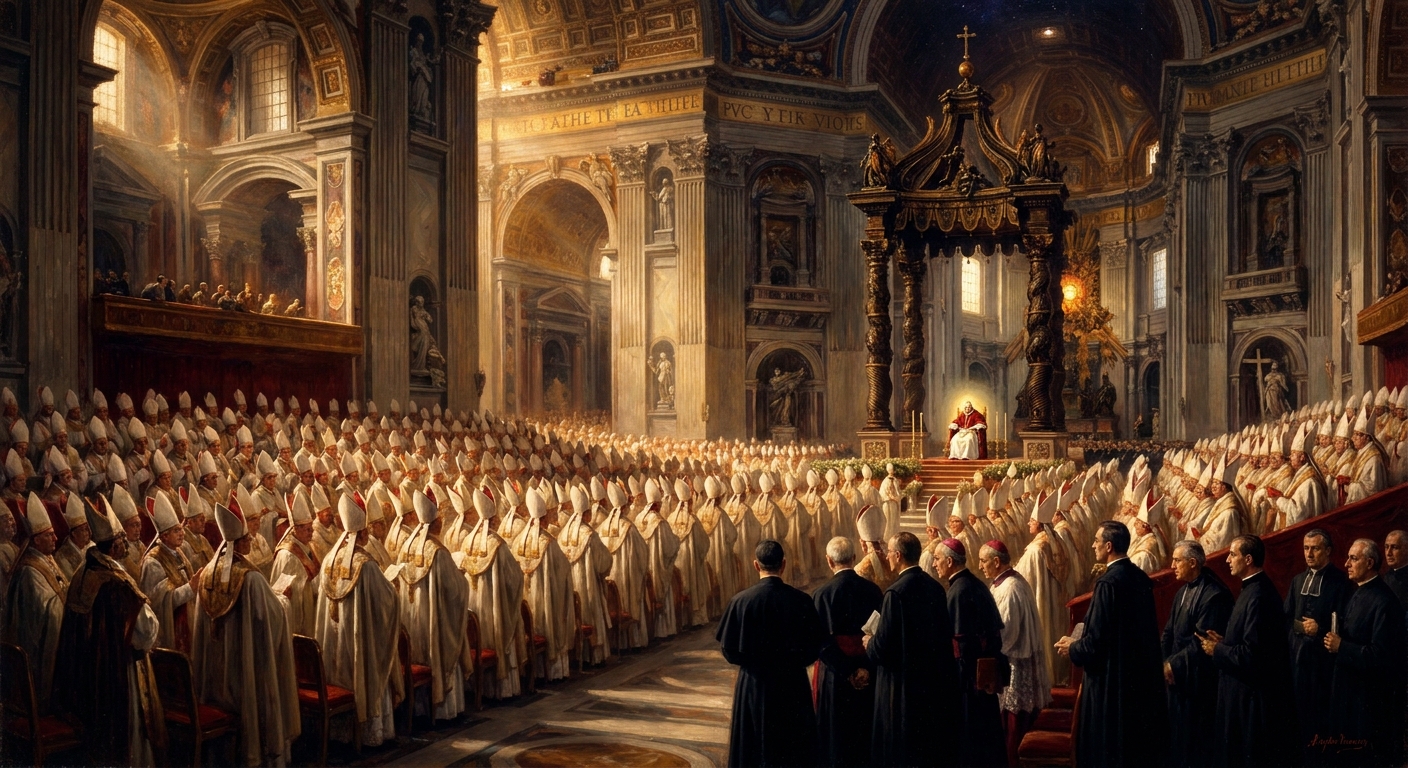
Pope John XXIII announced an ecumenical council in 1959 — only the twenty-first in church history, the first in nearly a century — speaking of aggiornamento (updating), opening windows to fresh air. Over four sessions (1962-1965), more than two thousand bishops produced sixteen documents that quietly transformed Catholicism. Mass moved from Latin to vernacular, priest faced the people (Sacrosanctum Concilium). The church redefined itself as “People of God” rather than hierarchy (Lumen Gentium). It affirmed religious liberty — remarkable reversal of nineteenth-century positions (Dignitatis Humanae). It recognized truth in non-Christian religions, repudiated antisemitic readings of the Passion (Nostra Aetate). Faithful development or rupture? Most Catholics read it as continuity. Traditionalist critics do not. The argument persists unsettled.
Timeline
| Era | Date | Event | Source |
|---|
| Apostolic | ~30 CE | Pentecost; the Spirit descends on the apostles | Acts 2 |
| Apostolic | ~33-67 CE | Peter’s ministry; Catholic tradition places his death in Rome under Nero | tradition; 1 Clement |
| Apostolic | ~50-67 CE | Paul’s missionary journeys; martyred in Rome | Acts; Pauline epistles |
| Sub-apostolic | ~100-200 CE | Apostolic Fathers (Ignatius, Polycarp, Clement); episcopal structure consolidates | early epistles |
| Persecution era | 64-313 CE | Cycles of imperial persecution — Nero, Decius, Diocletian | Eusebius |
| Imperial favor | 313 CE | Edict of Milan; Christianity legalized | Lactantius; Eusebius |
| Doctrinal definition | 325 CE | Council of Nicaea; Nicene Creed | conciliar acts |
| State religion | 380 CE | Theodosius’s Edict of Thessalonica | Codex Theodosianus |
| Patristic | 354-430 | Augustine of Hippo | his works |
| Christological councils | 431, 451 | Ephesus; Chalcedon (two natures of Christ) | conciliar acts |
| Monasticism | ~530 | Benedict writes his Rule at Monte Cassino | Rule of St. Benedict |
| Schism | 1054 | East-West mutual excommunications | Humbert / Cerularius |
| Crusades | 1095-1291 | Urban II calls First Crusade; eight major crusades follow | papal bulls; chronicles |
| Templars founded | 1119 | Knights Templar established in Jerusalem | Hugh of Payens |
| Mendicants | 1209-1216 | Francis of Assisi and Dominic found mendicant orders | Franciscan / Dominican rules |
| Scholasticism | 1225-1274 | Thomas Aquinas; Summa Theologica | his works |
| Templar suppression | 1307-1314 | Templars dissolved by Philip IV / Clement V | trial records |
| Avignon Papacy | 1309-1377 | Papacy relocated to Avignon under French influence | papal records |
| Western Schism | 1378-1417 | Two (then three) competing popes | Council of Constance |
| Reformation begins | 1517 | Luther’s 95 Theses | Disputatio |
| Counter-Reformation | 1540 | Ignatius of Loyola founds the Jesuits | Regimini Militantis Ecclesiae |
| Council of Trent | 1545-1563 | Catholic doctrinal and disciplinary response to Reformation | conciliar decrees |
| New World missions | 1500s-1700s | Catholic missions to Americas, Asia, Africa | Jesuit relations; Franciscan records |
| Mary as Immaculate | 1854 | Pius IX defines the Immaculate Conception | Ineffabilis Deus |
| Vatican I | 1869-1870 | Papal infallibility defined | Pastor Aeternus |
| Loss of Papal States | 1870 | Italian unification ends papal temporal sovereignty | Italian unification |
| Lateran Treaty | 1929 | Vatican City established as sovereign state | treaty text |
| Mary’s Assumption | 1950 | Pius XII defines the Assumption (the second-ever ex cathedra dogma) | Munificentissimus Deus |
| Vatican II | 1962-1965 | Aggiornamento; sixteen reform documents | conciliar documents |
| 1965 | Dec 7, 1965 | Mutual 1054 excommunications lifted | Joint Declaration |
| John Paul II | 1978-2005 | First non-Italian pope in 455 years; Polish; instrumental in fall of communism | papal records |
| Abuse crisis | 2002- | Boston Globe Spotlight investigation; cascading global revelations | grand jury reports |
| Benedict resigns | 2013 | First papal resignation since 1415 | Declaratio |
| Francis | 2013- | First Jesuit pope; first from the Americas | papal records |
| Present | 2026 | ~1.4 billion Catholics globally | Annuario Pontificio |
Distinctive Doctrines
What makes Catholicism Catholic is a cluster of doctrines uniquely defined in the Western tradition or held with particular weight.
The Eucharist as Transubstantiation. At the consecration, bread and wine become the actual Body and Blood of Christ — not symbolically, but in substance, retaining only the accidents (appearance, taste). Formalized at the Fourth Lateran Council (1215) and reaffirmed at Trent (Council of Trent, Doctrine of the Most Holy Eucharist). Most Protestants reject it; Lutherans hold “sacramental union”; Orthodox affirm the Real Presence without the philosophy.
The Seven Sacraments. Baptism, Confirmation, Eucharist, Reconciliation, Anointing of the Sick, Holy Orders, Matrimony. Defined as seven (not two, as Protestants define them) at Florence (1439) and reaffirmed at Trent (Council of Trent, Doctrine of the Sacraments). Each confers grace ex opere operato — from the work itself, independent of the minister’s holiness.
Papal Authority and Infallibility. The pope is Peter’s successor, visible head of the universal church, protected from doctrinal error when speaking ex cathedra on faith or morals. Defined formally at Vatican I (1870, Pastor Aeternus), with narrower scope than popular usage: invoked at most twice (Ineffabilis Deus, Pius IX, 1854 Immaculate Conception; Munificentissimus Deus, Pius XII, 1950 Assumption). Ordinary papal teaching is not held infallible. Orthodox and Protestants both reject it.
The Marian Dogmas. Four teachings: Theotokos (God-bearer, Council of Ephesus 431, shared with Orthodoxy); Ever-Virgin; Immaculately Conceived (preserved from original sin from her conception, Ineffabilis Deus, Pius IX, 1854); Assumed body and soul into heaven (Munificentissimus Deus, Pius XII, 1950). The last two are uniquely Catholic.
Purgatory. A purification state for souls dying in grace but with unresolved attachments to sin — not a “second chance” but final cleansing on the way to heaven. Defined at Florence (Council of Florence, 1439) and Trent (Council of Trent, Doctrine of Purgatory). Rejected by Protestants (sola gratia objections); Orthodox affirm prayer for the dead but reject the Western doctrine.
Communion of Saints. The living and dead in Christ form a single body. Catholics ask saints to intercede, venerate their images and relics, offer prayers for the dead. The distinction: latria (worship, for God alone) versus dulia (veneration, for saints), with hyperdulia for Mary — articulated to defend against iconoclast and Protestant objections.
The Magisterium. The teaching authority (pope and bishops) is a third source of authority alongside Scripture and Tradition. Protestants hold sola scriptura (Scripture alone). Catholics hold Scripture, Tradition, and Magisterium as a single deposit with three modes of transmission.
The seven deuterocanonical books — Tobit, Judith, Wisdom, Sirach, Baruch, 1-2 Maccabees, plus expansions of Daniel and Esther — are part of the Catholic Old Testament. Protestants moved them to the “Apocrypha” at the Reformation; Orthodox include them and add a few more.
Natural Law and Catholic Social Teaching. Theologically central: ethical truths are accessible to human reason, not only faith. Aquinas’s natural law (Summa Theologica I-II) holds that moral norms are written into created human nature and knowable by anyone.
This roots Catholic Social Teaching: papal encyclicals from Leo XIII’s Rerum Novarum (1891, labor and capital) through Pius XI’s Quadragesimo Anno (1931, subsidiarity), John XXIII’s Pacem in Terris (1963, peace), John Paul II’s Centesimus Annus (1991), Benedict XVI’s Caritas in Veritate (2009), and Francis’s Laudato Si’ (2015, ecology) and Fratelli Tutti (2020, fraternity).
A just society respects human dignity, the common good, subsidiarity (decisions at the lowest competent level), solidarity, universal destination of goods, and preferential option for the poor. As elaborated and serious as classical Marxism — and it predates Marx by centuries in some instincts.
The Communion of Saints in practice. Saints are available. Break something? Pray to St. Anthony. Travelers call on St. Christopher. Students before exams pray to St. Joseph of Cupertino (a seventeenth-century friar who passed his ordination exams because the examiner asked the one question he knew). Patron saints attach to professions, illnesses, cities: accountants (Matthew), brewers (Arnold of Soissons), epileptics (Vitus), lost causes (Jude), comedians (Genesius), the Internet (Isidore of Seville).
Idolatry? Catholics say no: saints aren’t worshiped, they’re asked to intercede. Same as asking a living Christian to pray for you — except the saint is already in God’s presence and (Catholic theology) their prayer has special power. Whether this distinction is convincing depends on your prior about the communion of saints. Catholics find it natural; Protestants find it slippery.
Notable Popes
The papacy has held roughly 266 occupants over two thousand years. Most are forgotten; some are saints; a few were monsters; many simply administered. A subjective list of the consequential:
| Pope | Reign | Why They Matter |
|---|
| Peter | ~30-67 | Catholic tradition’s first pope; the office’s biblical root |
| Leo I “the Great” | 440-461 | Confronted Attila the Hun; defined Christological orthodoxy via the Tome |
| Gregory I “the Great” | 590-604 | Reformed liturgy (Gregorian chant); sent Augustine of Canterbury to evangelize England |
| Urban II | 1088-1099 | Called the First Crusade at Clermont, 1095 |
| Innocent III | 1198-1216 | High-water mark of medieval papal power; Fourth Lateran Council |
| Boniface VIII | 1294-1303 | Unam Sanctam: the most extreme medieval claim of papal supremacy |
| Clement V | 1305-1314 | Moved papacy to Avignon; dissolved Templars under French pressure |
| Alexander VI (Borgia) | 1492-1503 | The Borgia pope; nepotism, scandal, fathered acknowledged children including Lucrezia and Cesare |
| Julius II | 1503-1513 | ”The Warrior Pope”; commissioned the Sistine Chapel ceiling and Raphael’s School of Athens |
| Leo X | 1513-1521 | The pope of the indulgence campaign that sparked Luther’s protest |
| Paul III | 1534-1549 | Convoked the Council of Trent; approved the Jesuits |
| Pius V | 1566-1572 | Standardized the Tridentine Mass; canonized for severe reform |
| Pius IX | 1846-1878 | Longest pontificate in history (31 years); defined Immaculate Conception (1854); presided over Vatican I |
| Leo XIII | 1878-1903 | Rerum Novarum (1891) inaugurated modern Catholic Social Teaching |
| Pius X | 1903-1914 | Anti-Modernist crackdown; canonized; lowered the age of First Communion |
| Pius XII | 1939-1958 | The wartime pope; defined the Assumption (1950); his record on the Holocaust is contested |
| John XXIII | 1958-1963 | ”Good Pope John”; convoked Vatican II; canonized |
| Paul VI | 1963-1978 | Closed Vatican II; promulgated Humanae Vitae against artificial contraception (1968); canonized |
| John Paul II | 1978-2005 | First non-Italian in 455 years; helped bring down Soviet communism; see entry |
| Benedict XVI | 2005-2013 | Theologian-pope; first papal resignation in nearly 600 years |
| Francis | 2013- | First Jesuit; first from the Americas; reformer; polarizing |
The list of canonized popes is long (about 80, mostly from the early centuries when martyrdom was the standard occupational hazard); the list of bad popes is shorter but more colorful. The Catholic position is that the office is preserved by divine providence even when its occupants are not. The contention is testable mostly by the long-run survival of the institution, which is, by any reasonable measure, the longest-running institution in the world.
The Dark Chapters
A 2,000-year-old institution with 1.4 billion members has accumulated a substantial bill of historical sins. An honest treatment names them.
The Crusades (1095-1291). The First Crusade (1099) sacked Jerusalem, slaughtering Muslim, Jewish, and local Christian populations. The Fourth Crusade (1204) never reached the Holy Land — it sacked Christian Constantinople instead, looting treasure and freezing the East-West schism for eight centuries. The Albigensian Crusade (1209-1229) targeted fellow Christians in southern France (the Cathars). John Paul II’s Memoria e Riconciliazione (2000) formally apologized for crusading violence.
The Inquisition. Multiple distinct institutions. The medieval Inquisition (12th-13th c.) targeted heretics; the Spanish Inquisition (1478-1834) operated under Spanish royal control and targeted conversos and moriscos (forced converts) for secret practice; the Roman Inquisition (1542-) prosecuted Galileo. Modern scholarship revised downward some Black Legend numbers: perhaps 3,000-5,000 executions over three and a half centuries, fewer than other European judicial systems then. Religious coercion under Catholic authority is undisputed and formally repudiated.
The Suppression of the Templars (1307-1314). Philip IV of France, in debt to the Templar bank, arrested the order on a single day (October 13, 1307), tortured them into confessing heresy, sodomy, idolatry, and burned them. Pope Clement V dissolved the order at Vienne (1312) under French pressure. The 2001 Chinon Parchment discovery revealed Clement had privately absolved the Templar leadership of heresy before bowing to Philip. A 5/5 documented historical conspiracy.
Galileo (1633). Convicted of “vehement suspicion of heresy” for teaching heliocentrism beyond church-set bounds. Sentenced to house arrest. This became the standard shorthand for Catholic obscurantism. The actual history is messier (Galileo had Catholic patrons; the case involved personal enemies), but the formal church position was wrong. John Paul II said so explicitly in 1992, regretting “errors committed.”
Slavery and Colonialism. Catholic missionaries accompanied Iberian colonization of the Americas, Africa, and Asia from the late 1400s. Some — Bartolome de las Casas, Antonio de Montesinos, the Jesuits in Paraguay — defended indigenous peoples; others were complicit. Papal bulls (1450s-1490s, the Doctrine of Discovery) authorized European Christian sovereignty over non-Christian lands. Formally repudiated, most clearly in 2023.
The Clergy Abuse Crisis. The most serious modern stain. Documented in court filings, grand jury reports, investigations, and church studies (John Jay Report, 2004). Sexual abuse of minors and — worse — episcopal cover-ups, priest transfers, institutional reputation prioritized over victims’ welfare, spanning decades and continents. The 2002 Boston Globe investigation broke the dam; subsequent investigations in Ireland, Germany, France, Australia, Chile, Mexico. Pope Francis convened the 2019 Vatican summit on protecting minors. Reform mechanisms exist; trust remains fractured; criminal and civil cases continue. See Conspiracies #16 for the evidence catalog.
An institution is measured by failures and repairs. Both ledgers run long. Honesty requires both.
The Mystical Tradition
A continuous mystical tradition runs alongside institutional and doctrinal life: lived experience of God in prayer, vision, union, codified by figures who shaped Catholic spiritual reading.
Early sources: the Desert Fathers and Mothers (~300-500 CE) whose sayings became the Apophthegmata Patrum. Pseudo-Dionysius (~500 CE) introduced cataphatic theology (saying what God is) versus apophatic (saying what God is not), shaping all later mystical writing.
Medieval Western mystics: Bernard of Clairvaux (12th c., God’s love), Hildegard of Bingen (12th c., visionary, composer), Meister Eckhart (~1300, German Dominican whose Godhead beyond God teachings were posthumously censured but influenced Tauler, Suso, and the Theologia Germanica), Julian of Norwich (14th c., anchoress, “all shall be well”), and the anonymous Cloud of Unknowing.
The Spanish Carmelite Reform (1500s) produced Teresa of Avila (The Interior Castle) and John of the Cross (The Dark Night of the Soul), two of the West’s most systematic mystical writers. Both canonized as Doctors of the Church.
Modern stream: Therese of Lisieux’s little way, Edith Stein’s phenomenological mysticism (killed at Auschwitz, canonized 1998), Thomas Merton’s Seven Storey Mountain and interfaith work, and Mother Teresa’s revealed dark night.
The mystical and doctrinal traditions are not opposed. Great mystics were nearly always orthodox; great theologians were serious pray-ers. Aquinas, asked why he stopped writing, said his visions made it all seem like straw. Mystical and rational meet in the same persons.
The Eastern Catholic Churches
“Catholic” usually means “Roman Catholic” — Latin Rite, Roman Mass, clerical celibacy, vertical Vatican hierarchy. The largest single group, but not the only one. In communion with Rome are roughly twenty-three sui iuris (“of their own right”) Eastern Catholic Churches — separate liturgical, canonical, and disciplinary traditions, each with patriarch or major archbishop, in full communion with the Pope but emphatically not Latin Rite. The largest:
- Ukrainian Greek Catholic Church (~5 million; Byzantine rite; Ukraine and diaspora)
- Maronite Church (~3 million; West Syriac rite; Lebanon and diaspora; never separated from Rome)
- Syro-Malabar Church (~4 million; East Syriac rite; Kerala, India; traces origins to St. Thomas the Apostle)
- Melkite Greek Catholic Church (~1.6 million; Byzantine rite; Middle East and diaspora)
- Chaldean Catholic Church (~600,000; East Syriac rite; Iraq and diaspora)
- Coptic Catholic, Ethiopian Catholic, Armenian Catholic, Romanian Greek Catholic, and others
These churches have married priests (celibacy is not universally Catholic), use leavened bread for the Eucharist (in Byzantine rite churches), and follow their own liturgical year. Vatican II’s Orientalium Ecclesiarum affirmed their distinctive heritage and ordered the West to stop Latinizing them. Their existence rebuts “Catholic = Roman.”
The Marian Tradition
What puzzles outsiders most about Catholic devotion is Mary’s place. Catholics don’t worship her (worship is for God alone), but the veneration given to her is intense, ancient, woven through prayer at every level.
The Christological logic. From Ephesus (431) onward, Catholic and Orthodox theology treats Mary as Theotokos (“God-bearer”). Doctrines about Mary are doctrines about Christ refracted through her: she is honored because of who her son is. Saying “Mary is the Mother of God” affirms Jesus is genuinely God and genuinely born of a human woman.
The four dogmas. Theotokos (Ephesus 431); Perpetual Virginity (patristic consensus, Lateran 649); Immaculate Conception (Pius IX, 1854 — Mary preserved from original sin from her own conception); and Bodily Assumption (Pius XII, 1950 — Mary taken body and soul into heaven). The first two are shared with Orthodoxy; the last two are uniquely Catholic. Note: Immaculate Conception is not about Jesus’s virgin birth — it’s about Mary’s conception by Joachim and Anne.
The apparitions and piety. Reported Marian apparitions include Guadalupe (1531, Mexico), Lourdes (1858, France), Fatima (1917, Portugal), Knock (1879, Ireland), others. The church investigates cautiously and approves only a fraction; approved apparitions are private revelation, not binding. Lourdes draws roughly six million pilgrims annually. Guadalupe is arguably the most consequential religious image in the Americas — the Virgin appeared to indigenous convert Juan Diego on Tepeyac hill, leaving her image on his tilma; the cult that grew around it is widely credited with Mesoamerica’s Christianization.
The Rosary — meditative prayer counting fifty Hail Marys organized around twenty meditations on Christ and Mary’s lives — is the most widely practiced Catholic devotion outside the Mass. Dating to the late medieval period, it remains for hundreds of millions of Catholics the daily rhythm of prayer.
The Papacy: Office, Authority, and Limits
The papacy is the most visible and contested Catholic feature. Catholic theology holds that the Bishop of Rome is Peter’s successor, exercises unique pastoral authority, and — under narrow conditions — can teach infallibly on faith or morals. Each claim has hedges.
Petrine succession. The biblical case: Matthew 16:18 (“on this rock I will build my church”), John 21:15-17 (“Feed my sheep”), Luke 22:32 (“Strengthen your brethren”). Catholic exegesis: Peter received unique pastoral authority inherited by Rome’s bishops. Orthodox exegesis: Rome has primacy of honor but not universal jurisdiction. Protestant exegesis: “the rock” is Peter’s confession, not Peter himself. Historical evidence for Peter as Bishop of Rome is decent but not airtight; evidence for a first-century “papal” office is thin.
Development. The Roman bishopric grew in stature because Rome was the imperial capital, because Peter and Paul died there, and because successive Roman bishops (Leo, Gregory) were exceptionally capable. The full medieval claim — that the pope holds plenitudo potestatis (fullness of power) over spiritual and temporal matters — developed in the 11th-14th centuries and is no longer pressed.
Infallibility. Defined at Vatican I (1870). Narrow conditions: the pope must speak (1) ex cathedra (from Peter’s chair); (2) on faith or morals; (3) intending to bind the universal church; (4) as definitive teaching. Most papal teaching doesn’t meet these. The 1854 Immaculate Conception and 1950 Assumption are the two clearest cases. Catholics cite this as evidence of the doctrine’s operation; skeptics cite it as self-fulfilling design.
The conclave. Cardinals under 80 gather for sealed election. Two-thirds majority. White smoke = elected pope; black smoke = another ballot. Rules date to Gregory X (1274). John Paul II (1978, non-Italian after 455 years) and Francis (2013, non-European after roughly 1,300 years) marked globalization.
The limits. The pope cannot redefine the faith’s deposit, cannot abolish a sacrament, cannot ordain without delegation. Celibacy, male-only priesthood, contraception prohibitions are held with various authority levels, not all infallible. Theological argument over binding levels is perennial Catholic sport.
Major Religious Orders
The Church’s vitality has been carried as much by religious orders as by diocesan structure. Each order arose to meet a perceived need; together they form a distributed R&D system for the faith.
| Order | Founded | Founder | Charism / Focus |
|---|
| Benedictines | ~530 | Benedict of Nursia | Ora et labora (prayer and work); stable monastic communities; preserved literacy through the Dark Ages |
| Cistercians | 1098 | Robert of Molesme | Reformed Benedictine austerity; agricultural innovation; medieval Europe’s first sustainability project |
| Carthusians | 1084 | Bruno of Cologne | Eremitic; “never reformed because never deformed”; produced Chartreuse liqueur |
| Augustinians | 1244 | regulated under Pope Innocent IV | Apostolic life under the Rule of Augustine; Luther was an Augustinian friar |
| Franciscans | 1209 | Francis of Assisi | Apostolic poverty; preaching; mission |
| Dominicans | 1216 | Dominic de Guzman | Preaching against heresy; theological scholarship; produced Aquinas |
| Carmelites | ~1206 | hermits on Mt. Carmel | Contemplative prayer; reformed by Teresa of Avila and John of the Cross in the 1500s |
| Jesuits | 1540 | Ignatius of Loyola | Education, mission, Spiritual Exercises; the intellectual order |
| Capuchins | 1525 | Matteo da Bascio | Stricter Franciscan reform; beards and brown robes |
| Salesians | 1859 | John Bosco | Education of poor youth; second-largest male religious order today |
| Missionaries of Charity | 1950 | Mother Teresa | Care of the dying and abandoned poor |
Female religious life runs in parallel and is equally consequential: the Poor Clares (Franciscan), the Discalced Carmelites (Teresa’s reform produced Therese of Lisieux), the Sisters of Mercy, Dominican Sisters, Daughters of Charity, and dozens of other congregations have built and staffed hospitals, schools, and orphanages for centuries. Until the late twentieth century, women religious were the largest single category of Catholic professional workers; their numbers in the developed world declined sharply since Vatican II while growing in the Global South.
The Liturgical Year and the Sacramental Imagination
The Catholic year cycles through feasts and seasons that re-enact the Christian story. It begins not in January but late November/early December with Advent (four preparation Sundays), runs through Christmas (Incarnation), Ordinary Time (public ministry), Lent (forty penitential days), the Triduum (Holy Thursday, Good Friday, Holy Saturday), Easter (Resurrection plus fifty days), Pentecost (Spirit’s descent), back to Ordinary Time until restart. Layered on top is the sanctoral cycle — saints’ feast days, fixed by date of death (dies natalis, “birthday” into eternal life). On any given day a priest celebrating Mass prays with saints whose memorial falls that day.
The Mass (central sacramental act) has two parts: Liturgy of the Word (OT reading, Psalm, NT reading, Gospel, homily, Creed, intercessions) and Liturgy of the Eucharist (offertory, Eucharistic Prayer, consecration, communion). The shape dates to the second century; language shifted at Vatican II; structure is unchanged. Every Catholic Mass on earth on any given day uses the same readings in different languages — one of the oldest and largest coordinated daily acts in human history.
Six other sacraments cluster around life-transitions: Baptism (entry, usually infant), Confirmation (adult ratification, typically adolescent), Reconciliation (confession to a priest, who pronounces absolution in persona Christi), Anointing of the Sick (healing of body and soul, often near death), Holy Orders (priestly ordination, reserved to baptized males in the Latin Rite), and Matrimony (the only sacrament where the ministers are the spouses themselves). Each confers specific graces and leaves a permanent spiritual mark (Baptism, Confirmation, Holy Orders confer an “indelible character” that cannot be repeated).
What’s Distinctive
Catholicism is, among other things, the religion of and. Scripture and Tradition. Faith and works. Christ and the saints. The visible institutional church and the mystical body. Reason and revelation. This and-ness is, depending on your priors, either Catholicism’s great strength (a both-and theology that refuses false dichotomies) or its great vulnerability (a tendency to add to the gospel what the gospel does not require). Protestants have built four hundred years of theology around the second view; Catholic theology has built two thousand years around the first.
Three other distinctives worth naming:
Sacramentality. The Catholic instinct is that grace works through matter — through water, oil, bread, wine, hands laid on heads, words spoken over bodies. The seven sacraments are the formalized cases; the wider sacramental imagination is the whole world as a potential vehicle of grace. This is why Catholic art is so embodied, why pilgrimage to physical sites is so central, why relics are venerated, why incense and bells are part of worship. It is also why iconoclast movements — whether Byzantine, Protestant, or Wahhabi — have always found the Catholic instinct alien.
Globality. Catholicism is the world’s first and oldest globalized institution. It has indigenous expressions in every major culture on earth — Roman, Byzantine, Coptic, Maronite, Syro-Malabar, Chaldean, Ethiopian, and twenty-odd Eastern Catholic churches in communion with Rome — alongside the Latin Rite that most Westerners think of as “Catholic.” Its center of demographic gravity has shifted to the Global South in our lifetimes; today more Catholics live in the Americas, Africa, and Asia than in Europe.
Continuity. The Catholic Church is the longest continuously operating institution in human history. The current pope is, on Catholic accounting, the 267th in a line going back to Peter; even on the most skeptical historical reading, the institutional continuity from the third or fourth century to today is unbroken. This continuity is the basis for the Catholic claim to authoritative tradition. It is also the basis for the criticism that the institution has accumulated, over twenty centuries, things that are not original to the gospel and not always defensible. Both observations can be true at once. Most thoughtful Catholics accept that they are.
Cross-Tradition Links
- See Saints.md for the full Catholic and Orthodox sanctoral cycle — George, Joan, Sebastian, Lawrence, Catherine, Bartholomew, Agatha, Lucy, Perpetua & Felicity, Francis, Teresa of Avila, Padre Pio, Hildegard, Augustine, Aquinas, Patrick, and dozens more, with stat blocks and dramatic biographies
- See Biblical.md for the New Testament figures — Peter, Paul, Mary, the apostles, and the early martyrs whose narratives the Catholic Church inherits and elaborates
- See Lost-Books.md for the seven deuterocanonical books that Catholic Bibles include and Protestant Bibles do not (Tobit, Judith, Wisdom, Sirach, Baruch, 1-2 Maccabees) — a canon difference that goes back to the Reformation, with longer roots in the Septuagint vs. Masoretic divergence
- See Conspiracies.md for #1 P2 Lodge / Vatican Bank, #2 Templar Suppression, #9 Vatican Suppression of Texts, #10 Nicaea “Invented” Christianity, #16 Catholic Abuse Cover-Up, #18 Prophecy of St. Malachy, and #21 The Jesuits / Black Pope — all evidence-ranked, none endorsed
- See Symbols.md for the cross variants (Latin, Crucifix, Papal), the Sacred Heart, Marian iconography, the keys of Peter, and the rosary as a meditative tool
- See Sacred-Numbers.md for 7 (sacraments, gifts of the Spirit, sorrows of Mary), 12 (apostles, fruits of the Spirit), 14 (Stations of the Cross), 40 (Lent), and 153 (the catch of fish in John 21, beloved by Augustine and the patristics)
- See Timeline.md for the unified timeline placing Catholic history alongside Jewish, Protestant, Orthodox, Masonic, Islamic, and secular events
- See Bestiary/Jewish.md for the older sibling tradition — Catholics and Jews share roughly two-thirds of their scriptures and an enormous amount of their interpretive tradition, even where they read the texts toward different conclusions
 RARE
RARE 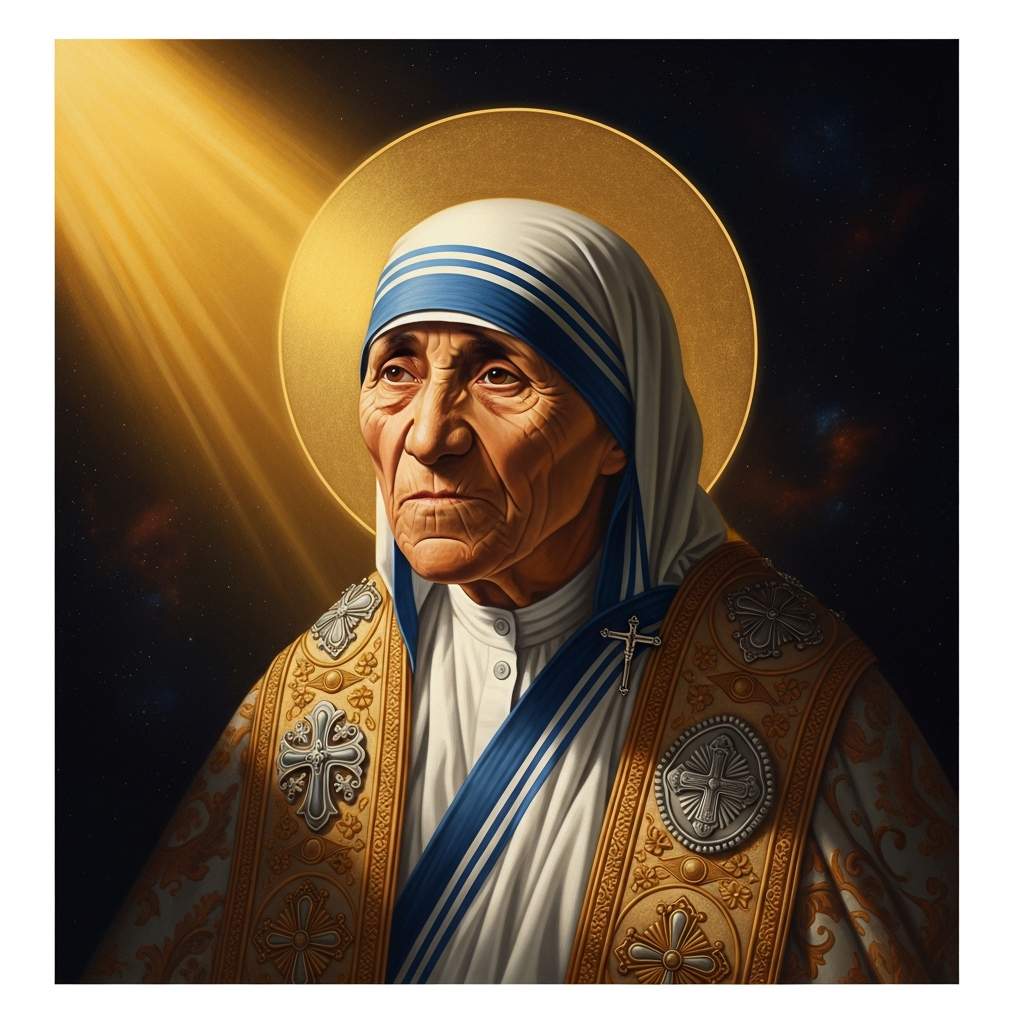 RARE
RARE 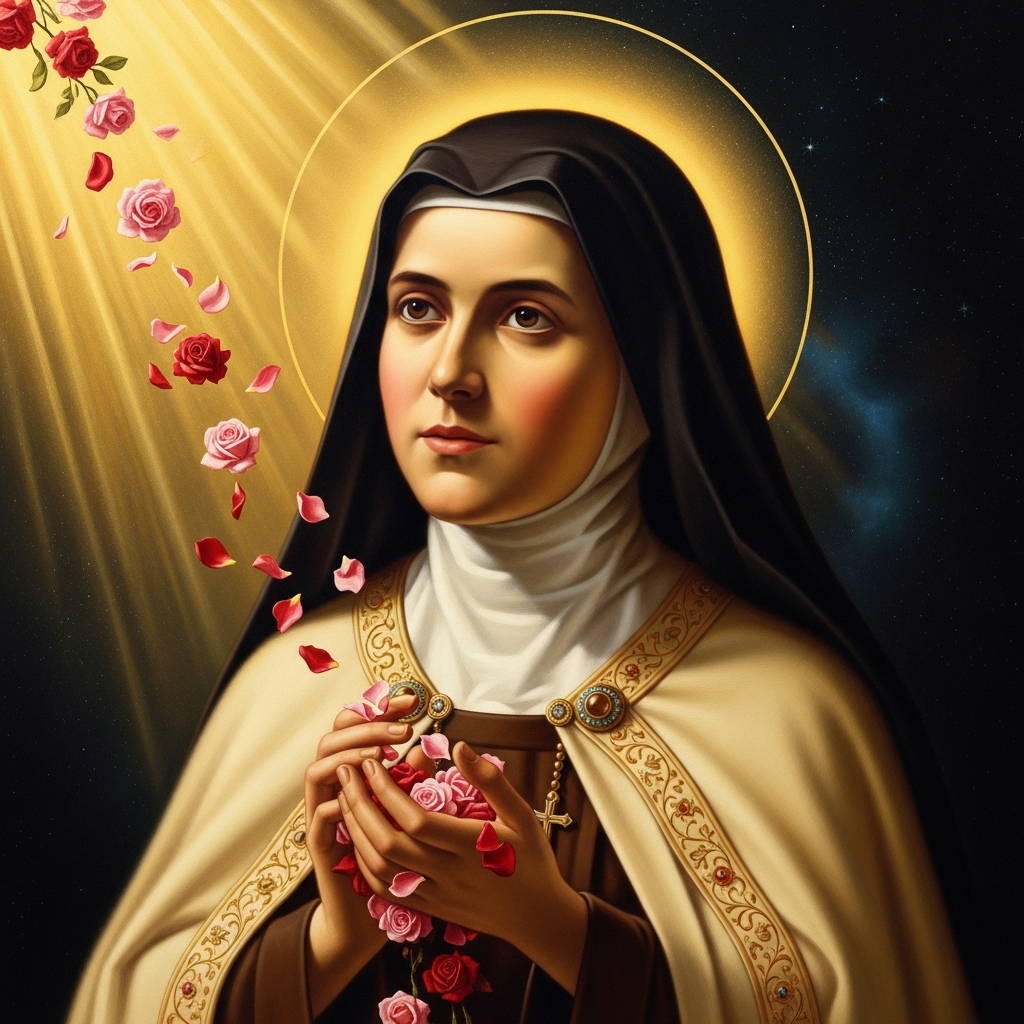 RARE
RARE  LEGENDARY