The Story
Judaism is the oldest continuously practiced monotheistic tradition on earth. It outlasted Babylon, Rome, the Caliphate, the Reich. Its scriptures are read in synagogues today in roughly the same Hebrew read 2,000 years ago. And it is a living tradition — not the prelude to Christianity, not “Old Testament background,” but a faith with its own internal life, its own ongoing argument, its own evolving practice. This file treats it as such.
The arc, with appropriate hedges where the record thins:
The Patriarchs (~2000-1500 BCE, contested): Abraham leaves Ur on the strength of a covenant — one God, one family, one promised land (Genesis 12:1-3). Some scholars treat the patriarchs as legendary composites, others as memory of real Bronze Age figures. The tradition does not depend on settling it. Isaac, Jacob (renamed Israel), and the twelve tribes follow.
Egypt and Exodus (~13th century BCE, contested): Jacob’s descendants end up enslaved in Egypt. Moses leads them out. Whether the historical exodus happened as described, in modified form, or as a foundational origin narrative composed over centuries is one of biblical archaeology’s most argued questions. What is not contested: the story has shaped Jewish identity for three millennia.
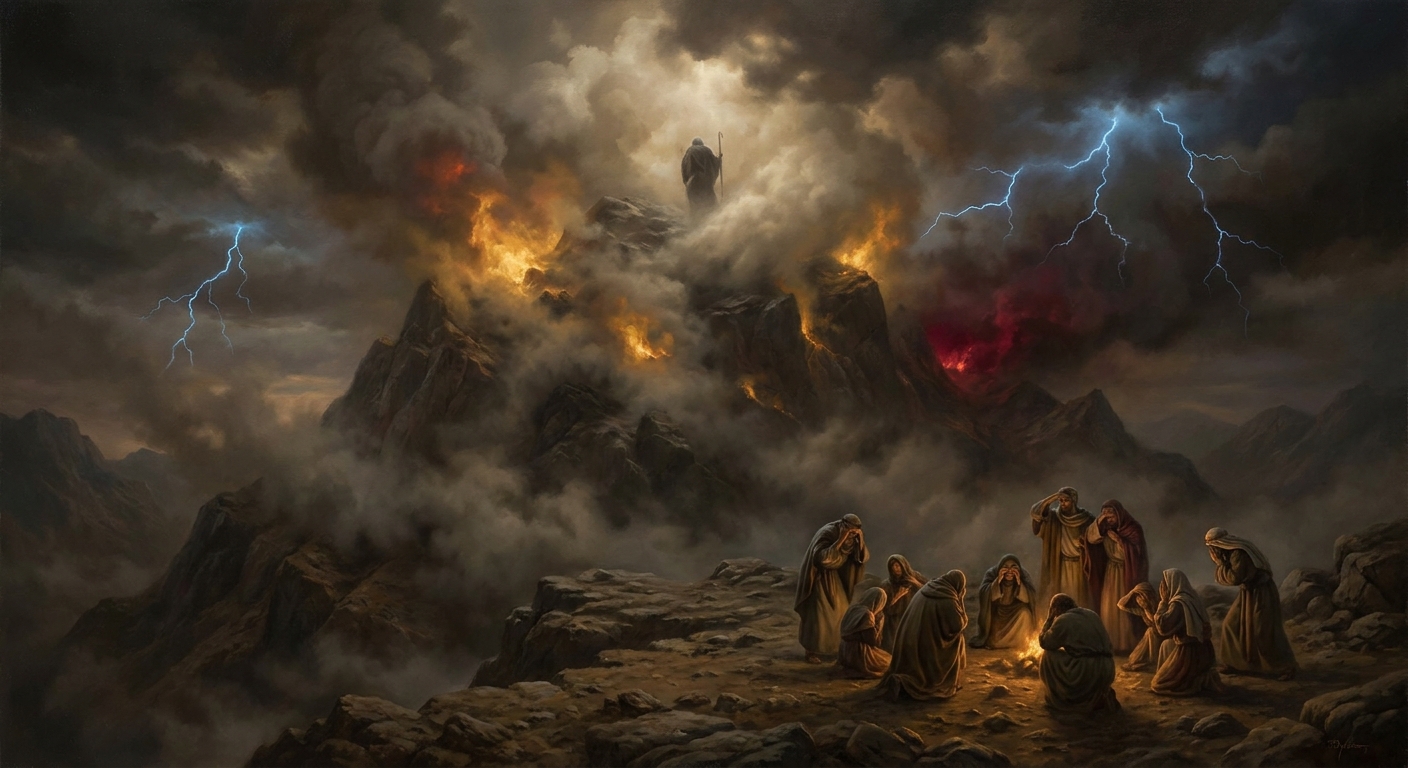
Sinai: The Torah is given (Exodus 19-40). Six hundred and thirteen mitzvot. A covenant not just with patriarchs but with a people. The theological heart — not a creed, an agreement.
Conquest, Judges, Kings (~1200-586 BCE): The Twelve Tribes settle Canaan. David unites the kingdom around 1000 BCE. Solomon builds the First Temple (~960 BCE). The kingdom splits. Prophets rise. The northern tribes fall to Assyria (722 BCE). Judah falls to Babylon (586 BCE; 2 Kings 25). The First Temple burns.
Exile and Return (586-516 BCE): Babylon was the formative trauma and the formative innovation. Cut off from the Temple, Jews developed synagogue worship, written Torah study, a portable identity. Cyrus of Persia let them return (Isaiah 45:1; Ezra 1). The Second Temple was rebuilt (516 BCE).
Second Temple Period (516 BCE - 70 CE): Persian rule, then Greek, then Roman. The Maccabean Revolt (164 BCE) won brief independence and gave us Hanukkah. Jesus of Nazareth lived and died inside this world as a Jewish teacher. In 70 CE, after a four-year revolt, Roman legions destroyed the Second Temple. They never built a third.
Rabbinic Reinvention (70-500 CE): The pivot. With the Temple gone, Yochanan ben Zakkai escaped Jerusalem in a coffin (Gittin 56a-b), founded a rabbinic academy at Yavneh, and quietly invented the religion that survives today. Sacrifice became prayer. Priesthood became scholarship. The Mishnah was compiled around 200 CE, the Talmud completed around 500 CE. Temple-less Judaism became Torah-centered Judaism.
Diaspora and Medieval Flowering (500-1500 CE): Jewish communities flourished in Babylonia, Spain, the Rhineland, North Africa. Rashi wrote the commentary that made the Talmud teachable. Maimonides systematized Jewish law and philosophy (Mishneh Torah, Guide for the Perplexed). Kabbalah emerged in 13th-century Spain (the Zohar) and exploded in 16th-century Safed (Isaac Luria). The Spanish Expulsion (1492) scattered Sephardim across the Mediterranean.
Hasidism, Haskalah, Modernity (1700-1900): The Baal Shem Tov launched a populist mystical revival in 18th-century Podolia (Shivchei ha-Besht). The Vilna Gaon led the rabbinic counter-attack. The Haskalah opened the ghetto walls. Reform Judaism emerged in 19th-century Germany (Pittsburgh Platform, 1885). Theodor Herzl launched modern political Zionism in the 1890s (Der Judenstaat, 1896).
The Twentieth Century: Between 1939 and 1945, the Holocaust murdered six million Jews — roughly one-third of the global Jewish population. The State of Israel was founded in 1948 (Declaration of Independence of Israel, May 14, 1948). The two events are connected. The connection is contested.
Today: Roughly 15 million Jews worldwide. Three major Western movements: Orthodox (halakha as binding divine law, with Modern Orthodox and Haredi/Hasidic sub-streams), Conservative (halakha as binding but historically evolving), Reform (ethical monotheism prioritized over ritual law). Reconstructionist, Renewal, and secular-cultural Jewish identities round out the spectrum. The conversation, four thousand years in, has not stopped.
Pivotal Events
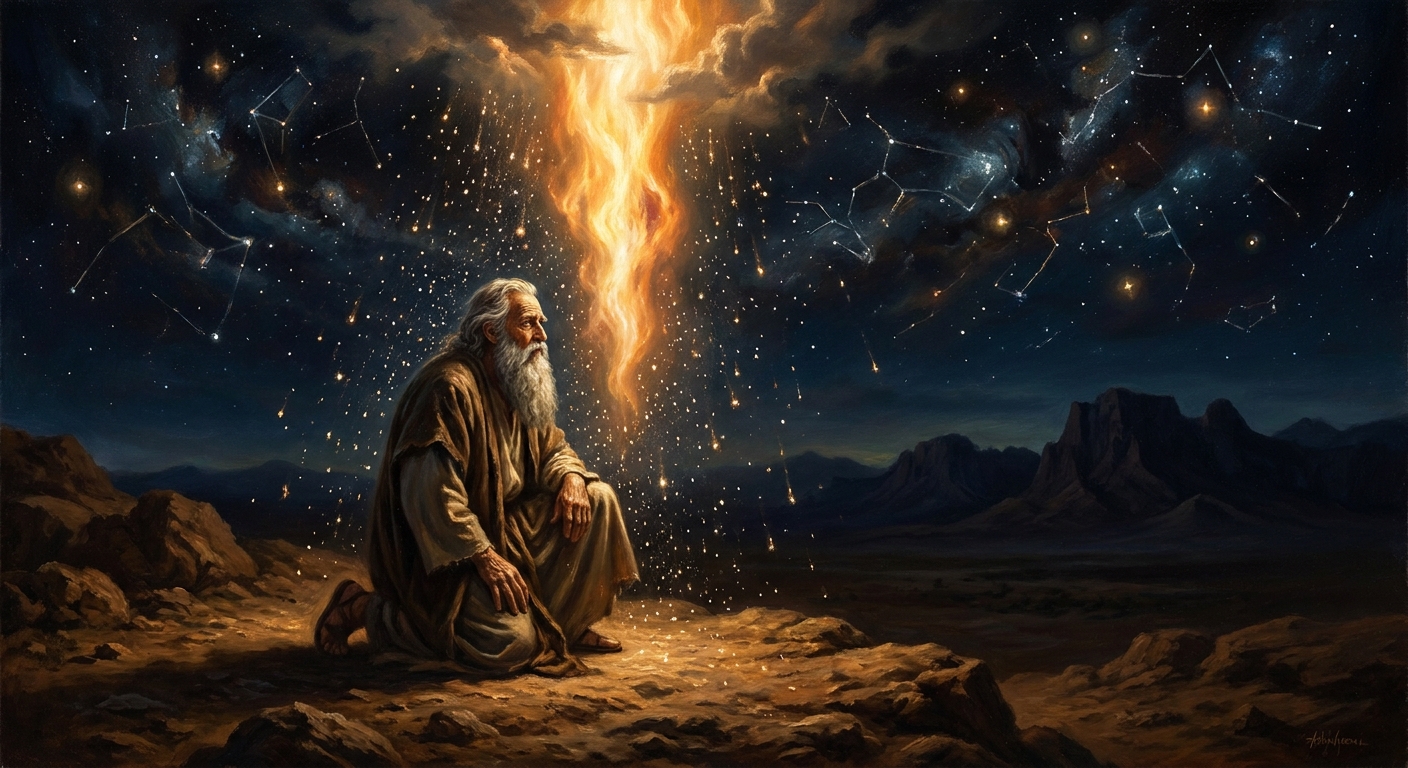
Around four thousand years ago — give or take several centuries — a man in Mesopotamia heard a voice telling him to leave everything and walk west (Genesis 12:1-3). He went. That covenant founded three world religions and four billion people’s religious heritage. Genesis frames it as a transactional agreement: land, descendants, and divine blessing in exchange for fidelity to one God and the cutting of foreskin as permanent sign (Genesis 17:10-11). The audacity is the singularity of the deal: not a tribal god among many, but the God, choosing one family. Everything in Jewish theology flows downstream.
The Exodus is the master narrative of Jewish liberation — retold every Passover, woven through every prophet, rewritten in Black spirituals as the template of all freedom struggles. Whether the historical event happened as described, partially, or as a founding story composed during the Babylonian exile is one of biblical archaeology’s most disputed questions. What is theologically unmistakable: at Sinai, the people receive the Torah (Exodus 19-20). Not a king. Not a temple. A text. The 613 mitzvot become the operating system of Jewish life. This is the moment Judaism becomes a portable religion — which mattered more than anyone could have known.
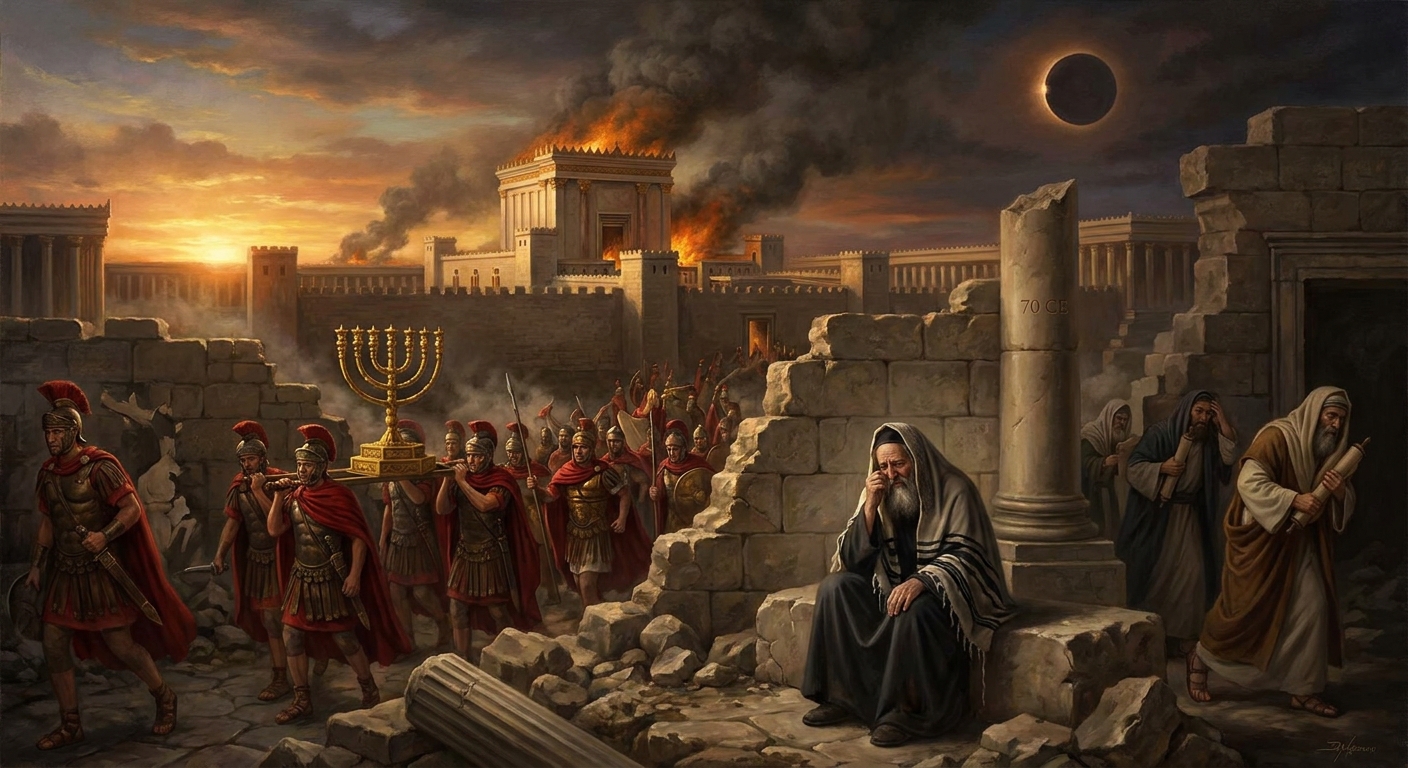
Summer, 70 CE. After a four-year Jewish revolt, Roman legions under Titus broke through Jerusalem’s walls, set fire to the Second Temple, and slaughtered or enslaved most of the city (Josephus, Jewish War 5-6). Josephus claims a million dead; modern historians put it closer to a few hundred thousand, which is plenty. The Temple was the geographical, ritual, and theological center of Jewish life — the only legitimate site of sacrifice, the dwelling place of the Shekhinah. Its destruction should have ended Judaism the way the fall of Tenochtitlan’s temples ended Aztec religion. It didn’t. What happened instead is in the next entry.
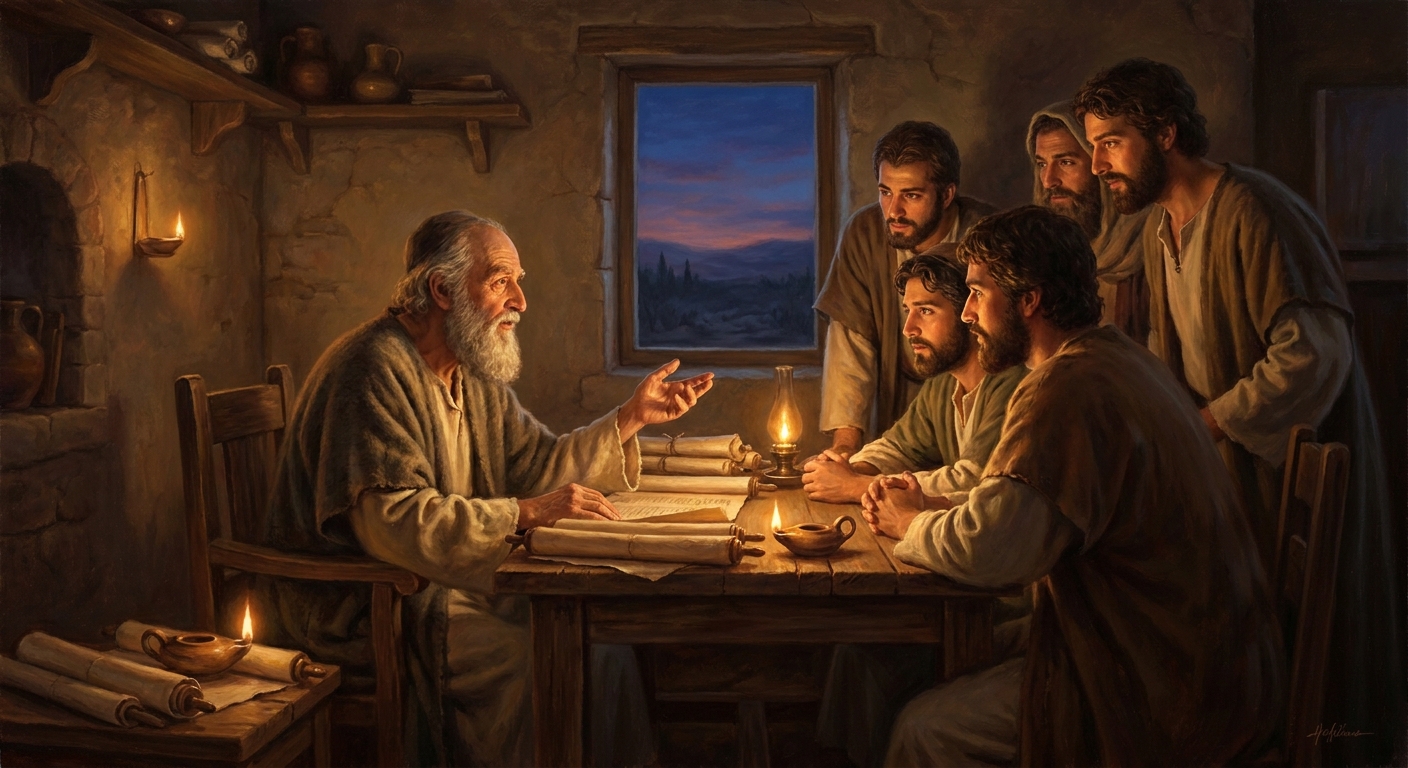
According to tradition, Yochanan ben Zakkai was smuggled out of besieged Jerusalem in a coffin (Gittin 56a-b; the Romans permitted corpses out for burial; live rabbis were a different matter). He went to the general Vespasian, predicted Vespasian would become Emperor, and was rewarded with one request: the small coastal town of Yavneh and permission to teach there. From that academy, over the next four hundred years, came the Mishnah (~200 CE), the Tosefta, the Jerusalem Talmud (~400 CE), and the Babylonian Talmud (~500 CE) — the vast multivocal record of rabbinic argument that became the second pillar alongside Torah. Sacrifice became prayer. Priesthood became scholarship. The Temple became the page. One of the great religious pivots in human history. The reason there are still Jews.
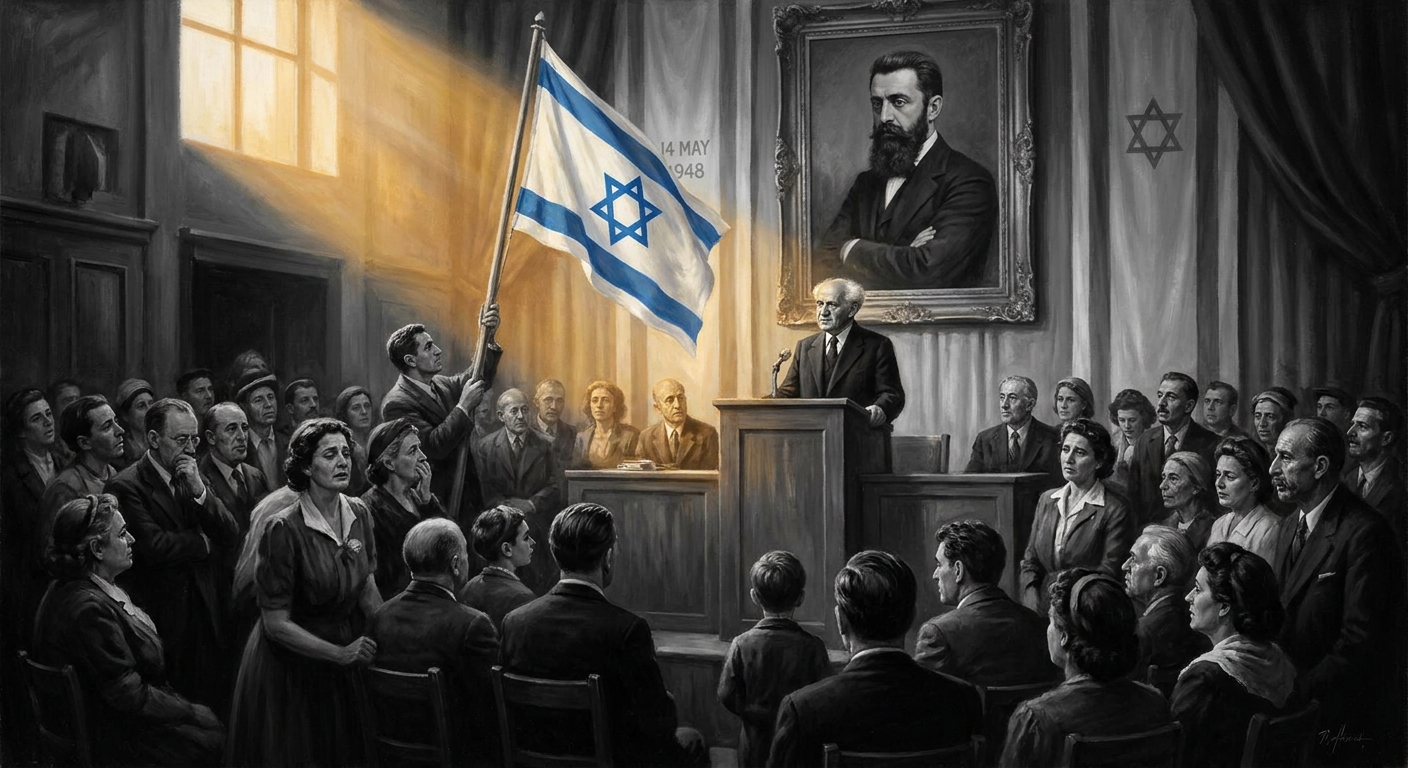
Between 1939 and 1945, Nazi Germany and its collaborators systematically murdered approximately six million European Jews — two-thirds of European Jewry, one-third of the global Jewish population. The largest organized targeted genocide in modern history. Three years after the camps were liberated, on May 14, 1948, David Ben-Gurion declared the State of Israel (Declaration of Independence of Israel, May 14, 1948) — the first sovereign Jewish polity in nearly two thousand years. The two events are connected. The exact nature of the connection (cause, catalyst, justification, separate trajectories converging) is theologically and politically contested to this day. What is not contested: modern Jewish identity, in Israel and the diaspora alike, is shaped by the shadow of the Shoah and the existence of the state.
Timeline
| Era | Date | Event | Source |
|---|
| Patriarchs | ~2000-1500 BCE (contested) | Abraham, Isaac, Jacob — founding covenants | Genesis 12-50 |
| Egypt | ~1700-1300 BCE (contested) | Joseph in Egypt; Hebrews enslaved | Genesis 37 - Exodus 1 |
| Exodus | ~13th century BCE (contested) | Moses, plagues, Red Sea | Exodus 1-15 |
| Sinai | ~13th century BCE | Torah given; covenant ratified | Exodus 19-40 |
| Conquest | ~1200 BCE | Joshua leads the conquest of Canaan | Joshua |
| Judges | ~1200-1050 BCE | Tribal confederation, judges, charismatic leaders | Judges |
| United Monarchy | ~1050-930 BCE | Saul, David (~1000 BCE), Solomon | 1-2 Samuel; 1 Kings |
| First Temple | ~960 BCE | Solomon’s Temple completed in Jerusalem | 1 Kings 6-8 |
| Divided Kingdom | 930 BCE | Israel (north) and Judah (south) split | 1 Kings 12 |
| Assyrian Exile | 722 BCE | Northern kingdom destroyed; ten tribes scattered | 2 Kings 17 |
| Babylonian Exile | 586 BCE | First Temple destroyed; Judah deported | 2 Kings 25; Jeremiah |
| Return | 538 BCE | Cyrus’s edict permits return to Judah | Ezra; Isaiah 45 |
| Second Temple | 516 BCE | Rebuilt under Zerubbabel | Ezra 6 |
| Maccabean Revolt | 167-160 BCE | Revolt against Antiochus IV; Hanukkah | 1-2 Maccabees |
| Hasmonean Period | 140-37 BCE | Brief Jewish independence | Josephus |
| Roman Rule | 63 BCE - | Pompey takes Jerusalem | Josephus |
| Destruction of Second Temple | 70 CE | Titus burns Jerusalem | Josephus, War |
| Bar Kokhba Revolt | 132-135 CE | Final Jewish revolt; Jerusalem renamed Aelia Capitolina | Cassius Dio |
| Mishnah Compiled | ~200 CE | Judah ha-Nasi codifies the Oral Torah | Mishnah |
| Jerusalem Talmud | ~400 CE | Palestinian Gemara completed | Talmud Yerushalmi |
| Babylonian Talmud | ~500 CE | Bavli completed — the standard Talmud | Talmud Bavli |
| Geonic Period | 500-1000 CE | Babylonian academies dominant | Sherira Gaon |
| Rashi | 1040-1105 | The standard medieval commentator | Rashi’s commentary |
| Maimonides (Rambam) | 1138-1204 | Mishneh Torah; Guide for the Perplexed | Maimonides |
| Zohar | ~1280 | Foundational Kabbalistic text appears in Spain | Moses de Leon |
| Spanish Expulsion | 1492 | Jews expelled from Spain | Edict of Expulsion |
| Lurianic Kabbalah | ~1570 | Isaac Luria’s school in Safed | Etz Chaim |
| Baal Shem Tov | ~1700-1760 | Founder of Hasidism | Shivchei ha-Besht |
| Vilna Gaon | 1720-1797 | Mitnagdim leader; rationalist Talmudism | his commentaries |
| Haskalah | ~1770-1881 | Jewish Enlightenment; Mendelssohn | Mendelssohn |
| Reform Movement | 1810-1885 | Hamburg Temple; Pittsburgh Platform | Reform documents |
| First Zionist Congress | 1897 | Theodor Herzl convenes Basel | Der Judenstaat |
| Holocaust | 1939-1945 | Six million Jews murdered | Yad Vashem archives |
| State of Israel Founded | May 14, 1948 | Ben-Gurion declares independence | Declaration of Independence |
| Six-Day War | 1967 | Israel reunifies Jerusalem; takes West Bank, Sinai, Golan | military records |
| Present | 2026 | ~15M Jews worldwide; Orthodox / Conservative / Reform | demographic studies |
What’s Distinctive
Judaism is the religion where “two Jews, three opinions” is not a joke — it is the methodology. The Talmud is not a creed, a catechism, or a systematic theology. It is a transcript of arguments. Disputed rulings sit beside the accepted ones because the conversation is the point. To learn Judaism is to learn how to argue inside a tradition.
This shapes everything. Halakha — Jewish law, derived from Torah and elaborated through millennia of rabbinic argument — governs daily life: what you eat (kashrut), when you rest (Shabbat), how you mourn, how you marry, how you pray. Orthodoxy holds halakha as binding divine law. Conservative Judaism holds it binding but historically evolving. Reform Judaism prioritizes ethical principle over ritual law. All three argue inside the same tradition, citing the same texts.
Mitzvot are the commandments — 613 enumerated, though the count itself is a rabbinic systematization of messier reality. They include ethical commands (do not steal) and ritual ones (don’t mix wool and linen). Both kinds matter. Both are God’s instruction.
Oral Torah is the doctrine that Moses received at Sinai not just the written text but a parallel oral tradition of interpretation, eventually codified as Mishnah and Talmud (Pirkei Avot 1:1). This is what makes rabbinic Judaism rabbinic — and what Karaite Judaism, the Sadducees, and (in their own way) the early Christian movement rejected.
The line “Judaism is what Jews do, not what Jews believe” is overstated — belief matters, particularly the affirmation of one God in the Shema — but it points at something real. There is no Jewish equivalent of the Nicene Creed. You do not become Jewish by signing a doctrinal statement. You become Jewish by birth to a Jewish mother (Orthodox/Conservative) or by conversion under rabbinic supervision (all denominations, with varying standards). And you stay Jewish whether you believe or not, practice or not, want to or not. Covenant, not creed. People, not denomination. Conversation, not conclusion.
Cross-Tradition Links
- Most Hebrew Bible figures live in Biblical.md — one source text, two readings: Jewish and Christian interpretive traditions diverge on what the text means, not on what it says
- See Sacred-Numbers.md for the deep dive on Kabbalistic gematria, the four interpretive methods, and the mathematics of the Hebrew alphabet
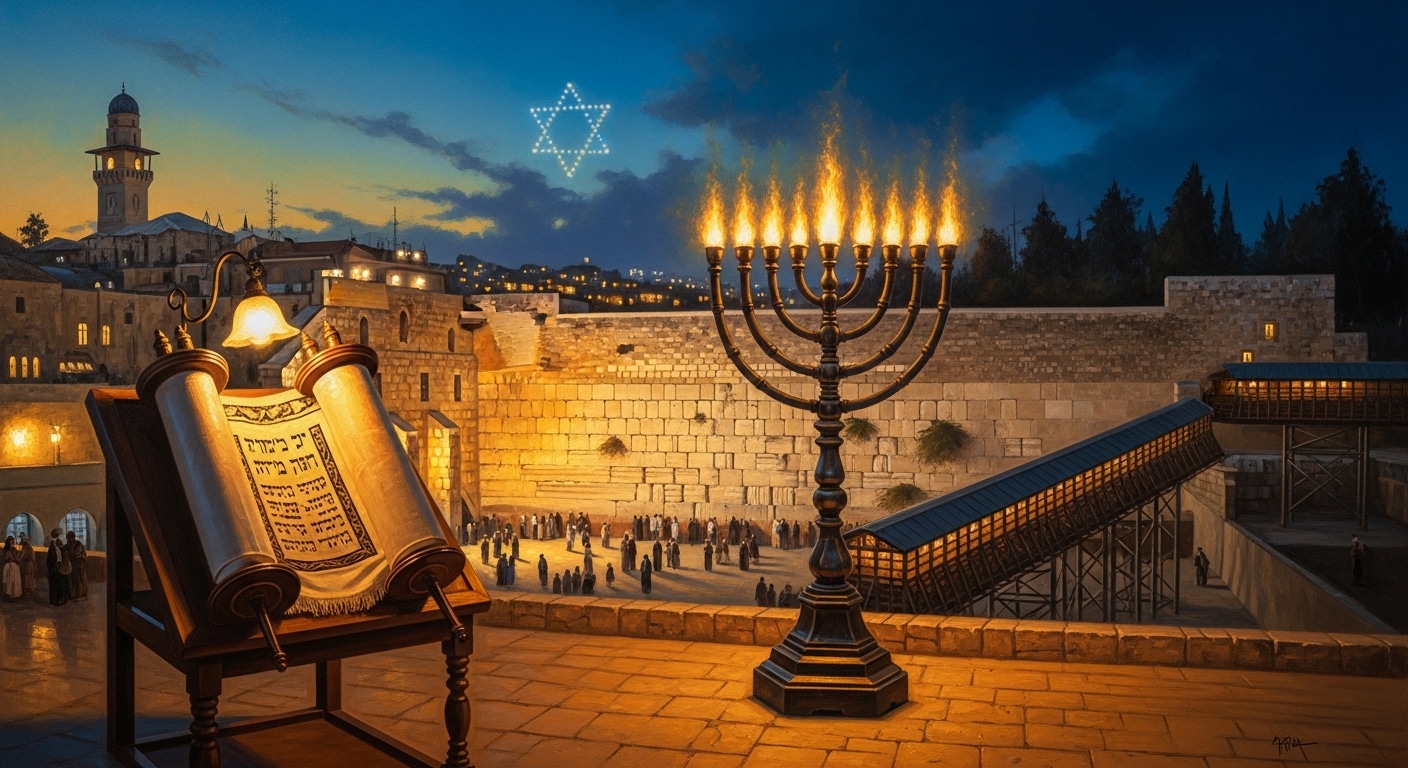
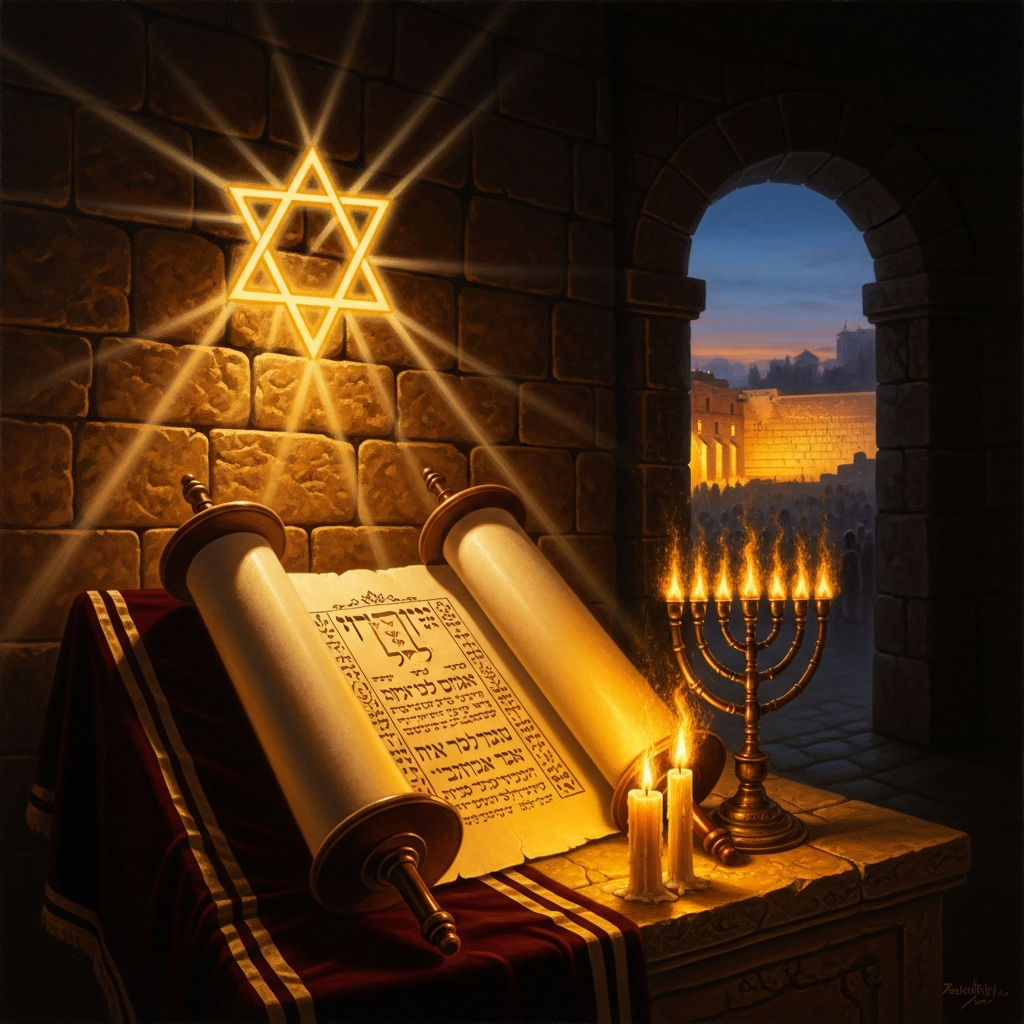
- See Symbols.md for the menorah, Star of David (Magen David), hamsa, and mezuzah analyzed across traditions
- See Lost-Books.md for the apocrypha that Jewish tradition rejected from the Tanakh — often centuries before Christianity made its own canonical decisions
- See Bestiary/Mandaean.md for the related Aramaic-speaking Gnostic group from Mesopotamia, frequently confused with Judaism (they are not — they reject Abraham and Moses outright) but sharing many of the same source-streams
- See Bestiary/Biblical.md and the Connections-Atlas for how Jewish prophetic texts shape every later Abrahamic eschatology
- See Timeline.md for the unified timeline placing Jewish history alongside Christian, Islamic, Masonic, and secular events
- See Conspiracies.md for the Protocols of the Elders of Zion (proven forgery, ranked accordingly) and other recurring antisemitic conspiracy structures
 LEGENDARY
  LEGENDARY
  LEGENDARY
  LEGENDARY
  LEGENDARY