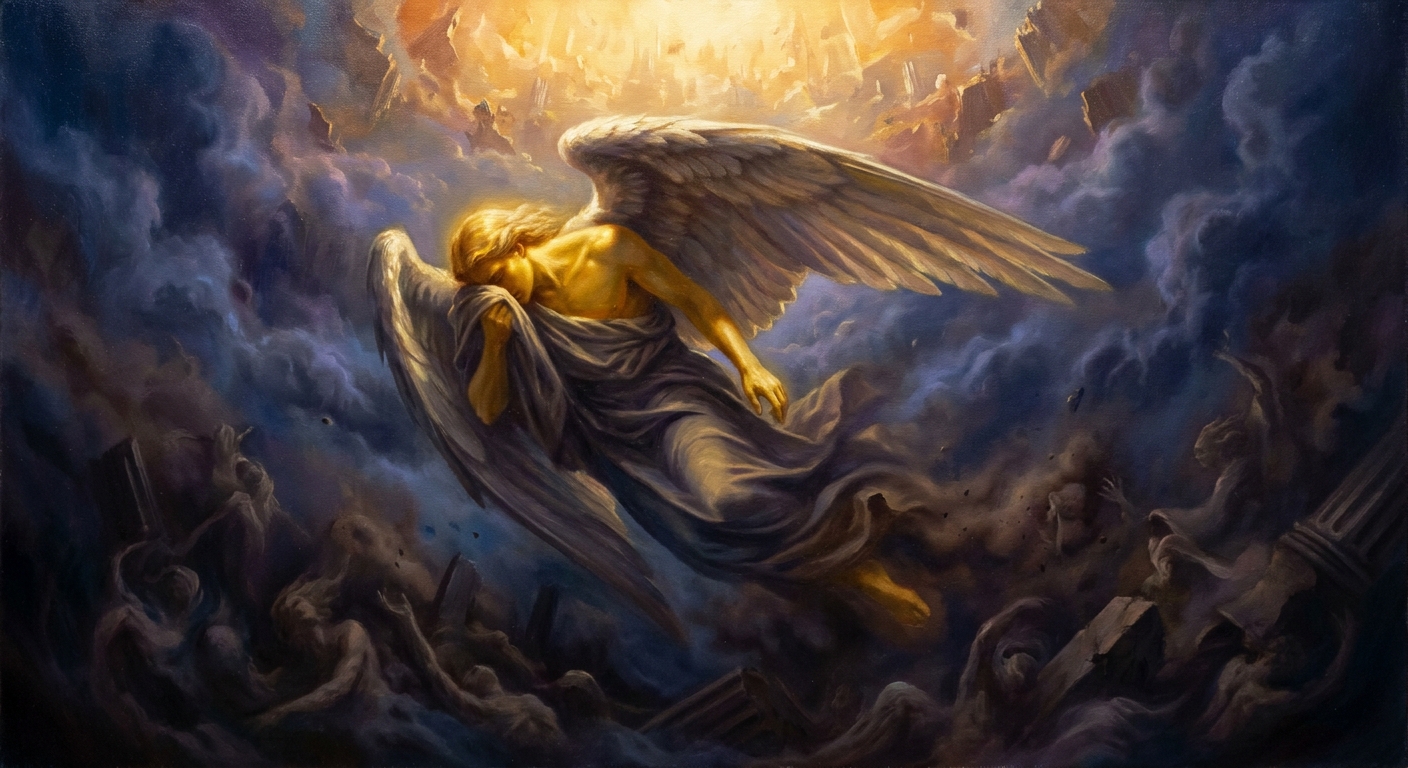
A Living Gnostic Religion in Crisis
The Mandaeans are the only surviving Gnostic religion on Earth (Ginza Rabba). For nearly 2,000 years they have maintained continuous ritual, sacred texts (Ginza Rabba and Divan Abatur), and a priesthood preserving the teachings of Manda d-Hayyi (“Knowledge of Life”). Not Christian. Not Jewish. Not Muslim. Their own distinct gnostic tradition — one that inverts every central doctrine of the Abrahamic religions (Jorunn Buckley).
Their crisis is existential. Before 2003, roughly 60,000-70,000 Mandaeans lived in Iraq, the spiritual heartland of the faith (E.S. Drower). By 2026, fewer than 5,000 remain. War, persecution, displacement, and assimilation decimated a community that survived the Islamic conquest, the Crusades, and centuries of minority status. The diaspora scatters them to Syria, Jordan, Sweden, the United States. Without intervention and recognition, the Mandaean tradition may not survive another generation.
Key Sources:
- Jorunn Buckley, The Mandaeans: Ancient Texts and Modern People (Yale University Press, 2002)
- E.S. Drower, The Mandaeans of Iraq and Iran (Oxford University Press, 1937)
- Şinasi Gündüz, The Knowledge of Life: The Origins and Early History of the Mandaeans (Oxford University Press, 1994)
- Charles Häberl, The Manichaean Texts in the Turfan Collection and Mandaic linguistic studies
- Edmondo Lupieri, The Mandaeans: The Last Gnostics (Continuum, 2002)
The Masbuta: Weekly Baptism in Running Water
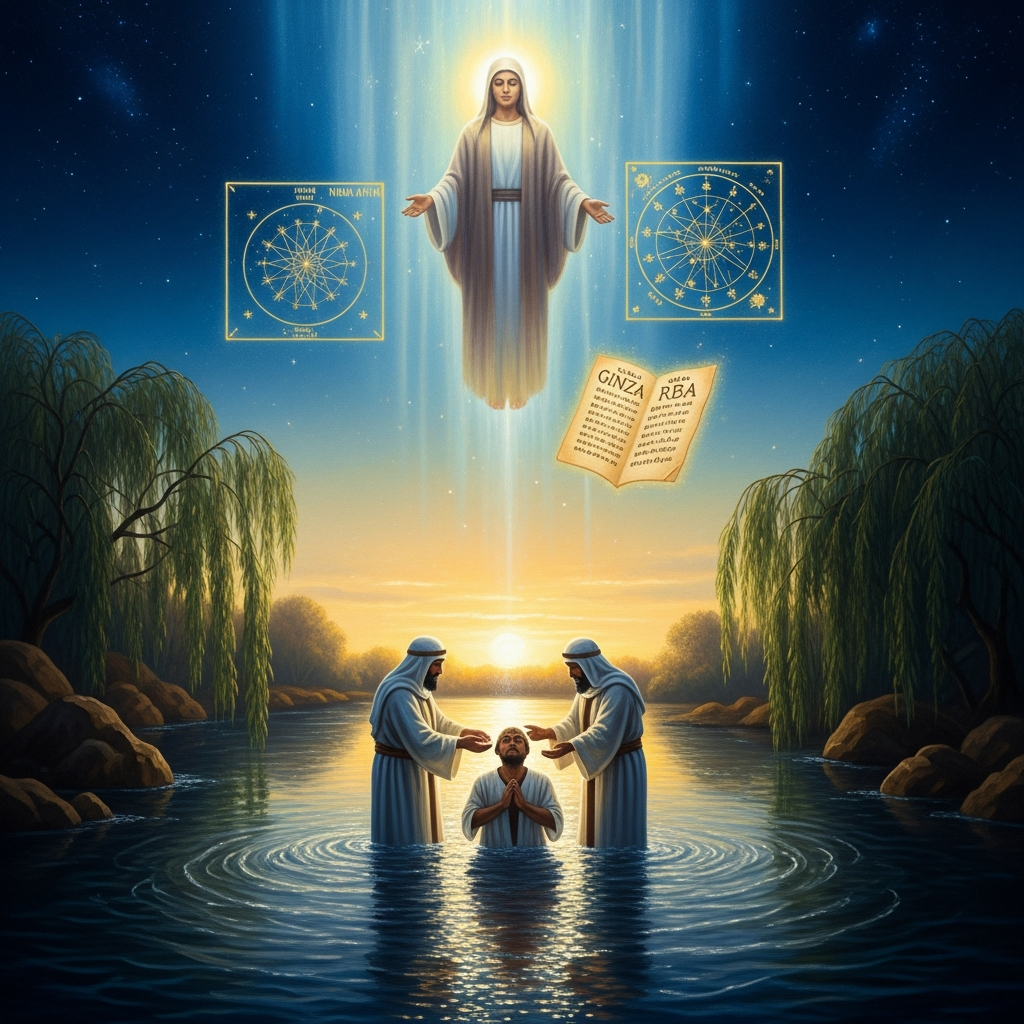
The Masbuta (also spelled Mazbuta or Masbutah) is the central sacrament of Mandaean religion (Ginza Rabba). Unlike Christian baptism — a one-time initiation — the Masbuta repeats every week, for life (Divan Abatur).
| Practice | Details |
|---|
| Frequency | Weekly, typically on Sunday (the Sabbath in the Mandaean calendar) |
| Location | ONLY in running water (rivers, streams, springs) — still water is not permitted |
| Priesthood | Performed by Mandaean priests (Tarmidut) in white robes |
| Purpose | Purification from the contaminations of the material world; renewal of gnosis; maintenance of the covenant with Hayyi Rabbi |
| Theology | The weekly Masbuta is not a sacrament of forgiveness (as in Christianity), but a continuous process of elevation. Each baptism elevates the soul slightly higher toward the World of Light. |
| Duration | Repeated baptisms throughout one’s life accumulate merit and spiritual advancement |
| Death Ritual | A final Masbuta is performed at death to complete the soul’s ascent |
The Masbuta is the living connection between believer and divine realm (Haran Gawaita). Running water is essential — water is the medium through which Manda d-Hayyi transmits gnosis. The constant motion symbolizes the flow of divine knowledge (Jorunn Buckley). Weekly repetition ensures the believer never falls away from the path of ascent.
The Mirror Religion: Christian Doctrine INVERTED in Mandaeism
One of the most striking features of Mandaean theology is how systematically it inverts Christian doctrine. Every central Christian claim becomes a heresy or mistake in Mandaean eyes.
| Christian Doctrine | Mandaean Position | Spiritual Significance |
|---|
| Jesus is the Messiah | Jesus is a false messiah who led astray a deceived people; his mother Mary was seduced by demons | Christianity is the great heresy that corrupted John’s true teaching |
| Jesus is God Incarnate | Absolutely rejected; God (Hayyi Rabbi) does not incarnate in matter | The very idea of divine incarnation in flesh is seen as corrupting the transcendence of God |
| The Holy Spirit is divine | The Holy Spirit (Ruha) is demonic and corrupt; she is the source of sexual generation and material illusion | The Christian Trinity unwittingly worships demons and illusion |
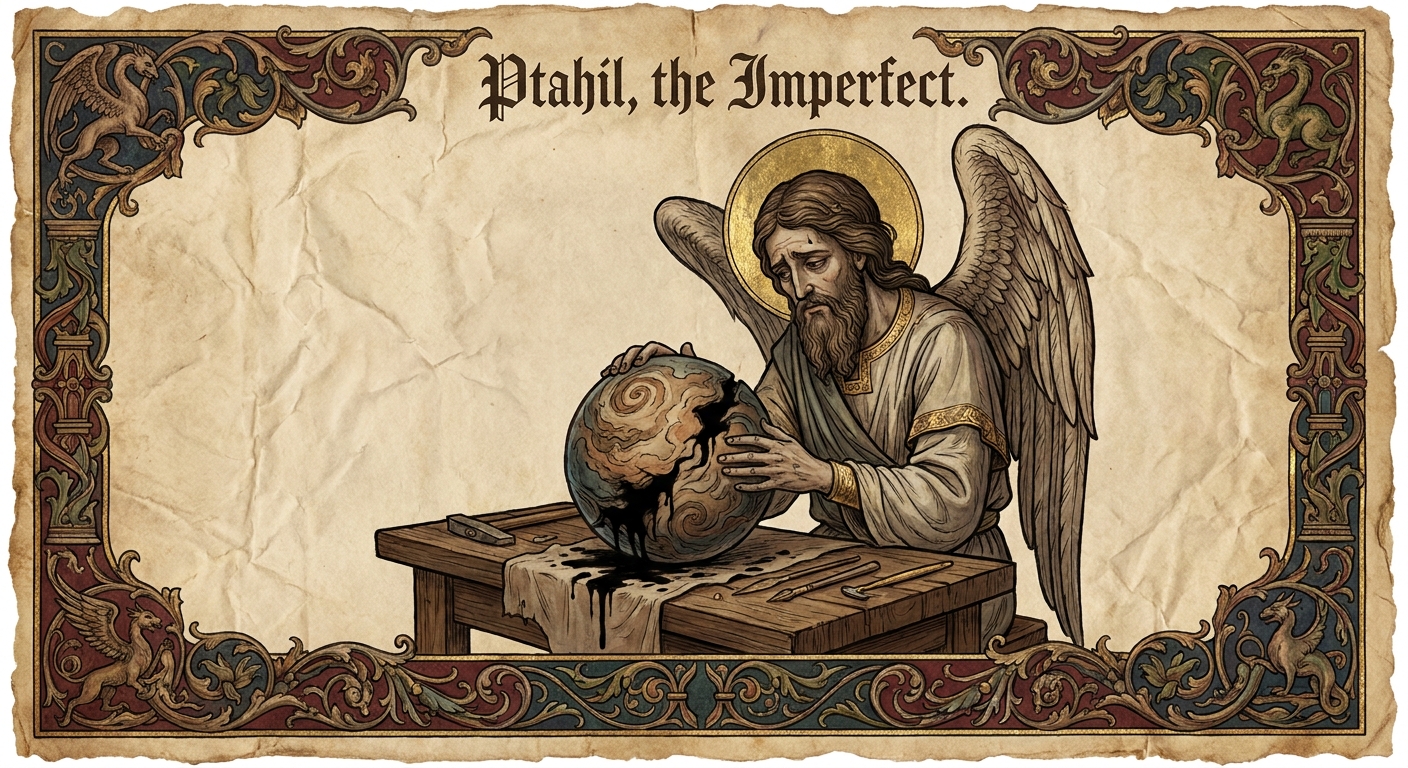
| The Old Testament God is good | The creator God of Genesis (Ptahil) is inferior and ignorant; he is NOT Hayyi Rabbi | Judaism and Christianity worship a false god |
| Salvation through faith in Christ | Salvation through gnosis (knowledge) + the weekly Masbuta (baptism in running water) | Christ cannot save; only knowledge and ritual practice can elevate the soul |
| The material world is God’s creation to be enjoyed | The material world is a prison created imperfectly; it is to be transcended, not enjoyed | Asceticism and rejection of material attachments are the path to salvation |
| Heaven is eternal reward | The World of Light (‘Alma d-Nhura) is the goal; it is utterly transcendent and only reached through ascent | The Christian heaven is a distortion of the true spiritual realm |
| The Cross is redemptive | The cross has no salvific power; it is a symbol of matter and suffering | Christian redemption theology is illusory |
| Satan is God’s enemy (rebellion) | Ruha and the archons are the powers that rule this world and trap souls in matter | Evil is not merely rebellion; it is the fundamental structure of material existence |
The Mandaean inversion is not arbitrary. It flows logically from the core gnostic insight: If matter is evil and the world is a prison, then the God who created it cannot be the supreme God. If a crucified man became your God, you have been deceived.
The Living Crisis: Mandaeism in 2026
| Year | Estimated Population | Location | Notes |
|---|
| 1950 | ~100,000 | Primarily Iraq (Baghdad, Basra, marshes) | Peak of the tradition |
| 2000 | ~60,000-70,000 | Iraq, with diaspora communities | Still majority in Iraq |
| 2003 | ~60,000 | Iraq; diaspora beginning | Post-invasion instability begins |
| 2010 | ~30,000 | Iraq; Sweden, Jordan, Syria, USA | Diaspora accelerates |
| 2023 | ~10,000 | Scattered diaspora; Iraq reduced to 1,000-2,000 | |
| 2026 | < 5,000 | Sweden (largest concentration), US, Australia; Iraq nearly extinct | Critical survival crisis |
-
War and Political Instability
- 2003 U.S. invasion destabilized Iraq
- Sectarian violence (2004-2008) targeted minorities
- ISIS occupation of northern Iraq (2014-2017) displaced entire communities
- Ongoing regional conflicts
-
Religious Persecution
- Mandaeans, as a non-Muslim, non-Christian minority, face pressure from Islamist groups
- Classification as “People of the Book” (Ahl al-Kitab) is uncertain and variable
- Lack of international recognition or protection
-
Forced Displacement & Diaspora
- Refugees fleeing Iraq have scattered to Syria, Jordan, Turkey, Europe, North America
- Diaspora communities lack the infrastructure (running water for baptism, priesthood density) to maintain practice
- Young people assimilate into host societies
-
Priesthood Crisis
- Mandaean priesthood (Tarmidut) requires years of training
- Many priests fled Iraq; training has nearly ceased
- A few high priests remain, mostly in diaspora
- Without priests, the Masbuta cannot be performed
-
Language Loss
- Mandaic (the ancient Aramaic dialect of sacred texts) is losing fluency among younger generations
- In diaspora communities, Arabic, Swedish, or English becomes dominant
- Sacred knowledge transmitted through Mandaic liturgy becomes inaccessible
As of 2026:
- Iraq: Fewer than 5,000 Mandaeans remain; communities exist only in Baghdad and Basra; complete evacuation is ongoing
- Sweden: The largest diaspora concentration, with an estimated 2,000-3,000 Mandaeans; community centers and priests present
- United States: Scattered communities in Chicago, Detroit, and California; some ritual practice maintained
- Australia: A small but organized diaspora community
- Europe: France, Germany, and the UK have smaller populations
Mandaeism is unique: the only surviving Gnostic religion, with unbroken priestly succession and continuous ritual practice spanning nearly 2,000 years (Ginza Rabba). Yet it is also on the verge of extinction. The very practices that sustained it — priesthood-centered ritual, the Mandaic language, weekly Masbuta in running water — are becoming impossible in diaspora (E.S. Drower).
The question for 2026 and beyond: can Mandaean communities in the West reconstruct the conditions for the Masbuta and maintain priestly training? Or will the tradition survive only in scholarly memory and diaspora fragments?
Mandaean Cosmography: The Worlds
| World | Mandaic Name | Ruler | Nature | Path to Next |
|---|
| 1. World of Matter | ’Alma d-Qolmusta | Ptahil (creator), Ruha (spiritual ruler) | Physical realm; realm of suffering and illusion | Ascent through knowledge |
| 2. The Planetary Heavens | Shmatin d-Kawkaba (Heavens of Stars) | 7 Archons under Ruha | The seven spheres; planetary rulers block ascent | Passing guardians with secret names |
| 3. The Realm of the Aethers | ’Alma d-Thaura | Lesser demiurgic beings | Ethereal realm above matter; still not ultimate | Continued ascent through gnosis |
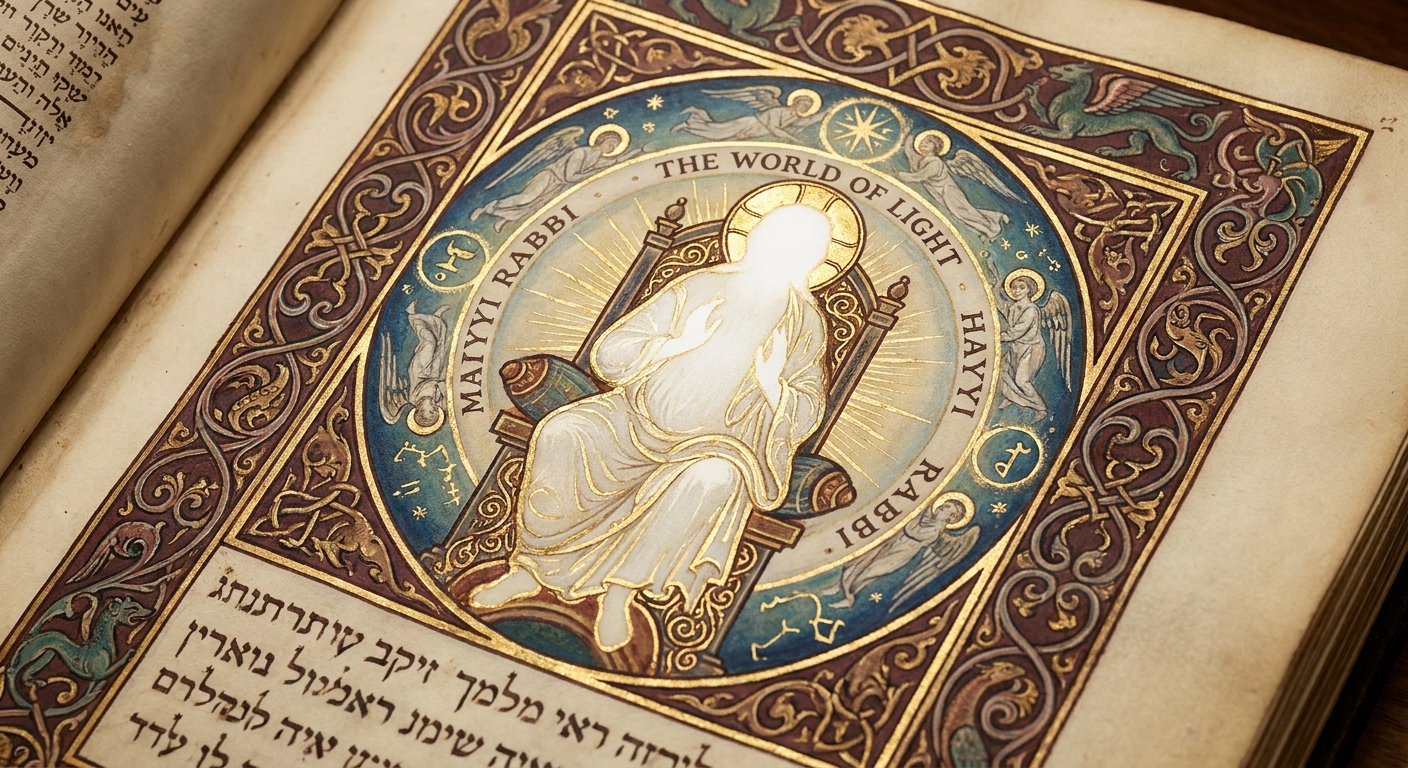
| 4. The World of Light | ’Alma d-Nhura | Hayyi Rabbi; Manda d-Hayyi | Pure light, spirit, transcendence, immortality | DESTINATION: The goal of all ascent |
Key Mandaean Sacred Texts
| Text | Mandaic Name | Content | Significance |
|---|
| Ginza Rabba | Ginza (“Treasure”) | Cosmological myth, hymns, teachings of Manda d-Hayyi | The foundational sacred scripture |
| Divan Abatur | Divan (“Book/Collection”) | Prayers, baptismal formulas, liturgies for the dead | The ritual prayer book of the priesthood |
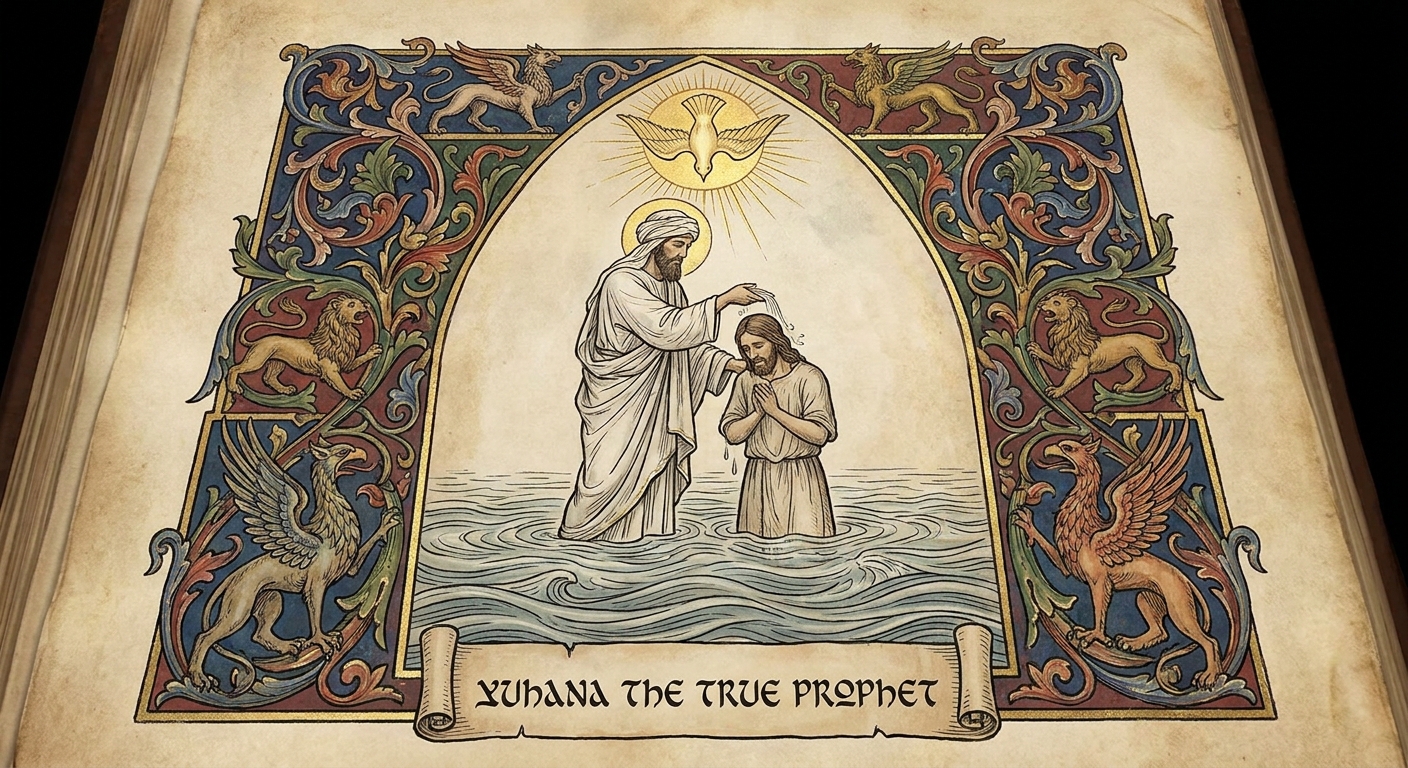
| Book of John | Kitab Yuhana | Teachings of John the Baptist; cosmological secrets | Exalts John as supreme prophet |
| Mandaean Alphabet | Raza d-Raza | Esoteric teachings on letters and cosmic power | Secret knowledge for initiates |
The Priesthood: Tarmidut
The Mandaean priesthood (Tarmidut) is divided into two orders:
| Order | Role | Requirements |
|---|
| Tarmidit (Priests) | Full priesthood; authorized to perform Masbuta and major rituals | Years of training; initiation into mysteries; celibacy optional |
| Nisiritut (Deacons) | Lesser priesthood; assist priests; limited ritual authority | Shorter training period |
Priests wear white robes and must perform the Masbuta weekly. They are custodians of the sacred texts and the transmission of gnosis.
A Final Word: The Survival of Gnosis
The Mandaeans are living proof that Gnosticism did not die in the 4th century. They are also living evidence that even the most profound spiritual traditions are vulnerable to history, war, and cultural erasure.
In 2026, the Mandaean community faces an existential choice: rebuild and reinvent itself in diaspora, or fade into memory as scholars study the Ginza Rabba and marvel at the religion that refused to disappear — until it did.
The Masbuta continues in running water, wherever Mandaean priests can find it. The gnosis is still taught. The World of Light still calls to those who listen.
The question is: for how much longer?
Last Updated: April 2026
Status: Active Tradition, Critical Situation
Scholars to Consult: Jorunn Buckley, E.S. Drower, Şinasi Gündüz, Charles Häberl