Eyes Horizontal, Nose Vertical
1223–1227 CE · Mount Tiantong, Song Dynasty China — and Eihei-ji, Echizen Province, Japan
Contents
A Japanese monk crosses to Song China searching for the true dharma, hears a master in the meditation hall snap one sentence at a sleeping student, and returns home empty-handed carrying nothing but the sky.
- When
- 1223–1227 CE
- Where
- Mount Tiantong, Song Dynasty China — and Eihei-ji, Echizen Province, Japan
He has the question early.
He is thirteen years old at Mount Hiei, an ordained monk already, reading the standard Tendai textbook, and he comes to a sentence he cannot get past: all sentient beings are originally enlightened. He sets the book down and asks his teachers — if every being is already enlightened, why did the Buddha sit under the tree? Why did the patriarchs cross the deserts? Why am I sitting here at this temple shaving my head every fortnight?
His teachers do not have an answer that satisfies him. The polite ones say practice anyway. The honest ones say it is a paradox, do not push. Neither is enough.
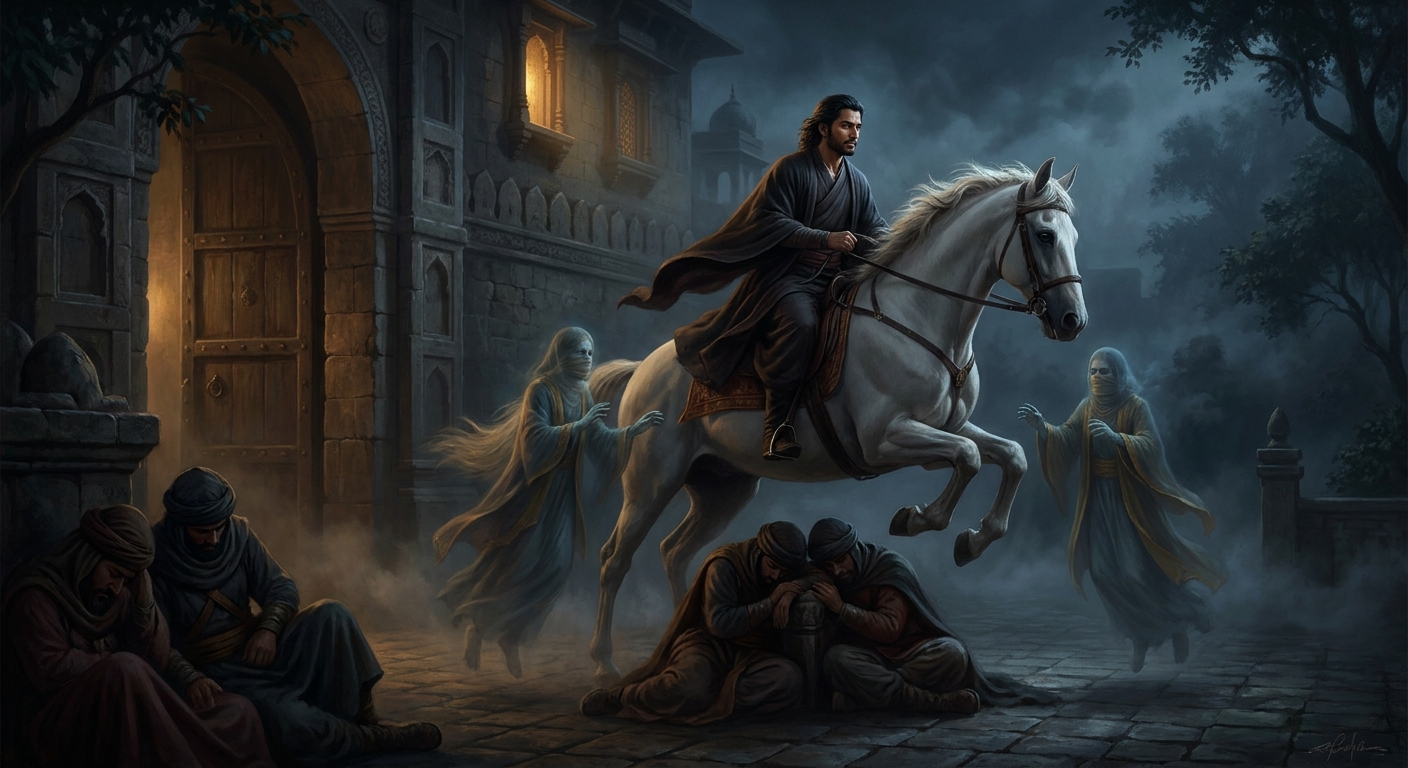
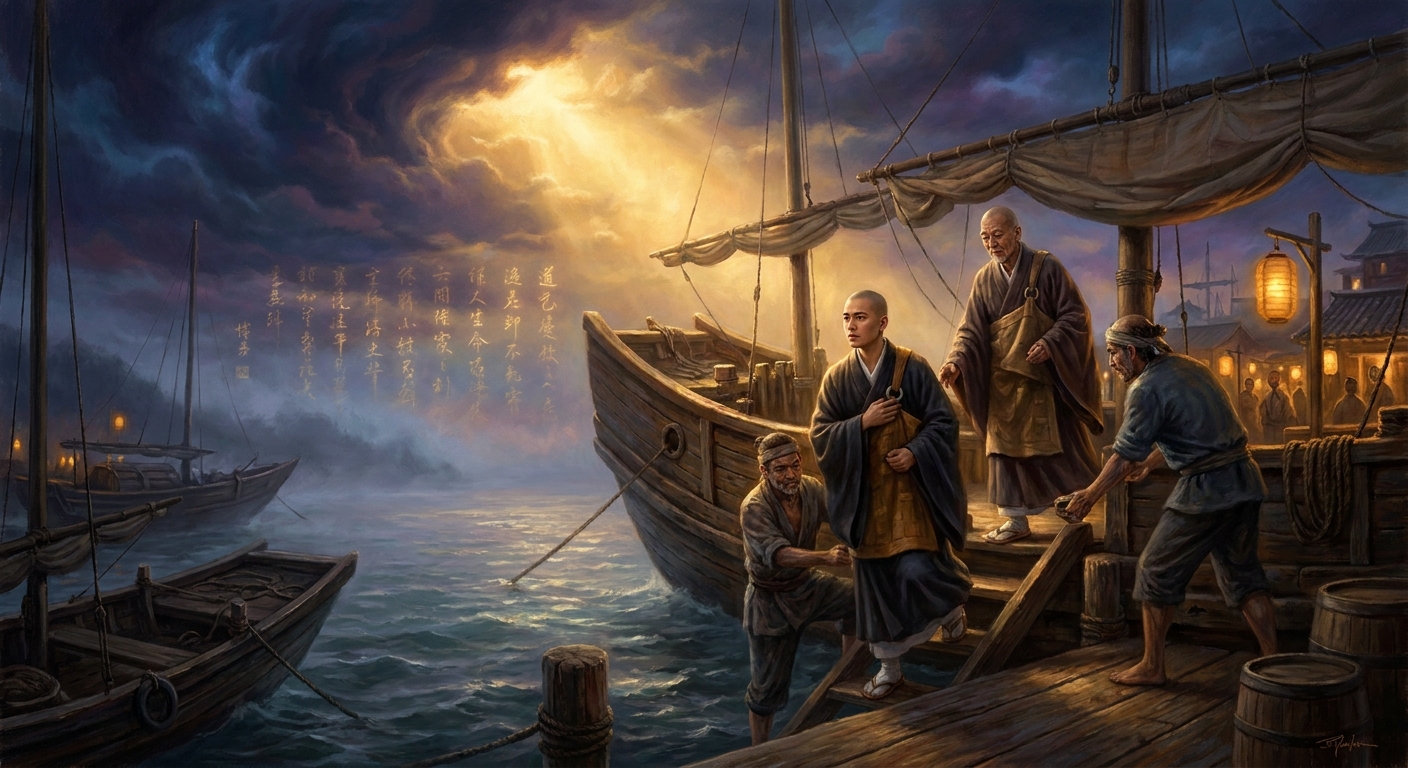
He leaves Hiei. He looks for a teacher who can answer the question. He finds Eisai, the man who first brought Rinzai Zen back from China, and after Eisai dies he attaches himself to Eisai’s heir Myōzen. In 1223, Myōzen books passage on a merchant ship to Song China, and Dōgen — twenty-three, sea-sick, still carrying his question — goes with him.
He spends two years getting it wrong.
He visits monasteries up and down the Chinese coast. He studies under various masters. The teachers are kind; he becomes proficient; he is granted certificates of transmission that other Japanese monks would have considered the prize of a lifetime. He turns them down. He keeps walking. He has come to China to find a real teacher, and the certificates are just paper.
He almost gives up. He is preparing to sail back to Japan with his collection of texts and his polite credentials when he hears that a new abbot has been installed at Mount Tiantong: a man named Rujing, formerly retired, now sixty years old, brought back to the abbacy by imperial request. The monks who speak of him do not speak the way monks usually speak of abbots. They speak the way men speak about a fire they are not sure they can stand near.
Dōgen turns around. He climbs Mount Tiantong.
Rujing is the strictest abbot in the empire.
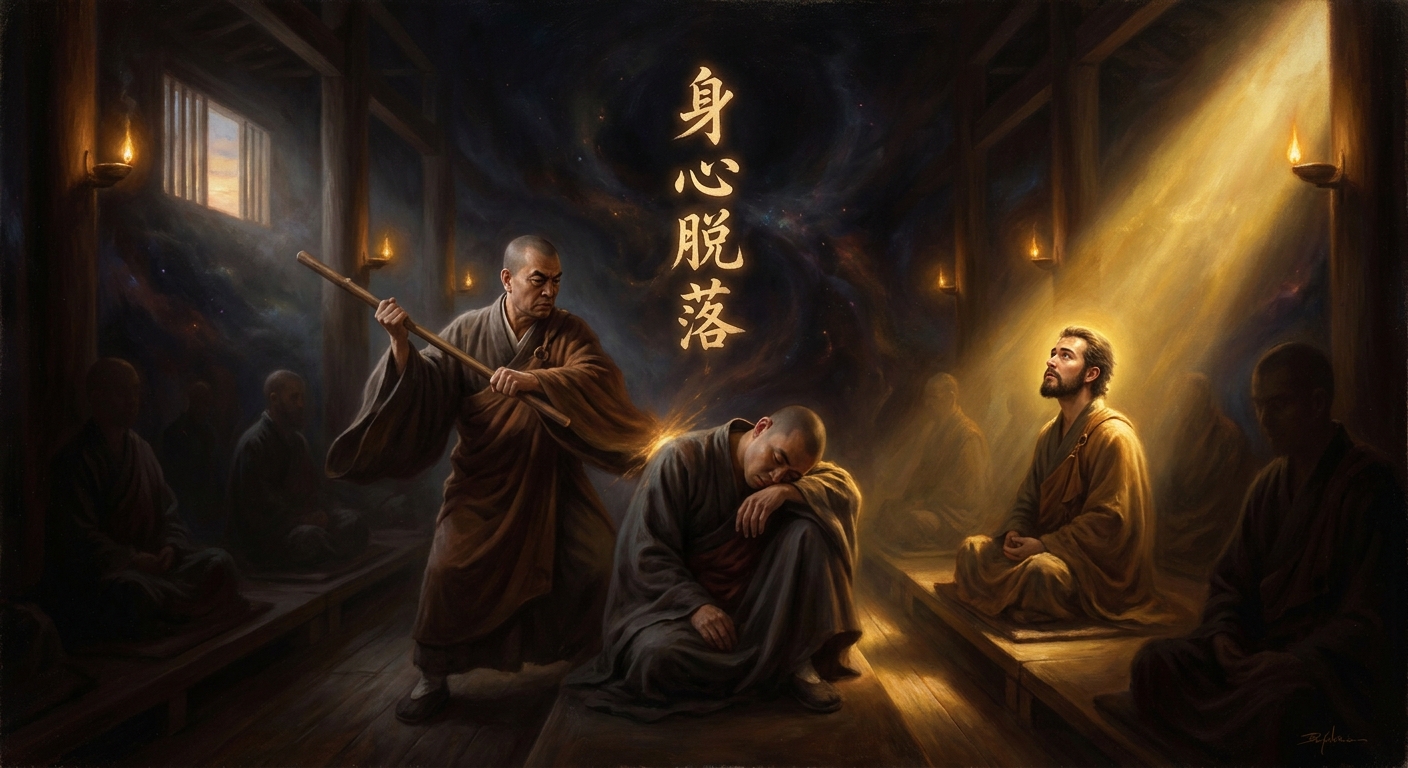
The meditation hall sits from before dawn until late at night. The bell governs everything. Monks who fall asleep during zazen are struck with the kyōsaku, the wake-up stick, without warning and without ceremony. Rujing himself does not sleep more than three hours. He once told his monks that he had not laid down to sleep in forty years.
Dōgen sits with them. The Japanese monk in the back row, eyes lowered, spine straight, asking the question of his life with his thighs.
One pre-dawn morning during the long summer retreat, the monk seated in front of Dōgen falls asleep at his cushion. Rujing comes down the row. The stick in his hand. He does not pause. He strikes the sleeping monk across the shoulders and barks one sentence into the resounding hall:
“In zazen, body and mind are dropped off. Why do you sleep?”
The sentence enters Dōgen the way a door opens.
Not metaphor. Not simile. The way a door, which had been a wall the entire time, simply opens. Shinjin datsuraku — body-and-mind dropped off. Not the cultivation of a state. Not the climbing of a path. The dropping. Of body. And mind. The sleeping monk is not a contrast; the sleeping monk is the audience for whom the sentence cannot land. Dōgen, in the row behind, hears it land in him.
He sits the rest of the period. He does not move. He does not breathe in any way he can recall afterward. The hall ends; the monks rise; he goes to Rujing’s room and prostrates himself on the floor.
“Body and mind are dropped off,” he says.
Rujing considers him. “Body and mind dropped off, dropped-off body and mind.”
“This is a temporary insight. Do not cling to it.”
“This is not a temporary insight.”
“Body and mind dropped off, dropped-off body and mind.” Rujing is testing whether the realization will hold under the test of being told it isn’t real. It holds. Dōgen does not flinch. The old abbot finally allows himself something close to a smile.
The certificate Dōgen had spent two years refusing to want is, suddenly and almost incidentally, given.
He sails back to Japan in 1227 with what other Chinese-trained Japanese monks brought back: texts, robes, ritual implements, mandalas, lineage charts. He sails back, that is, with nothing.
When monks at Kennin-ji ask him what he learned in China, the line he gives them — repeated in Eihei Kōroku and quoted by every later commentator — is plain:
“I returned to my native country with empty hands. There is no Buddha-dharma at all. I have only realized that the eyes are horizontal and the nose is vertical.”
It is a joke and it is not. He has not brought home a new sect. He has not brought home a secret. He has brought home the recognition that the dharma is not a thing that can be brought home. The eyes are horizontal. The nose is vertical. The morning light falls on this floor exactly as it falls on this floor. Genjōkōan — the koan made manifest in the present moment — the title of his most famous fascicle and the doctrine of the rest of his life.
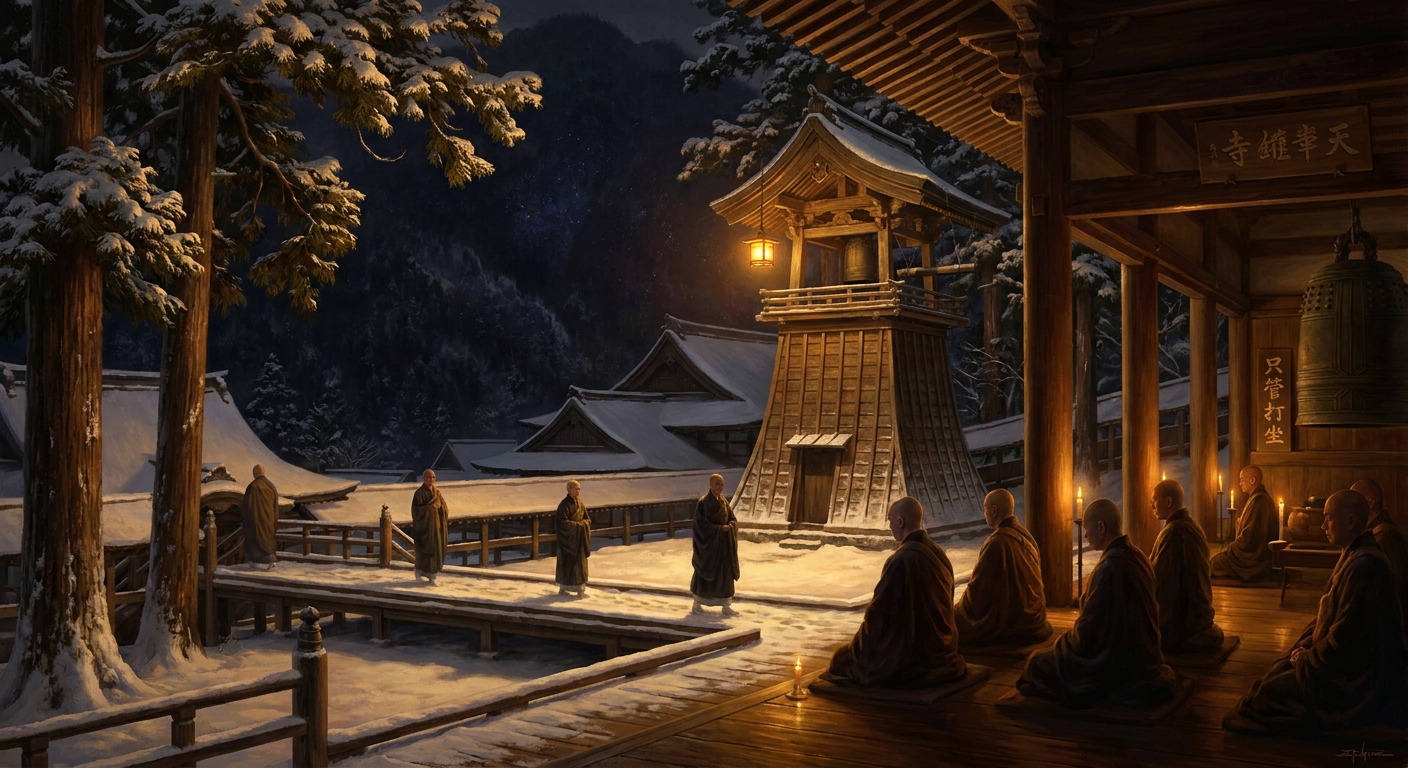
He builds Eihei-ji in the Echizen mountains in 1244 because Kyoto is too political and the older sects keep trying to absorb him.
The cedars at Eihei-ji are taller than the buildings. The snow buries the lower halls in winter. The schedule is brutal: zazen before dawn, zazen after dinner, the jihatsu meal eaten silently from the begging bowl, the fusatsu recitation twice a month. The monks rotate the kitchen jobs. The cook — tenzo — is one of the senior officers of the monastery, because in Dōgen’s reading the kitchen is a meditation hall and the rice is a sutra. He writes Tenzo Kyōkun, Instructions for the Cook, and the small treatise is still required reading for every Sōtō priest seven hundred years later.
He writes Shōbōgenzō — Treasury of the True Dharma Eye — across the last twenty years of his life, in a Japanese so dense and inventive that scholars still argue paragraph by paragraph what he meant. The book is one of the great philosophical works in any language. The thesis under all of it is the same Rujing-sentence translated into a hundred essays:
Practice and enlightenment are one. Zazen is not a means to enlightenment. Zazen is enlightenment, sitting.
He dies in Kyoto in 1253, at fifty-three, of an illness no medicine could touch. His last poem speaks of the body falling away as a leaf from a branch. His successor Ejō takes the lineage forward. Eihei-ji is still standing. The bell still rings before dawn. The monks still sit.
The eyes are still horizontal. The nose is still vertical.
Dōgen’s claim is not modest. He is saying that the entire architecture of Buddhism — the stages of the path, the ladder of attainments, the lifetimes of cultivation — is a misreading. There is no path. There is no attainment. There is no later. Sitting upright on a cushion at four in the morning while the snow falls on a cedar in Echizen is not a preparation for enlightenment. It is enlightenment, behaving as a body.
The sentence at Mount Tiantong did not give Dōgen something he didn’t have. It removed a thing that had been blocking what he already was. Body and mind dropped off. The certificate, the texts, the lineage charts — all of it, in the end, irrelevant. He came home with empty hands because the dharma was the hands.
This is the Sōtō claim. It is still being sat.
Scenes
1223
 Generating art…
 Mount Tiantong, before dawn
Generating art… Eihei-ji in the Echizen mountains
 Generating art…
 Echoes Across Traditions
Entities
- Dōgen
- Tiantong Rujing
- Myōzen
Sources
- Dōgen, *Shōbōgenzō* — *Bendōwa* (1231), *Genjōkōan* (1233), *Sansuikyō* (1240)
- Dōgen, *Hōkyōki* — record of his China years
- Kazuaki Tanahashi (ed.), *Treasury of the True Dharma Eye: Dōgen's Shōbō Genzō* (2010)
- Hee-Jin Kim, *Eihei Dōgen: Mystical Realist* (1975)
- Steven Heine, *Did Dōgen Go to China? What He Wrote and When He Wrote It* (2006)