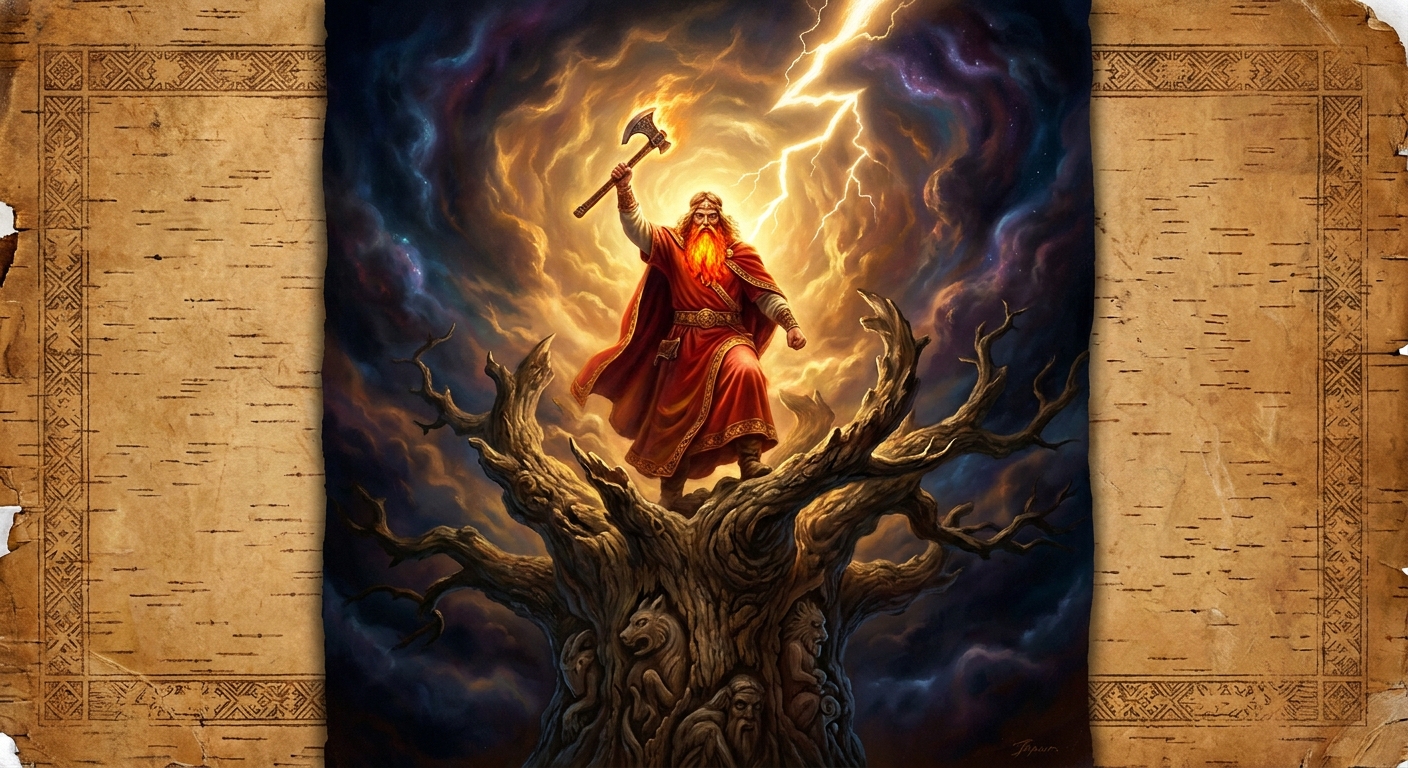
Dobrynya and the Serpent
Epic-mythic time — Kievan Rus, nominally set in the reign of Prince Vladimir (980-1015 CE); oral tradition codified in byliny collected 18th-19th century · Kievan Rus — the Puchai River, the court of Prince Vladimir, the serpent's cave in the mountains
Contents
Dobrynya Nikitich, bogatyr of Kievan Rus, disobeys his mother and swims the forbidden river. The Serpent of the Deep attacks. He beats it into the earth with his cap. He makes peace. The Serpent breaks the peace immediately. This time Dobrynya does not make mistakes — but the second fight is only possible because the first fight happened.
- When
- Epic-mythic time — Kievan Rus, nominally set in the reign of Prince Vladimir (980-1015 CE); oral tradition codified in byliny collected 18th-19th century
- Where
- Kievan Rus — the Puchai River, the court of Prince Vladimir, the serpent's cave in the mountains
His mother tells him three things, and he ignores all three.
Do not ride to the Puchai River, she says. The Puchai is no ordinary river — it runs hot in summer and the current there has a character, a stubbornness, the way some bodies of water seem to resist particular people on particular days for reasons that have nothing to do with hydrology. Do not swim in it. And above all, she says, do not pick up anything you find on the bank.
Dobrynya Nikitich is young. He is the second of the three great bogatyri — below Ilya Muromets in age and power, above Alyosha Popovich in both — and his particular virtue is not brute strength or cunning but politeness, which in the Slavic heroic tradition is its own kind of power: courtesy as the outward sign of a man who knows the difference between what he wants and what the world owes him. He is, in theory, the one who does not make the obvious mistake.
He rides to the Puchai River.
He strips off his armor. He strips off his sword. He enters the water.
The river is warm, which should tell him something. Water that is warm in early summer in the forests of Kievan Rus has a reason for its warmth. Dobrynya is a powerful swimmer and the current is with him and he reaches the far bank, where there is a stone with something coiled behind it — a skin, or a rope, or a whip, or a length of something woven from materials he cannot immediately identify.
He picks it up.
The sky changes. Not all at once — the way the sky changes before a storm that is already here, the clouds having moved in from a direction you were not watching. The Puchai begins to run faster. The warmth of it increases.
Zmey Gorynych — the Dragon of the Mountains, the Serpent of the Deep, the creature that has been collecting princesses and children and blacksmiths in its cave under the mountains since before there were cities in Rus — comes out of the horizon. Three heads. Wings like the wings of something that was never meant to fly but has decided to anyway. Older than the river and far less reasonable. It has been watching Dobrynya’s approach since he left his mother’s gate.
Dobrynya is in the water, unarmed, holding a piece of serpent-shed skin.
He does the only thing available.
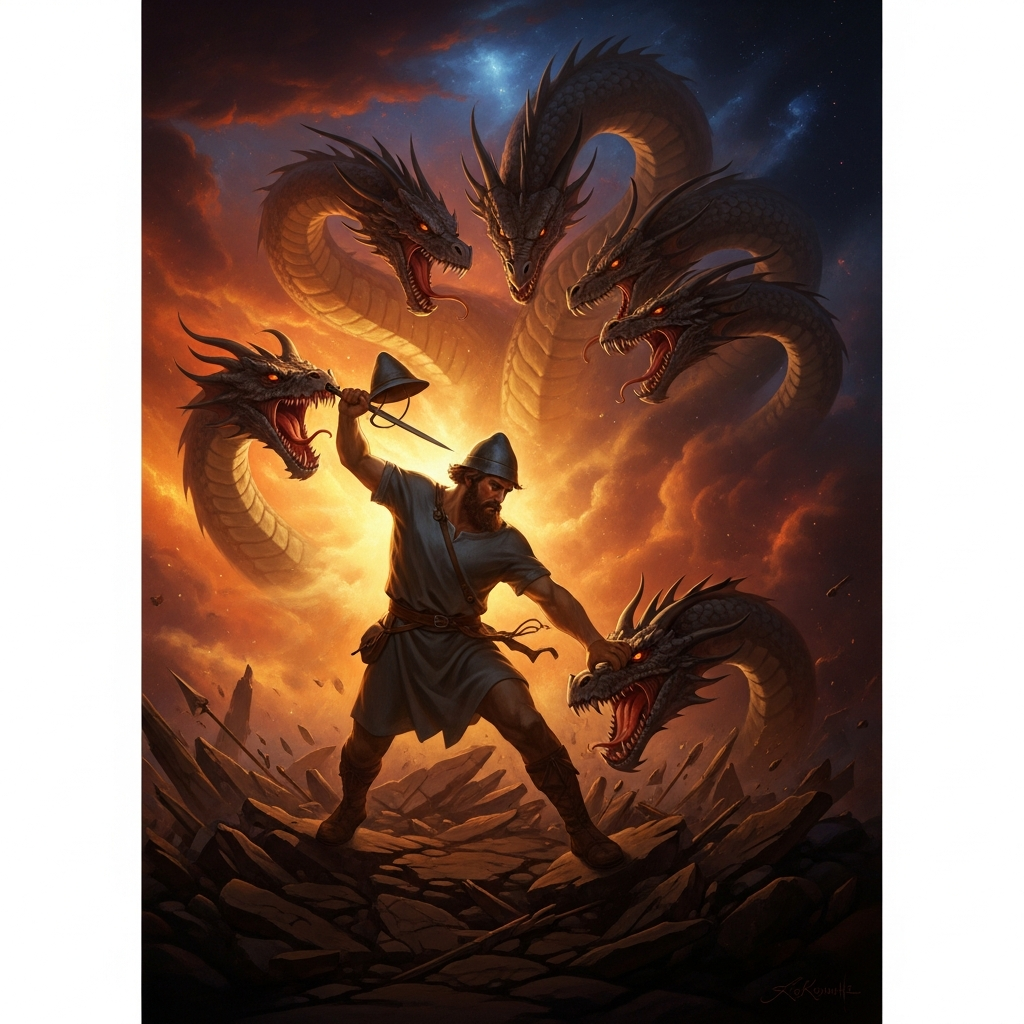
He grabs his hat. His pilgrim’s cap, a Greek hat of the kind pilgrims wore returning from Constantinople, made of felt and not much else. He swings it.
He beats Zmey Gorynych into the ground.
This takes the rest of the day. The Puchai runs red and then runs clear again and then runs red. Dobrynya has the specific kind of endurance that is not strength exactly but refusal — the bogatyr’s refusal to concede the premise that he is losing, even when the ground is shaking, even when three serpent-heads are working in rotation, even when his arms are dead with exhaustion from swinging a felt hat at a dragon for six hours. By evening the Serpent has its three heads in the earth and its wings flat and is saying the words.
I yield, says Zmey Gorynych.
Swear, says Dobrynya, which is the correct answer. Swear by the oath that cannot be taken back. You will leave the princes’ daughters. You will leave the merchants. You will leave the farmers and the blacksmiths and the children. You will not fly over Kievan Rus again.
The Serpent swears.
Dobrynya goes home. He has won with a hat, which will be a good story for the rest of his life. His mother does not say I told you so. She does not need to.
Three weeks later, Zmey Gorynych flies over Kiev and takes Princess Zabava — the niece of Prince Vladimir, a girl of eleven or twelve, small enough to carry under one wing while the other beats the air above the golden domes of the city — and goes back to the mountains.
Dobrynya goes to Prince Vladimir. Vladimir looks at him the way a prince looks at the bogatyr who was personally responsible for the oath that the dragon has just broken.
You made the truce, Vladimir says. You will correct it.
This is entirely fair. Dobrynya does not argue. He goes home and gets his armor. He gets his sword — the one in the chest under the window, not the ordinary sword on the wall peg, the specific sword that was given to him by the same wise woman who gave instructions to half the heroes in the byline, the sword that knows what it is for. He gets his horse, the one he did not ride to the Puchai because he did not want to tire it before the swim.
He gets everything right this time.
He rides east.
The cave under the mountains is not hidden. Zmey Gorynych has never bothered to hide it — when you are large enough and old enough and have never been hurt badly enough to teach you fear, you do not hide your home. The cave entrance is scorched black at the edges from decades of exits and entrances. The bones of things the Serpent has finished with are visible from fifty yards out.
Dobrynya goes in with his sword.
He finds the Serpent in the back. The battle is different this time: not a young man improvising with a hat, not exhaustion-against-stubbornness, but a hero fully armed and properly motivated facing a serpent that had a truce and broke it and knows, somewhere in its old reptilian intelligence, what that means. The swords cut. The three heads work. The fight goes through the entire cave system, through chambers full of the Serpent’s other collected things — gold and silk and the bones of knights who arrived less prepared than Dobrynya — and eventually back to the entrance.
Dobrynya takes all three heads off.
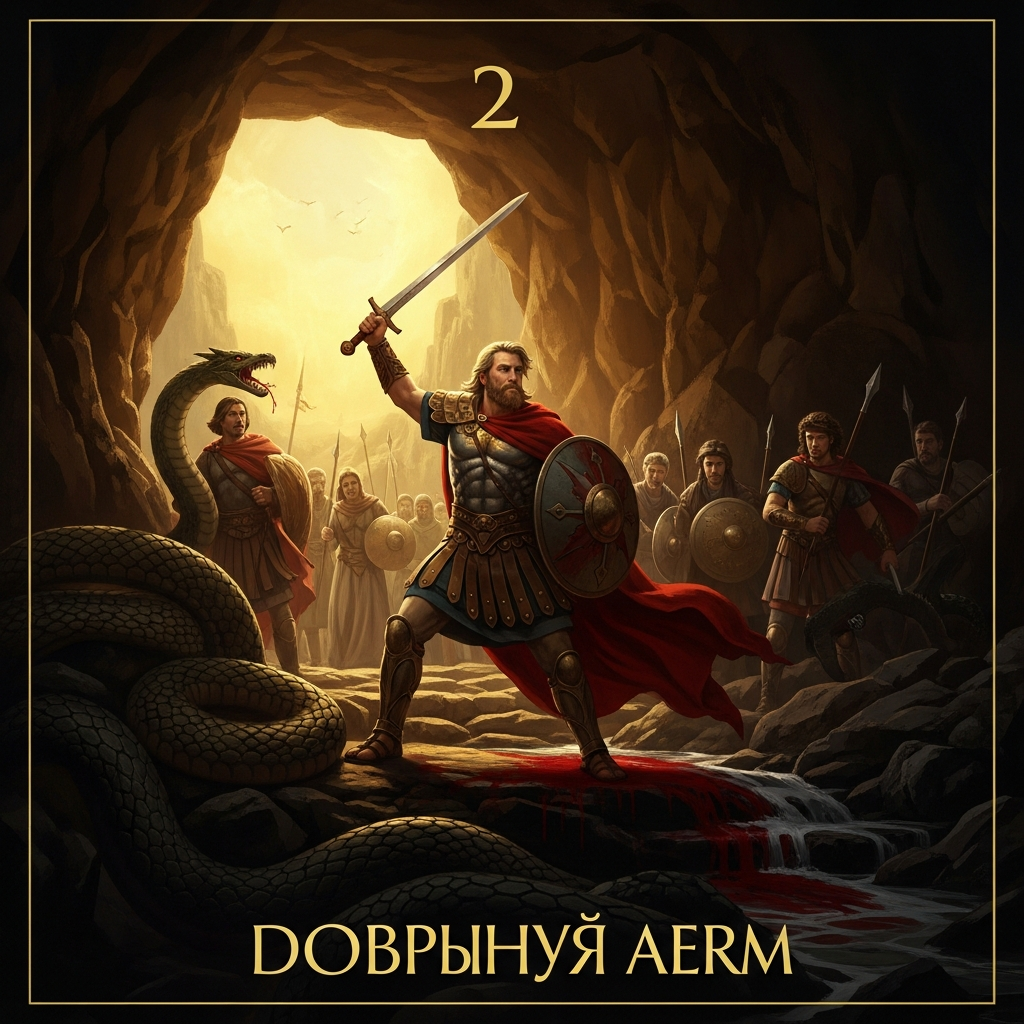
The Serpent’s blood comes out of the ground the way a river does when the spring ice breaks: fast, and red, and filling every channel. It runs across the cave floor and out the entrance and down the mountainside. Dobrynya is standing in it. He is standing in it and it does not stop, and he understands with the practical intelligence of a man who has been in difficult situations before that drowning in the blood of a serpent you have just killed is a specific enough ignominy to be worth avoiding.
He stands in the blood for three days. He drives his spear into the ground and says a specific phrase, an old one, that the earth understands as instruction. The earth opens. The blood drains.
He goes in and finds the princess. He finds thirty-nine other captives as well: queens from three kingdoms, a blacksmith from Novgorod, a bishop who has been providing the Serpent with theological arguments for twelve years and appears genuinely sorry to leave. He leads them all out into a mountain morning that is the specific gold of a morning after something has been settled.
The first fight made the second fight possible, and the first fight was only possible because Dobrynya made every mistake his mother warned him about. This is the thing the story says quietly under the story about the hero.
He had to go to the river. He had to pick up the skin. He had to fight the Serpent with a hat and win badly enough that the Serpent survived and broke the truce and gave Dobrynya a reason to go back with the right sword. The improvised victory in the first battle was the education for the real one.
Heroes who never make mistakes never become heroes — they become cautious men who live a long time and do not have songs sung about them. The bogatyr tradition is specific on this point: the virtue is not perfection. The virtue is the refusal to stay down after the mistake, the insistence on returning to the cave with better equipment and a cleaner heart.
Dobrynya’s mother knew he would go to the river. She told him not to go because that is what mothers do. He went because that is what heroes do. The distinction between the two is not who was right. It is who was necessary.
Scenes
Dobrynya in the forbidden river — the Puchai running gold in the evening light, the young bogatyr swimming with the confidence of someone who has not yet been wrong about his own strength
 Generating art…
 The first battle — Dobrynya beating Zmey Gorynych into the churned earth with a pilgrim's cap, three heads rearing against a burning sky, neither god nor hero yet knowing how this ends
 Generating art…
 The second battle, properly armed — Dobrynya with his dragon-slaying sword at the threshold of the serpent's cave, the liberated captives behind him, the Serpent's blood running in rivers that threaten to drown the hero in his own victory
 Generating art…
 Echoes Across Traditions
Entities
- Dobrynya Nikitich
- Zmey Gorynych
- the Princess Zabava
- Prince Vladimir
- Dobrynya's mother
Sources
- Natalie Kononenko, *Slavic Folklore: A Handbook* (2007)
- W.R.S. Ralston, *The Songs of the Russian People* (1872)
- Felix Oinas, *Heroic Epic and Saga* (1978)
- Y.M. Sokolov, *Russian Folklore* (1938, trans. 1950)
- A.M. Astakhova, ed., *Byliny of the North* (1938)