The Floating Man
Samanid and Buyid Dynasties · c. 1000-1037 CE · Bukhara, Gurganj, Hamadan, Isfahan — the shifting courts of Central Asia and Persia between the Oxus and the Zagros
Contents
A boy who has memorized the Qur'an by age ten treats princes by sixteen, composes philosophy while drunk and theology while sober, and writes the million-word synthesis of all medical knowledge that Europe will study for six hundred years — then proposes a thought experiment that anticipates Descartes by six centuries.
- When
- Samanid and Buyid Dynasties · c. 1000-1037 CE
- Where
- Bukhara, Gurganj, Hamadan, Isfahan — the shifting courts of Central Asia and Persia between the Oxus and the Zagros
He is ten years old and he has memorized the Qur’an.
This is not unusual in Bukhara — the Samanid capital at the edge of the Central Asian steppe, where the libraries are larger than anywhere except Baghdad and the merchants carry philosophy manuscripts alongside bales of silk. What is unusual is that the boy has also memorized most of what the libraries contain. His father sends him to every scholar in the city. The scholars teach him for a few weeks, then send him home with a note saying they have nothing further to offer.
He is not arrogant. He is simply operating at a speed the city’s educational infrastructure cannot match. He sleeps four hours. He wakes before dawn and reads by lamplight until the booksellers open. He walks to the bathhouse not to wash but to think.
At sixteen he treats the Samanid caliph Nuh ibn Mansur for an illness every other physician has diagnosed and failed to cure.
The diagnosis takes Ibn Sina two hours. He asks the caliph to walk while he watches. He asks about the quality of sleep, the pattern of appetite, the color of urine at different times of day. He prescribes a treatment so specific it sounds invented. The caliph recovers in six days. Ibn Sina asks for one thing in payment: unrestricted access to the royal library.
The librarians lead him through room after room — Greek manuscripts translated into Syriac and then Arabic, Persian court histories, Indian astronomical tables, the medical encyclopedias of Galen, the logic of Aristotle, the geometry of Euclid. He reads for an entire winter. He later writes that there was one book he encountered in that library — a copy of Aristotle’s Metaphysics — that he read forty times without understanding it, until he found a short commentary by al-Farabi in the booksellers’ market for three dirhams, and it opened at once.
The library burns down the following year. People say he burned it himself, to ensure no one else could read what he had read. The story is certainly false. It is also certainly not entirely false.
The Canon of Medicine begins as a clinical problem: no medical knowledge is organized.
Galen’s hundreds of treatises contradict each other. Indian and Greek theories of disease causation argue across languages no single physician reads. The clinical literature is brilliant and unsorted — case studies without principles, principles without cases. A physician treating a fever in Bukhara has no way of knowing whether the Alexandrian school or the Baghdad school or the Persian school has seen this fever before and what they learned.
Ibn Sina decides to write down all of medicine. Not a compilation — a system. He devises five books: general principles, simple drugs, head-to-toe organ disease, whole-body conditions, compound drugs. Within each book the same logical structure repeats: definition, cause, symptom, diagnosis, treatment, prevention. Every disease in the known world fits into this grid. Every drug known to Greek, Indian, Persian, and Islamic medicine is listed, described, and calibrated by strength and combination.
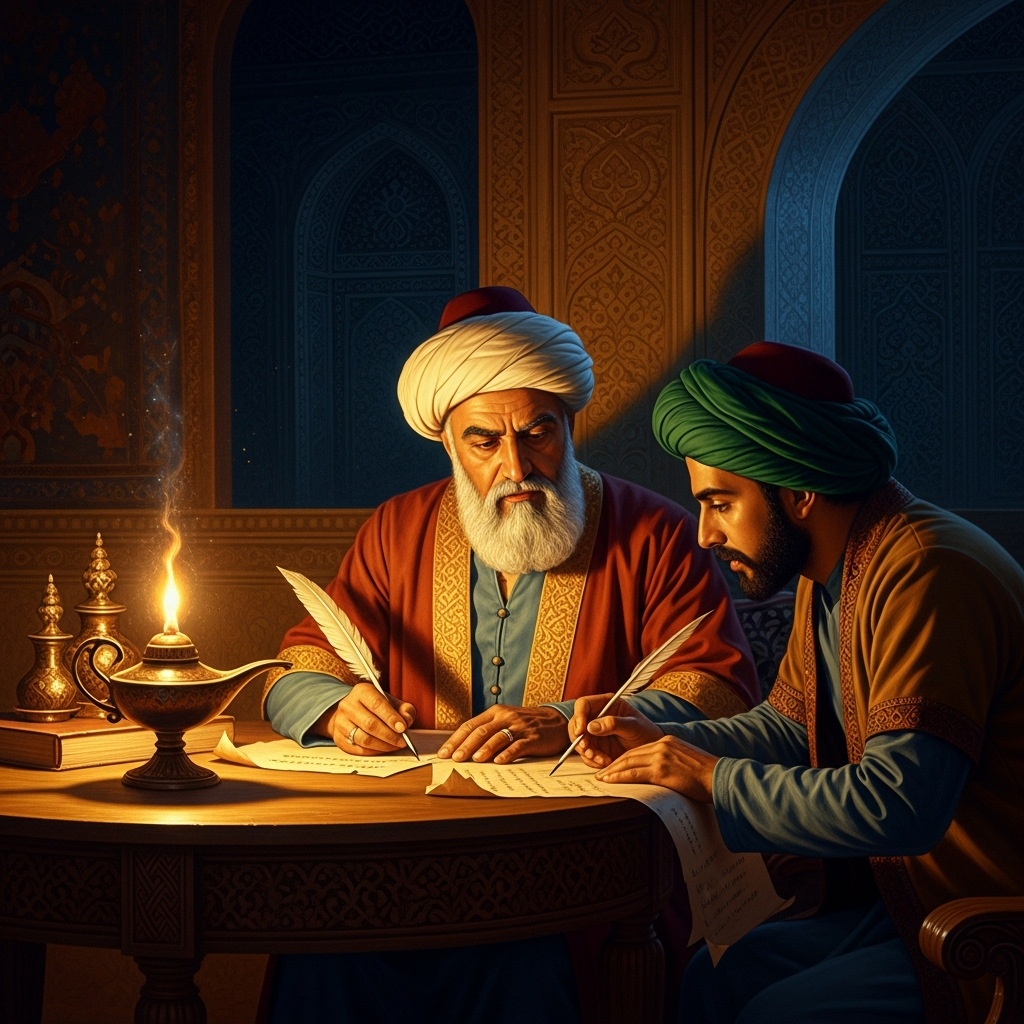
He composes it in Hamadan during the day, by lamplight after the Buyid emir’s court functions end, dictating to his student Juzjani while drinking wine to keep himself awake. Philosophy he writes drunk, he tells Juzjani. Theology he writes sober. Medicine he writes in the condition the work itself prescribes.
The thought experiment begins as a lecture problem in the philosophy of mind.
He sets it up in the Shifa, the Book of Healing — his philosophical encyclopedia that runs to eighteen volumes and takes seven years to compose. The passage is three paragraphs long. He asks you to imagine a man created instantaneously, suspended in empty space, with no sensory contact with the world — no sight, no sound, no body touching any surface, no air on his skin, no warmth from the earth. Does this man exist?
He does not hesitate. Yes: the man is undeniably present to himself. He knows that he is, even without any sensory evidence. His awareness of his own existence does not depend on any input from outside. The self is its own most immediate datum.
Ibn Sina calls this the Floating Man. What it proves is that the soul is not identical with the body, that pure self-consciousness survives the subtraction of all sensation, that I am is prior to and independent of I perceive. Descartes will arrive at the same conclusion six hundred years later, through the same method of systematic doubt, and call it the fixed point of all philosophy. Ibn Sina calls it a medical school lecture and moves on to the next problem.
The courts keep moving him.
The Samanid dynasty falls to the Ghaznavids and Ibn Sina loses his library. He serves the Buyid emirs in Hamadan and Isfahan, treating princes who distrust intellectuals and intellectuals who distrust princes. He is arrested twice — once for corresponding with the wrong caliph, once for reasons the sources do not specify. He escapes from jail, disguised as a Sufi, and walks to the next city. He carries the manuscript of the Canon on his back.
He sleeps four hours when conditions permit and three when they do not. He fills the time between patients and court duties writing. Not just medicine and philosophy — he writes one of the great Arabic treatises on music, a systematic geography of the Islamic world, a commentary on every major Aristotelian text, an Arabic poem summarizing logic, a Persian poem summarizing medicine. He writes in Arabic and Persian with equal fluency, switching languages the way a bilingual musician switches instruments.
His student Juzjani begs him to slow down. Ibn Sina says: A short life spent wide is better than a long life spent narrow. He dies at fifty-seven, in the field with an army marching to recover Isfahan, of a colic that his own prescriptions had been holding at bay for years. He refuses surgery. He says: The manager who has managed this body has grown weary of the management.
The Canon reaches Europe in 1150, translated from Arabic into Latin by Gerard of Cremona in Toledo.
It enters the curriculum at Bologna, then Paris, then Oxford, then Montpellier. For five hundred years it is what medicine means — the textbook that every physician reads before any other, the framework inside which every case study is interpreted. The university lectures on the Canon continue in some European schools into the 1650s. Students at Montpellier in 1600 are learning pulse diagnosis from a system Ibn Sina devised in Bukhara in 1010.
The philosophers do not forget the Floating Man. Avicennism — the synthesis of Aristotle and Islamic thought that the Shifa proposes — becomes the dominant intellectual framework of Islamic and Jewish philosophy for two centuries, and the unavoidable interlocutor for every Christian philosopher who reads the Latin translations. Albert the Great comments on it. Roger Bacon argues with it. Duns Scotus builds his theory of individuation against it. Thomas Aquinas quotes it on almost every page where mind is the subject.
The Floating Man is still floating. He is still aware of himself. He cannot see the armies that marched below him, or the libraries that burned, or the courts that rose and fell while Ibn Sina moved between them. He has no body and no history and no country. He has only the bare fact of his own existence, which turns out to be enough.
The man who organizes everything dies with the unfinished manuscripts still in his bag — the one detail no system can account for, which is the body that carries it, which insists on having its own opinion about how long the work takes.
Scenes
By lamplight in the Hamadan palace, Ibn Sina dictates the *Canon* to his student Juzjani — fifty sections, one million words, the entire architecture of medicine organized for the first time into a single rational system
Generating art… The sixteen-year-old physician enters the restricted stacks of the Samanid royal library in Bukhara, granted access because he cured the caliph — and reads everything, room by room, in a single winter
 Generating art…
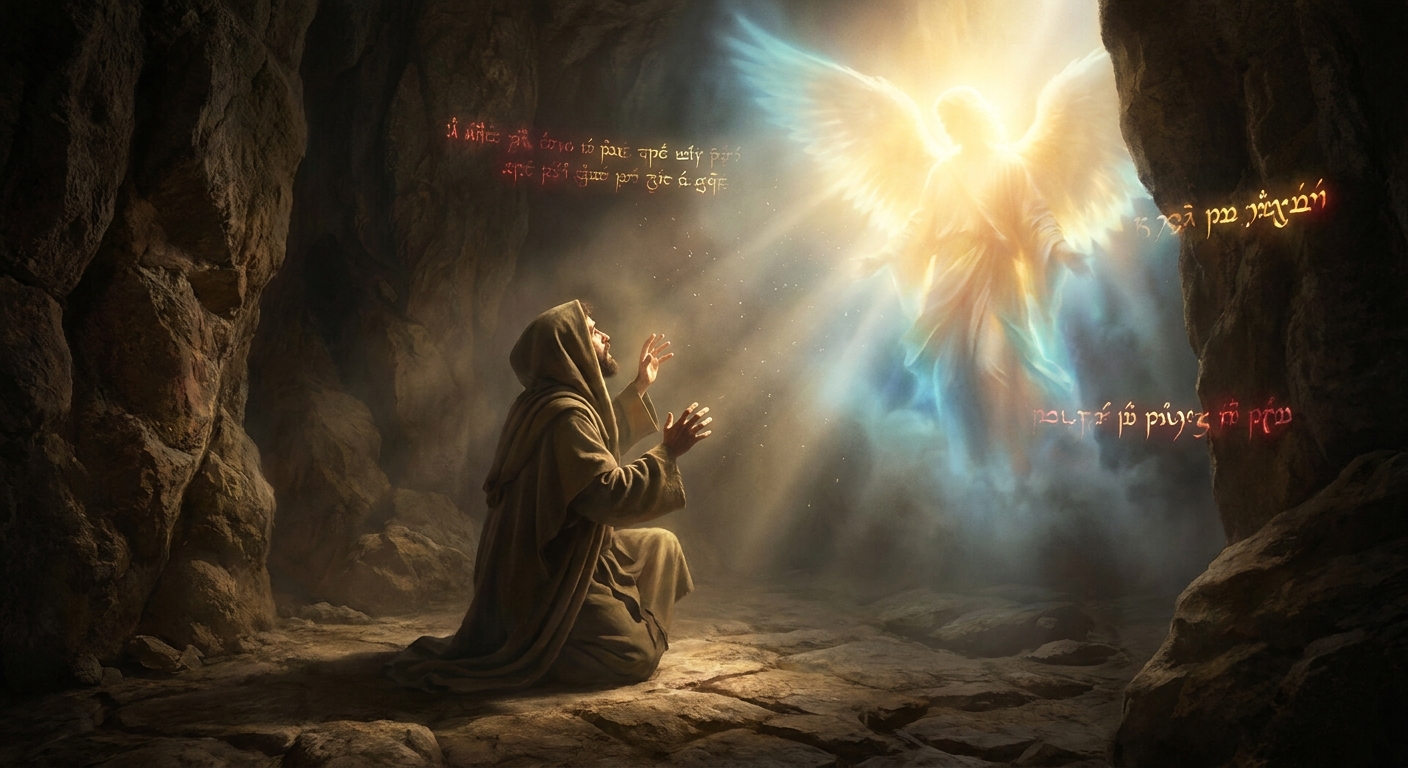
 The mind suspended in empty space — no eyes, no ears, no body, no sensation — and yet undeniably present to itself: the Floating Man, philosophy's first pure thought experiment, drawn in the margin of the *Shifa
 Generating art…
 Echoes Across Traditions
Entities
- Ibn Sina (Avicenna)
- the Floating Man
- Nuh II ibn Mansur (Samanid Caliph)
- the Samanid Library of Bukhara
Sources
- Ibn Sina, *al-Qanun fi al-Tibb* (the *Canon of Medicine*), c. 1025 — translated by Gerard of Cremona into Latin, c. 1150
- Ibn Sina, *Kitab al-Shifa* (the *Book of Healing*), c. 1020-1027
- Ibn Sina, *Risala fi al-Nafs* (the *Treatise on the Soul*) — the Floating Man passage
- Dimitri Gutas, *Avicenna and the Aristotelian Tradition* (Brill, 1988; rev. 2014)
- Peter Adamson, *Great Medieval Thinkers: Ibn Sina* (Oxford, 2013)
- Ibn Abi Usaybi'a, *'Uyun al-Anba fi Tabaqat al-Atibba* — the biographical source for Ibn Sina's childhood