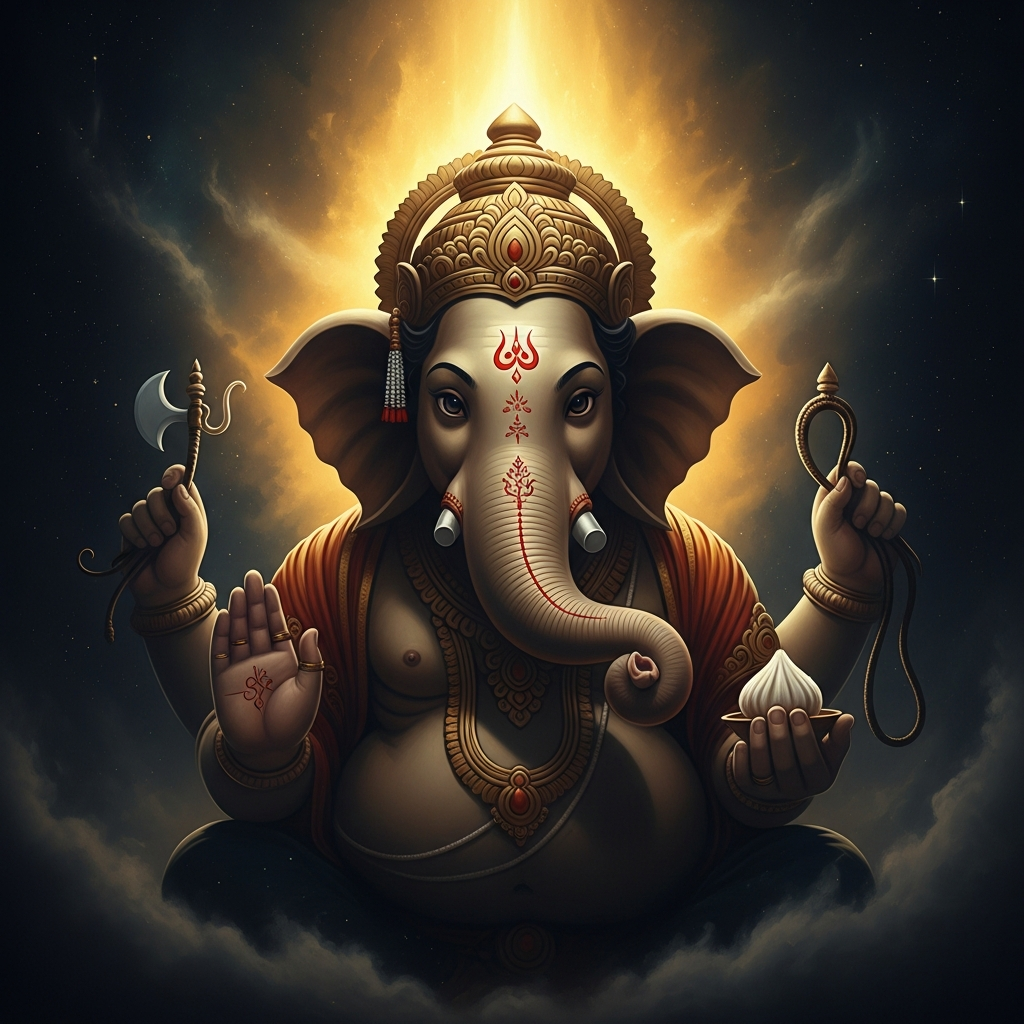
Ganesha and the Elephant Head
Mythic Time · Shiva Purana ~750-1350 CE · Mount Kailash — Shiva and Parvati's mountain home
Contents
Parvati shapes a son from the dust of her own body to guard her bath. Shiva returns home, finds a stranger blocking his door, and beheads the boy. Parvati's grief reorders the cosmos. The first creature found in the forest gives up its head — an elephant.
- When
- Mythic Time · Shiva Purana ~750-1350 CE
- Where
- Mount Kailash — Shiva and Parvati's mountain home
Parvati wants a bath.
She has waited for solitude on Mount Kailash the way mortal women wait for solitude — between the visits of in-laws, the demands of the household, the constant arrivals of ascetics seeking her husband. Shiva is away. The ganas, his wild attendant spirits, are scattered through the forests. The mountain is finally hers.
She draws water. She mixes it with sandalwood paste and turmeric. She rubs the paste into her skin until a film of fragrant dust comes loose under her hands — the dead skin of a goddess, mixed with the oil of her own body.
She looks at the dust in her palms. She thinks: I will make him from this.
She shapes the boy on the floor of her chamber.
Two arms. Two legs. The smooth chest of a child who has never been struck. A face she gives the careful seriousness of a son who knows his mother is alone in the world. She breathes into him. She does not need a god’s permission. She is the goddess. The dust of her body is enough.
He opens his eyes. He sits up. He looks at her with a recognition that has no history behind it — only the immediate, total devotion of a creature who has existed for thirty seconds and already knows whose son he is.
She places a staff in his hand. Stand at the door, she says. Let no one in until I tell you. Not anyone. Not even gods.
He nods. He takes his post.
She closes the door behind her and steps into the water.
Shiva returns at midday.
He has been wandering — he is always wandering, the way ascetics wander, the way the destroyer of universes wanders between cosmic ages — and he is hungry and thirsty and ready to find his wife. He walks up the path to his own house. There is a child at the door.
The child raises a staff. You may not enter.
Shiva stops. He looks at the boy. The boy looks back. There is no trace of recognition on either face — Shiva has never seen him, and the boy has been told to admit no one, and the boy is the son of the goddess who shaped him, and that is the only loyalty he has.
Shiva says: I live here.
The boy says: No one lives here today except my mother.
The ganas arrive. They throw themselves at the child. He breaks them. Shiva sends Vishnu. Vishnu cannot pass. The boy fights with the wild competence of something that was made for exactly one purpose, and the gods of the cosmos pile up at the doorway of a mountain house and cannot get past a child who has existed for less than an hour.
Shiva loses his patience. He raises his trident.
The head comes off cleanly.
It rolls into the courtyard. The body falls. The staff drops from a hand that was never given time to know what it was holding.
Shiva walks past. He pushes the door open. He is still angry — the small, household anger of a husband locked out of his own home — and he calls for Parvati.
Parvati steps out of the bath.
She sees the body in the doorway. She sees her husband holding the trident. She sees her son’s head separated from her son’s neck on the stones of her own courtyard.
She does not scream. She is the goddess. Screams are too small for what is happening. What she does is more dangerous: she stands very still, and the mountain begins to shake, and the air in Kailash thickens, and somewhere in the lower realms the demons feel the change and lift their faces from their work, because Mahadevi is grieving and the cosmos is going to pay for it.
She says, very quietly: Bring him back.
Shiva understands, then, what he has done.
He has destroyed a god — not just a child, not just a guardian, but a being his wife shaped from her own body. He has killed his own son without knowing he had one. The wound he made is a wound in the marriage, in the cosmos, in the long negotiation between the masculine destroyer and the feminine creator that holds the world together.
He calls the ganas. Go north, he tells them. Go into the forest. The first living creature you find — the first one whose head faces north when it sleeps — bring me its head.
The ganas run. They cross the Himalayas in the time a thought takes. They find an elephant — old, mighty, sleeping with its trunk curled and its tusks glinting in the high mountain light, its head turned to the north star.
They do what they have been told to do. They bring the head back.
Shiva places it on the body.
He breathes. The breath of the destroyer is also the breath that makes things; it is the same breath, used differently. The seam closes. The elephant’s eyes open in the boy’s face. The trunk rises. The body that was a child stands up, and what stands up is no longer only a child — it is a child with the head of an elephant, the wisdom of an animal that never forgets, the strength of a creature that can uproot trees.
Parvati comes forward. She takes her son’s face in both hands. She does not flinch. She has shaped him from her own body once, and now he has been shaped a second time, and he is still hers.
Shiva says: He will be the lord of beginnings. No undertaking will succeed without his blessing. No god will be worshiped before him. He will be first.
The boy bows. He is Ganesha now — the elephant-headed, the obstacle-remover, the patron of every threshold, every doorway, every act of starting.
He returns to his post at the door. He has been given back to his mother, and his mother has been given back her household, and the marriage has survived the worst day in its long mythic life.
Ganesha is the most beloved god in Hindu practice. Every wedding, every business opening, every new house, every published book begins with a prayer to him. The first marks made on a Sanskrit page are the syllables of his name.
The myth refuses to clean itself up. Shiva killed his own son. Parvati shaped a child without consulting her husband. The household fell apart, and the gods stitched it back together with the head of an animal whose loyalty to its kin is the deepest in the natural world. The substitution is not an embarrassment. It is the theology.
To begin anything is to risk the wrong head being placed on it. To remove an obstacle is to know what an obstacle is — to have been one, once, at a doorway, holding a staff, doing exactly what your mother told you to do.
Echoes Across Traditions
Entities


Sources
- *Shiva Purana*, Rudra Samhita, Kumara Khanda 13-18
- J.L. Shastri (trans.), *The Siva-Purana*, All India Kashiraj Trust series
- Wendy Doniger, *Hindu Myths* (1975)
- Cornelia Dimmitt and J.A.B. van Buitenen, *Classical Hindu Mythology* (1978)
- Paul Courtright, *Ganesa: Lord of Obstacles, Lord of Beginnings* (1985)