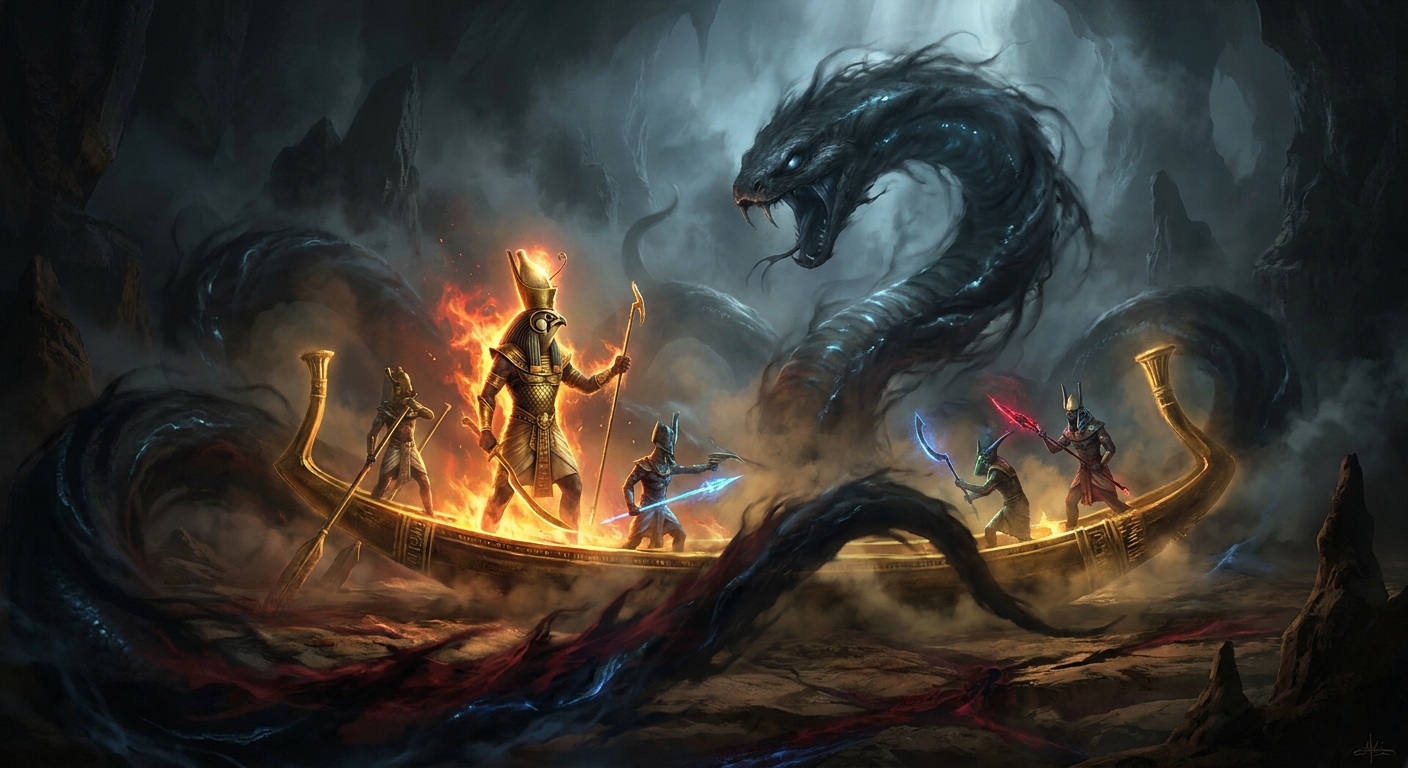
Ra and the Nightly Serpent
~2400 BCE Pyramid Texts; the imagery older still · The Duat — the night sky and the underworld
Contents
Every night Ra descends into the Duat in his solar barque, and Apophis — the great serpent of chaos — waits to swallow the sun. The gods fight. The serpent falls. Dawn is not a given. It is a victory.
- When
- ~2400 BCE Pyramid Texts; the imagery older still
- Where
- The Duat — the night sky and the underworld
The sun goes down, and this is what happens.
Ra steps from the day-sky into the solar barque — the Mandjet, the Barque of Millions of Years — and the prow turns west. The horizon swallows the gold disk whole. In Thebes and Memphis and Heliopolis, the priests know what this means. They do not call it night. They call it the entrance to the Duat, and they light the lamps, and they begin the spells.
The Duat is not darkness. That is the misunderstanding. It is a place with twelve hours and twelve gates and twelve guardian serpents, and it is ruled by laws as strict as any that govern the daylight world. Ra must pass through all twelve hours before dawn. He has never failed. He has never been safe.
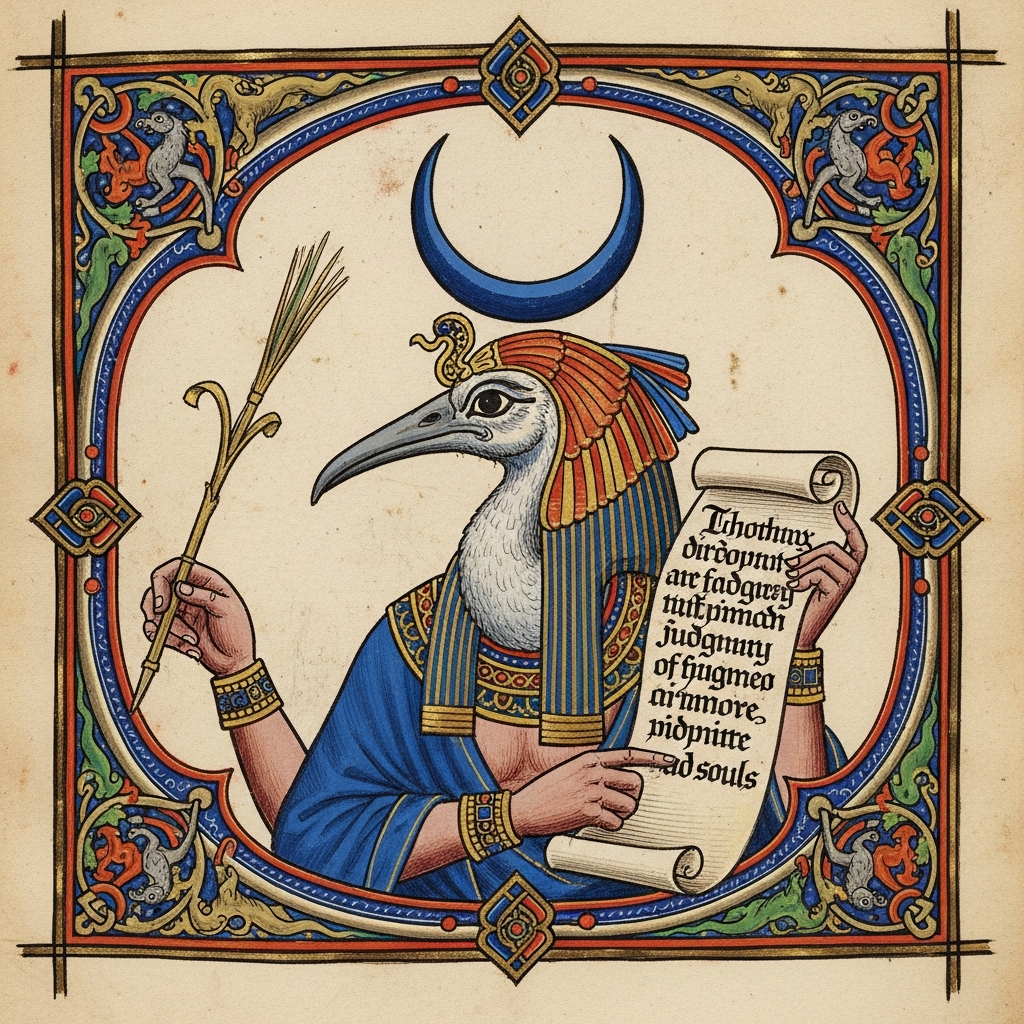
In the third hour the barque passes through the realm of Sokar, where the dead cluster at the banks and Ra’s light reaches them — only for that hour, only that much. The crew navigates in silence. Thoth stands at the stern, reed in hand, recording everything. He records the names of the gates. He records the spells that open them. He records the precise geometry of each confrontation that is coming, because geometry is the only defense against a thing that has no shape.
In the fourth hour the water runs out.
The Duat narrows here into a passage the texts call the Cavern of Sokar, a tunnel so tight the barque must be dragged on runners through the sand. No river. No oars. Just the crew hauling, hand over hand, in absolute dark, and Ra reduced to a small gold coal in his cabin, waiting.
This is where Apophis waits.
He is not a snake the way a garden snake is a snake. He is the snake that was before snakes, before scales, before the first god opened the first eye over the first ocean. His name is chaos made specific — not the absence of order but the active appetite for it. He is nine rods long in the Book of the Dead, which is a way of saying incalculably large, larger than the passage can contain, larger than the night sky can hold, and yet he is always here, always coiled, always waiting for the hull of the barque to come within reach.
He does not sleep. He does not remember last night’s defeat. He has no last night. He is continuous.
When the prow enters his range he opens his mouth.
Set moves first.
This is the thing about Set that Egypt understood and the myths remember badly: he is not simply the god of chaos. He is the god who can face chaos. His red hair, his unclassifiable animal-head, his desert origins — these are not flaws. They are qualifications. You do not send Osiris against Apophis. Osiris is lord of the dead, and the dead are the prize, not the weapon. You send the one god who is as strange as the serpent himself, who speaks the red-sand dialect of violence, who will not flinch at the coils.
Set stands at the prow and drives his spear into the serpent’s skull.
It goes in. Apophis screams — the sound is what the Pyramid Texts are trying to record when they pile epithet on epithet, insult on insult, curse on curse. You do not charm Apophis with beauty. You humiliate him. You name him as diminished. You who are felled, the texts say. You who shall not rise. The insults are part of the weapon.
Bastet follows with her knives. She is the solar eye, the fire that Ra sends out ahead of him, and tonight she is fury made feline — she nets sections of the coiling body, holds them, cuts. The net is not metaphor; the Books of Overthrowing Apophis specify the net in detail, its cords, its weight, the hands that hold each corner. Chaos is not defeated with vague hope. It is defeated with nets and knives and correct names.
The crew joins them. The crew of the solar barque has no individual names in the earliest texts. They are simply those who crew the barque — the principle that the light requires company, that Ra’s passage through the dark is not a solo act but a collective one, that the sun rises because people do the work.
They dismember him.
This takes time. This takes the full depth of the Duat, hour after hour of cutting, because Apophis is not a thing you kill in one stroke. He is a thing you disassemble, section by section, coil by coil, and even then he is not gone. He heals. He regenerates. He will be whole again by the time the barque completes its passage and the prow pushes toward the eastern horizon, and he will be waiting, coiled in the same cavern, when tomorrow’s barque arrives.
Egypt knew this. The priests who performed the ritual burning of Apophis’s effigy in the temples — who painted his image and set it alight and then ground the ash and mixed it with filth and burned it again — they knew the effigy would need to be burned again tomorrow. The point is not to finish Apophis. The point is to fight him correctly enough that the barque gets through.
Thoth records the cuts. He records the names of the knives. He records which sections fall and in what order, so that tonight’s battle can be replicated tomorrow with the same precision. This is why Thoth matters here: the dismemberment of chaos is not improvisation. It is a liturgy. It is performed the same way every night because the serpent’s regeneration is exact, and the response must be exact.
In the twelfth hour the first light appears.
It is not daylight yet. It is the promise of daylight — the slight warming of the tunnel walls, the shift in the quality of the dark from absolute to merely profound. Ra stirs in his cabin. The crew rows. The barque pushes through the last gate, past the last guardian, and the prow rises toward the eastern horizon with the force of a thing that has come through the underworld and refuses, refuses, to be stopped.
The eastern horizon opens.
The disk lifts.
In the temples the priests see the light touch the top of the pylons and they release the breath they have been holding all night, and they begin the morning prayers, which are also victory hymns, which are also tallies of what was survived. Ra has risen. The barque has come through. The serpent has been felled for another day.
Not destroyed. Felled. The language is precise.
This is the Egyptian universe: not a place where chaos was defeated at the beginning and now runs in peace, but a place where chaos is real, continuous, and personally motivated, and where the gods go into the dark every night to hold the line. Creation is not the past event. Creation is what happens each morning when the sun clears the horizon. It has to be fought for. It can be lost.
The priests burning Apophis’s effigy were not performing theater. They were crew members. Their spells were oars. The correct words, spoken at the correct hour, in the correct temple, added to the weight against the serpent and helped the barque through. The liturgy was load-bearing.
If they stopped — if the temples fell silent, if the spells went unspoken, if the net was not cast at the correct moment — Apophis would close his mouth on the sun and it would not rise.
Every sunrise since the Pyramid Texts were cut into stone has been contingent. Every one of them has been a narrow victory over the entity that does not sleep and does not remember being defeated and will not stop.
The Egyptians looked at dawn and called it what it was.
The nightly battle imagery appears in the Pyramid Texts as early as the 24th century BCE, making it one of the oldest continuously documented religious cosmologies on record. The Book of the Dead*, Spell 39, provides the most explicit script for repelling the serpent — including the specific insults to be hurled at Apophis by name. Egypt treated the spell as functional equipment.*
The parallel to Marduk and Tiamat is structural but the outcome differs crucially: Marduk kills Tiamat once, permanently, and builds the world from her body. Egypt understood that chaos is not a problem to be solved but a condition to be managed. This distinction — order as event vs. order as maintenance — separates the two cosmologies completely.
Every dawn is proof that last night, the gods did not lose.
Echoes Across Traditions
Entities


Sources
- *Pyramid Texts* (c. 2400–2300 BCE), Utterances 280, 320, 506
- *Coffin Texts* (c. 2100–1650 BCE)
- *Book of the Dead*, Spell 39 (Repelling the Serpent)
- Erik Hornung, *The Ancient Egyptian Books of the Afterlife* (1999)
- Jan Assmann, *Death and Salvation in Ancient Egypt* (2005)