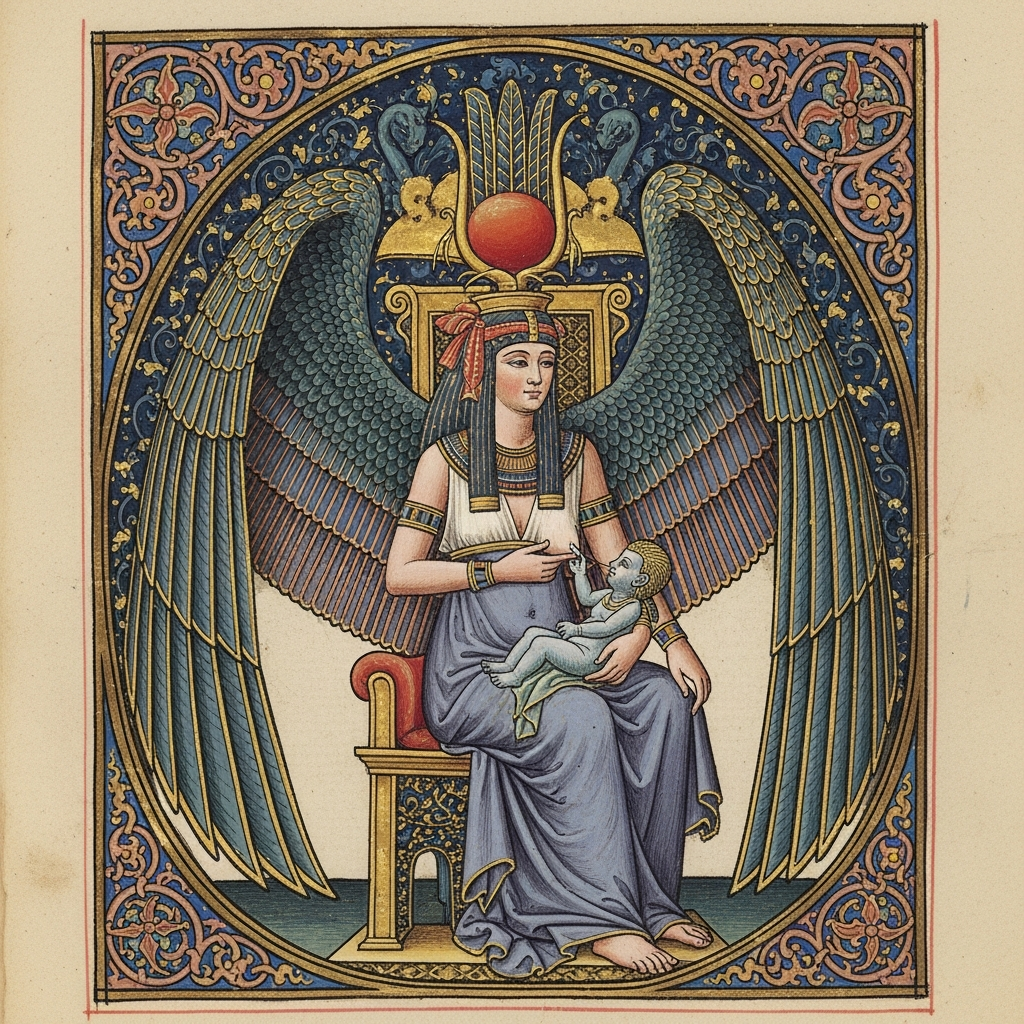
The First Lament
Mythic Time · Pyramid Texts ~2350 BCE through Ptolemaic period · Egypt — the full length of the Nile valley, from the delta to the first cataract
Contents
Nephthys, wife of Set and secret lover of Osiris, walks the length of Egypt with her sister Isis to find the pieces of the murdered god. She mourns her lover, helps her rival, searches for what her husband destroyed. The cry she makes over the body — the kite-shriek, the hawk's grief — becomes the sound Egyptian priests will imitate for three thousand years.
- When
- Mythic Time · Pyramid Texts ~2350 BCE through Ptolemaic period
- Where
- Egypt — the full length of the Nile valley, from the delta to the first cataract
She has no good role in this story. She knows it. She has known it since before the story began, since she understood her position — Set’s wife, Osiris’s lover, Isis’s sister, Anubis’s mother — and saw that there is no position in the family structure from which she is not implicated in something she did not entirely choose.
This is the myth of Nephthys: the goddess who is always already in the wrong situation, who proceeds anyway, who does what she can do from inside the impossible.
The texts do not dwell on how she came to love Osiris. They state it the way they state other practical arrangements of divine power: Nephthys, disguised as Isis, lay with Osiris. He was deceived. Anubis was born. Set does not know, or knows and chooses the particular Egyptian male dignity of not acknowledging. The resulting child — Anubis, the jackal-headed embalmer, the guide of the dead — is raised in silence, his parentage an open secret in the divine family, another thread in the impossible weaving that is the House of Osiris.
Then Set builds the coffin. Then the river takes it. Then the pieces are scattered.
She does not mourn immediately. There is no time for the luxury of private grief.
Isis finds her first. Isis always finds who she needs; she is a goddess of magic and searching, and searching is the force she was made to embody. She finds Nephthys in whatever dark place Nephthys has gone to in the hours after the scattering, and she says: Come with me.
The texts do not record what negotiation happens, if any. The two sisters begin to walk.
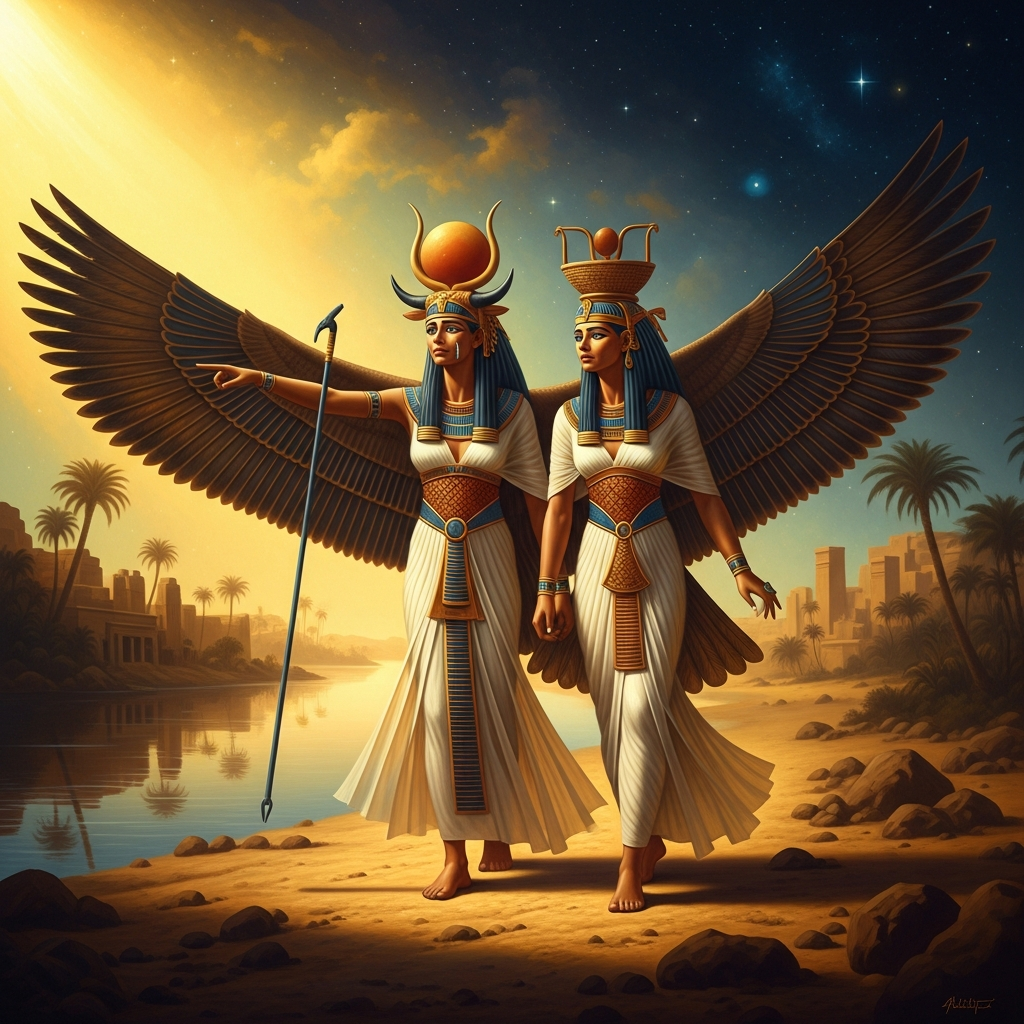
They are hawk-winged in their searching forms — the kite, the kind of hawk that rides thermals over the delta, the great circles above the floodplain, the bird that can see from a height what is invisible at ground level. They walk the length of Egypt. They ask at every settlement, every fishing camp, every temple complex. They kneel at the river’s edge and look into the water for the color of divinity. They go into the desert, which is Set’s country — the red land, his territory, where his power is maximum and their errand is most exposed.
Nephthys walks. She searches for pieces of the man she loved, in the country of the husband who killed him, alongside the wife whose shape she borrowed. She has no angle from which any of this is uncomplicated.
This is the theology: she does it anyway.
What she carries that Isis does not is a specific knowledge of guilt. Not guilt for the killing — she did not kill him, Set killed him, and even Set is not exactly guilty in the way humans use the word, because Set is chaos functioning as chaos, fulfilling the role the cosmos assigned him. But she carries the knowledge that her love for Osiris was not entirely innocent, that the child she bore is the product of a deception that used her sister’s face, that her presence in the house of Osiris was never clean.
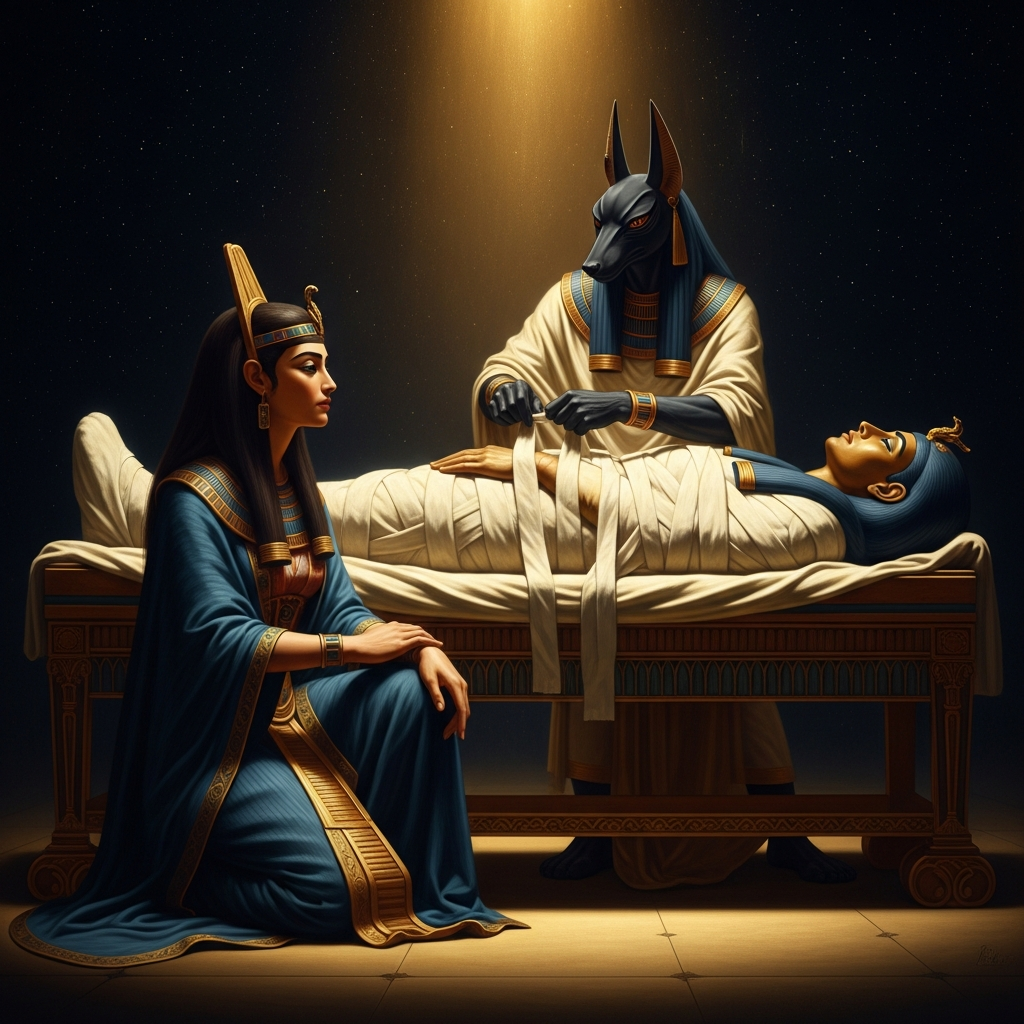
And she carries the knowledge of what will happen to Anubis. Her son by Osiris will be the embalmer of Osiris. He will wrap the body she is now searching for, will prepare it for the spells Isis will work, will seal it with the precision and care that reflects, perhaps, the intensity of what he was made from — desire dressed as duty, love encoded in linen.
She walks. She asks. She finds.
The first lament happens before Isis arrives.
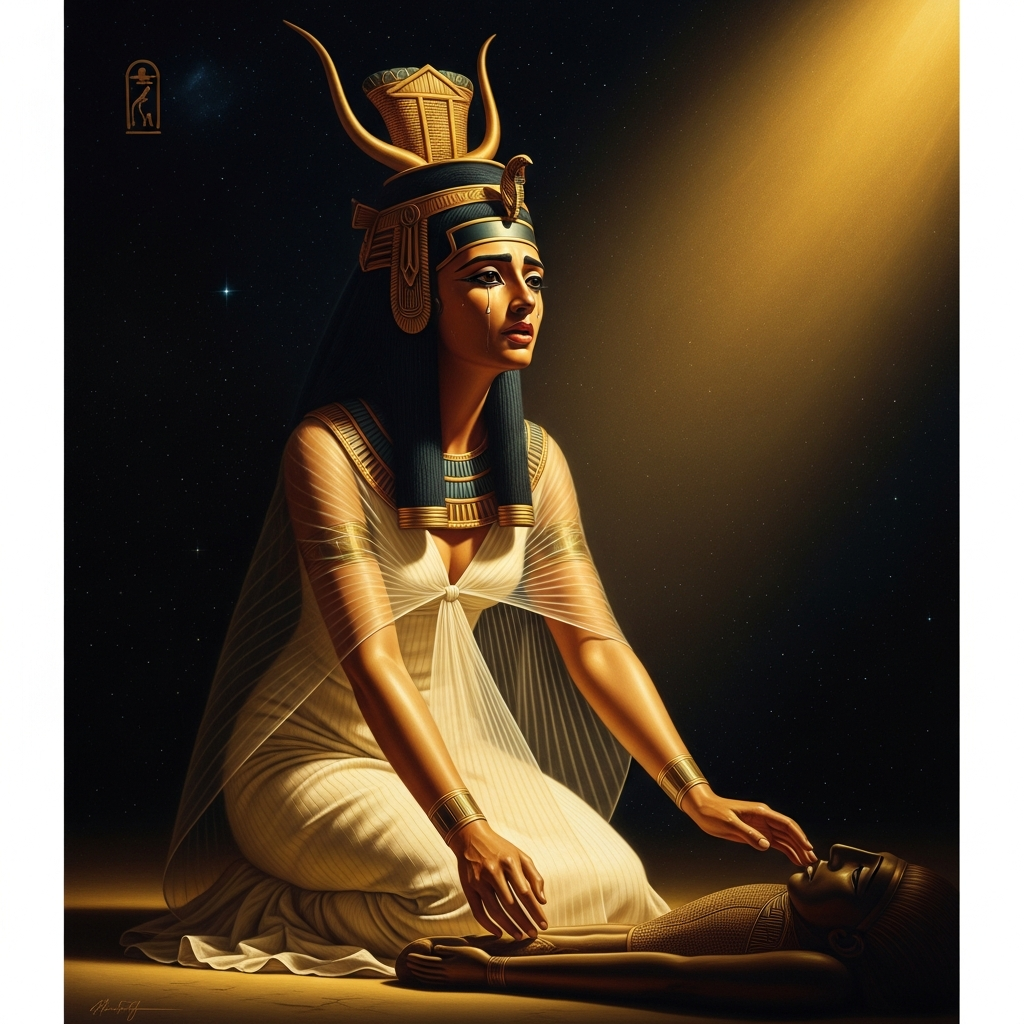
She finds a piece of Osiris alone, in a reed bed near the edge of the delta — the texts do not specify which piece, the traditions disagree, but the lament happens the way a sound happens: without decision, before language has organized the feeling into something controlled and appropriate.
It is a cry. The kite cry, the hawk’s grief sound — a high, sustained, arrowing sound that carries over water and flat land, that farmers in the delta will hear and look up from their work and not be able to name the source. A cry that is not pain exactly, not rage, not prayer. A cry that is what the body does when the mind has not yet caught up to what the hands have found.
The priests know this sound. They learn it. They are trained to make it — women at Egyptian funerals for three thousand years are trained to produce this cry, the kite-cry over the body, the shriek that means this is real, the god has been found, the mourning begins. They open their throats and make the sound Nephthys made in the reed bed, the sound of the first moment anyone understood that what had been lost could be found and would still be irretrievably gone.
Isis joins her. They work together now — moving east and west across the valley, recovering the fourteen pieces over the length of the nome-territories, marking each recovery with the cry and with prayers that Anubis has provided, that Thoth has encoded, that Isis has memorized with the totality of purpose that defines her. Nephthys does what Isis does: she wraps, she prays, she marks the spot with stones and intention.
She is mourning her lover. She is helping her sister-rival find and reassemble the man they both loved in different ways and with different consequences. She is performing the labor that her husband’s act created. She is present for all of it, in the full complexity of all of it, without the grace of any clear position from which any of it is simple.
There is no Egyptian myth that tries to resolve Nephthys’s situation by simplifying it. The texts do not say she repented, or that Isis forgave her, or that Set was punished for what he did to her specifically (as opposed to what he did to Osiris). The texts say she walked the length of Egypt and found the pieces and made the sound over them and helped with the wrapping.
This is her story: she did the work that the situation required, from inside the situation she could not have chosen.
At funerals, two women stand at opposite ends of the bier.
The woman at the head is Isis. The woman at the feet is Nephthys. They face each other across the body. They cry the kite-cry together — sometimes they alternate, sometimes in unison, the two voices braiding in the hall — and the sound they make is the sound the two sisters made across the length of Egypt, calling each other across the distance between the pieces of the god, the sound that locates and acknowledges and does not pretend the loss is smaller than it is.
Three thousand years of Egyptian funerals. Three thousand years of priestesses opening their throats in that particular cry. Three thousand years of Nephthys at the feet of the dead, doing the work of grief that the impossible position she occupies requires of her, making the sound she made the first time so that every mourner after her can borrow it, can enter her grief through the sound, can be for a moment the goddess who has no good angle on the situation and mourns fully anyway.
The Lamentations of Isis and Nephthys — a Ptolemaic papyrus, two thousand years of tradition compressed into a single text — records the duet. Both sisters speak. They address the dead Osiris in alternating verses: Isis from the head, Nephthys from the feet, the two voices weaving the same grief from opposite ends. The text is not symmetric. Isis’s lines are longer, more elaborate, more cosmologically freighted. Nephthys’s lines are shorter. More direct. She says: I have sought thee, I will not cease to search.
No explanation. No defense. No theology of her complicated position.
I have sought thee. I will not cease to search.
This is the whole myth of Nephthys compressed into eight words. She is the goddess whose grief is uncomplicated by any ambiguity about whether she deserves to grieve. She loved what she lost. She helped find what was scattered. She stands at the feet of every dead body in Egypt and makes the sound.
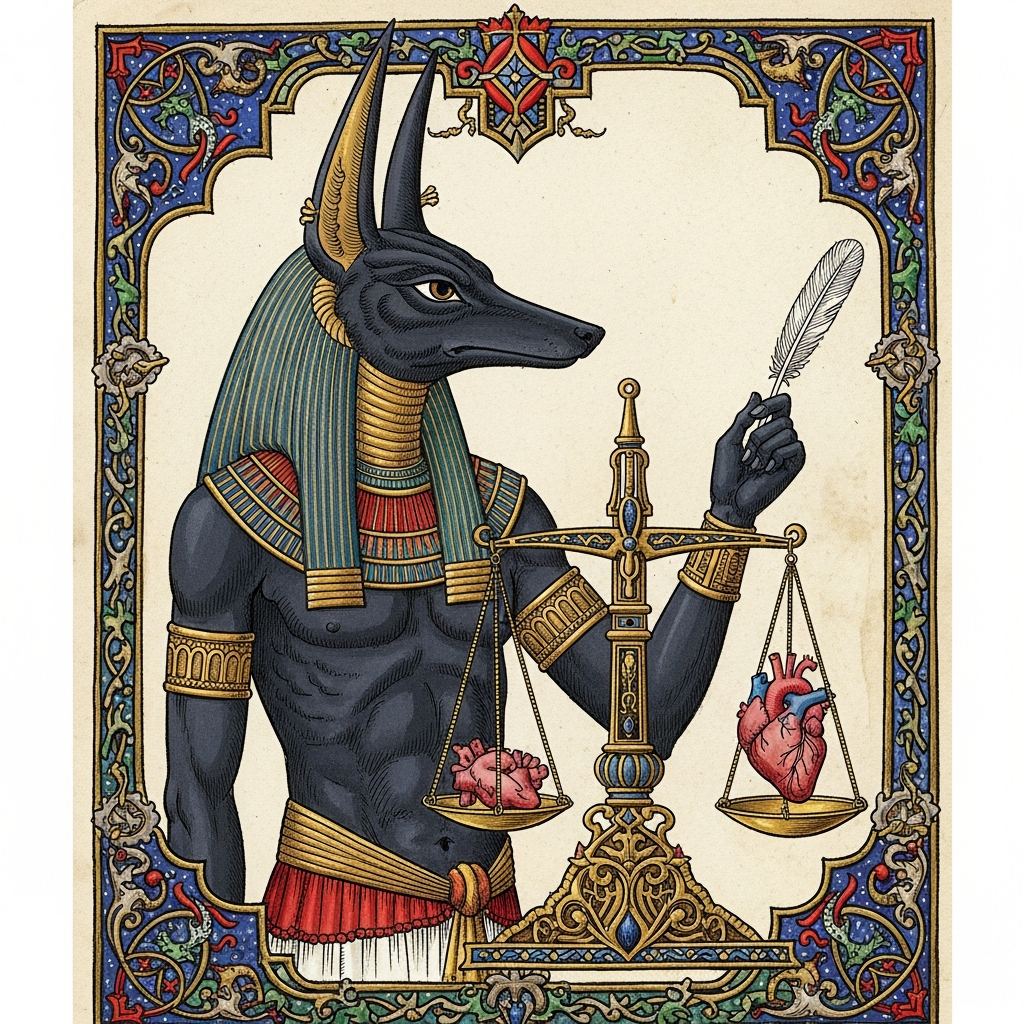
Anubis weighs the hearts of the dead in the Hall of Two Truths. He learned the embalming from the work his mother did alongside his father’s wife, in the reed beds, across the length of Egypt, in the impossible first mourning. The precision with which he works the linen — precise as a measurement, careful as a calculation — carries something that is not purely professional.
The son of the impossible situation becomes the master of the transition between life and death. He guides every soul because he himself was the product of a crossing that should not have happened, and he emerged from it anyway, and he does the work the crossing made necessary.
Nephthys does not appear in later religious traditions under her own name. But the woman at the feet of the dead, the mourner who grieves from the wrong position, who does the work of grief without the clarity of a clean role — she is recognizable in every tradition that has ever stood at a bier and not known exactly how much it was permitted to feel.
She made the sound first. Everyone since has been learning it from her.
Scenes
Nephthys and Isis walking the length of Egypt — the two sisters, hawk-winged, searching the riverbanks and the desert edges for what Set has scattered
 Generating art…
 The first lament — Nephthys at the moment she finds what she was searching for, the sound that will be repeated at every Egyptian funeral for thirty centuries
 Generating art…
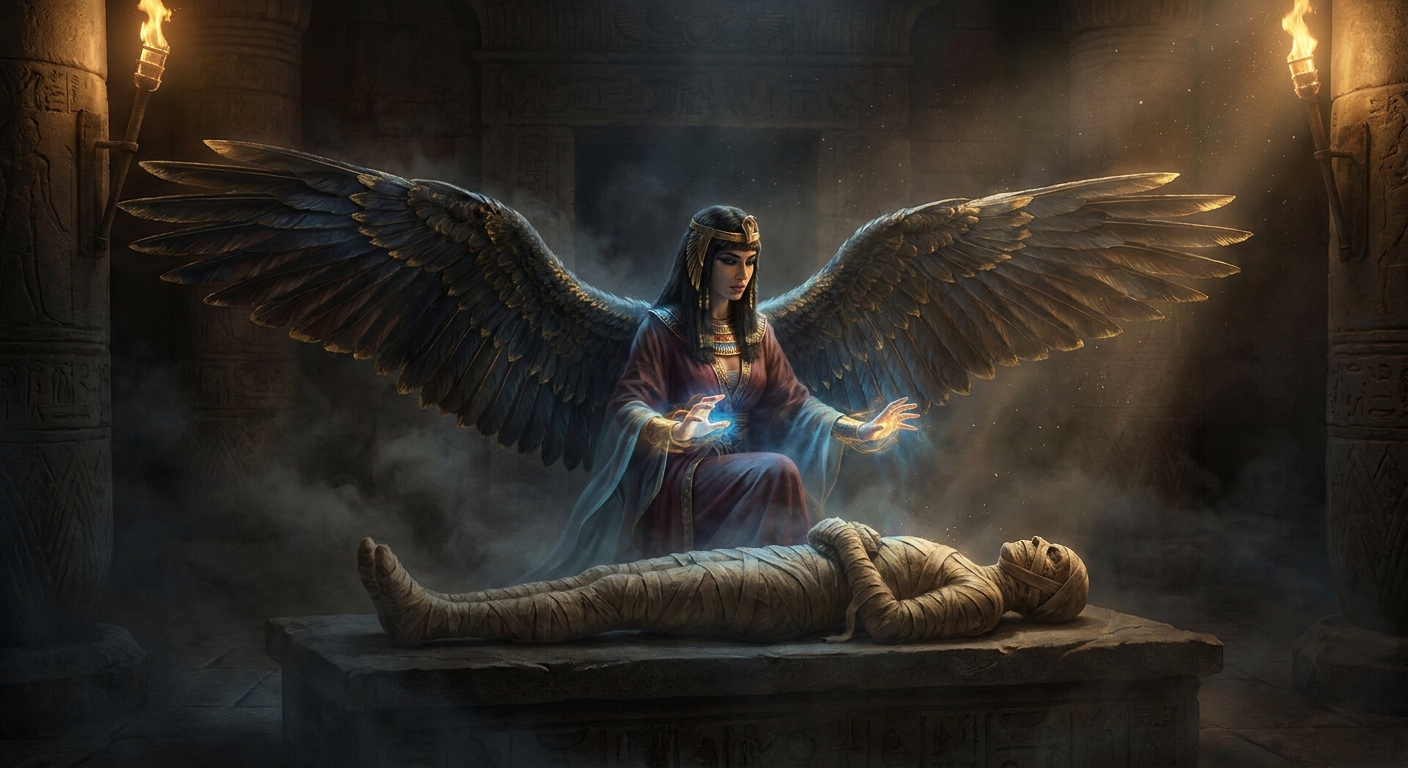
 Nephthys at the foot of the bier while Anubis — her son by Osiris, the child of the impossible situation — works the wrappings that will hold what she has found
 Generating art…
 Echoes Across Traditions
Entities


Sources
- *Pyramid Texts* — Utterances 535, 554 (~2350 BCE)
- *Lamentations of Isis and Nephthys* (Ptolemaic period, Berlin Papyrus 3008)
- Bojana Mojsov, *Osiris: Death and Afterlife of a God* (Blackwell, 2005)
- Jan Assmann, *Death and Salvation in Ancient Egypt* (Cornell, 2005)
- Geraldine Pinch, *Egyptian Mythology: A Guide to the Gods, Goddesses, and Traditions of Ancient Egypt* (Oxford, 2002)