The Chariot-Throne of God
593 BCE · Fifth year of Jehoiachin's exile · Babylonian Captivity · The Chebar River (Kabar Canal), Babylon; the banks of exile, far from the Temple
Contents
Ezekiel, a priest in Babylonian exile, sees the divine chariot-throne on the banks of the Chebar River: four living creatures with four faces and eyes covering their wings, wheels within wheels covered in eyes, a crystalline expanse, and above it all, something like the appearance of the likeness of the glory of God. This vision — hedged in four layers of approximation — launches two thousand years of Jewish mysticism.
- When
- 593 BCE · Fifth year of Jehoiachin's exile · Babylonian Captivity
- Where
- The Chebar River (Kabar Canal), Babylon; the banks of exile, far from the Temple
The fifth year of King Jehoiachin’s exile.
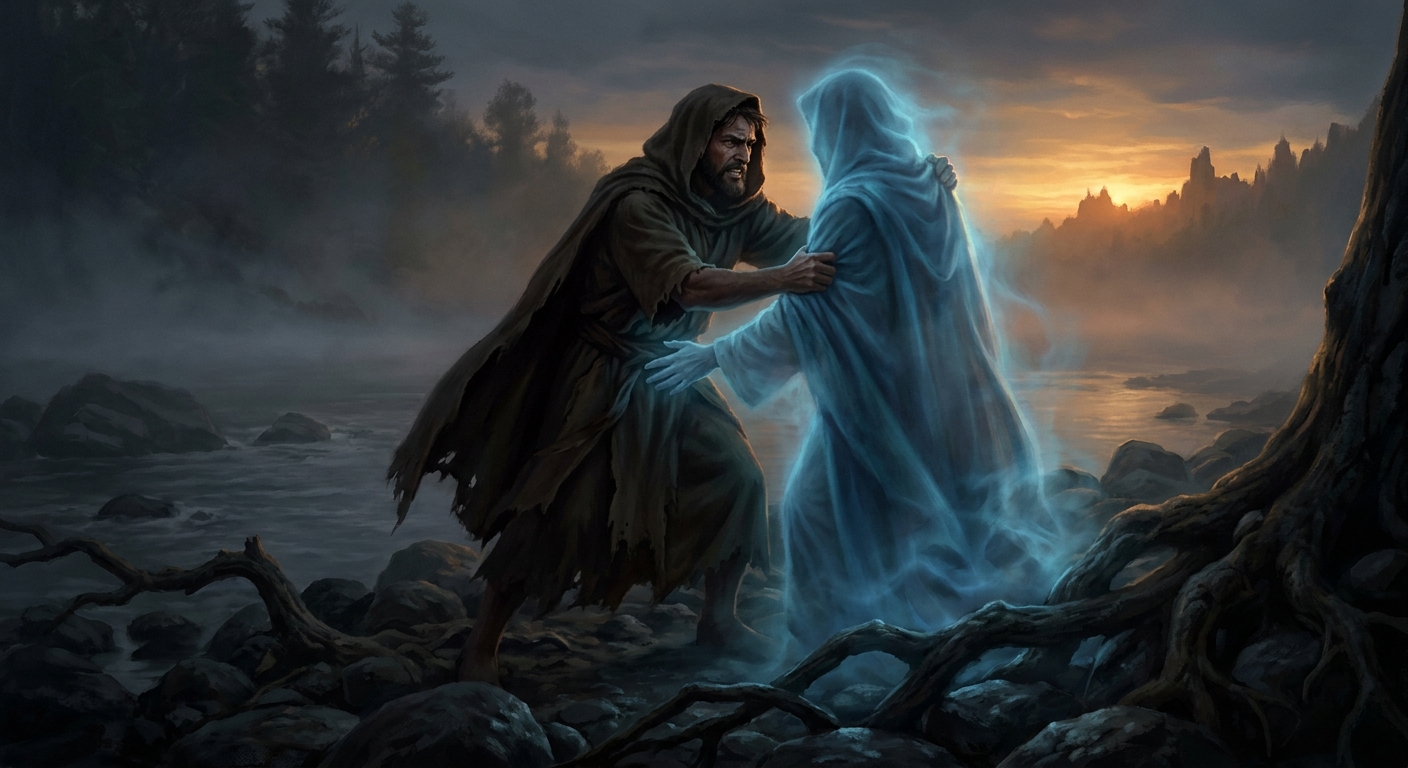
Jehoiachin has been in Babylon for five years — taken there by Nebuchadnezzar along with the first wave of deportees, the aristocracy and the skilled workers, the first dismemberment of Jerusalem before the final destruction. Ezekiel is among the deportees. He is a priest, Zadokite by lineage, trained for service in the Temple in Jerusalem, a man whose entire vocation required the presence of that building and those rituals and that city. He is living on the banks of the Chebar — the Kabar Canal, an irrigation channel of the Babylonian empire — in a settlement called Tel Abib. He is among people who are asking, in the way of the exiled: is God still accessible from here? Is the covenant still operative without the land, the city, the Temple? Has YHWH left with the Ark of the Covenant when Nebuchadnezzar took it, or did YHWH stay in the ruins of the holy place, and if so, what does that mean for us here?
Ezekiel is thirty years old. The thirtieth year was the year a priest came of age to serve in the Temple. He should be in Jerusalem, beginning his ministry. He is instead in Babylon.
Then the heavens open.
He sees a storm-cloud coming from the north.
This is significant directionally: north is where the Babylonians came from. North is where disaster enters Israel in the prophetic tradition. But this is not disaster — this is something inside and behind and above disaster, something that disaster does not know is riding it. A great cloud. Fire flashing within itself. A brightness all around it. And from the center of the fire, the gleam of amber — hashmal, a word that occurs only here and that translators have called electrum, amber, glowing metal, the one word in the Hebrew Bible that seems to have no certain meaning, which may itself be the point.
From the center of the hashmal: the living creatures.
Ezekiel spends fifty verses trying to describe them, and the description is not obscure or mystical in the manner of dream-vision. It is methodical. He is a precise man, a priest trained to exact description in ritual context, and he is applying that precision to something the precision cannot capture. So he describes each element in detail: the general appearance, then the faces, then the wings, then the legs, then the movement, then the fire. He circles back and corrects himself. He uses the phrase and I saw again and again, as if he is afraid you will not believe him, as if the repetition proves the reality of what he saw.
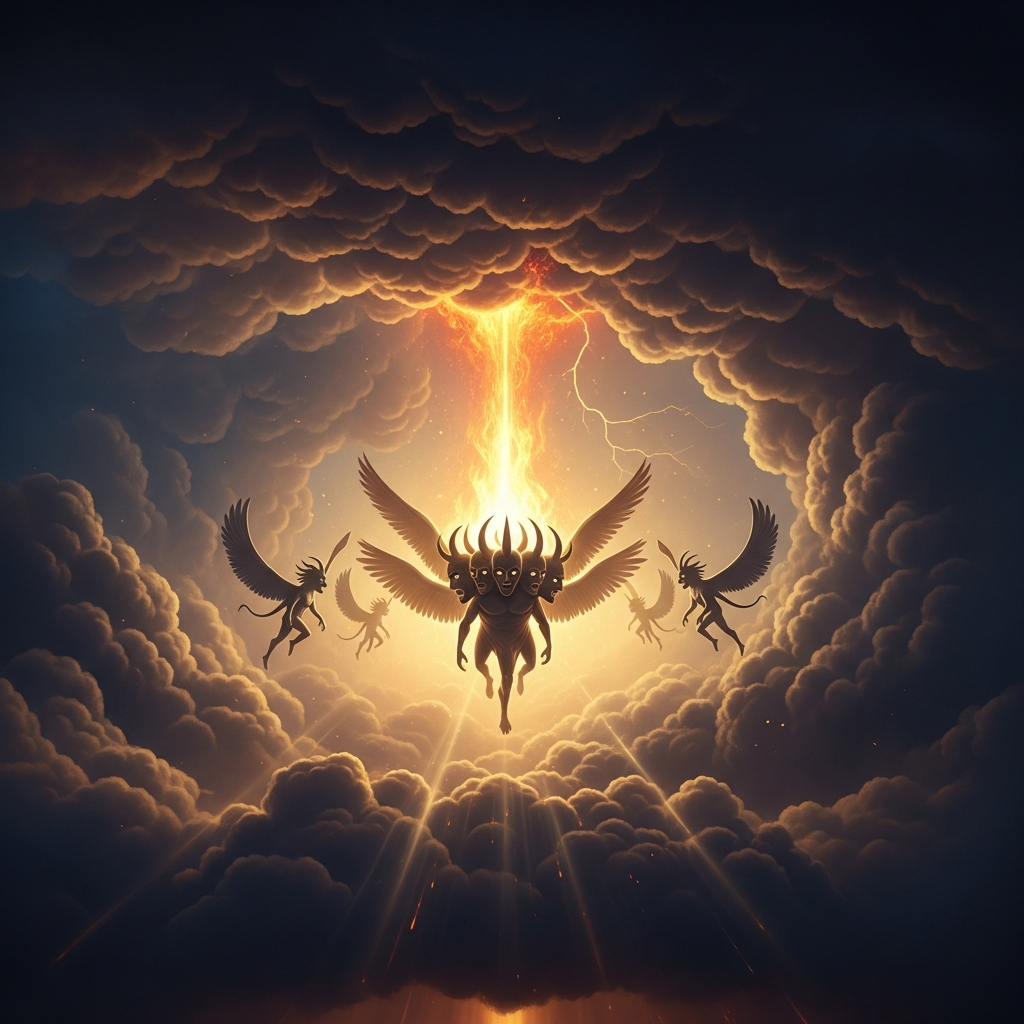
Four living creatures. Each with four faces: the face of a man, the face of a lion on the right side, the face of an ox on the left, the face of an eagle. Each with four wings: two wings spread upward to touch the wings of the creature beside it, two wings covering the body. They do not turn when they move — they go straight forward in whatever direction the spirit moves. The movement is the spirit’s movement. Their legs are straight; the soles of their feet are like the sole of a calf’s foot. Their appearance is like burning coals of fire, like the appearance of torches — fire moving among them. The fire is bright. Lightning comes out of the fire.
They run and return like the appearance of lightning.
This is the first major feature of the chariot-vision: things in it move with a speed and simultaneity that ordinary causation cannot account for. They do not turn — they go. They do not wheel — they flash. The living creatures are not laboriously turning a great vehicle; they are the vehicle, moving in all four cardinal directions simultaneously, forward in all directions at once, because the spirit that moves them is not in a direction but in a relationship.
Beside each living creature: a wheel.
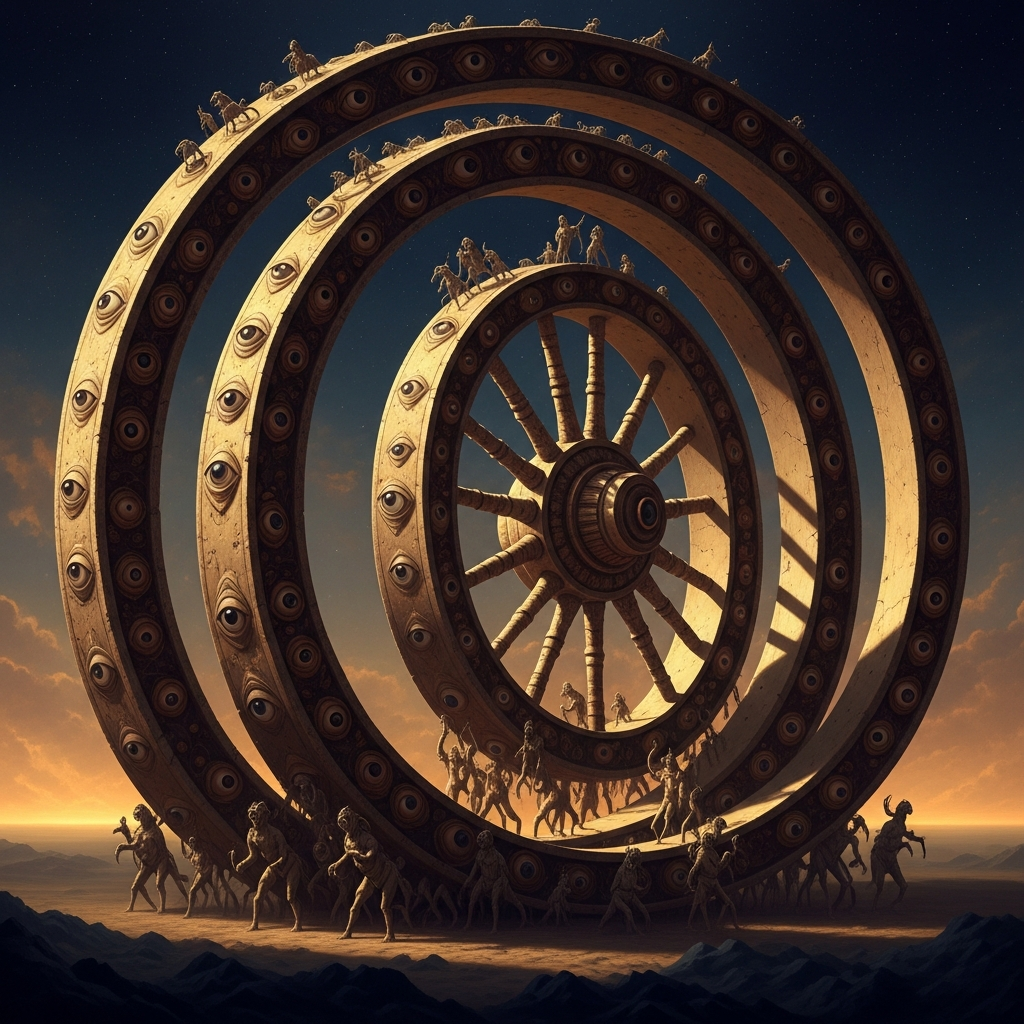
The wheels are on the earth beside the creatures. Their appearance and construction: like a wheel within a wheel — a gyroscope, a sphere intersected by a sphere, able to move in any direction without turning. The rims of the wheels are high and dreadful. And the rims are full of eyes, all around the four wheels.
Eyes in the wheels.
This detail — the eyes in the wheels, eyes in the rims, eyes everywhere — will become the central image of Merkavah mysticism. The wheels see in all directions at all times. The chariot of God is not a blind vehicle that has to be pointed somewhere. It is a vehicle that is always already looking at everything. The eyes are not decorative. They are what the wheels do, which is to see what the wheels move through.
When the living creatures move, the wheels move. When the creatures rise, the wheels rise. The spirit of the living creatures is in the wheels. This is the core of the Merkavah: God’s chariot-throne is alive with the spirit that animates the creatures, and the creatures and the wheels and the spirit are not three things but one thing in different modes of its being-present.
Over the heads of the living creatures: a crystal expanse.
Like the awesome shimmer of ice stretched out. The Hebrew: raqia, the word used in Genesis for the dome of the sky, the firmament. Here it is not the sky but something above the creatures, a crystalline expanse stretched over the top of the chariot-vision, and when the creatures move their wings to fly, the sound is like the sound of many waters, like the voice of the Almighty, like the sound of an army. The sound, Ezekiel will say later, is like the sound of the camp of El Shaddai.
Above the expanse: a throne, in appearance like sapphire.
Above the throne: something like the appearance of a human figure.
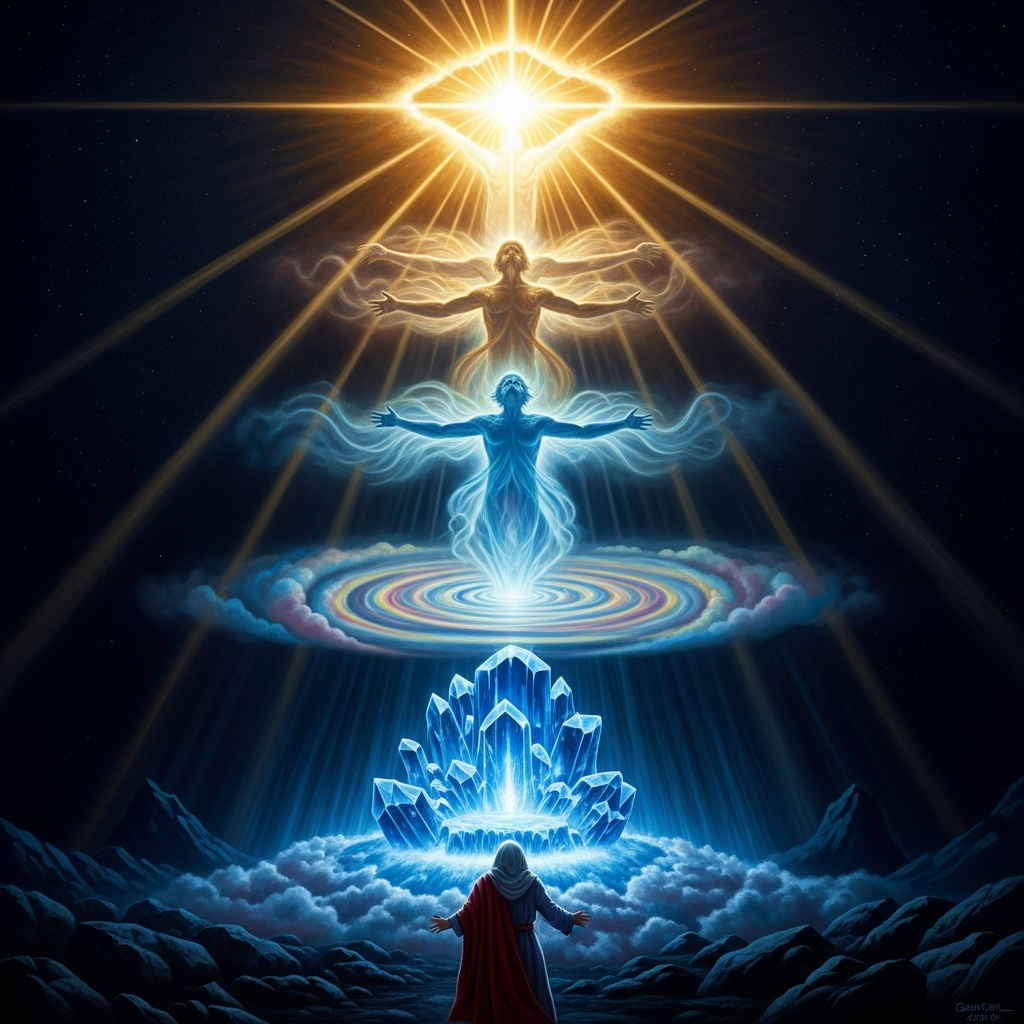
From the loins upward, something like the gleam of amber — the hashmal again, the same word he used for the inner fire of the cloud at the beginning. From the loins downward, something like fire, and a brightness all around. Like the appearance of a rainbow in a cloud on a rainy day — that brightness. Such was the appearance of the likeness of the glory of the Lord.
Four hedges of approximation: the appearance. Of the likeness. Of the glory. Of the Lord. Not God, not the glory of God, not the likeness of God, not the appearance of the likeness of God — but the appearance of the likeness of the glory of God. The most careful sentence in the Hebrew Bible. A priest’s sentence, precise about what his language cannot be precise about.
When Ezekiel sees it, he falls on his face.
A voice speaks. Son of man, stand on your feet and I will speak with you.
The spirit enters him and sets him on his feet. He hears the voice speaking.
The call that follows this vision is not what we expect from theophanies. Moses at the burning bush received a commission that went forward in time: go to Egypt, liberate the people, begin the great work. Elijah at Horeb received three tasks and was sent back. Isaiah in the Temple cried Here I am, send me and was sent to preach to a people who would not listen.
Ezekiel receives a different commission. He is sent to the house of Israel — but the house of Israel is described as a nation of rebels, a rebellious house, and he is told from the beginning that they may not listen, that they will set themselves against him like briers and thorns and scorpions, that his success will be measured not by whether they hear but by whether he speaks. He is to eat the scroll God gives him, and it is sweet as honey in his mouth, and it tastes of lamentation and mourning and woe.
He is sent to exile. To speak to the exiles. To be the voice of God on the Chebar Canal, on the banks of the wrong river.
But the vision of the chariot is the answer to the question the exiles are asking.
YHWH’s Temple is in Jerusalem. YHWH’s land is Canaan. YHWH’s people are supposed to be at home, serving in the prescribed way, in the prescribed place. The exile breaks all of this simultaneously. If YHWH is territorial — if the divine presence is tied to the land and the Temple — then YHWH has either been defeated by Marduk and Babylon, or abandoned his people, or both. Either answer destroys the covenant.
The chariot-vision says: neither.
The chariot moves. The chariot has always been capable of movement — the wheels are designed for movement in all directions, the living creatures do not turn but go, the spirit is in them and not in a fixed place. The God of Israel is not a deity who sits in a Temple and waits to be visited. The God of Israel is the deity whose throne is mobile, whose presence fills the four directions simultaneously, whose chariot can appear on the banks of a canal in Babylon just as readily as on the heights of Zion.
The implication is almost too large to absorb. The exile has not separated the people from their God. The God is already in Babylon. The God was there before Nebuchadnezzar. The God is the reason the exile is happening — not as abandonment but as presence, a presence so committed to the people that it follows them into the alien empire.
Gershom Scholem — the scholar who mapped Jewish mysticism in the twentieth century — identified the vision in Ezekiel 1 as the founding moment of the Merkavah tradition: the chariot-mysticism that would produce the Hekhalot texts, the palace-ascents of Rabbi Ishmael and Rabbi Akiva, and ultimately the Kabbalistic system of the Zohar.
The Merkavah mystics were trying to ascend to the throne Ezekiel had seen. They developed elaborate practices of preparation — fasting, ritual purity, meditation on the chariot-text — and claimed that trained practitioners could make the journey Ezekiel made not voluntarily but by divine transport: up through seven palaces, past angelic gatekeepers, to the throne-room where the Shi’ur Qomah — the cosmic dimensions of the divine figure — could be contemplated.
The rabbis were alarmed. The Mishnah forbids public teaching of the chariot-vision. The Talmud says it may be taught to a single student, but only a student who is already wise and can understand from his own reasoning. The account of the chariot (maaseh merkabah) is dangerous knowledge — not because it is false, but because direct encounter with the divine figure on the throne is not something the average student’s soul can sustain.
Ezekiel’s four layers of approximation — the appearance of the likeness of the glory of God — were the rabbis’ protection. As long as you remember that what Ezekiel saw was not God but an appearance of a likeness of a glory, you remain outside the zone of pure encounter. The mystics kept pushing toward the zone. The rabbis kept building walls.
This tension — between the aspiration to direct vision and the tradition’s protective hedges around it — runs through all of Jewish mysticism and surfaces in every tradition that has grappled with Ezekiel’s vision. The Christian tradition takes the four faces and makes them the evangelists. The Islamic tradition takes the throne-bearers and makes them the hamalat al-arsh. The Kabbalists take the divine figure on the throne and elaborate it into the Sephirot, the ten aspects of the divine light that together constitute the face of God without reducing God to any one of them.
All of them are trying to do what Ezekiel did: describe something that cannot be described, using language that knows its own inadequacy, approaching the throne by exactly the distance that language can carry you and then falling on their faces at the edge of the expanse.
Such was the appearance of the likeness of the glory of the Lord.
Four hedges. The vision that launched two thousand years of Jewish mysticism gives its central object — the divine presence — four layers of linguistic distance. The greater the vision, the more careful the language. Ezekiel is not modest because he saw little. He is precise because he saw much, and he knows the difference between the thing he saw and the words available to report it.
The chariot comes from the north in a storm because north is where Babylon is. The God of Israel appears in the symbol of the Babylonian storm in order to say: I am not defeated by this storm. I am inside it.
The eyes in the wheels see everything simultaneously. Not sequentially — not one direction, then another — but all at once, because the divine gaze does not turn to look at things. The divine gaze is already there when the thing exists.
Ezekiel falls on his face at the sight, and the spirit lifts him up and sends him back to the rebels. The vision does not excuse him from the hard work of speaking to people who will not listen. The vision is not a reward. The vision is a commissioning — and the commission is to carry the knowledge of this mobile, present, exile-following God to the people who have concluded that God has abandoned them.
They have been looking in the wrong direction. God did not stay in Jerusalem. God took the chariot and followed them to Babylon. The wheels turn in every direction. The spirit is in the wheels.
Scenes
A great storm-cloud from the north, fire flashing within itself, surrounded by radiance — and from the center of the fire, the outline of four living creatures, each with four faces and four wings, moving in the strange simultaneity the prophet spends fifty verses trying to describe
 Generating art…
 The Ophanim — the wheels of the divine chariot — each wheel inside another wheel, their rims high and dreadful and full of eyes all around
 Generating art…
 Above the crystal expanse, above the sapphire throne, something in the appearance of the likeness of the glory of YHWH — four layers of approximation stacked between the prophet's language and the thing his language cannot name
 Generating art…
 Echoes Across Traditions
Entities
- Ezekiel
- YHWH
- the four living creatures (Chayot)
- the Ophanim (wheels)
- the Merkabah
Sources
- Ezekiel 1, 3, 10 (Robert Alter, trans., *The Hebrew Bible: The Prophets*, 2019)
- Moshe Idel, *Kabbalah: New Perspectives* (Yale, 1988)
- Gershom Scholem, *Major Trends in Jewish Mysticism* (Schocken, 1941) — chapters on Merkavah mysticism
- David Halperin, *The Faces of the Chariot: Early Jewish Responses to Ezekiel's Vision* (Mohr Siebeck, 1988)
- Walther Zimmerli, *Ezekiel 1: A Commentary* (Hermeneia, 1979)