The Lid of Pakal's Sarcophagus
August 28, 683 CE, Palenque · Palenque (Lakamha), Chiapas, Mexico
Contents
On the night of August 28, 683 CE, K'inich Janaab' Pakal I of Palenque dies after sixty-eight years on the throne — and is buried under five tons of carved limestone that shows him not dying but becoming the Maize God, falling into the earth to rise again. The burial was prepared decades before it was needed. The crypt was built around the sarcophagus because the lid could not be lowered in afterward.
- When
- August 28, 683 CE, Palenque
- Where
- Palenque (Lakamha), Chiapas, Mexico
He has been preparing this room since he was a young man.
This is the first thing you must understand about the death of K’inich Janaab’ Pakal I: it was not an event that happened to him. It was a project he managed for most of his sixty-eight-year reign over Palenque. The crypt beneath the Temple of the Inscriptions — nine tiers of corbeled stone rising above the Chiapas jungle floor, its inner stairway sealed with rubble to preserve the secret for more than twelve centuries — was built around the sarcophagus because the sarcophagus could not have been lowered in afterward. The lid is five tons of carved limestone. The stairway that descends to the crypt is too narrow for it. Therefore the lid was carved, placed in position, and then the temple was built above it.
Pakal designed his own resurrection theater and supervised its construction while still alive to give notes.
He is eighty years old and has reigned since he was twelve. His mother, Lady Sak Kuk, placed the jade crown on his head in 615 CE, a child-king inheriting a city that had been sacked and humiliated by Calakmul two years before. He has spent sixty-eight years rebuilding Palenque — the temples, the aqueducts, the palace complex with its astronomical tower, the hieroglyphic texts that record his dynasty going back to the creation of the current world-age. He has outlived three sons. He has outlived the scribes who cut the first hieroglyphs of the Temple of the Inscriptions, the engineers who quarried the limestone, the workers who carried the stone up nine tiers of stairs on their backs.
He has not outlived the sarcophagus. The sarcophagus is waiting for him below.
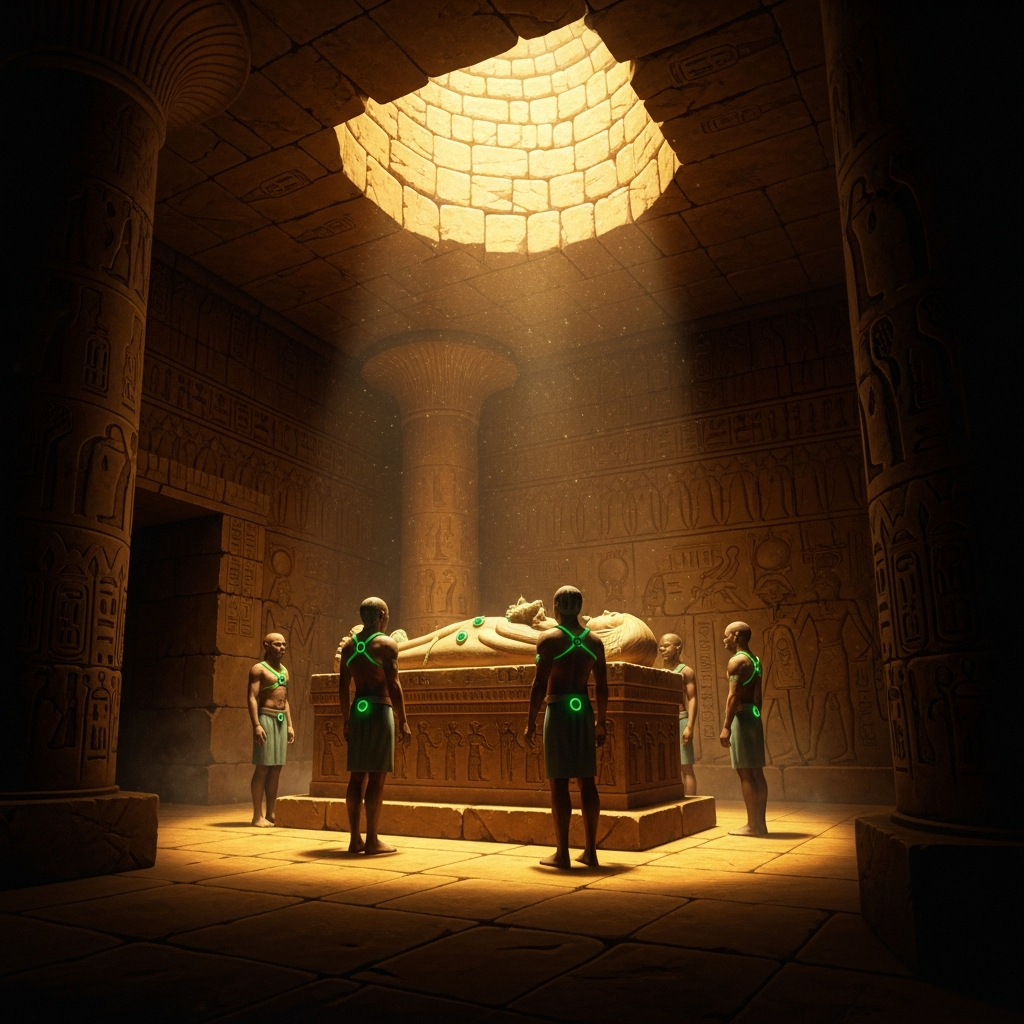
On August 28, 683 CE — the Long Count date is 9.12.11.5.18 — K’inich Janaab’ Pakal I dies in the palace at Palenque. The cause is not recorded. He is prepared for burial by priests and attendants who have also been preparing for this for years, who know what goes into the tomb with him and in what position and under which spells. His face receives a jade mosaic mask — two hundred pieces of jade cut and fitted to the shape of his face, with obsidian eyes and shell whites. His body is placed in the sarcophagus and the lid is lowered. Six people are sacrificed to accompany him: their bones will be found on the sarcophagus lid and in the stairway above, distributed at regular intervals up the nine-tier climb to the light.
The stairway is filled with rubble. The entrance is sealed. Alberto Ruz Lhuillier will open it in 1952, and when he does, after four years of clearing debris, he will find the crypt exactly as it was left and the jade mask of Pakal staring at the ceiling of a room that has been dark for 1,269 years.
The lid is what matters now. Not the body below it — the body is the agricultural input, the corn going into the ground — but the lid, which is the theological statement, the argument the Maya are making about what death is.
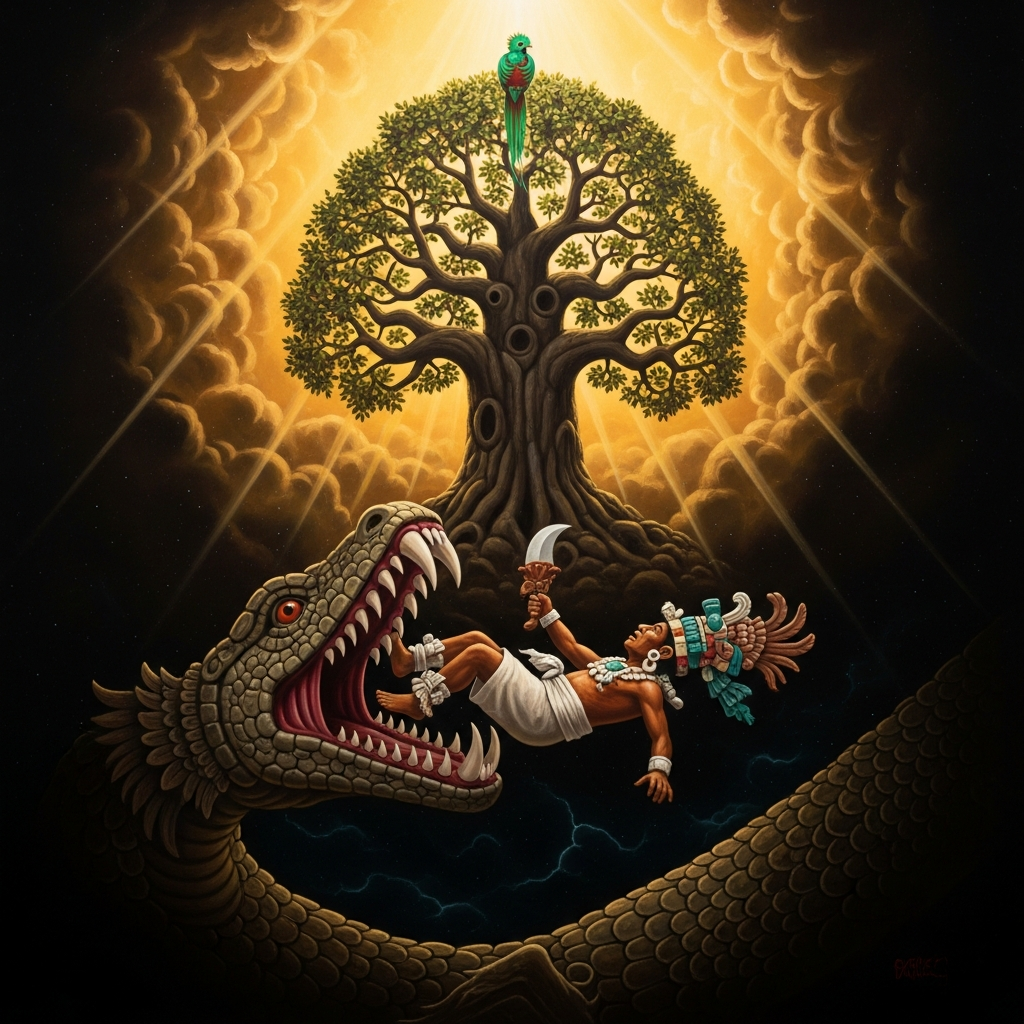
The central figure is Pakal, shown at the moment of death. He reclines on a diagonal — his body falling backward, not lying down in the horizontal posture of a corpse but tilted, mid-fall, in the specific posture the Maya use for descent into the underworld. His head tips back. His knees bend. His arms are loose. He is not posed and composed in the manner of a monarch. He is falling.
Below him, the earth opens its mouth. It is depicted as a creature — the skeletal earth-serpent, the monster that swallows the sun at dusk and disgorges it at dawn, the same creature the Maya farmers feel under their feet when they plant the first seed of the season. Its maw is open and Pakal is falling into it and the expression on his face, as best as can be read in the carved stone, is not terror.
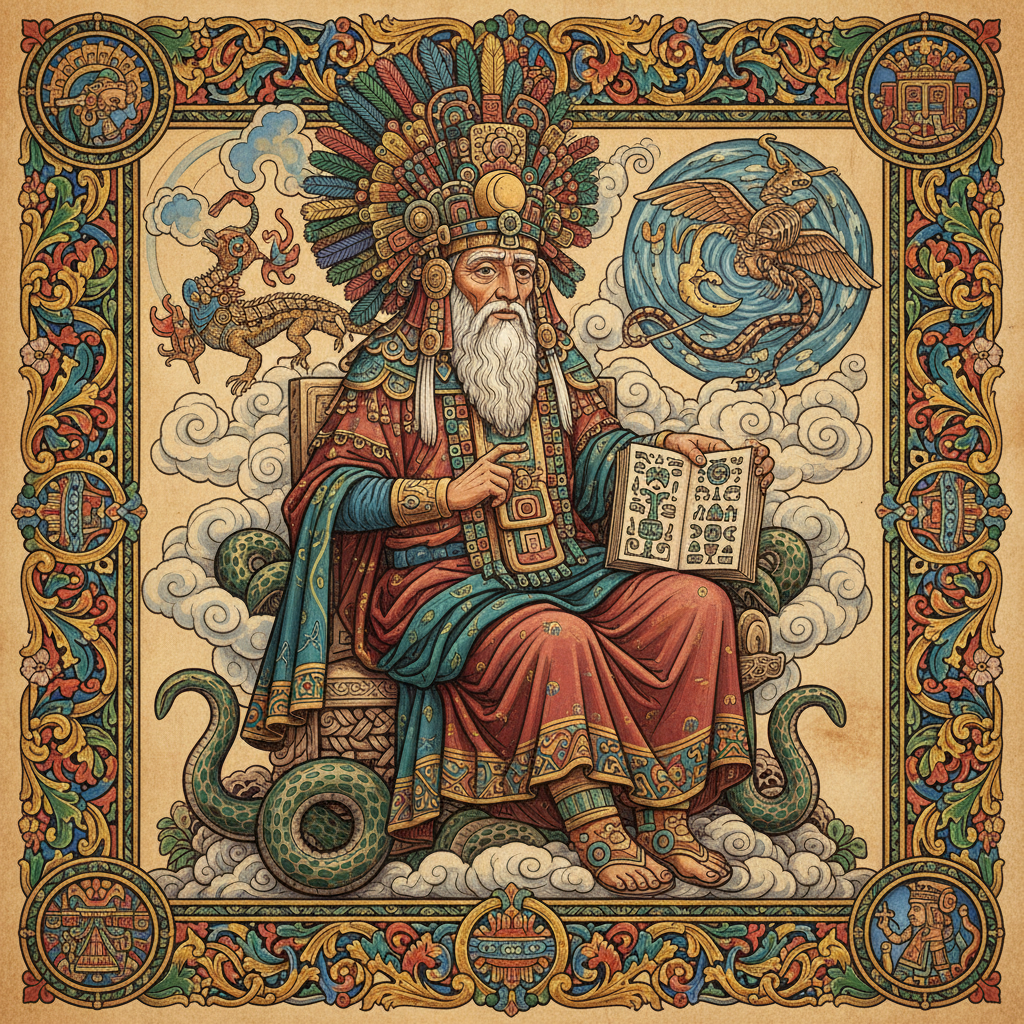
Behind him — growing up from the earth-mouth, rising through his body and beyond it — the world tree grows. Its roots reach into the underworld below. Its trunk passes through the middle world. Its branches support the sky. At the very top, a celestial bird sits in the branches — the quetzal, or in some readings the Principal Bird Deity, the divine raptor who perches at the axis of the cosmos. The tree is not incidental. The tree is the theological point. Pakal is falling into the earth, yes, but the tree is growing up through him, and the tree connects all three levels of the Maya cosmos, and what is falling is also what is rooting, and what is rooting is also what will rise.
He is becoming the Maize God.
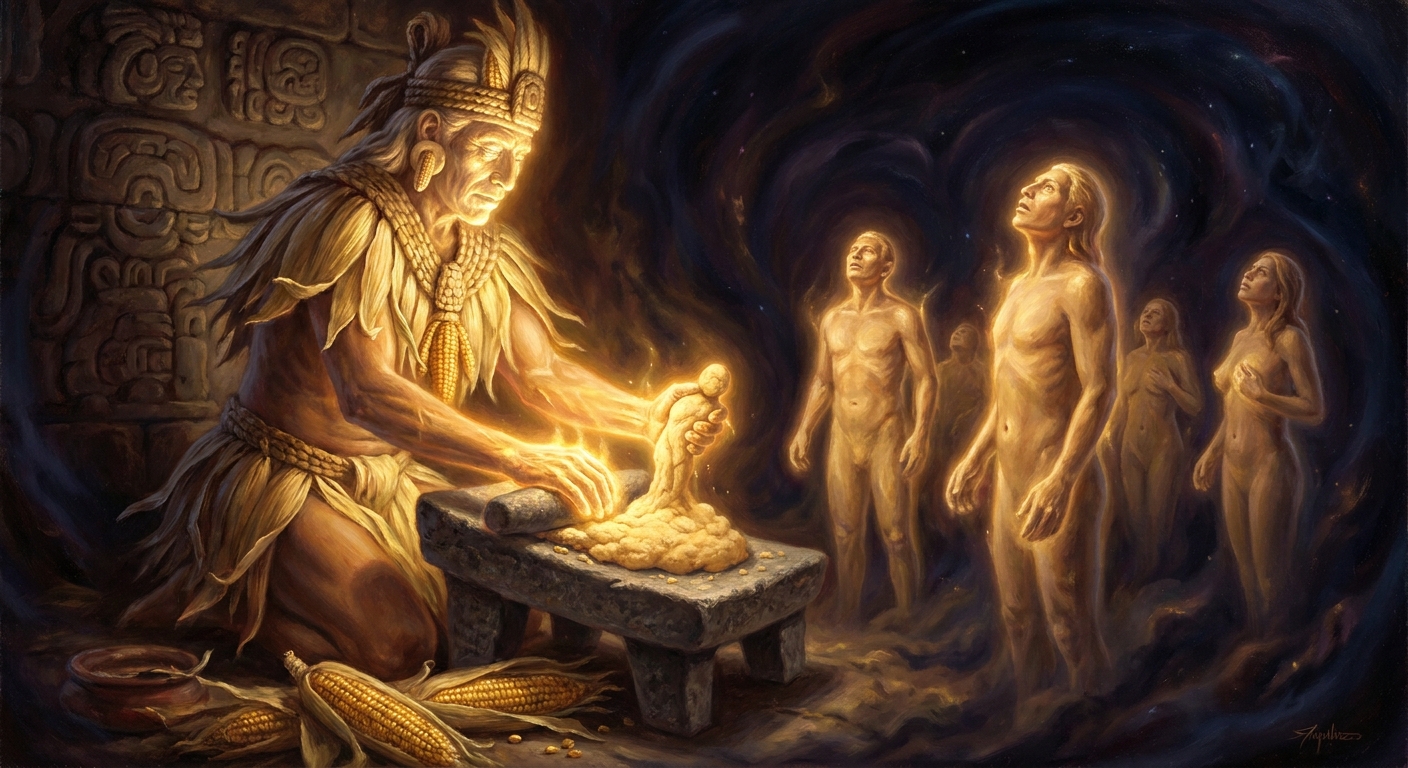
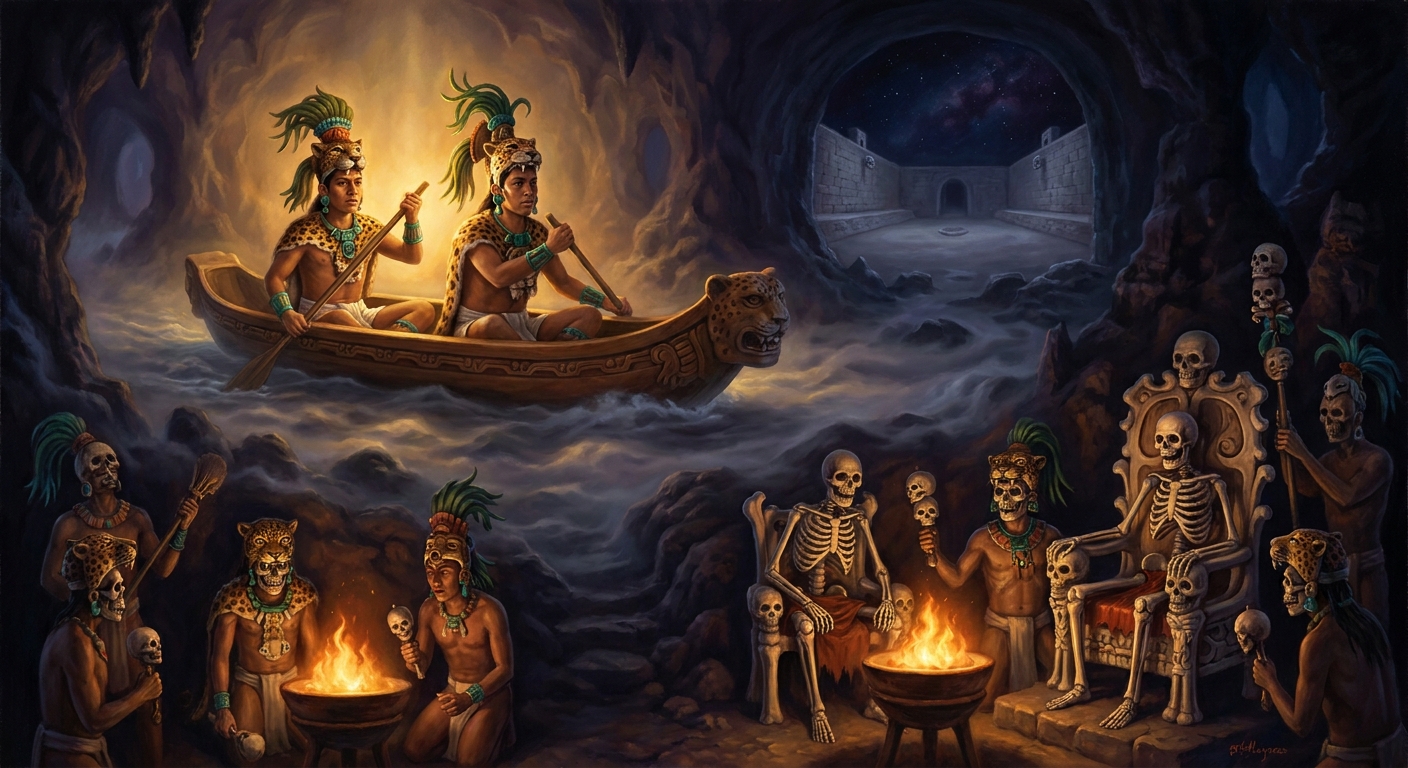
The Classic-period Maya made no categorical distinction between the king’s death and the Maize God’s descent into Xibalba. They were the same event, told at two scales. At the cosmic scale: One Hunahpu is killed by the Lords of Death and descends into the turtle shell and rises as a young corn plant, flanked by his sons. At the human scale: Pakal dies, is buried in the earth, and will rise — not literally, not as a walking body, but as the corn rises, as the world tree rises, as the sun rises from the earth-mouth every morning after the night’s descent.
The jade mask is green. Green is the color of the Maize God, of growing corn, of the world tree’s new growth. To bury Pakal’s face in jade is to bury the Maize God’s face. The two are not being compared. They are being identified.
This is the theology: the king does not die like ordinary people and wait for a judgment that may or may not go his way. The king dies like the corn — on a schedule, in a specific theological posture, in a prepared receptacle, under a carved image that tells everyone who follows him what is happening and what will happen next. The corn does not wait for judgment. The corn comes up. The king does not wait for mercy. The king transforms.
The six sacrificed attendants on their way up the stairway are harder to read with the same equanimity. They are young — their bones suggest teens and young adults — and they did not design their own deaths or commission their own jade masks. They are the agricultural context taken to its terrible logical extension: if the corn god must be accompanied by other seeds, the king must be accompanied by other dead.
The Maya theology does not resolve this tension. It holds it. The same system of thought that produces the world tree on the sarcophagus lid also produces the six bodies on the stairs. The beauty and the cost exist in the same carved stone.
Pakal’s son Chan Bahlum, who succeeds him, completes the Temple of the Inscriptions according to his father’s design and adds the Cross Group temples whose texts are the longest interpretation of the Palenque king-list the ancient Maya left us. He records his father’s death in hieroglyphs that will take twentieth-century scholars decades to decode, and what the glyphs say when decoded is not what any archaeologist expected: not a eulogy, not a biography, but a theological argument about the nature of time itself, about how the current world-age began and how kings fit into its structure and how death is not the interruption of royal power but its ultimate expression.
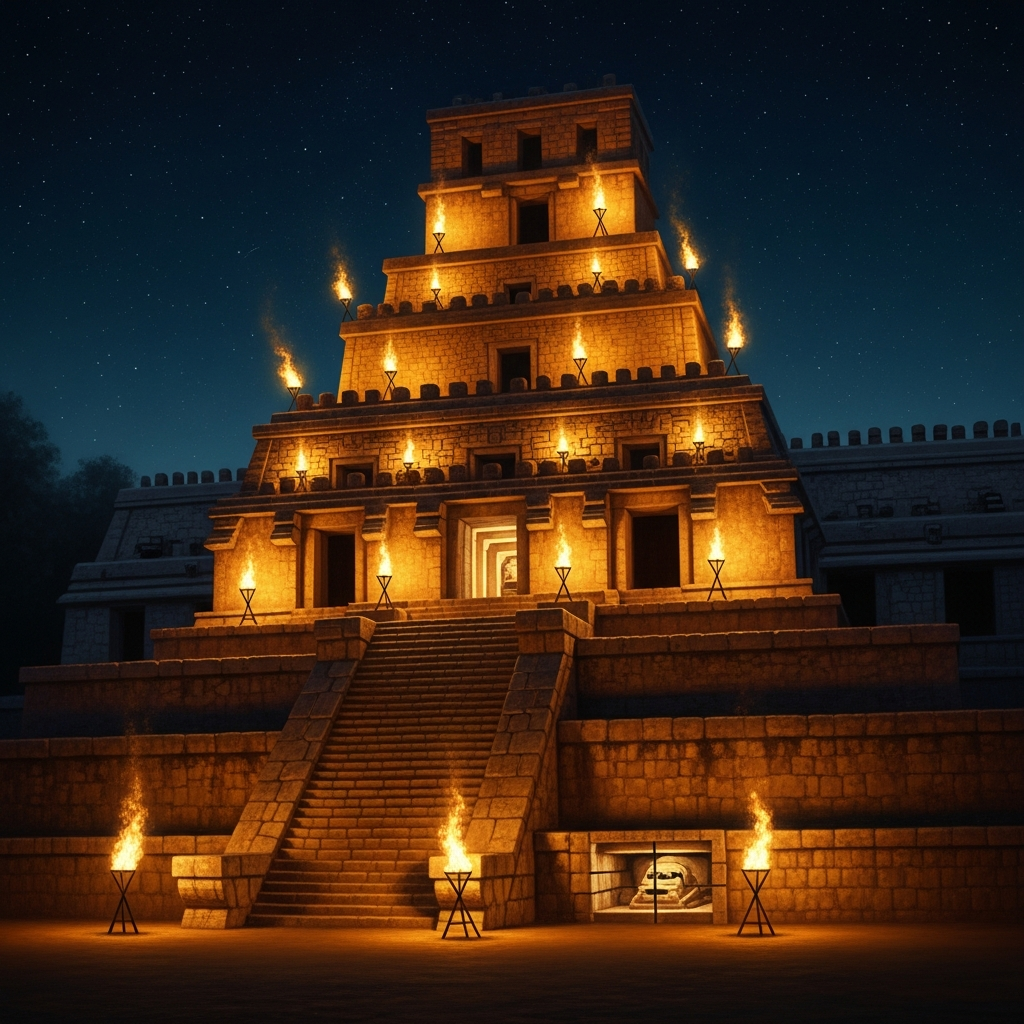
The pyramid rises nine tiers because the Maya underworld has nine levels. The stairway descends to meet the dead. The dead ascend in the corn.
Alberto Ruz Lhuillier had been excavating the Temple of the Inscriptions for three seasons before he noticed that the floor slab in the innermost chamber had finger-holes carved into it. He lifted it in 1952 and found the rubble-filled stairway below. It took four more years to clear. When he entered the crypt on June 15, 1952, he was the first human being to see it since 683 CE, and what he saw was the jade mask looking up at the ceiling of a room that had been waiting — waiting, specifically — for 1,269 years.
The quetzal still sits at the top of the world tree. The earth-serpent’s mouth is still open. Pakal is still falling. The corn is still rising.
Scenes
The Temple of the Inscriptions at Palenque on the night of Pakal's death — nine tiers of stone lit by fire, the stairs descending inside to the sealed crypt
 Generating art…
 The limestone sarcophagus lid: Pakal falling backward into the earth-serpent's maw, the world tree rising behind him, a quetzal at its crown
 Generating art…
 The crypt beneath the Temple of the Inscriptions, where the sarcophagus sits surrounded by six sacrificed attendants and jade offerings, sealed for 1,268 years
 Generating art…
 Echoes Across Traditions
Entities
- K'inich Janaab' Pakal I
- One Hunahpu
- Lady Sak Kuk
Sources
- Alberto Ruz Lhuillier, *El Templo de las Inscripciones de Palenque* (1973)
- Linda Schele and David Freidel, *A Forest of Kings: The Untold Story of the Ancient Maya* (1990)
- Simon Martin and Nikolai Grube, *Chronicle of the Maya Kings and Queens* (2nd ed., 2008)
- David Freidel, Linda Schele, and Joy Parker, *Maya Cosmos: Three Thousand Years on the Shaman's Path* (1993)
- Michael D. Coe and Stephen Houston, *The Maya* (9th ed., 2015)