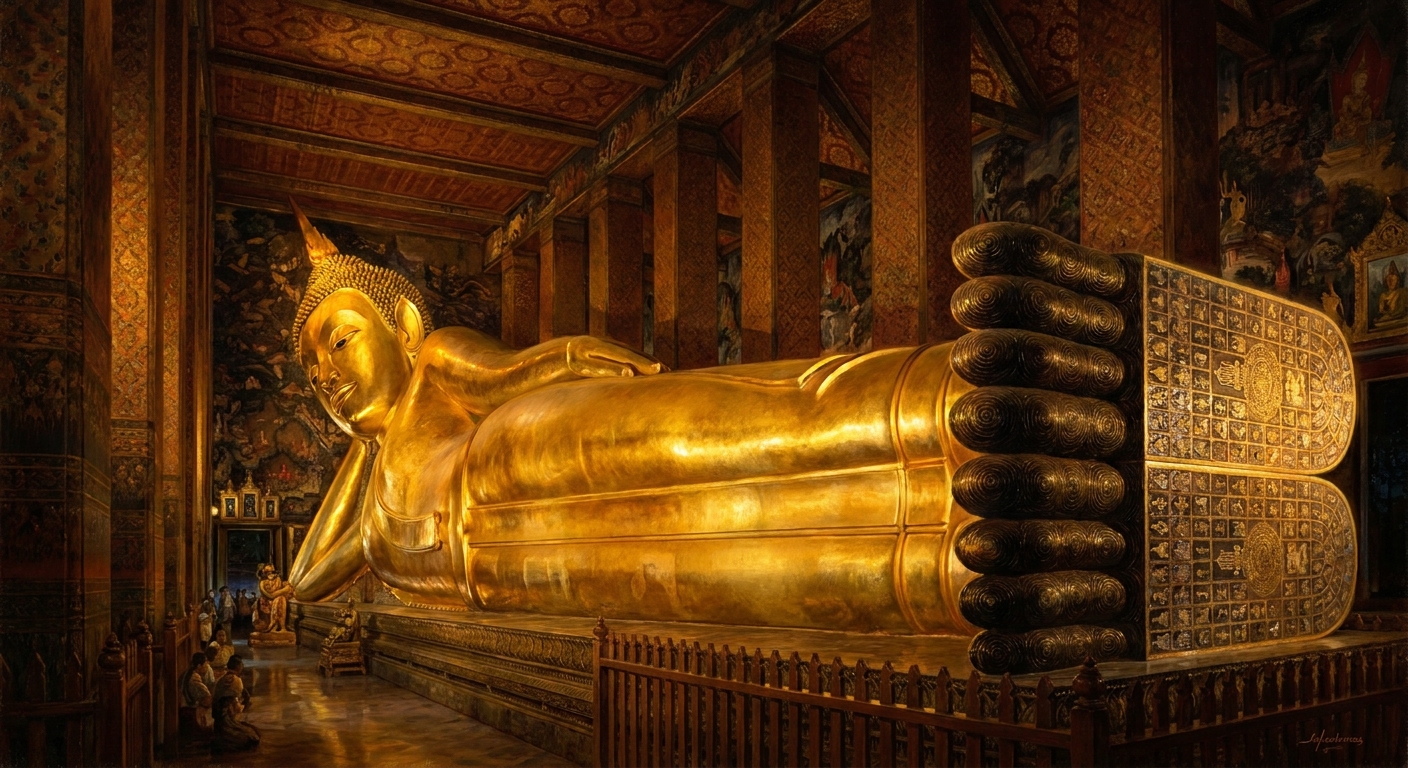
The Reclining Buddha of Wat Pho
1832 CE · Rattanakosin Kingdom (Siam) · Wat Phra Chetuphon (Wat Pho), Bangkok — adjacent to the Grand Palace, on the eastern bank of the Chao Phraya River
Contents
1832, Bangkok. King Rama III commissions a forty-six-meter image of the Buddha entering parinirvana — gilded brick, mother-of-pearl soles inlaid with the 108 auspicious signs, an eyelid the size of a man. The largest reclining Buddha in Thailand, lying down to die without dying.
- When
- 1832 CE · Rattanakosin Kingdom (Siam)
- Where
- Wat Phra Chetuphon (Wat Pho), Bangkok — adjacent to the Grand Palace, on the eastern bank of the Chao Phraya River
The king has a problem of scale.
Rama III — Phra Nangklao, third monarch of the Chakri dynasty, ruler of Siam — has decided that Wat Pho, the temple complex adjacent to his Grand Palace, requires a Reclining Buddha. The image already exists in smaller form across the Theravada world; the Mahaparinibbana Sutta describes the Buddha’s death between two sal trees, lying on his right side, head supported on his hand. The posture is fixed by canon. The size is the king’s choice.
The king chooses forty-six meters.
This is larger than the existing hall. This is larger than any reclining Buddha in Siam, larger than the great image at Polonnaruwa in Sri Lanka, large enough that the monks who have advised on the project pause and check, gently, whether His Majesty is certain. He is certain. The architects are summoned. The brick is ordered. The hall, it is determined, will be built around the Buddha rather than the Buddha into the hall.
Construction begins in 1832.
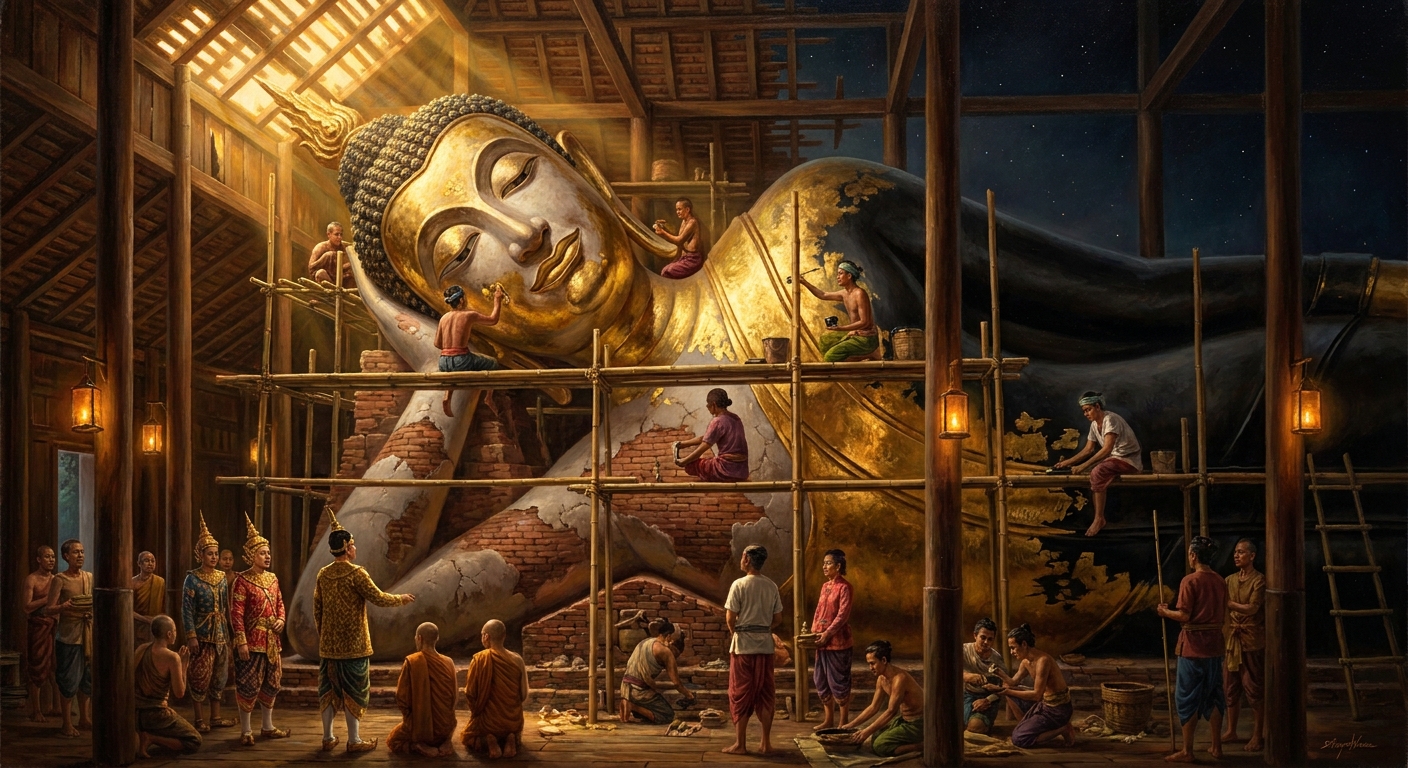
The figure goes up in plaster and brick.
The structural method is medieval — a brick armature over a timber core, parged in lime plaster, sculpted while wet. Crews work the body in segments, scaffolds lashed to the partial walls of the hall as it rises around them. The legs are laid first, the long horizontal mass of them resting on the temple floor. The torso rises, then the great supporting arm, then the head — fifteen meters tall on its own, the eye three feet across, the urna between the brows the size of a man’s fist.
The face is the hardest piece.
The Mahapurisa Lakkhana — the canonical thirty-two great-marks of a Buddha-body — specify the proportions: the neck three-lined, the lips smooth, the lashes ox-like. The artisans have studied the Sukhothai images, four centuries old, the high-classical Siamese style: serene, half-smiling, eyes lowered. They reproduce it at scale. The face emerges from the plaster looking down its own length toward the soles of its own feet, calm in a way that suggests the figure already knows what is coming and has decided it is acceptable.
The gilding takes months.
Black lacquer first.
The lacquer is laid over the cured plaster in coats so thin they have to be applied wet-on-wet, eight or ten layers, polished between with rice husk and water. The black surface goes on shining. Then the gold leaf — sheets so thin they tear under a breath — pressed onto the tacky lacquer with squirrel-tail brushes, sheet by sheet, the body becoming gold one hand-sized rectangle at a time.
Forty-six meters is a great deal of body.
The crew works for weeks. The interior of the hall fills with the smell of lacquer and the faint metallic taste gold leaf leaves on the back of the throat when the artisans inhale near it. The Buddha emerges in stages — gold below the gilders’ working level, dark above it where they have not yet reached. By the end the figure is uniform: a mountain of gold lying on its side, the right hand cradling the head, the left arm laid along the body, the feet pressed together at the southern end of the hall.
The soles are reserved for last.
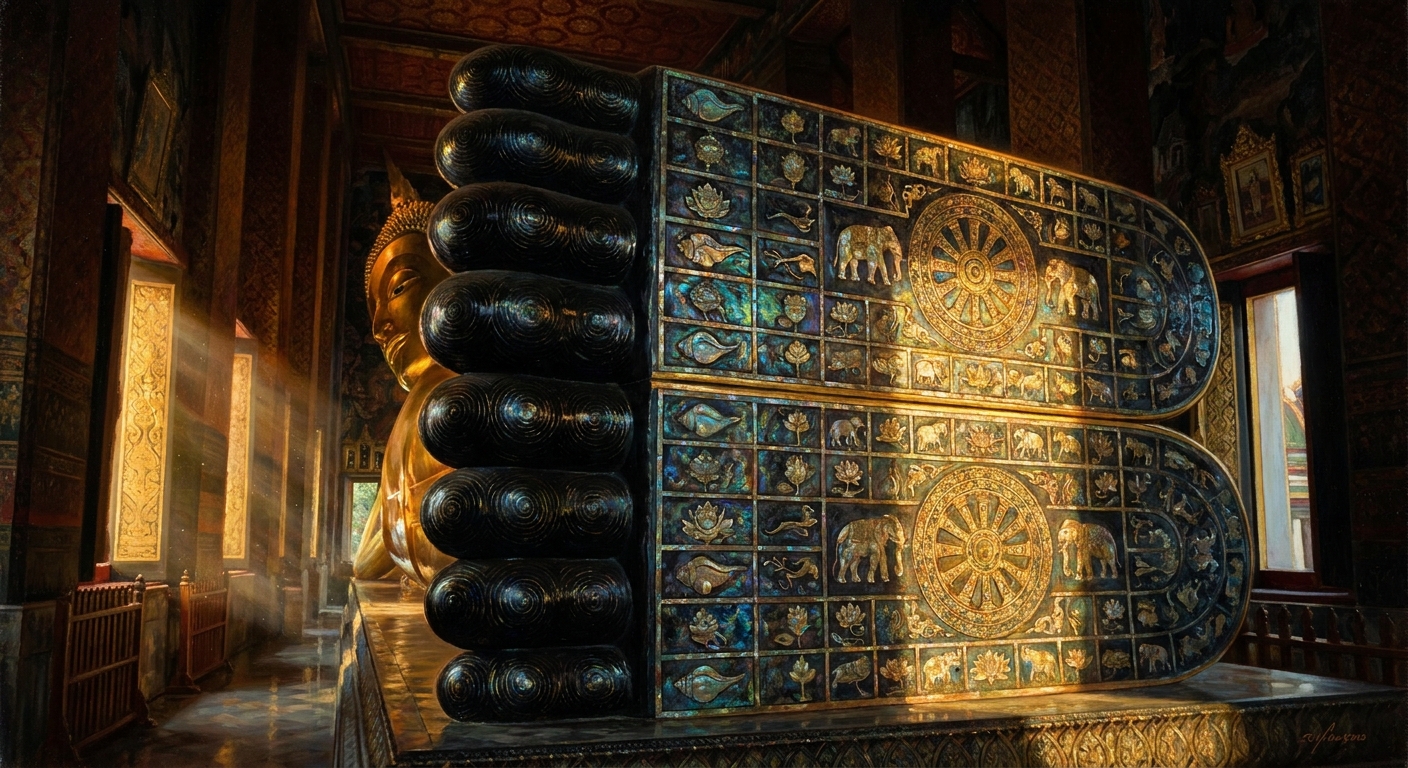
The soles are mother-of-pearl.
This is the king’s specific instruction. The thirty-two Mahapurisa Lakkhana are insufficient; the older Pali tradition expanded the count to one hundred and eight auspicious signs — the mangala lakkhana — and Rama III wants all of them, on the soles of the feet, where pilgrims will see them last and longest, where the cosmos is signed.
The shells are local, harvested from the Gulf of Siam. They are cut into thin nacreous plates, polished, fitted into the lacquered ground in a checkerboard of one hundred and eight panels — each three meters wide on the great soles, each containing one of the marks: the Wheel of Dharma at the center, the conch shell, the swastika of auspiciousness (older than the European misuse by two thousand years), the white parasol of sovereignty, the lotus, the bowl, the eight-spoked sun, the seven-headed naga, the elephant in white, the three-bodied prince. Each panel reads as its own diagram. Together they read as a single chart of the cosmos seen from beneath, the way you would see it if you were lying on your back at the Buddha’s feet and looking up at the soles of his enlightenment.
The work takes a year.
The hall is finished.
The doors open, the first time, on a morning in the early 1840s. The king has lived to see his commission completed. The monks have consecrated the figure. The first pilgrims walk the corridor along the body’s right side — the only side it is correct to circumambulate, the pradakshina path, the right shoulder always toward the sacred — and the corridor is so narrow and the figure so vast that the pilgrim cannot see the whole at once.
This is deliberate.
The architecture forbids the panoramic view. There is no spot inside the hall from which the entire Buddha is visible. The pilgrim must move. The pilgrim must walk the length of the body — the legs, the torso, the supporting arm, the head, the mother-of-pearl soles — and assemble the whole in memory, not vision. The figure is too large for the eye and is meant to be too large. Parinirvana is too large for the eye. The teaching scales the architecture to the doctrine.
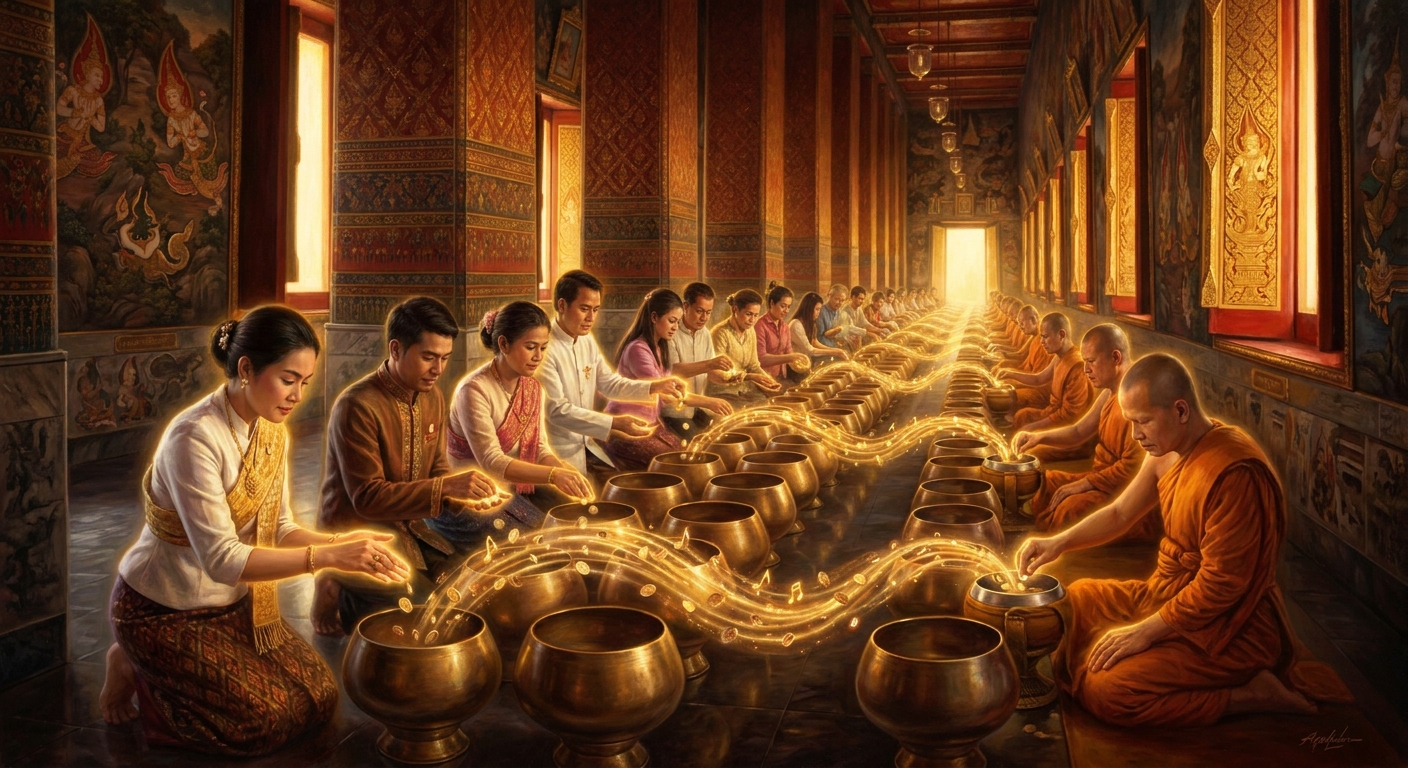
At the head end, by the great ear and the half-closed eye, the corridor turns and runs back along the spine. One hundred and eight bronze bowls line the inner wall.
The pilgrim drops a coin in each.
The bowls are small, brass-yellow, no larger than rice bowls. The pilgrim holds a paper cone of one hundred and eight satang coins, supplied at the entrance for a small donation, and drops one in each bowl as he passes. The corridor fills with a soft continuous chiming — the bronze ring is short and overlaps the next, and the next, so that for the time the pilgrim is walking the length of the figure the entire hall hums like a single struck bell whose note never quite fades.
The merit, the inscription explains, supports the temple’s ongoing restoration.
The bowls are emptied each evening. The coins are counted. The cycle starts again at dawn. The Buddha is still lying down. The Buddha will continue to lie down. The Mahaparinibbana Sutta says he passed through the four jhanas and the four formless attainments and the cessation of perception and feeling, and then he passed back down through them, and then up again, and then between the fourth jhana and the next breath he was gone — the Tathagata fully unbound, the candle out, the parinirvana complete.
The Buddha at Wat Pho is fixed at the moment just before that breath.
Theravada Buddhism does not commemorate the Buddha’s birth or his enlightenment with the same architectural intensity Mahayana commemorates them. Theravada commemorates the death. The parinirvana is the moment the doctrine was finished — nothing left to say, nothing left to teach, the Tathagata gone beyond beyond. Wat Pho fixes that moment in gold and shell and brick, at a scale that forbids the eye to take it in at once.
Rama III also commissioned the temple to function as Siam’s first public university. The pillars and walls of the surrounding cloisters carry inscribed treatises on Thai traditional medicine, on astrology, on the seventy-two yogic postures, on Pali grammar, on the chronicles of the kingdom. Anyone who could read could read them. The Reclining Buddha is the centerpiece, but the surrounding temple is an encyclopedia. The image of the dying Buddha is the still point at the center of an institution whose entire function was to keep teaching after he had stopped.
This is the Theravada gesture. The teacher lies down. The teaching does not.
Scenes
Construction begins in 1832 under Rama III
 Generating art…
 The soles of the Buddha's feet, three meters tall each, inlaid with mother-of-pearl in 108 panels — the auspicious signs (mangala lakkhana) of the Mahapurisa, the Great Person
 Generating art…
 The 108 bronze bowls along the corridor behind the Buddha
 Generating art…
 Echoes Across Traditions
Entities
- The Buddha
- Rama III
- Phra Phuttha Saiyat
- Wat Pho
Sources
- Robert Knox, *Wat Phra Chetuphon: A Royal Temple of Bangkok* — for the architectural history of the temple complex
- Bhikkhu Bodhi (trans.), *The Connected Discourses of the Buddha* (Wisdom, 2000) — for the Mahaparinibbana Sutta describing the Buddha's death
- Donald S. Lopez Jr. (ed.), *Buddhism in Practice* (Princeton, 1995) — for the doctrinal context of parinirvana and the body of the Tathagata
- B. J. Terwiel, *Thailand's Political History: From the 13th Century to Recent Times* (River Books, 2005) — for the Rattanakosin context and Rama III's reign
- Forrest McGill (ed.), *Emerald Cities: Arts of Siam and Burma, 1775–1950* (Asian Art Museum, 2009)