Kiều: A Hundred Years, Everything
Story set in Ming Dynasty China (1368–1644 CE); composed 1820 CE · Vietnam — Nguyễn Du's epic is Vietnamese to its core despite its Chinese setting
Contents
Vietnam's national epic: Thúy Kiều, a woman of extraordinary talent, sells herself into servitude to save her father. Over fifteen years she is trafficked, exploited, and twice driven to attempt suicide. She survives. She finds her childhood love again. She refuses the full marriage because she considers herself beyond redemption. The refusal is the theology.
- When
- Story set in Ming Dynasty China (1368–1644 CE); composed 1820 CE
- Where
- Vietnam — Nguyễn Du's epic is Vietnamese to its core despite its Chinese setting
The story begins with a line every Vietnamese person knows by heart.
Trăm năm trong cõi người ta, Nguyễn Du writes. A hundred years within the human world. The first six syllables of the first line of the national epic, and already the poem has stated its scope: a hundred years, meaning a lifetime, meaning everything you will ever be and do and suffer and love. He is not exaggerating. He means the whole life. He means yours.
Thúy Kiều’s hundred years begin in a garden.
She is the eldest daughter of a scholar-gentry family in moderate comfort — the kind of family whose position is real but fragile, whose reputation is its primary asset, whose daughters are trained in the four accomplishments: poetry, music, painting, chess. Kiều is accomplished at all four in the way that occasionally happens, where talent is so far beyond the norm that it registers as something almost alarming. She composes poems that circulate in manuscript and are quoted back to her by strangers. She plays the đàn tranh — the sixteen-string Vietnamese zither — with a technique that makes people cry without understanding why.
She meets Kim Trọng at the festival of the Tomb-Sweepers in early spring. He is a young scholar from a neighboring family. They exchange glances across the road. Later, they exchange poems over the garden wall. The pledges are made in the careful language of classical poetry, the words carrying more weight than plain speech because they have survived being shaped into form.
They pledge to each other. They call it trăm năm — a hundred years. Everything.
Three days later, Kim Trọng’s uncle dies and he must leave for the south, for the mourning duties that cannot be deferred. He tells Kiều he will return in six months. She gives him her lute to remember her by.
Her father is arrested the following week.
The charges are false.
A local magistrate with a grudge has accused the family of some minor economic impropriety — the details do not matter because they are not true and everyone in the story knows they are not true. What matters is that the father is in prison, the family’s assets are seized pending resolution of the case, and the only way to raise the bribe required to free him is money the family does not have.
Kiều does the arithmetic quickly and arrives at the only answer available.
She sells herself.
A broker named Mã Giám Sinh arrives — a man of the kind whose profession produces a particular professional smoothness, a particular ability to seem like something other than what he is. He examines Kiều as one examines a commodity. He quotes a price. She accepts. She writes the document with her full name, her handwriting as precise and composed as it always is, and signs it without asking what the destination is.
She writes a farewell letter to Kim Trọng, which she leaves with her sister. She asks her sister to take her place in the pledge to Kim Trọng — to marry him when he returns, to give him the hundred years she cannot give. She folds the letter. She walks out of the house.
She is fifteen, or sixteen, or seventeen — the poem is not precise because precise ages are not the point.
The broker sells her to a brothel-keeper named Tú Bà in the city of Lâm Tri.
This is not what he told her.
She understood, in the abstract, what she was agreeing to — Vietnamese readers of Nguyễn Du’s century understood the categories of women’s servitude with clear eyes — but the specific location and the specific work were not disclosed. Tú Bà explains the terms. Kiều refuses. Tú Bà locks her in a room and refuses to feed her until she complies.
Kiều attempts suicide.
She is found and revived. Tú Bà, demonstrating a purely practical mercy, treats her wounds and agrees to a compromise: Kiều will be presented as a respectable courtesan, skilled in poetry and music, available for the company of scholars. The worst of it — Tú Bà gestures vaguely — can be deferred until Kiều is more amenable.
What Tú Bà understands, and what the story understands, is that Kiều’s talent is more valuable than her compliance. The men who come to the house to hear her play the lute and trade poems with her spend more than they would otherwise spend because she is extraordinary and they know it. Tú Bà is not sentimental. She is simply doing the arithmetic.
Kiều plays the lute for men who buy her company and thinks, behind her composed face, of Kim Trọng and the garden and the festival of the Tomb-Sweepers and the spring that was three years ago and might as well be a hundred.
The next twelve years are a chronicle of descents.
She is sold again — this time to a scholar named Thúc Sinh, who loves her genuinely and installs her as his second wife, which is legal and which his first wife Hoạn Thư refuses to accept. Hoạn Thư’s revenge is inventive: she arranges for Kiều to be abducted, sold back into servitude, and installed in her own household as a servant, where Kiều must wait on the husband she once shared and pretend not to know him. The cruelty is so precisely calibrated that Nguyễn Du’s readers have been debating whether to admire Hoạn Thư for two centuries.
Kiều escapes into a convent. The abbess is kind. The convent is temporary.
She is sold again — this time to a warlord named Từ Hải, who is different from the others in that he is genuinely powerful, genuinely in love with her, and genuinely willing to give her the only revenge available in her situation: he grants her the authority to judge and execute those who wronged her. She sits in formal judgment on Tú Bà and Mã Giám Sinh and the others, and sentences them, and the sentences are carried out.
This is, the poem notes, the closest thing to justice she will receive.
Từ Hải is killed by a military trap she was complicit in, without fully understanding what she was agreeing to. She attempts suicide for the second time, leaping into the river where he died. She is pulled from the water by the abbess whose convent she escaped years earlier, who has somehow followed her trail across a decade and a thousand miles of chaos.
She enters the convent in earnest this time. She shaves her head. She recites the sutras. She tries to be done.
Kim Trọng has not stopped looking.
He married Kiều’s sister, as Kiều asked, because that was the honorable thing to do with a pledge that one party has been removed from by force. He has loved his wife. He has not forgotten Kiều. He has spent fifteen years making inquiries along every route a trafficked woman from their province might have been taken.
He finds her.
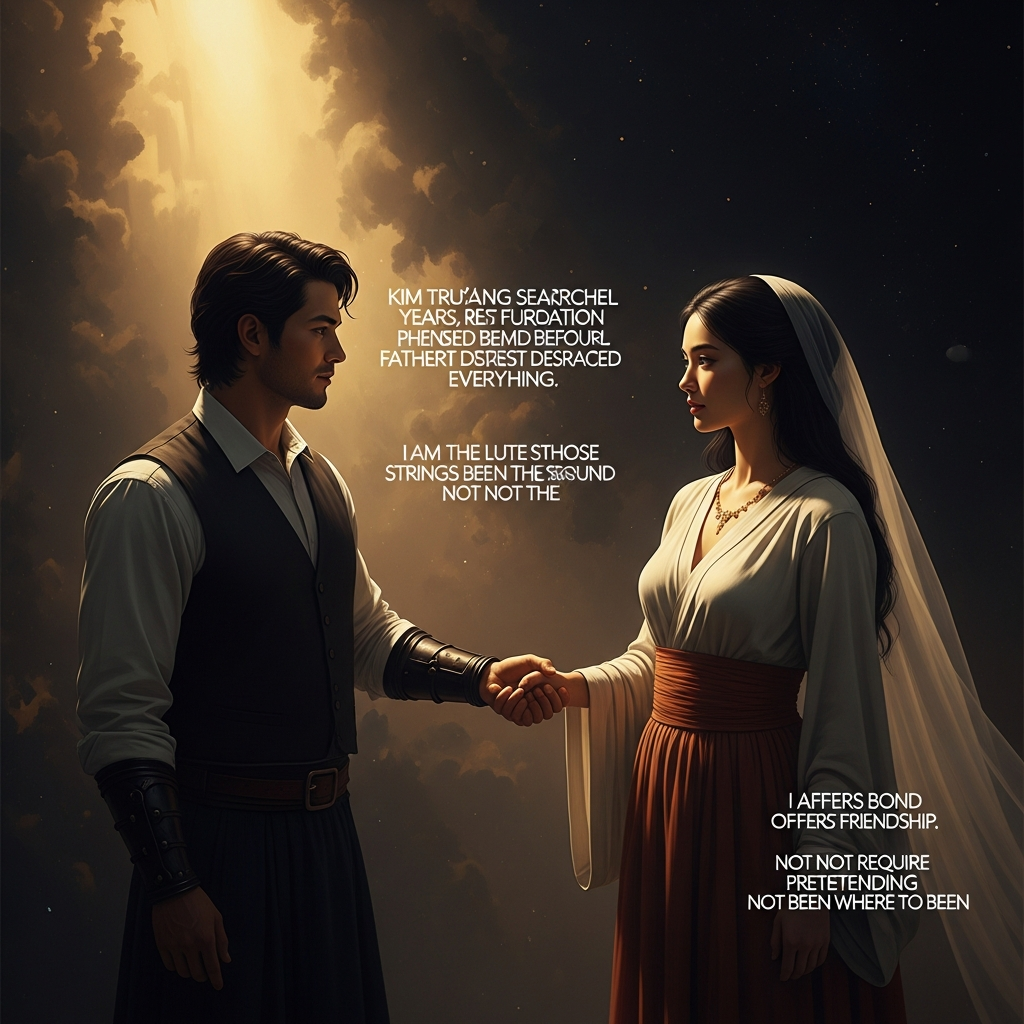
She is in the convent on the Qiantang River — thin, older, composed in the way that people who have decided to be done with the world become composed. He stands in the doorway. She looks at him across fifteen years of intervening catastrophe.
She does not pretend the years did not happen.
He offers everything: the restoration of the pledge, the full marriage, the life that was interrupted before it could begin. He says that none of what happened to her diminishes what she is. He says the hundred years are still possible.
She says: I am a lute whose strings have been restrung. The sound is not the same.
This is the theological heart of the poem.
Kiều does not doubt Kim Trọng’s sincerity. She does not doubt that he means what he says. She doubts her own capacity to be the person the original pledge required, and she will not allow herself to accept a marriage premised on a person she is not.
The Buddhist frame: she has accumulated debts across this lifetime that have now been discharged. The trafficking, the servitude, the loss, the survival — this was her karma, the consequence of something carried from a previous life, and she has lived through it and come out the other side into the pure, quiet air of the convent. To re-enter the world of the five relationships — wife, mother, daughter-in-law — would be to take on new debts she has not agreed to take on.
The human frame: she has been too many people’s property to become freely someone’s wife. Not because she is damaged beyond value, but because the category of wife requires a kind of selfhood she spent fifteen years learning to survive without, and she cannot simply switch it back on because someone who loves her sincerely wants her to.
She accepts the reunion. She accepts his company, his friendship, the warmth of the family she has been returned to. She accepts the ceremonial form of marriage — the gesture, the recognition, the acknowledgment of what they were to each other — but not the consummation, not the full resumption of what was interrupted.
Kim Trọng accepts this because he has spent fifteen years looking for her and knows what he is looking at.
Trăm năm. A hundred years. The poem means the whole life, the full weight of a human existence moving through a world that is not arranged for the convenience of the people in it.
Kiều gets her hundred years. They are not what she planned. They are not what the spring of the Tomb-Sweeper festival promised, when she was fifteen and gifted and everything was still possible in the abstract.
She refuses the restoration not out of despair but out of precision: she knows what she has been. She will not pretend to be what she was. This is the thing the poem calls tiết — purity, virtue, the quality the world kept trying to take from her. She did not let it be taken. It is simply no longer the same shape it was.
She plays the lute one more time. The music is the same music. The strings have been replaced. Kim Trọng weeps, and does not know if he is weeping for what was lost or for what remains.
Scenes
Kiều at the moment of transaction: her father is imprisoned on false charges, her family ruined, the buyer waiting
 Generating art…
 Kiều plays the đàn tranh — the sixteen-string zither — in the house of Tú Bà, in a brothel in Lâm Tri
 Generating art…
 The reunion
 Generating art…
 Echoes Across Traditions
Entities
- Thúy Kiều
- Kim Trọng
- Đạm Tiên
- Từ Hải
Sources
- Nguyễn Du, *Truyện Kiều* (The Tale of Kiều), 1820 CE — the original Vietnamese text in 3,254 verses of lục bát poetry
- Huynh Sanh Thong (trans.), *The Tale of Kiều* (Yale University Press, 1983) — the standard English translation
- Ngo Vinh Long, *Before the Revolution: The Vietnamese Peasants Under the French* (1973)
- Nguyen Du, *Kim Van Kieu*, trans. Vladislav Zhukov (Moscow, 1965)
- Alexander Woodside, *Vietnam and the Chinese Model* (Harvard, 1971)