Joseph Smith and the Grove
Spring 1820 · Palmyra, New York · A grove of trees on the Smith family farm, Manchester Township, near Palmyra, New York
Contents
A fourteen-year-old farm boy in upstate New York reads James 1:5, walks into a grove of trees to ask God which church is true, and reports seeing two personages of light descending in a pillar of fire at noon.
- When
- Spring 1820 · Palmyra, New York
- Where
- A grove of trees on the Smith family farm, Manchester Township, near Palmyra, New York
The boy is fourteen.
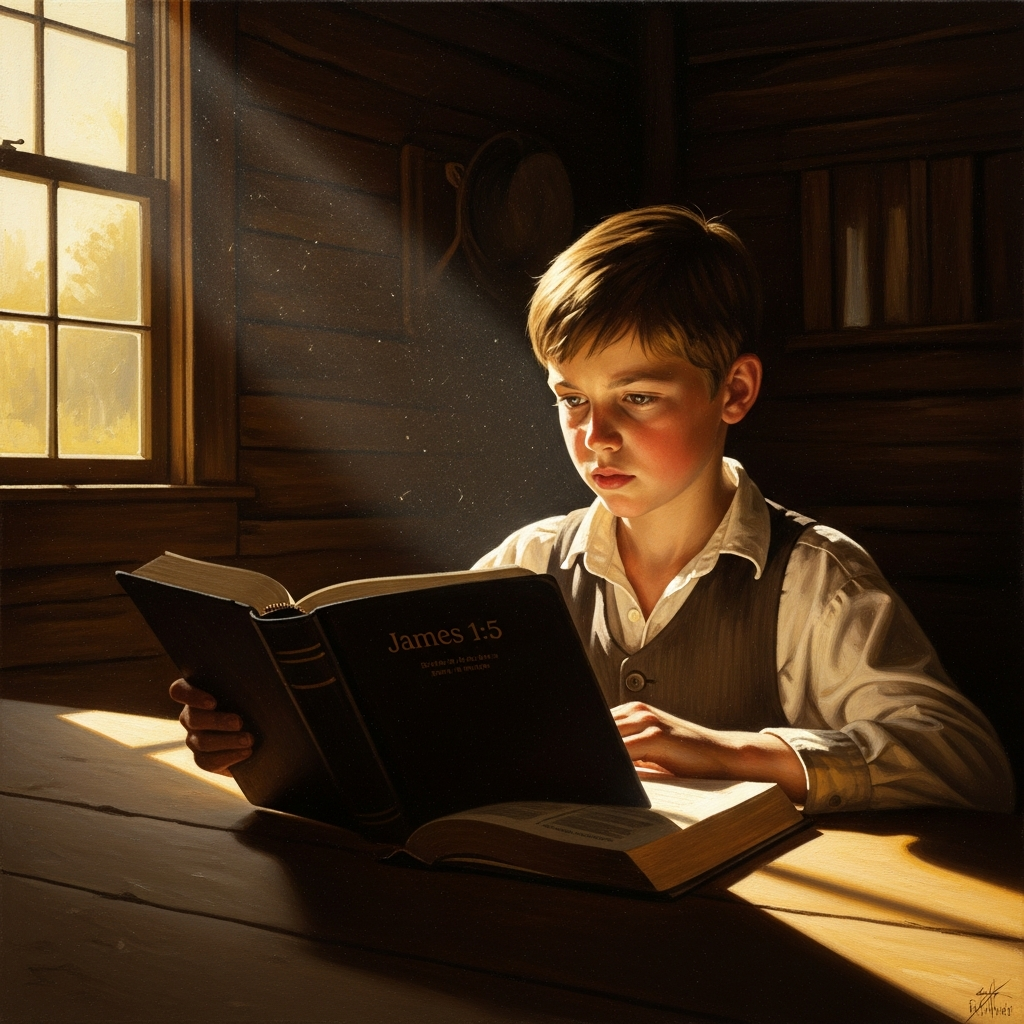
He reads at the kitchen table by the light of a window his mother has just washed. The Bible is open to James, chapter one. If any of you lack wisdom, let him ask of God, that giveth to all men liberally, and upbraideth not, and it shall be given him. He reads it twice. He reads it a third time. The verse settles into him the way a stone settles into a riverbed — not loudly, but permanently.
Outside, the Palmyra revival is in its second year. Methodists, Baptists, and Presbyterians have been quarreling over the souls of his neighbors all summer. His mother has joined one camp. His father has refused them all. Joseph cannot decide.
So he decides to ask.
He chooses the grove because it is private.
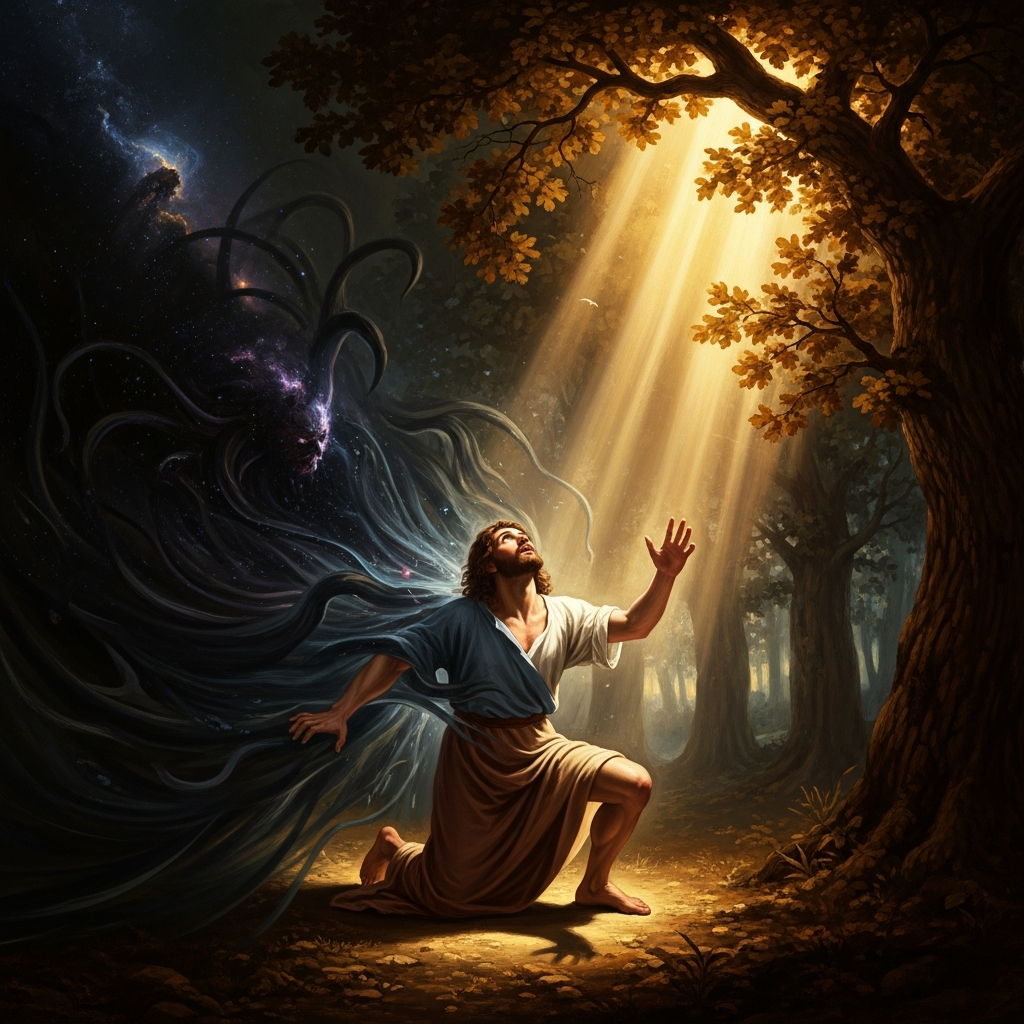
The trees stand a few hundred yards from the farmhouse — maples and beeches, their leaves still pale with spring. He walks out at midmorning with no plan beyond the verse. He has never prayed aloud in his life. He kneels in the leaf litter and opens his mouth and discovers his tongue will not move.
A darkness gathers around him. Not metaphor — pressure. Something binds his throat. He has read, later he will say, that opposition rises against any soul attempting to call upon God for the first time, and he believes it now in the muscles of his chest. He thinks he is going to die in the grove without speaking.
He spends what feels like a long time in that silence.
Then the pillar.
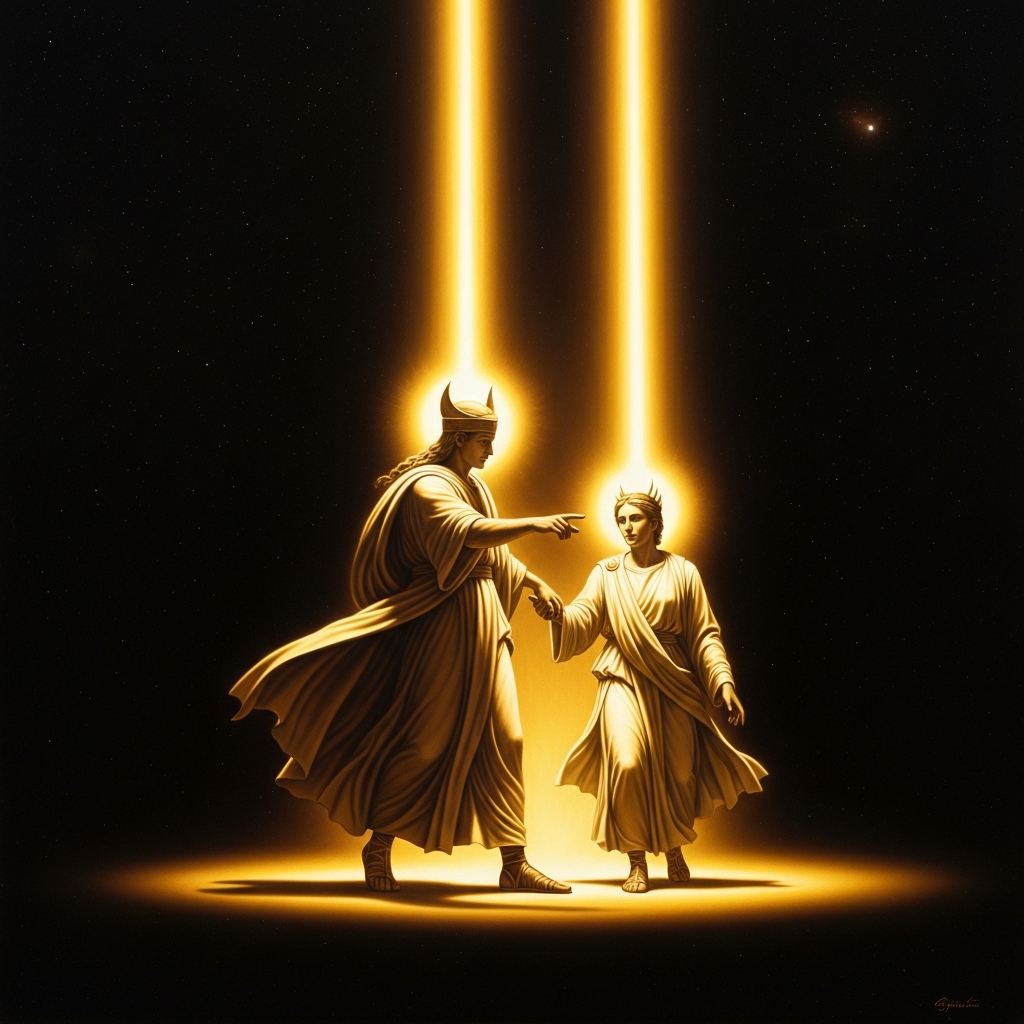
It descends out of the noon sky directly above his head — a column of light brighter than the sun, and yet the leaves do not burn. The light comes down gradually until it rests upon him, and the moment it touches him the darkness in his throat releases.
Inside the pillar stand two personages.
They are not symbols. They are not flame. They are bodies — distinct, embodied, looking at him. One raises his arm and points to the other and speaks his name.
Joseph. This is my beloved Son. Hear him.
The boy will spend the rest of his life trying to describe what he saw in that minute. He will write four different accounts, none of them identical, none of them exactly wrong. The canonized version is the longest. The earliest, in his own handwriting in 1832, is the rawest: the Lord opened the heavens upon me and I saw the Lord.
He asks his question.
It is the question every fourteen-year-old in a revival town asks if they are honest: which of the churches is right? Which sect should I join? Which preacher is telling the truth?
The answer he receives is the answer that will define a religion.
Join none of them. All their creeds, the voice tells him, are an abomination. Their professors draw near with their lips but their hearts are far. They have a form of godliness but deny the power thereof.
The boy hears the verdict on every church in Palmyra, every revival tent, every quarreling pastor, delivered in the voice he has been told to listen to. He does not yet understand what is being asked of him. He understands only that he is supposed to wait.
He comes home and lies on the bed.
His mother, alarmed, asks what has happened. He says only: I have learned for myself that Presbyterianism is not true. He does not tell her the rest. He will not tell most people the rest for twelve years.
The neighbors find out anyway. He tells a Methodist preacher, expecting fellowship, and is met with contempt — visions and revelations have ceased with the apostles. He learns, in that conversation, the second lesson the grove was teaching him: that the cost of the vision is the disbelief of everyone who has not had it.
He goes back to plowing. He goes back to school for one more winter. He waits.
The angel will come three years later, with the plates. The Church will come ten years later, with six members in a farmhouse parlor. The exodus, the murder, the wagons across the plains — all of it lies on the other side of one boy kneeling in a grove of beeches at noon, asking a question out loud for the first time in his life.
Every founded religion has a moment like this. Saul on the Damascus road. Muhammad in the cave. Siddhartha under the tree. The pattern is older than any of them: a young person alone in a natural place, asking a question they have been told not to ask, receiving an answer they have been told not to expect.
What makes the First Vision distinctly American is the question itself. Joseph Smith does not ask whether God exists. He does not ask what the meaning of life is. He asks, with the practical desperation of a frontier teenager: which of the competing institutions is telling the truth? And the answer he receives — none of them; start over — is the answer the Second Great Awakening had been straining toward for forty years.
Whether you take the vision as theophany, as adolescent imagination, as fraud, or as something that does not fit any of those categories: the boy walked out of the grove changed, and within a generation millions of people were following the change. That is the thing the historians cannot dissolve, and it is the thing the believers will not let them.
Scenes
The boy reads James 1:5 in a Palmyra farmhouse during a revival summer
 Generating art…
 He kneels in the grove at noon and is seized by a darkness before the light comes
 Generating art…
 Two personages descend in a pillar of light; one introduces the other as 'my beloved Son
 Generating art…
 Echoes Across Traditions
Entities
- Joseph Smith Jr.
- God the Father
- Jesus Christ
- the Palmyra revivalists
Sources
- Joseph Smith — *History*, 1838-1856 (canonized as Joseph Smith — History in the *Pearl of Great Price*)
- Doctrine and Covenants 76 (the later expanded vision)
- Richard Lyman Bushman, *Joseph Smith: Rough Stone Rolling* (Knopf, 2005)
- Fawn M. Brodie, *No Man Knows My History* (Knopf, 1945)
- Steven C. Harper, *First Vision: Memory and Mormon Origins* (Oxford, 2019)