Seraphim of Sarov and the Bear
Sarov, Russia · 1754-1833 CE · The forest hermitages around the Sarov Monastery, Tambov Governorate, Imperial Russia
Contents
A Russian hermit feeds bears from his hand, prays a thousand nights on a stone, and one winter afternoon his face begins to shine with the same light Palamas defended — while a stunned landowner watches from three feet away.
- When
- Sarov, Russia · 1754-1833 CE
- Where
- The forest hermitages around the Sarov Monastery, Tambov Governorate, Imperial Russia
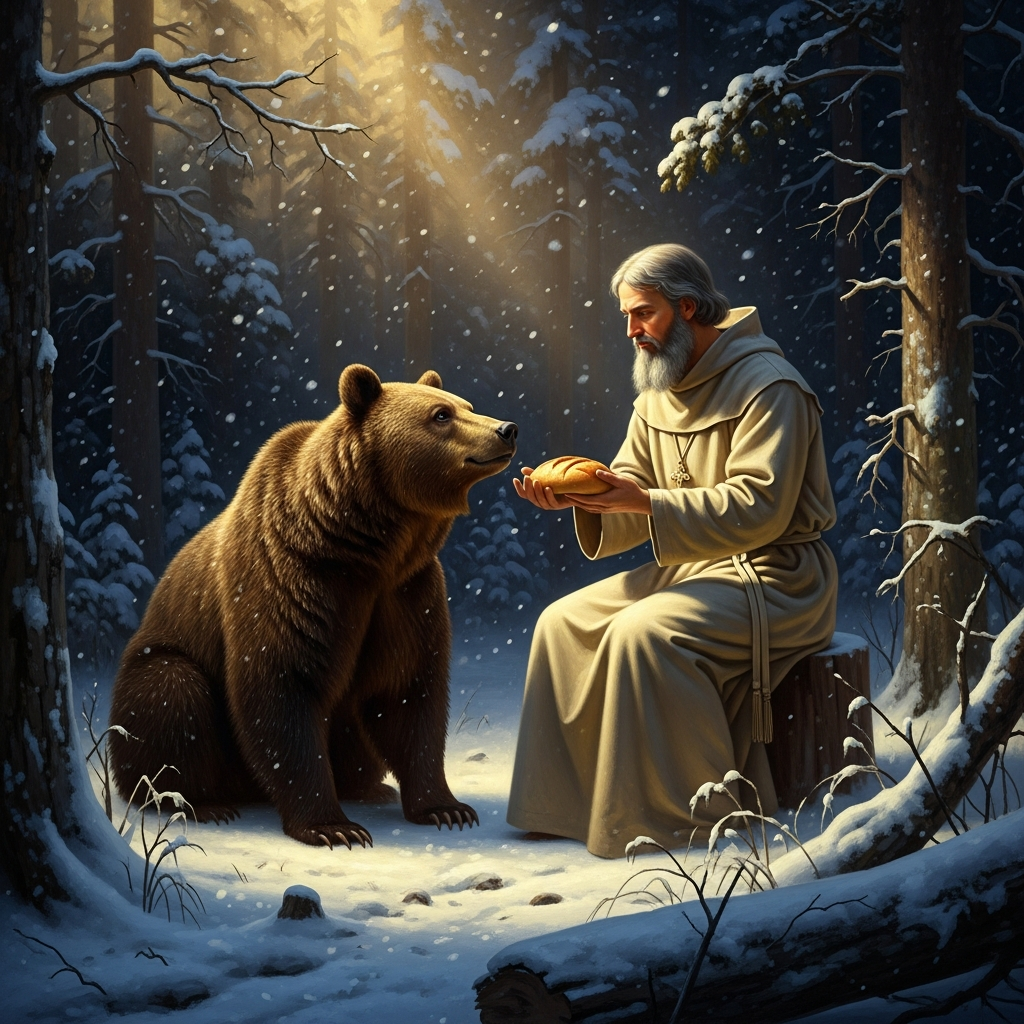
The bear comes out of the trees at the edge of the clearing.
It is winter. The snow is up to the bear’s belly. Seraphim is sitting on a tree stump in his white cassock — the linen one he has worn for forty years, patched at the elbows, belted with a rope. He has a piece of black bread in his hand. He breaks off a corner.
The bear does not charge. The bear walks. It walks the way a tired dog walks toward a familiar hearth. It lowers its enormous head and takes the bread from Seraphim’s palm with lips so soft they barely brush him. Then it sits down. Seraphim scratches behind its ear. The bear closes its eyes.
A novice hiding behind a birch tree fifty yards away watches and forgets, for a long minute, how to breathe.
Seraphim has been a hermit in the Sarov forest since 1794. Before that, he was a monk in the monastery. Before that, he was Prokhor Moshnin, a merchant’s son from Kursk, who at nineteen walked away from his mother’s shop and never went back.
In 1804, he is attacked in the forest by three peasants who think a hermit must have hidden silver. He is holding an axe — he was chopping firewood — and he could defend himself. He sets the axe down. He folds his arms across his chest. They beat him with the handle of his own axe until his skull is fractured and his back is broken.
He survives. He never walks upright again. He hunches forward for the rest of his life, a small bent man with a long white beard, and he refuses, when the peasants are caught, to press charges.
That same year he begins the discipline of the stone.
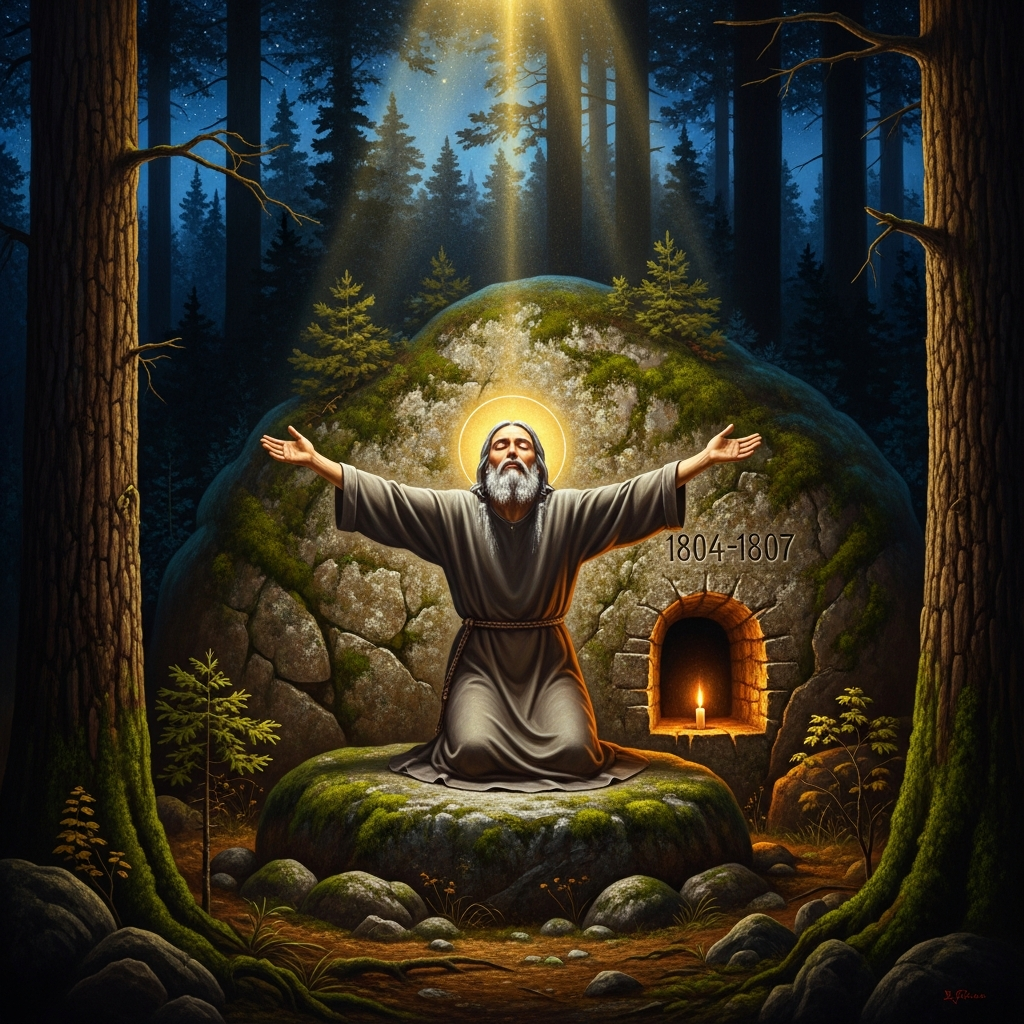
There is a granite boulder in the forest, half-buried, rough with lichen. Each night for a thousand nights — a thousand and one nights, the tradition says, though Seraphim never counted out loud — he kneels on it with his arms raised in the form of the cross, and he prays. Lord Jesus Christ, Son of God, have mercy on me, a sinner.
The cold goes through his knees into his hips into his ribs. The mosquitoes feast on his face in summer. The frost crusts his beard in winter. He is sixty years old. He prays through it.
When asked, decades later, why, he says: because the demons would not leave, and a man must do something while he waits for them to tire of him.
After three years he stops. He returns to his cell. The Mother of God has appeared to him — this is what he tells his confessor, and only his confessor, until much later — and told him his time on the stone is finished. There is other work.
The other work is people.
He opens his cell door. He had been a strict hermit; now he is what the Russians call a starets — an elder, a spiritual father to anyone who walks the path through the forest to find him. They come in their thousands. Peasant women with sick children. Officers from St. Petersburg. Old monks. Skeptics.
He greets every one of them, regardless of season or station, with the same words: My joy! Christ is risen! — even in Lent. He bows to the ground before them. He says he is bowing to the Christ inside them.
He reads their minds. He answers questions they have not yet asked. He sends them home with instructions so specific — do not let your son travel on the seventeenth, forgive your sister tonight — that the village around Sarov begins to whisper that something has come back into Russia that had not been seen since the desert fathers.
In November 1831 — two years before his death — a landowner named Nikolay Motovilov comes to him with a question he has carried for years.
Father, what is the aim of the Christian life?
Seraphim does not answer in the usual way. He does not say salvation or holiness or love of neighbor. He says: The aim of the Christian life is the acquisition of the Holy Spirit of God.
Motovilov asks how one knows when one has acquired it. Seraphim takes him by the shoulders. They are standing in a clearing. Snow is falling on Motovilov’s hat and on Seraphim’s white cassock.
Look at me, Seraphim says.
Motovilov looks. Seraphim’s face — the bent, scarred, eighty-year-old face of the Sarov hermit — is shining. Not metaphorically. Motovilov writes it down later, exactly: I cannot look upon you, Father. Your eyes flash like lightning. Your face is brighter than the sun, and yet I am not blinded, and I feel a warmth as though I were standing at the height of summer.
Seraphim says, very calmly: Do not be afraid. You also are shining now. Otherwise you could not see me.
The snow continues to fall. Neither of them moves for a long time.
He dies on January 2, 1833, kneeling in front of the icon of the Mother of God in his cell, with a candle still burning. The novices find him at dawn.
The bear, the stone, the thousand nights, the shining face — these are the four images Russia carries of him. Together they form an answer to the question Barlaam asked Palamas five hundred years earlier: can a man, while still in the body, really see the uncreated light?
The Russian answer, after Sarov, is not theological. It is a small bent man in a white cassock, scratching a bear behind the ear, telling a stunned landowner: acquire the Spirit of Peace, and thousands around you will be saved.
Seraphim is the proof Palamas asked for. Without the essence/energies distinction, Motovilov’s testimony is hallucination. With it, it is the ordinary endpoint of a life given to the prayer.
The Soviet government dynamited the Sarov Monastery and used the site for nuclear weapons research. The relics were hidden, then lost, then found again in 1991 in a storeroom of the Museum of Atheism in Leningrad. They were carried back to Sarov in procession. Crowds lined the railway tracks for a thousand kilometers.
The bear, by then, was long dead. But every Russian child who hears the story knows that somewhere in the forest, the bread is still being held out, and something gentle is still walking toward it.
Scenes
Sarov Forest, ~1810 — Seraphim in a white linen cassock holding a crust of bread out to a brown bear, snow falling, the bear gentle as a dog at his knee
 Generating art…
 A granite stone in the forest, 1804-1807 — Seraphim kneeling on the rock by night, arms raised in cruciform prayer, frost on his beard, a single candle flame inside his cell
 Generating art…
 A clearing in winter, November 1831 — Seraphim's face blazing with white light, snow on his shoulders, Nikolay Motovilov gripping his arm in stunned recognition
 Generating art…
 Echoes Across Traditions
Entities
- Seraphim of Sarov
- Nikolay Motovilov
- the Mother of God
- the bear of Sarov
Sources
- Nicholas Motovilov, *Conversation with St. Seraphim of Sarov on the Aim of the Christian Life* (recorded ~1831, published 1903)
- *The Way of a Pilgrim* (anonymous, ~1860; English trans. R.M. French, 1930)
- Valentine Zander, *St. Seraphim of Sarov* (1968)
- Vladimir Lossky, *The Mystical Theology of the Eastern Church* (1944)
- Timothy Ware, *The Orthodox Church* (1964)