Contents
Ryōkan, the Sōtō Zen monk who lives alone on Mount Kugami with nothing to steal, wakes to find a thief in his hut and gives the man his robe. Then he sits in the open doorway, watches the moon, and writes the poem that earns him his place in Japanese literature.
- When
- c. 1800 CE
- Where
- Mount Kugami, Echigo Province, Japan
He has chosen to be poor.
This is the first thing to understand about Ryōkan, and it is the thing that makes him inexplicable to everyone who tries to help him. He is not poor in the way of someone who has failed at wealth. He is poor in the way of someone who tried wealth, saw what it required, and declined. He was born in 1758 to a village headman in Izumozaki, on the Sea of Japan coast in Echigo Province — a man of local prestige, a man with obligations and a house and a hereditary position. At seventeen, Ryōkan looked at the hereditary position and walked away from it. He walked to the Zen temple of Kōshō-ji, became a monk, and spent twelve years studying under the Sōtō master Kokusen at Entsu-ji in Tamashima, in western Japan.
Then Kokusen died, and Ryōkan received his certificate of transmission, and instead of founding a temple or assuming a teaching role, he walked back to Echigo and climbed Mount Kugami. He found a small hut — the Gogō-an, the Five-Quart Hermitage, named for the amount of rice it could store — and he moved in. He is fifty-six years old. He has no students. He has no temple. He has one bowl, one robe, and a brush.
He spends his days in ways that alarm the neighboring villagers.
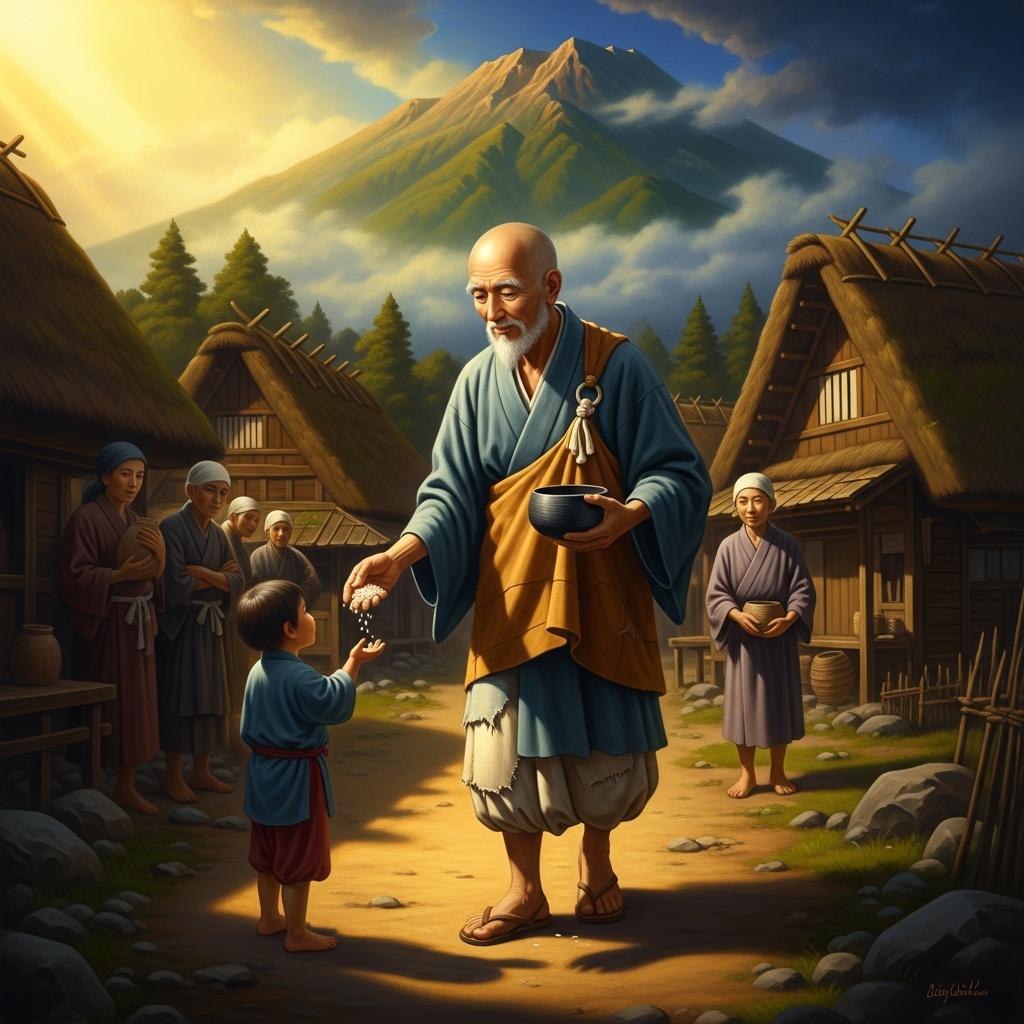
He plays marbles with the children of Izumozaki. Not sometimes — every day, or as close to every day as the weather allows. He hides his begging bowl from them so they cannot steal it, and then he lets them find it, and then he chases them for it through the narrow lanes of the fishing quarter, his robes hitched up, his shaved head gleaming. He is terrible at catching children. He is almost certainly terrible at it on purpose. The children know he will let them win. They love him completely.
His calligraphy is famous, and it is famous for a specific reason: it is bad. Not technically bad — people who know calligraphy look at his brushwork and see a master. But it is bad in the way that defeats connoisseurship. It tilts slightly. The ink loads unevenly. A stroke will begin firmly and then trail off in a way that no trained calligrapher allows and that Ryōkan produces consistently, deliberately, because he believes — and this is pure Zen — that beauty achieved by effort is a kind of lie. The brushwork that looks perfect is the brushwork of someone who wanted to look perfect. His own brushwork looks like someone forgot he was writing.
He composes haiku. They are likewise bad in the way of being unsettlingly simple, so simple they look like a child wrote them, which is why they have lasted.
When he goes to the village to beg, he gives away what is given to him before he returns to the mountain. He has done this long enough that the villagers understand it is not an oversight. They give him what they can. He redistributes it before sunset. He returns to Gogō-an empty-handed and eats what he has or does not eat.
One autumn night — he is somewhere in his late forties, the exact year is not recorded — he wakes to find someone in his hut.
The figure is moving quietly near the wall, lifting things, setting them down with the care of someone who has done this before. The care is, in this case, futile. Ryōkan’s hut contains a sleeping mat, a brush and ink stone, several scrolls of poetry, and the robe he is wearing. The thief has been thorough and found nothing.
Ryōkan sits up. The figure freezes.
What happens next is told in different ways, and perhaps all of them are true. In some versions, Ryōkan speaks first. In some, he says nothing and simply removes his robe and holds it out. In all versions, the robe changes hands. The thief takes it — alarmed, perhaps, or moved, or simply practical in the way that a man who has come all the way up Mount Kugami in the cold needs a robe more than its owner does — and goes. The door, which has no lock, swings open and stays open.
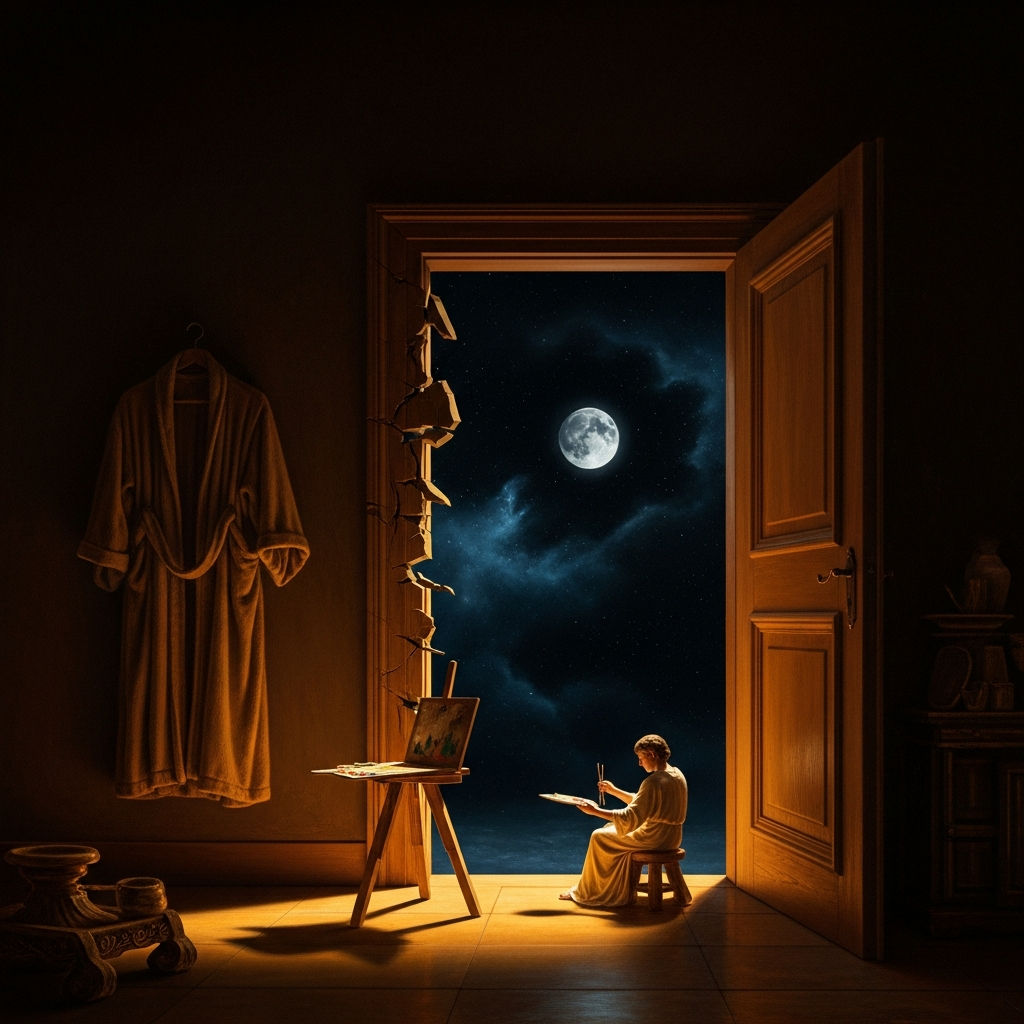
Ryōkan sits in the cold, in nothing, and looks through the open doorway at the sky.
The moon is full.
It is moving slowly through the frame of the door. Ryōkan watches it with the attention he gives to everything he watches: total, undemanding, interested in what it actually is rather than what it is supposed to mean. The moon does not know the hut is cold. The moon does not know anything has been taken. The moon is simply there, doing what the moon does, moving through the space where the door is. It is, Ryōkan realizes, the one thing the thief could not carry off.
He picks up his brush. He writes:
Nusubito ni — the thief left it behind — torinokosarete — having taken what there was — mado no tsuki — the moon in the window
It is eleven syllables. It takes perhaps three minutes to write. It will be read for the next two and a half centuries as one of the finest short poems in Japanese literature, which would have puzzled Ryōkan, who would have said he only wrote down what was in front of him.
The moon moves on. The hut stays cold. He does not try to find another robe. In the morning he will go down the mountain as he always does, and the children will steal his bowl, and he will fail to catch them, and someone will give him rice that he will give to someone else, and the brushwork will be imperfect in exactly the way that perfection cannot produce.
He is not famous in his lifetime in the way that abbots are famous. He holds no position. He publishes nothing — his poems circulate in manuscript copies made by the villagers who memorize them. He refuses every invitation to take a temple post, not from false modesty but from genuine indifference to the institution. He is not a reformer. He has no doctrine. He does not disagree with institutional Buddhism; he simply does not practice it, in the same way he does not disagree with the aristocracy and simply does not participate in it.
In his sixties, a young Zen nun named Teishin becomes his student and close companion. She nurses him through his final illness. She compiles his poems after his death in 1831. Without her compilation there would be almost no record of his work — it existed entirely in the memories of fishermen’s children and the handwriting of villagers who thought they were copying local curiosities.
He dies in January of 1831, at seventy-three. His last poem, written from bed, is about the spring that will come after he is gone:
Uraurā to — in the warm spring light — ware mo koto no — I too am content — haru no kure — at the close of spring
Whether the spring he means is the season or something else is a question his poems habitually refuse to answer.
Ryōkan’s poverty is not the poverty of the man who has nothing because he could not get more. It is the poverty of the man who saw what more costs and chose the moon instead. The thief who climbed Mount Kugami expecting to find nothing and left with a robe was correct on both counts: there was nothing, and the only thing worth taking was the thing that cannot be taken.
His haiku look like accidents. So does his entire life. A village headman’s son who gave away his inheritance to chase children and watch the moon. A Zen master who mastered Zen by declining to be one. A poet whose poems look like mistakes and have lasted two centuries because the only thing more durable than craft is the refusal of it.
The thief left the moon behind. Ryōkan left it behind too, for everyone who needed it.
Scenes
Ryōkan carries his begging bowl through the village at the foot of Mount Kugami
 Generating art…
 The children of Izumozaki know his route
 Generating art…
 After the thief
 Generating art…
 Echoes Across Traditions
Entities
- Ryōkan
- Taigu Ryōkan
Sources
- Ryōkan, *Dewdrops on a Lotus Leaf*, trans. John Stevens (1993)
- Ryōkan, *One Robe, One Bowl: The Zen Poetry of Ryokan*, trans. John Stevens (1977)
- Ryuichi Abé and Peter Haskel, *Great Fool: Zen Master Ryōkan* (1996)
- Burton Watson, *Ryokan: Zen Monk-Poet of Japan* (1977)