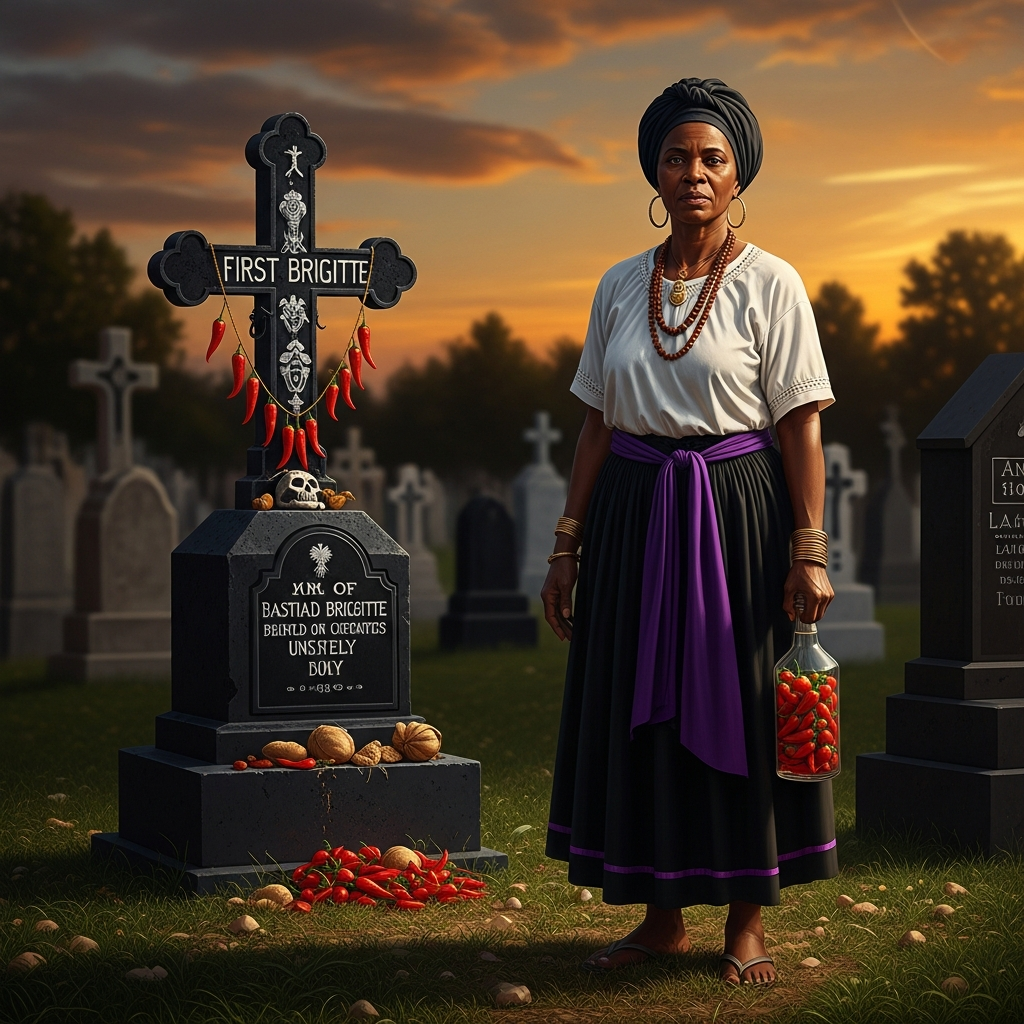
Maman Brigitte and the First Grave
The Vodou liturgical year — All Souls' Day (November 2) is the primary Gede feast; tradition solidified in 18th–19th century Haiti · A Haitian cemetery at the Fete Gede — the Festival of the Dead on November 2; the first grave in any cemetery, which belongs to her
Contents
Maman Brigitte — wife of Baron Samedi, lwa of the first grave, healer of the dying — is of Celtic origin, a European spirit absorbed into Haitian Vodou through colonial encounter. She drinks rum with hot peppers, dances with her husband at the cemetery gate, and speaks truth about death. She is the tradition's proof that spiritual encounter does not respect colonial borders.
- When
- The Vodou liturgical year — All Souls' Day (November 2) is the primary Gede feast; tradition solidified in 18th–19th century Haiti
- Where
- A Haitian cemetery at the Fete Gede — the Festival of the Dead on November 2; the first grave in any cemetery, which belongs to her
The first grave in every Haitian cemetery belongs to her.
Whoever was buried first in that ground — the oldest bones, the first body that consecrated the earth as a place of the dead — that grave is Maman Brigitte’s. Her iron cross, painted black, stands at its head. Her offerings accumulate on the grave’s surface: black and purple cloth, a bottle of rum steeped with twenty-one hot peppers, a black candle, sometimes a small crocheted doll in her colors. You leave these things and you ask what you came to ask, and you wait, because Maman Brigitte is not in a hurry but she is present, and the difference between her and her husband Baron Samedi is that the Baron performs his presence loudly, with rum and crude jokes and dancing, while Brigitte performs hers quietly, with the particular quiet of someone who has been sitting with the dying long enough to know that most of what needs to be said doesn’t require volume.
She comes on the second of November.
Fete Gede — the Festival of the Dead — is the great Vodou holiday of the year, the day when the Gede nation floods into the bodies of the living and the cemeteries fill with ceremony and the line between the world of the living and Ginen becomes permeable enough that almost anyone can feel it. It is the day the Catholic calendar calls All Souls’ Day, which is not an accident — the Vodou tradition absorbed the date and the theological premise (the dead are present, the dead can be addressed, the dead require the attention of the living) and made it its own.
On the Fete Gede, the first grave in every cemetery becomes the center of the world.
The mambo who leads this year’s ceremony is a woman in her fifties who has been a daughter of the Gede since her initiation in her twenties. She wears black and purple — the Gede colors — and she moves with the efficiency of someone who has done this many times and finds nothing to be casual about. She arrives at the cemetery before the sun rises. She has the offerings in a basket: the rum and the peppers and the black cloth and the purple cloth and the money — because the Gede, like all lwa, appreciate a practical gift, and cash is the most practical gift there is.
She lays the cloth across the first grave. She opens the rum. She pours three times — left, right, center — and says the greeting in Kreyòl:
Maman Brigitte, nou la pou ou.
Maman Brigitte, we are here for you.
Maman Brigitte is, in the strictest theological sense, a European.
This is the most unusual thing about her and the thing that Vodou scholars find most remarkable: she is almost certainly descended from Saint Brigid of Ireland — the fifth-century abbess of Kildare, herself a Christianization of the older Celtic goddess Brigit, patroness of healing, poetry, and the sacred flame. The saint’s feast day is February 1; she is one of the three patron saints of Ireland; her symbol is the cross woven from rushes that hangs over doorways to protect houses; her sacred spring at Kildare is still visited today.
How does a medieval Irish saint become a Haitian lwa of the dead?
Through colonial encounter. The French colony of Saint-Domingue was administered by a Catholic Church that brought the full iconographic weight of European Christianity with it — the saints’ images, the feast days, the hagiographies. Irish and Scottish indentured servants, transported to the Caribbean in the seventeenth century, brought their particular saints with them. The enslaved Africans who were forced to attend Catholic mass looked at the images they were shown and, in the same process that made Saint Patrick into Damballah and the Virgin of the Sorrows into Erzulie, they looked at the image of this healing woman associated with fire and water and the boundary between worlds — and they recognized something.
They recognized a lwa.
She was recognized because she performs a function the African tradition already had a place for.
The female death-deity — the woman who stands at the boundary of life and death and administers it with both severity and compassion — exists in every tradition that has a death theology. In Yoruba, it is Oya, the orisha of storms and the cemetery marketplace. In the Fon tradition it is Mawu, the divine female principle, co-ruler of the cosmos. In Greek tradition, it is Persephone. In Norse tradition, it is Hel. The function is constant across human religious imagination: death requires a female face, because death is too intimate for only the masculine grotesque, too close to the body’s rhythms to be addressed only in the language of war and power.
Maman Brigitte fills that function in Vodou. She heals the dying — she and the Baron together can decide whether a grave is dug, and she is often the mercy in that decision, the voice that argues for more time. She protects the graves of women in particular. She presides over the first grave because she is, in some sense, the first death: not the most recent or the most dramatic, but the foundational one, the one that consecrated the ground as a place where the living and the dead can speak.
She drinks the rum with hot peppers because death requires a truth-teller, and the peppers are the truth: burning, honest, impossible to ignore.
She mounts a cheval around midmorning.
The woman who receives her has been a Gede initiate for fifteen years and has carried Brigitte before. She knows what is coming. She has prepared herself — fasted, prayed, worn the colors, arrived at the ceremony in the state of disponibilité that Maya Deren described as the posture the lwa requires: emptied of self, present to what is larger.
The Gede rhythm is unlike the rhythms of most lwa. It is blunt, insistent, slightly off-balance in the way of something that knows it does not have to be graceful because death is not graceful. The cheval begins to move in the banda — the Gede death-dance — and then stops. Her posture changes: the shoulders straighten, the head lifts, and the quality of stillness in her body becomes the stillness of someone listening to something the rest of the room cannot hear.
Maman Brigitte is less violent in her arrival than Baron Samedi. She does not fall. She settles, the way a bird settles on a branch: a weight, a landing, a being-present-where-she-was-not-before.
She goes to the first grave. She kneels at it and places her hands on the cloth. She sits with the grave for a long time — longer than most lwa sit with anything — and the ceremony quiets around her. The drums slow to almost nothing. She is doing something that requires the quiet. No one is certain what it is. She is reading the dead the way the houngan reads a dying person’s face, and whatever she is reading, it satisfies her, because eventually she stands and accepts the offering bottle and takes a long drink — the peppers making no visible impression on the cheval’s face — and turns to receive the petitioners.
She speaks truth about death.
This is her primary gift and the thing that distinguishes her from her husband: the Baron performs the comedy of death, which is also a truth; Brigitte speaks the plain fact of it. She tells a man that his mother is at peace, without decoration. She tells a woman that her husband’s spirit has gone past the first gate and cannot be called back — the time for that kind of petition is past. She tells a young mother that the child who died last year is held in Ginen and is not lost and does not need to be grieved in this particular way anymore.
She does not perform comfort. She delivers accuracy. In the tradition’s understanding, that is the same thing: the most comforting thing about death is not to be told it isn’t real, but to be told that it has a shape that can be known, a place it goes, a keeper who is present and capable.
She is that keeper. She is the European spirit that the enslaved people of Haiti recognized and named and absorbed into a cosmology that was already large enough to hold her — because a cosmology that had survived the Middle Passage was large enough to hold anything.
What colonial logic built as a wall, Maman Brigitte walked through. The colonial encounter was supposed to replace African spiritual life with European Christian life — to substitute saints for orishas, mass for ceremony, Latin for Kreyòl. What happened instead was that the enslaved people of Haiti looked at Saint Brigid in her niche and said: we know you. You are one of ours. Come in. She came in. She is still here, dressed in black and purple, drinking the rum that burns, standing at the oldest grave in every Haitian cemetery, holding the first boundary between the living and the dead. No colonial project anticipated this: that the weapons of cultural erasure could be absorbed, metabolized, and turned into the gods of the people they were meant to erase.
Scenes
Maman Brigitte stands at the first grave in the cemetery — the oldest iron cross, painted black, decorated with her black and purple offerings
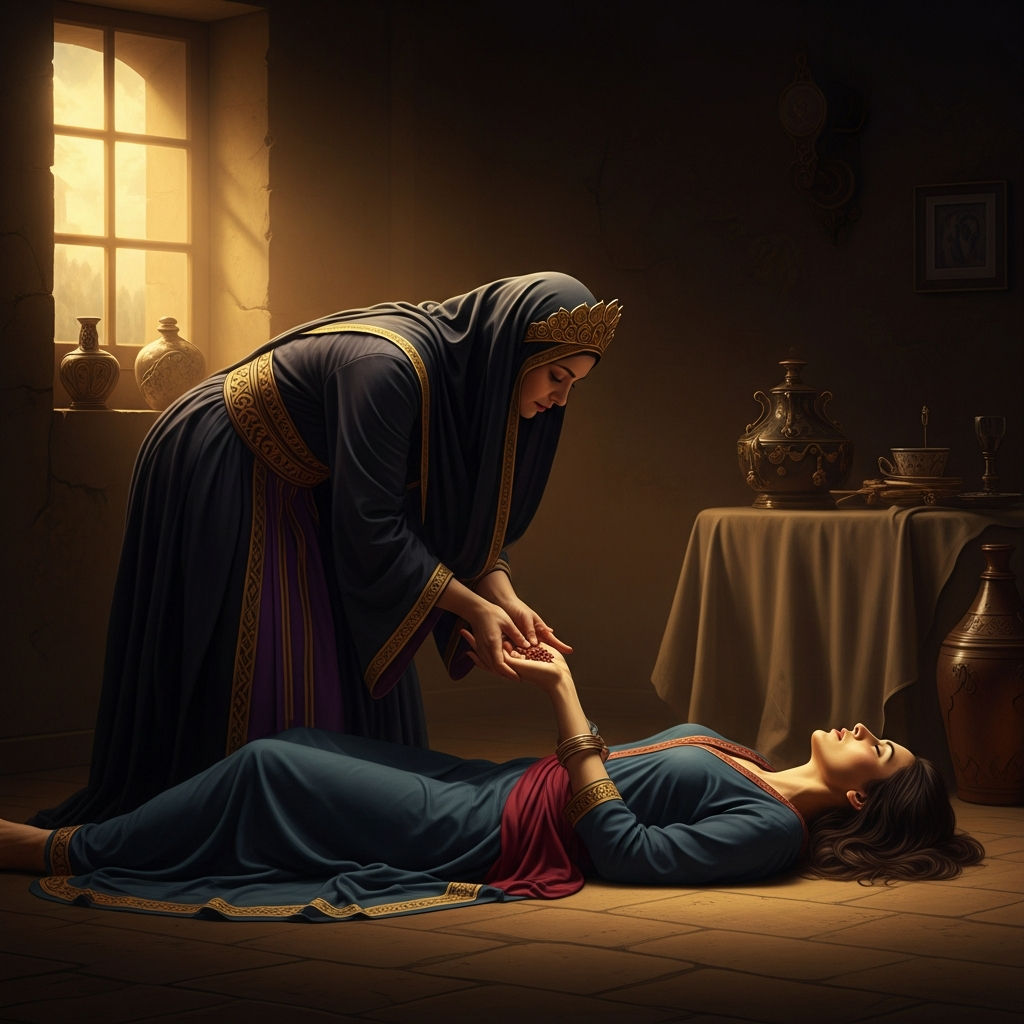
Generating art… She bends over the dying woman, her black and purple robes pooling on the floor of the house
 Generating art…
 At the Fete Gede, Maman Brigitte and Baron Samedi dance together at the cemetery crossroads — she in black and purple, he in black and white, the two death-lwa in the dance that is also a joke about death
 Generating art…
 Echoes Across Traditions
Entities
- Maman Brigitte (lwa of the first grave and the dead)
- Baron Samedi (her husband, lord of death)
- the Gede (the nation of the dead she co-rules with the Baron)
- Saint Brigid of Ireland (her Catholic face)
- the mambo (priestess who calls her)
Sources
- Maya Deren, *Divine Horsemen: The Living Gods of Haiti* (1953)
- Karen McCarthy Brown, *Mama Lola: A Vodou Priestess in Brooklyn* (1991, updated 2001)
- Alfred Métraux, *Voodoo in Haiti* (1959, English translation 1972)
- Donald Cosentino (ed.), *Sacred Arts of Haitian Vodou* (1995, UCLA Fowler Museum)
- Lilith Dorsey, *Voodoo and Afro-Caribbean Paganism* (2005)