Damballah Mounts the Serviteur
The Vodou liturgical calendar · the synthesis crystallized 1700-1804 in Saint-Domingue · A peristil — open-walled temple — in the Haitian countryside; the central poto-mitan post
Contents
In a peristil outside Port-au-Prince, the cornmeal veve of the cosmic serpent is drawn on the floor, the egg-and-flour libation is poured, the drums begin, and Damballah Wedo — the great rainbow loa whose other face is St. Patrick — descends and rides the serviteur.
- When
- The Vodou liturgical calendar · the synthesis crystallized 1700-1804 in Saint-Domingue
- Where
- A peristil — open-walled temple — in the Haitian countryside; the central poto-mitan post
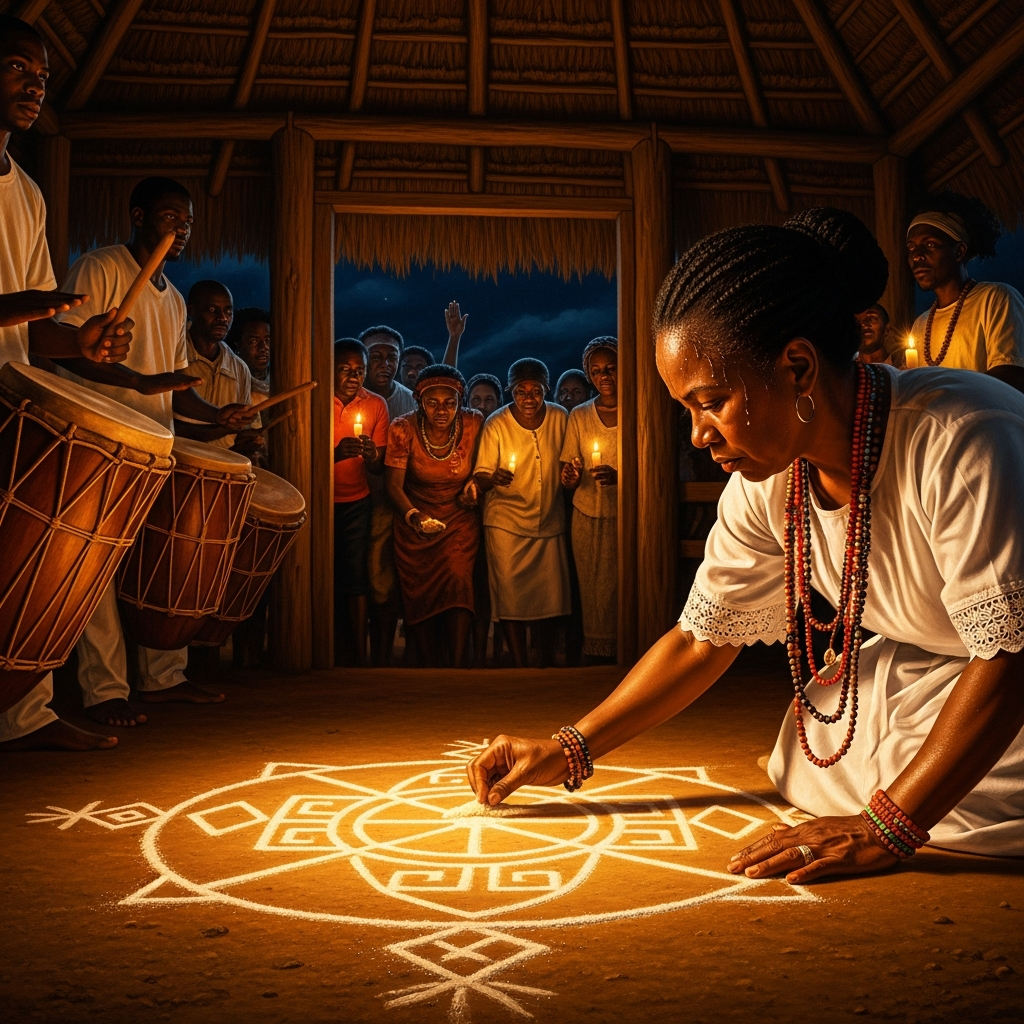
The mambo kneels at the center of the peristil and begins to draw.
It is past midnight. The peristil is open-sided, roofed with palm thatch, a cross-shaped column at the center — the poto-mitan, the post that joins the world below to the world above. The floor is packed earth swept smooth. The mambo holds a small cloth pouch of cornmeal. She lets the meal fall through her fingers in a thin white stream, drawing.
She is drawing the veve of Damballah Wedo: a great serpent, stylized, its coils rising and falling, twin lines for the rainbow that is his consort Ayida-Wedo, an egg shape at the center, two crossbars for the celestial axes. The line must not break. She does not look up. The drumming has not begun yet, but the drummers are watching her hands, and when the last line of the veve closes — the snake’s tail meeting the snake’s head — the lead drummer lifts his palm.
Boum.
The assembly draws breath together. Damballah is being called.
Legba goes first. He always goes first.
The mambo turns to the eastern gate of the peristil and salutes the cross drawn there in chalk. Papa Legba, ouvri baryè pou mwen — Papa Legba, open the gate for me. Legba is the old man at the crossroads, the keeper of the doorway between worlds. No loa enters before him. The assembly sings:
Atibon Legba, ouvri baryè-a pou mwen, agoé
The drums find the rhythm. It is not the urgent rhythm of Ogou the warrior, not the lascivious rhythm of Erzulie, not the staccato cemetery rhythm of the Gede. It is the yanvalou — the slow, undulating rhythm, the rhythm of water moving, of a serpent unwinding. The dancers begin to bend their backs in a long ripple from hip to shoulder, the Haitian movement that quotes the snake’s body without naming it.
The candles around the poto-mitan flicker. The white cloths tied to the post lift slightly though there is no wind.
The serviteur enters in white.
She is in her forties. She wears a long white dress and a white headwrap and no shoes. She has been fasting since dawn. She is a cheval — a horse — one of those whose body the loa will sometimes choose to ride, and tonight she has come hoping to be ridden.
She circles the poto-mitan three times. She kisses the earth at its base. She rises and joins the dance — the slow ripple, the bend at the hip, the drift across the floor that is half-dance and half-trance. She does not lead. She is being led.
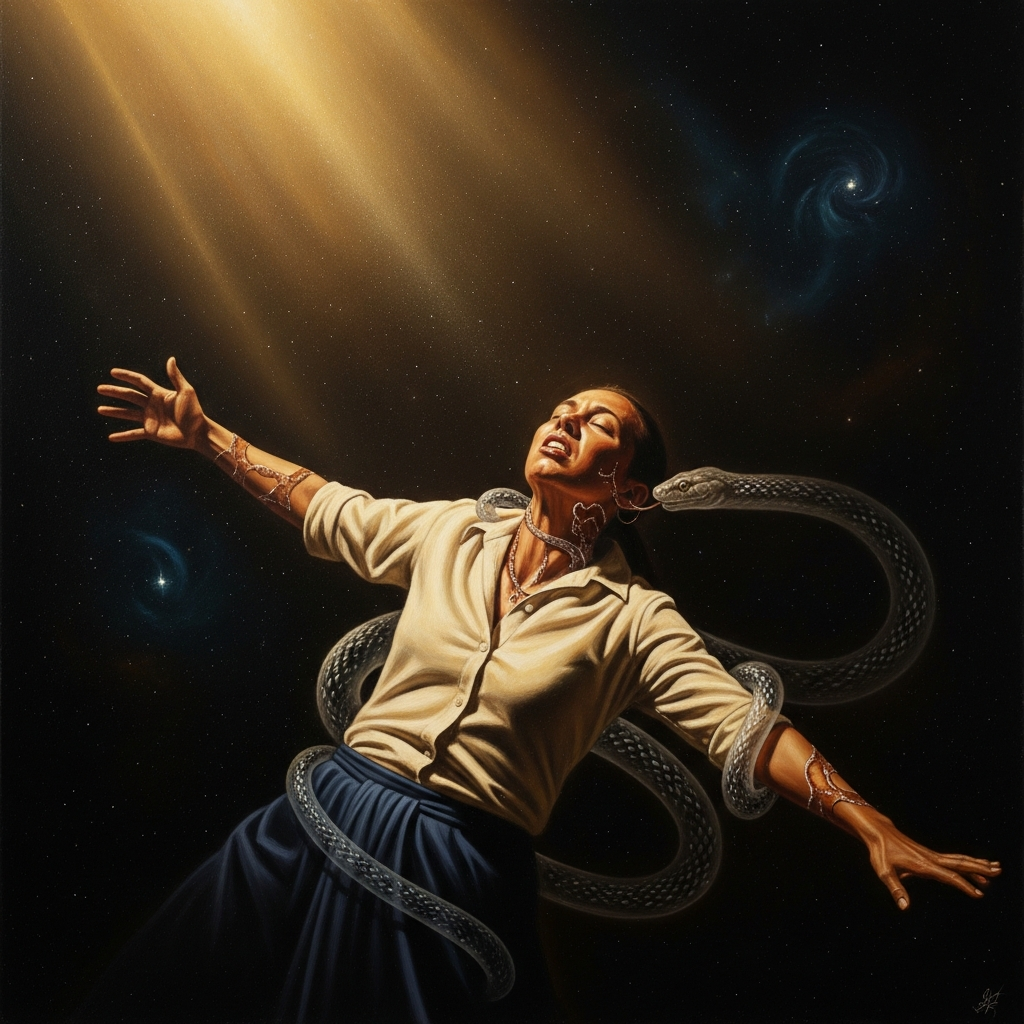
The drums shift. The lead drummer begins the kasé — the break, the rhythmic stutter that pulls the dancer off the beat the way a fisherman jerks a line. Her shoulders snap. Her head whips back. Her arms go rigid for one moment and then loose, completely loose, and her face — her face changes.
She falls.
She does not collapse. She folds, knees first, then hips, then forehead to the earth, like cloth being put down, and a sound comes out of her that no human throat has been making — a low, wet, sustained hisssssss, two octaves below where her voice usually lives, and her tongue flicks once between her lips, twice, three times.
The assembly steps back. They have seen it before but they are never bored.
The mambo bows.
Damballah Wedo, she says. You are welcome.
The loa lifts the serviteur’s body and stands.
He does not stand the way the woman stood. The shoulders are drawn back. The head is held very still on a long neck. He moves across the floor in a single fluid line, no shuffle, no step — the body advances as if floating an inch above the packed earth. He does not speak. Damballah almost never speaks; he is older than language. The hissing continues, soft now, almost a sigh.
Someone brings the offerings.
A white plate. A whole raw egg. A small heap of white flour. A small pitcher of white milk. A handful of white rice. Damballah takes the things that are white, the way snakes love the light.
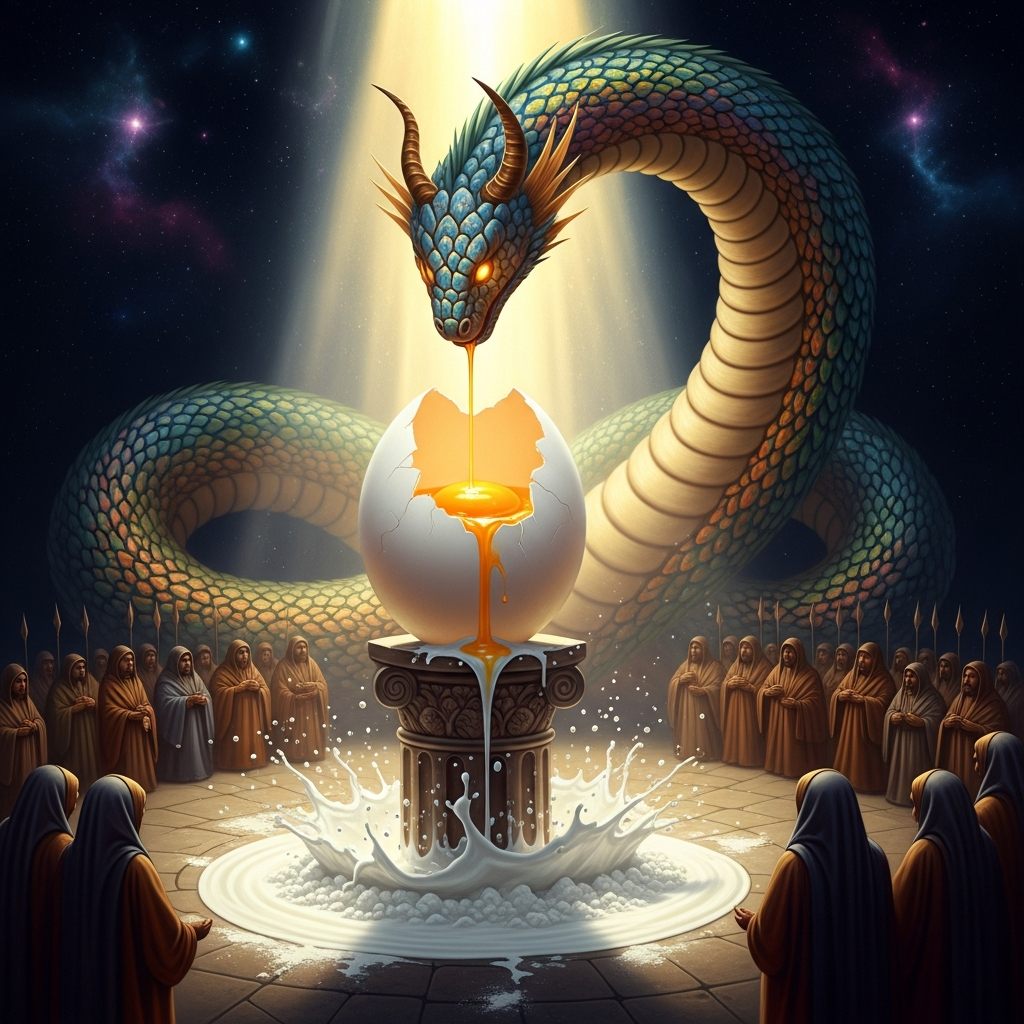
The houngan — Vodou priest, the male counterpart of the mambo — kneels at the poto-mitan and cracks the egg against the post. The yolk breaks across the wood and runs down. The flour is sifted onto the running yolk. The milk is poured. The white libation slides down the post and pools at the base. Damballah bends and dips a finger in the pool and brings it to his lips and the assembly sighs as one body.
This is the libation. The cosmic serpent is drinking the world’s whiteness, the milk and the egg and the flour — the things that are pure, the things that are unmarked, the things that came before the colors. He is being fed the dawn.
He moves to each member of the assembly.
He does not speak, but he places his hand — the serviteur’s hand, but also not — on the foreheads of the petitioners. A woman whose son is sick. A man whose business is failing. An old woman who simply wants to be near the loa one more time before she dies. He hisses softly over each of them. Some of them cry. One man laughs out loud, a single sharp bark, and then sits down hard on the ground, smiling like a child.
The houngan watches the time. Damballah cannot stay long. The serviteur’s body is not built for the cosmic serpent — no human body is — and the longer he stays, the harder the dismount. Twenty minutes is normal. Forty is dangerous.
A drummer begins the kongo rhythm, the rhythm that asks the loa politely to release the horse. Damballah lingers a moment more, looks once at the painted lithograph nailed to the central post — Saint Patrick of Ireland, driving the serpents into the sea, an old French print, the saint with his bishop’s crook and his green robes — and the assembly catches a sound that might be laughter, the low hiss bending upward.
He has worn that face for two hundred years. He finds it funny every time.
He leaves the way he came.
The serviteur folds again, knees first, then hips, then forehead to the earth. The hissing stops. For a long moment she is empty — just a body draped on the packed dirt, breathing. Two of the assembly come forward and lift her gently and carry her to a mat at the side of the peristil. They wrap her in a clean white cloth. They wipe her face. They give her water.
She sleeps.
She will not remember the twenty minutes. She never does. When she wakes in an hour or two, she will ask what the loa said, and the houngan will tell her, and she will nod the way you nod when someone tells you what your sleeping face looked like.
The drums shift again — into the rhythm of Ogou, who is being called next, the warrior loa who is also St. James the Greater on a white horse, and the ceremony moves on. The veve of Damballah is still drawn on the earth, slightly smudged now where the libation pooled. By morning it will be gone, brushed away with the rest of the ritual debris, the way the old serpent uncoiled the world and then withdrew into the mountains and the deep waters.
Damballah is the oldest loa in the Haitian pantheon and the most peaceful. He is so old he predates speech. He came across the Atlantic in the holds of slave ships in the bones and the songs of Yoruba and Fon people who refused to forget him. In the colony of Saint-Domingue, where the planters demanded the slaves be baptized Catholic, the slaves looked at the lithographs of the saints the priests handed them — and looked at St. Patrick driving the serpents into the sea — and decided, with the dark hilarity of the colonized, that this was Damballah. They hid him in plain sight.
The synthesis was not a confusion. It was a strategy. Behind every Catholic saint in a Haitian household altar, there is a loa whose African name was kept alive by the very mask that was supposed to bury it. St. Patrick is Damballah. The Virgin of the Sorrows is Erzulie. St. James the Greater is Ogou. The colonial church taught the slaves the saints; the slaves taught the saints to dance.
And when, two centuries after the first drums in Saint-Domingue, the cornmeal veve is still drawn on a packed-earth floor and the egg cracks against the central post and the serviteur folds at the knees and the long hiss begins — the old serpent is still answering. The diaspora is not an extinction. The diaspora is a translation that kept the original.
Scenes
The mambo draws the veve in cornmeal at midnight; the drums begin and the assembly enters the peristil
 Generating art…
 The serviteur shudders, falls, and rises hissing — Damballah has mounted the horse
 Generating art…
 The white egg cracks on the central post, the milk and the flour mingle, and the great serpent blesses the assembly before departing
 Generating art…
 Echoes Across Traditions
Entities
- Damballah Wedo
- Ayida-Wedo (his rainbow consort)
- Legba (gatekeeper of the loa)
- the houngan and mambo
- St. Patrick (the Catholic mask)
Sources
- Maya Deren, *Divine Horsemen: The Living Gods of Haiti* (1953)
- Alfred Métraux, *Voodoo in Haiti* (1959, English translation 1972)
- Karen McCarthy Brown, *Mama Lola: A Vodou Priestess in Brooklyn* (1991, updated 2001)
- Leslie G. Desmangles, *The Faces of the Gods: Vodou and Roman Catholicism in Haiti* (1992)
- Donald Cosentino (ed.), *Sacred Arts of Haitian Vodou* (1995, UCLA Fowler Museum)