Toussaint Louverture: The Revolution He Did Not Start and Could Not Stop
August 1791 (Bois Caïman and the rising) through April 7, 1803 (Toussaint's death in Fort de Joux) and January 1, 1804 (Haitian independence) · Saint-Domingue (Haiti) — the northern plains, Cap-Français, the mountains; Fort de Joux in the Jura mountains of France
Contents
Haiti, 1791. Toussaint Louverture — 48, literate, a former slave who has read Julius Caesar and Epictetus — hears that the north has risen. He has a vision, or a decision, and joins the only slave revolution in history to found a nation. He negotiates, fights, governs, is betrayed by Napoleon, and dies in a French prison in 1803. Haiti is free in 1804.
- When
- August 1791 (Bois Caïman and the rising) through April 7, 1803 (Toussaint's death in Fort de Joux) and January 1, 1804 (Haitian independence)
- Where
- Saint-Domingue (Haiti) — the northern plains, Cap-Français, the mountains; Fort de Joux in the Jura mountains of France
He hears the news on the morning of August 23, 1791.
He hears it the way all important news travels in Saint-Domingue: in pieces, from different directions, each piece slightly different from the last because the colony’s communication is the whisper network of the enslaved, which is simultaneously the most reliable and the most distorted information system on the island. What the pieces add up to is this: the northern plain is burning. Two hundred delegates met in a forest clearing eight days ago. Dutty Boukman spoke a prayer. A mambo was mounted by a warrior-mother loa. A pig was slaughtered. An oath was sworn. And now the Plaine du Nord is on fire and the plantation owners are running toward Cap-Français and the enslaved people of the north have risen and it has begun.
Toussaint is 48. He is literate, which is unusual. He is a freed man — freed in 1776 by the plantation owner who valued his work as a coachman and sometime overseer — which means he has spent the last fifteen years in the peculiar position of the freedman in a slave colony: legally free, practically surveilled, economically marginal, perpetually aware that his freedom is a permission granted by a system that granted nothing without reservation. He has read Julius Caesar in French translation. He has read Epictetus, the Stoic philosopher who was himself enslaved and taught that no one can enslave the mind that refuses enslavement.
He has been thinking about this for a very long time.
What happens next is the subject of considerable historical debate.
The romantic version: Toussaint hears the news and experiences a vision — the lwa Ogou descends, or an angel appears, or simply the voice of his own conscience arrives at the volume of a command — and he knows, in the way prophets know things, that he must join the revolution.
The realistic version: Toussaint hears the news and spends several days making the most careful and consequential strategic calculation of his life. He is not young. He is not reckless. He has spent fifteen years observing the colony’s military structure, its communication networks, its vulnerabilities. He has also spent fifteen years watching every previous rebellion fail — watching Makandal executed in 1758, watching the free colored uprisings of the 1780s suppressed with brutal efficiency, watching the colony’s capacity for violence deployed against every challenge to its order.
He joins anyway, in late August or early September 1791. He spends the first weeks helping the enslaved people under his protection escape to safety — the men and women of the plantation where he worked — before joining the rebel army as a medical officer and then rapidly as a military commander. Within months, his tactical genius is visible to everyone who sees him in the field.
The vision and the decision are probably the same thing. In the Vodou tradition, the lwa descends into a person because the person is ready. Toussaint was ready.
He fights the Spanish. He fights the British. He fights the French. He fights his own side.
The military history of the Haitian Revolution between 1791 and 1803 is so complex that historians who have devoted careers to it still argue about its architecture. What is clear is that Toussaint Louverture becomes the decisive military figure on the island within four years of joining the revolution. He fights for Spain against France when the Spanish offer freedom to enslaved fighters. He switches to France when the French Republic abolishes slavery in 1794 — a move that is simultaneously principled (it is the right side) and strategic (France is now the more powerful patron). He defeats the British expeditionary force that occupies the western coast of the island, ending the British experiment in Saint-Domingue in 1798. He consolidates power across the island, including the Spanish colony on the eastern end.
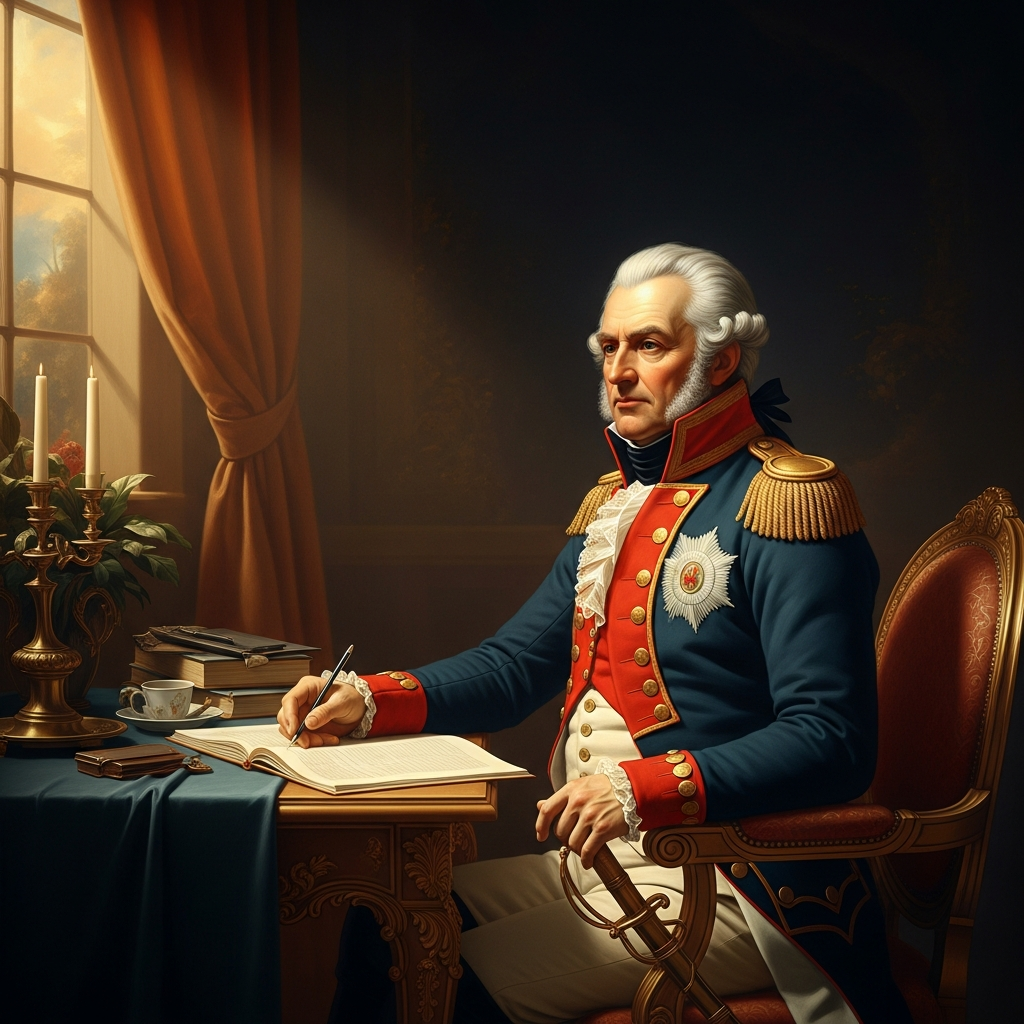
He does all of this while governing. He writes letters. He negotiates treaties. He administers agricultural policy. He composes a constitution. The constitution of 1801 — which he dictates to secretaries and has printed in Cap-Français — declares him Governor-General for life and declares Catholicism the state religion and, buried in its provisions, effectively asserts the sovereignty of the colony against French control.
Napoleon reads it and decides that Toussaint Louverture must be removed.
The revolution is a Vodou ceremony throughout.
This is not metaphor. The generals who fight under Toussaint — Dessalines, Christophe, Pétion — are initiated into the lwa before battle. The flag that the rebellion fights under is a Vodou flag — sacred banners, drapo, of the kind displayed in every peristil, inscribed with the veve patterns of the warrior lwa. The soldiers sing Vodou songs in the field. When the Petwo lwa — the hot, fierce, revolutionary lwa of the Haitian nation, as opposed to the cooler Rada lwa carried from West Africa — are invoked before an engagement, the fighters experience what their tradition calls chwal, being mounted: the warrior lwa occupying the body, removing fear, bringing the divine force of Ogou’s iron into the arms of the fighter.
Toussaint himself is a Catholic — deeply, sincerely, complicated by his knowledge of Epictetus and Caesar but genuine. His relationship to Vodou is the relationship of a man who does not practice it himself but respects its function in the lives of the people he is responsible for. He does not suppress it. He could not have led the army without it.
The revolution is the place where the Enlightenment meets Ogou and finds they agree on the conclusion, if not the vocabulary.
In 1802, Napoleon’s betrayal arrives in ships.
Twenty thousand French troops under General Leclerc — Napoleon’s brother-in-law — anchor in the harbor of Cap-Français. Their orders are to retake the colony, restore the authority of the French Republic, and, in secret orders, to reimpose slavery. Toussaint negotiates. He is told that French authority will be respected, that the rights of the freed population will be protected, that he himself will be given a role in the new administration.
He negotiates in good faith. This is the decision that his admirers have most difficulty accounting for: how could a man this intelligent trust Napoleon’s representatives? The answer may be that Toussaint understood the military situation — that fighting the French with his forces fully committed would result in the destruction of what he had built — and chose a negotiated submission that he believed could be reversed once the political situation in France changed.
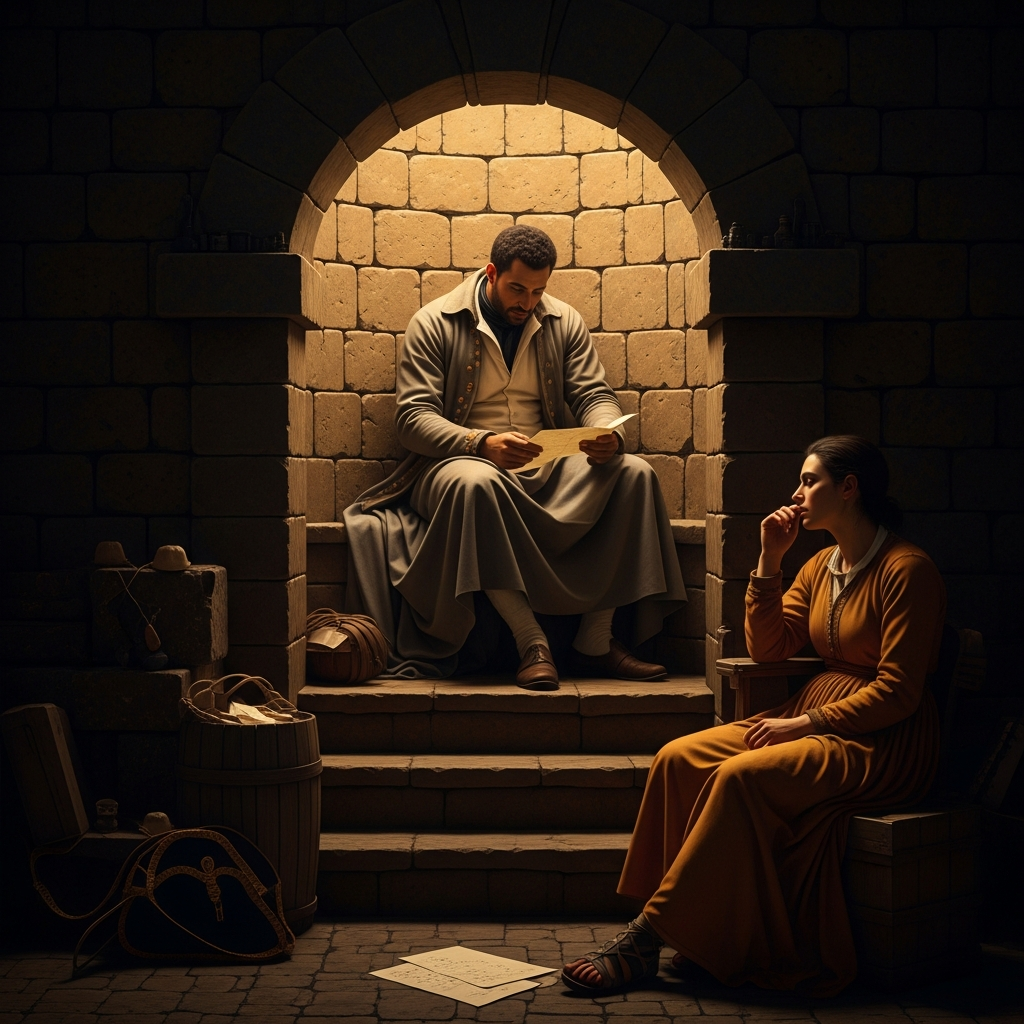
He is arrested in June 1802 at a meeting that was supposed to be a negotiation. The French officers seize him, his wife, his children, and his papers. He is transported to France in chains on a ship called the Héros. He is taken to Fort de Joux in the Jura mountains — a prison on a high rock, cold even in summer, brutal in winter — and placed in the highest cell.
He dies on April 7, 1803.
The cold comes through the stone walls. He is 60 years old. He has been in the cell for less than a year, but malnutrition and pneumonia and the altitude have done the work that military defeat could not. He writes to Napoleon several times. Napoleon does not respond. He asks for his papers, his letters, his records. They are withheld. He asks for a fire in the cell. It is insufficient.
The last authenticated account of him is a prison guard’s report from the week before his death: an old man, sitting upright in a chair near the inadequate fire, not sleeping, not eating much, not speaking. Still, in the soldier’s phrase, digne — dignified.
In Saint-Domingue, the revolution continues without him. Yellow fever kills General Leclerc in November 1802. Yellow fever kills thousands of French soldiers faster than the rebels can. By the fall of 1803, Napoleon has accepted that Saint-Domingue is gone. He sells the Louisiana Territory to Thomas Jefferson for fifteen million dollars — an emergency sale, a liquidation of New World ambitions — and the United States doubles in size because a Haitian revolution made it impossible for France to hold the North American continent.
On January 1, 1804, in the city of Gonaïves, Jean-Jacques Dessalines tears the white stripe out of the French tricolor and sews the blue and the red back together. He names the new nation Haiti — the Taino word, the original word, the name the island had before Columbus — and declares independence. He is the first head of state in the modern world born into slavery.
Toussaint has been dead for nine months.
The Vodou tradition says he is with the lwa.
The Haitian national consciousness places him somewhere between history and myth, in the way that great men who die before the victory are always placed: he made the victory possible and did not survive to see it, which is the particular tragedy that tends to produce saints. Dessalines’s harsher genius finished what Toussaint’s more complex genius began.
At the crossroads of every Haitian cemetery, the Gede lwa hold the dead. In the Vodou ceremony on the night before a battle — in 1791, in 1802, in every year that Haiti has had to defend itself, which has been most years — Ogou is called in his red and his blue, the colors of the flag, and he comes in the body of a fighter, and the fighter goes into the field knowing that the warrior lwa is with them.
The revolution is not over, the tradition says. The revolution is the permanent condition of a people who have once decided that slavery is unacceptable. It is renewed in every ceremony. It is present in every veve of Ogou drawn on the floor of every peristil.
In 1802, Napoleon wrote in a private memo: “I should never have abandoned Haiti.” He wrote it after the defeat, after Leclerc was dead, after the army was broken and the Louisiana Territory sold. He was right, but not in the way he meant. He abandoned Haiti because Haiti refused to be held. The revolution that began in a forest clearing with a priest’s prayer and a pig’s blood and a Vodou ceremony was too much for the most powerful military force on earth. Toussaint Louverture read Caesar and Epictetus and the lwa Ogou in the body of the fighters and understood something Napoleon did not: that a people who have decided they are free cannot be made unfree by force alone. Force only confirms the decision.
Scenes
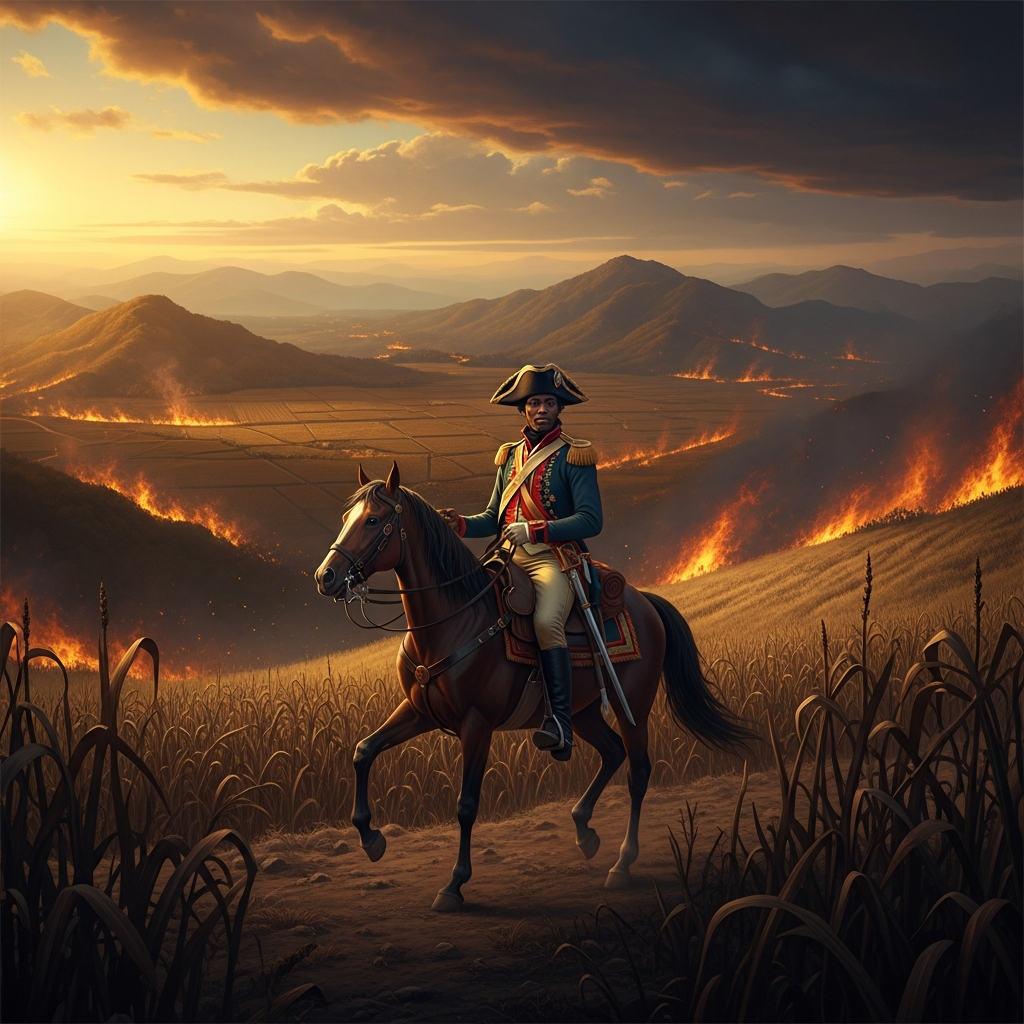
Toussaint Louverture on horseback in the northern mountains of Saint-Domingue — the hills behind him lit with the burning cane fields of the Plaine du Nord
Generating art… Toussaint as Governor-General of Saint-Domingue, 1801 — in uniform, at the table where he dictated the colony's first constitution, which declared himself governor-for-life and implicitly asserted sovereignty
 Generating art…
 Fort de Joux in the Jura mountains of France, winter 1802–1803
 Generating art…
 Echoes Across Traditions
Entities
- Toussaint Louverture (general, governor, revolutionary)
- Dutty Boukman (houngan, leader of Bois Caïman ceremony)
- Jean-Jacques Dessalines (general, first emperor of Haiti)
- Napoleon Bonaparte (French consul who ordered Toussaint's capture)
- Ogou (the Vodou warrior lwa, patron of the revolution)
Sources
- C.L.R. James, *The Black Jacobins: Toussaint L'Ouverture and the San Domingo Revolution* (1938, revised 1963)
- Madison Smartt Bell, *Toussaint Louverture: A Biography* (2007)
- Laurent Dubois, *Avengers of the New World: The Story of the Haitian Revolution* (2004)
- Carolyn E. Fick, *The Making of Haiti: The Saint Domingue Revolution from Below* (1990)
- David Geggus (ed.), *The Haitian Revolution: A Documentary History* (2014)