Papa Legba Opens the Gate
The eternal present of every Vodou ceremony · synthesis crystallized 1700–1804 in Saint-Domingue · The peristil — the open-walled temple of Haitian Vodou; the crossroads between the human world and the realm of the lwa
Contents
No ceremony begins in Haitian Vodou until Papa Legba — the old man at the crossroads, keeper of the gate between worlds — has been greeted, fed, and asked permission. He was carried across the Atlantic in the memory of enslaved West Africans. He is still there, leaning on his crutch, speaking every language at once.
- When
- The eternal present of every Vodou ceremony · synthesis crystallized 1700–1804 in Saint-Domingue
- Where
- The peristil — the open-walled temple of Haitian Vodou; the crossroads between the human world and the realm of the lwa
The drums stop before they start.
This is the first rule and the most important: before any ceremony in Haitian Vodou can begin, before any drum can speak, before any lwa can be called, before any prayer can ascend the poto-mitan — the central post that joins the world of the living to the world of the spirits — Papa Legba must be asked permission. The mambo faces east. The assembly waits. The drums are silent in a particular way, the way silence is silent when it is holding something.
She begins the song that every mambo and houngan has sung before every ceremony for three hundred years, in the colony and the republic and the diaspora:
Atibon Legba, ouvri baryè-a pou mwen, agoé.
Papa Legba, open the gate for me.
He takes his time.
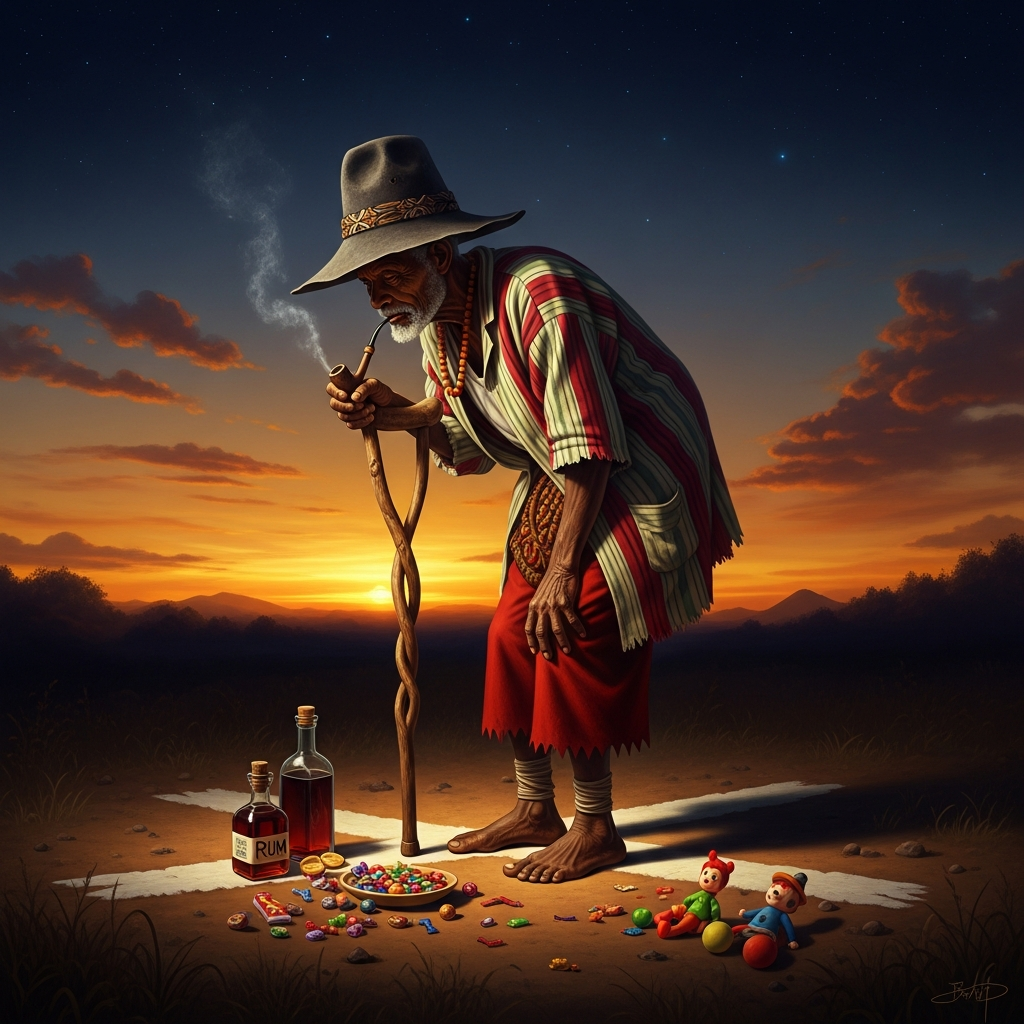
He always takes his time. This is the first thing you learn about him: Papa Legba is in no hurry. He is old — older than the Caribbean, older than the colony, older than the crossing — and his body, when he arrives in the body of a cheval, is always the body of an old man: bent, one leg dragging, leaning on a wooden crutch or a gnarled staff, face creased and patient and amused. He wears a wide-brimmed hat against the sun that no longer touches him. He smokes a pipe with tobacco that is always lit. He speaks all languages because he has been listening at every crossroads since language was invented.
He is not lazy. He is deliberate. There is a difference.
He arrives — not dramatically, not in the flash and violence of Ogou’s lightning arrival, not in the slow ophidian glide of Damballah — he simply appears to be present. One moment the cheval is a woman dancing the yanvalou, and the next moment an old man is moving through the ceremony on her legs, slower, more careful, pausing to lean on the wall and cough and spit and look around with the sharp eyes of someone who has seen this peristil before and everyone in it.
He greets each person.
This is what Legba does that the other lwa do not always do: he moves through the assembly person by person, touching a shoulder here, squeezing a hand there, looking directly into the face of each petitioner with an expression that is not pity and is not indifference but is something between — the look of someone who knows the full weight of what you are carrying and is not surprised by it. He has heard heavier. He has seen worse. He is still opening the gate.
A child at the edge of the assembly reaches up and touches the sleeve of the cheval — the old man in the woman’s body — and Legba stops. He looks down at the child for a long time. He reaches into the pocket of the garment and produces a piece of hard candy, red, wrapped in foil, and hands it down without a word. Children and Legba have always understood each other. He is the guardian of the threshold, and children are always crossing thresholds.
He moves on. The drums have begun softly behind him, the yanvalou rhythm that honors him — slow, undulating, the rhythm of someone walking a long road with dignity.
The mambo speaks to him.
She has been waiting her turn. She stands at the base of the poto-mitan with a small clay pot of rum and a handful of roasted corn — his offerings — and she speaks in Kreyòl, the language that was assembled from West African grammars and French vocabulary by enslaved people who needed to speak to each other without being understood, the language that Legba speaks like a native because he was present when it was built.
She tells him what the ceremony is for. A woman is sick and her family wants the lwa’s guidance. A man is at a crossroads — literally: two paths in his life, and he does not know which to take. A young woman is ready for initiation, for the kanzo ceremony that will make her asogwe, and the spirits must be consulted. Legba listens with his head tilted, the way old men listen when they are actually listening.
He takes the rum. He pours a small amount on the ground at the base of the post — a libation to the dead below, to the ancestors who hold up the floor of the living world. He drinks the rest. He takes the corn. He eats it slowly, methodically, without rushing, and the assembly waits and the drums breathe their slow breath.
When he is done, he nods once.
The gate is open.
The ceremony opens like a flower.
The drums shift — from the yanvalou of Legba into the rolling invitation of Damballah, and then the martial pounding of Ogou, and then the sweet seductive rhythm of Erzulie Freda, each lwa called in order, each arriving or not arriving according to their own will. But none of them would have come if Legba had not first opened the gate. They flow through the opening he makes. He is the doorway through which every divine voice must pass.
He stays through much of the ceremony. He does not mount a cheval continuously — he moves in and out of the woman’s body, and between possessions she rests and drinks water and does not remember — but he is present in the way the crossroads is always present: the intersection that does not cease to be an intersection because you are not looking at it.
At some point, near the end of the ceremony, the old man pauses near the eastern gate of the peristil. He looks out at the road beyond — the night road that runs north toward the mountains and south toward the city, the road that is every road at once. He stands there for a long moment, leaning on his crutch, smoking his pipe.
He was there before the boats.
He was there in the Bight of Benin and the Slave Coast, in the Yoruba city-states where he was Eshu, the trickster who walks between worlds, the orisha at the crossroads of all divine communication. He was there when the ships came. He was there in the holds — not visible, not in a body, but present in the words people whispered to each other in the dark: the prayers, the names of the ancestors, the rhythms of the songs that kept something alive during six weeks in the dark of the hull.
He arrived in Saint-Domingue already changed. The crossing does that. The Eshu who crossed the Atlantic was not the same Eshu who left West Africa — he had been through the crossing himself, and the crossing is the crossroads of all crossroads, the place where a whole civilization’s relationship with itself was severed and had to be rebuilt from memory. In the colony, among the Fon and Ewe and Yoruba and Kongo people who were thrown together on French sugar plantations, Legba became something new: the guardian not just of any crossroads but of the crossing, the one that could not be undone.
They gave him a Catholic face. Saint Peter with his keys. Saint Lazarus on his crutches. Behind each face: the same old man, the same pipe, the same amused and sorrowful patience.
He closes the gate when he is ready.
The cheval folds at the knees. She is returned. The ceremony continues around her as she is wrapped and cared for and laid to rest. The drums move on to the next rhythm, the next lwa, the next petition. But the first opening — the permission that made all of it possible — that was Legba’s work, and it is done.
The mambo sings the closing song as dawn begins to gray the edges of the sky:
Papa Legba, fèmen baryè-a dèyè mwen. Merci.
Papa Legba, close the gate behind me. Thank you.
He has been opening and closing gates since before the colony was a colony, since before the island had a French name, since before the drums on this island were the drums of this tradition. He will be opening gates when all of this is done. He is the first word of every ceremony and the last. Without him, nothing passes. With him, everything can.
Scenes
Papa Legba stands at the crossroads at dusk — an old man bent over a twisted wooden crutch, a pipe in his teeth, his wide-brimmed hat shading a face that has seen every crossing there is
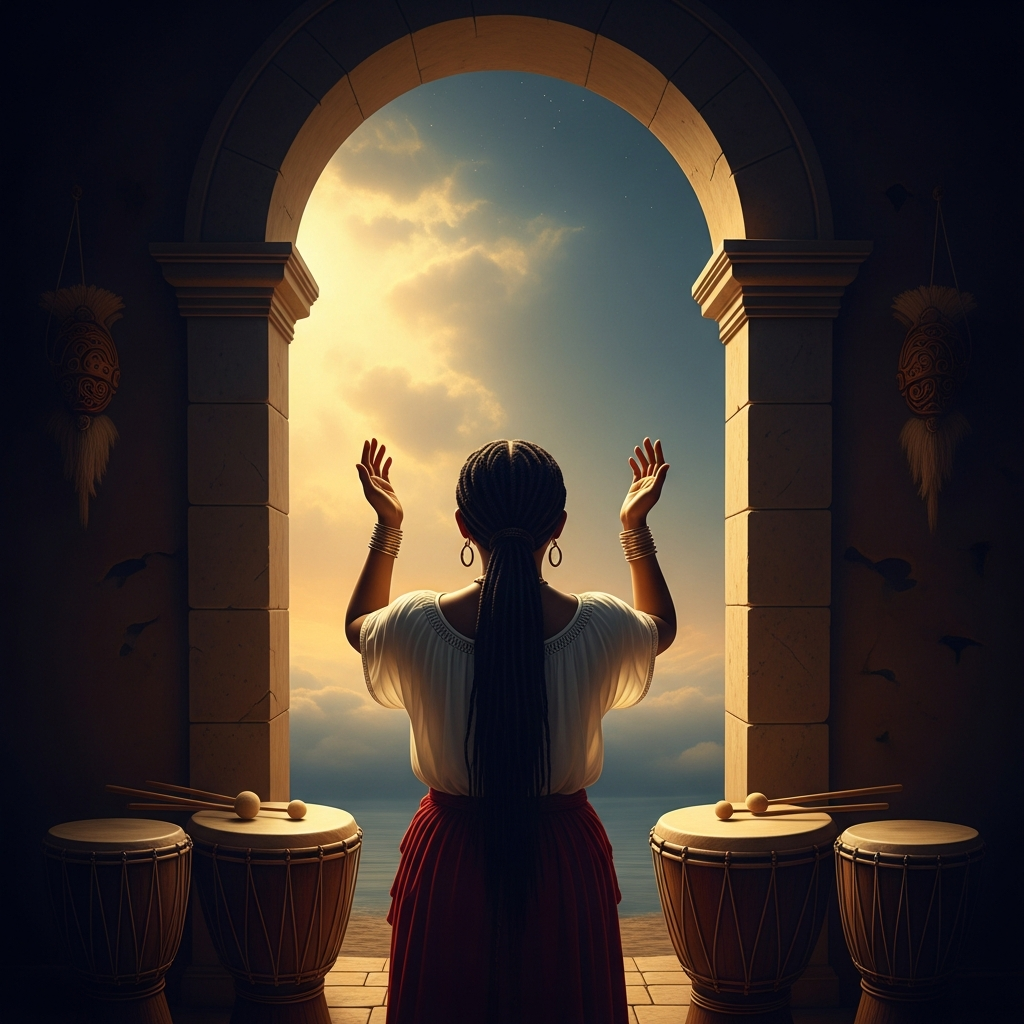
Generating art… The mambo faces the eastern post of the peristil, her hands raised, calling the Vodou liturgy's oldest words: 'Atibon Legba, ouvri baryè-a pou mwen' — Papa Legba, open the gate for me
 Generating art…
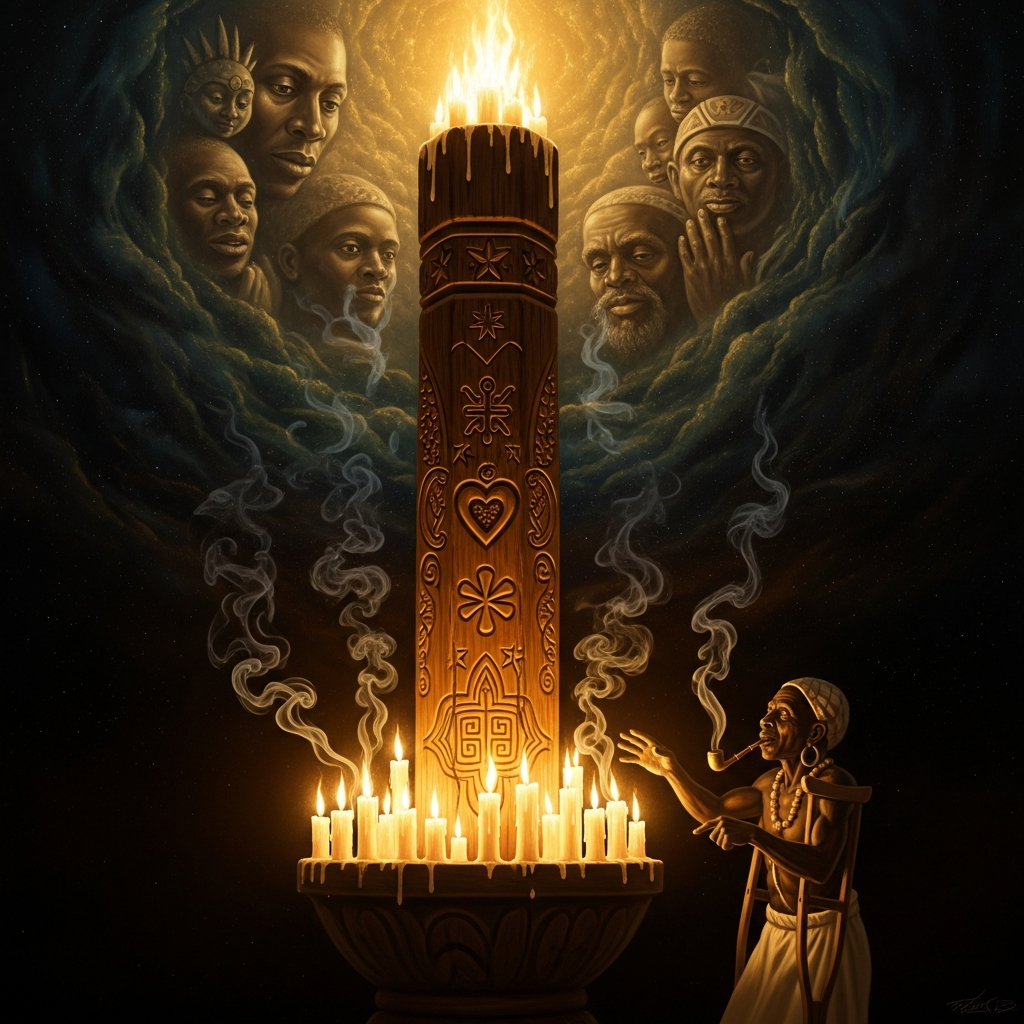
 The poto-mitan — the central post that connects the living world to the realm of the lwa — blazes with candle flame
 Generating art…
 Echoes Across Traditions
Entities
- Papa Legba (lwa of crossroads and communication)
- Eshu/Elegba (his Yoruba ancestor)
- Atibon Legba (his elder, more ancient aspect)
- the mambo (Vodou priestess)
- the hounsi (initiates of the ceremony)
Sources
- Maya Deren, *Divine Horsemen: The Living Gods of Haiti* (1953)
- Alfred Métraux, *Voodoo in Haiti* (1959, English translation 1972)
- Karen McCarthy Brown, *Mama Lola: A Vodou Priestess in Brooklyn* (1991, updated 2001)
- Leslie G. Desmangles, *The Faces of the Gods: Vodou and Roman Catholicism in Haiti* (1992)
- Robert Farris Thompson, *Flash of the Spirit: African and Afro-American Art and Philosophy* (1983)