The Fox Who Keeps the Account
Edo Period, approximately 1750 CE; mythic time extends to the founding of Fushimi Inari Taisha, 711 CE · Edo (Tokyo); Fushimi Inari Taisha, Kyoto; the rice fields at the edge of the city
Contents
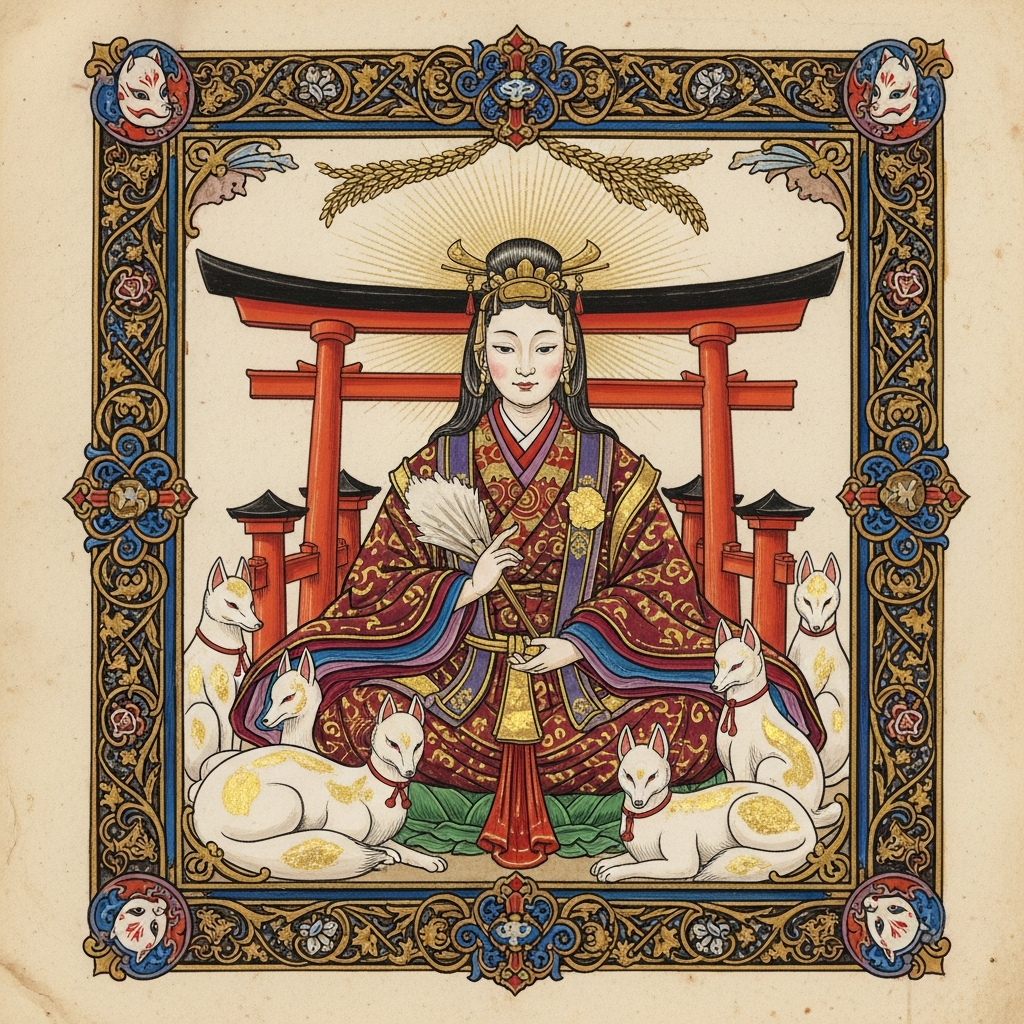
Inari Okami — kami of foxes, rice, fertility, and worldly success — is the most widely worshipped deity in Japan. A failing rice merchant in Edo comes to an Inari shrine in desperation and encounters the fox who lives there. The fox is not a miracle worker. It is a keeper of debts. The merchant learns that all abundance has a prior offering, and the fox has been counting.
- When
- Edo Period, approximately 1750 CE; mythic time extends to the founding of Fushimi Inari Taisha, 711 CE
- Where
- Edo (Tokyo); Fushimi Inari Taisha, Kyoto; the rice fields at the edge of the city
There are thirty thousand Inari shrines in Japan.
This is the fact that the mythology rests on, the number that tells you what kind of deity you are dealing with before you read a single text. More than any other kami — more than Amaterasu, more than Susanoo, more than the great deities of the Kojiki who created the islands and set the sun in the sky — Inari is the one people actually go to when they need something. Rice. A pregnancy. A successful business. A sharp sword. A good harvest. Sake that sells. The swords at Inari shrines are famous; so are the fox statues flanking the torii gates, stone or ceramic, each holding in its mouth the key to the rice granary, or a scroll, or a jewel, or a sheaf of grain. The fox is not the deity. The fox is the messenger, the intermediary, the one who runs between the human world and Inari’s realm. But in practice — in the practice of thirty thousand shrines staffed by priests and visited by supplicants over thirteen centuries — the fox and the deity have become difficult to separate.
This is the story of a merchant who learned why.
His name, for the purposes of this account, is Yasubei. He trades in rice — buying from the farming villages west of Edo, selling to the wholesale merchants in the city, living on the margin between the harvest price and the market price, which is a margin that the weather, the shogunate’s grain policies, and the unpredictability of the river routes can erase in a single season. He has a wife, two apprentices, a warehouse near the water, and a debt that has grown large enough to have its own weight. The harvest that year was bad. The river route was disrupted by flooding in the eighth month. The merchant who usually buys from him found another supplier. The debt’s weight presses on him when he tries to sleep and is still there when he wakes.
He goes to the Inari shrine before dawn because that is when the fox is likeliest to be visible.
Everyone in Edo knows this. The foxes of Inari move at the borders of day and night, in the light that is neither one thing nor the other. If you want to encounter one, you go before the sun rises and you wait with an offering of abura-age — the fried tofu that foxes favor — and you keep very still and you do not let your desperation smell too strongly, because foxes can smell desperation and it makes them cautious.
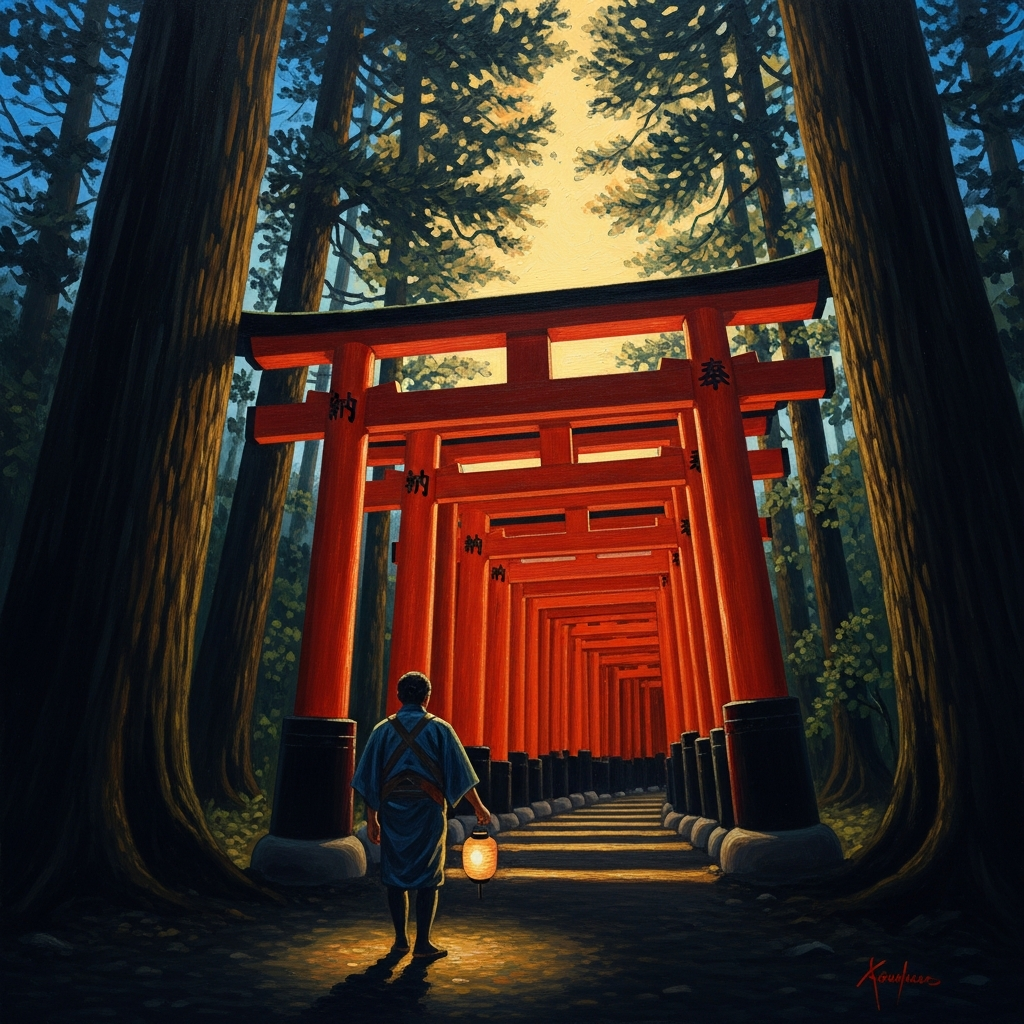
He has brought the abura-age. He passes through the vermillion torii gates one by one — there are dozens, a tunnel of lacquered wood in the cedar dark — and he arrives at the inner shrine and sets the offering before it and bows and waits. He recites what he wants. The words feel thin in the cold air. He is asking for a reversal of fortune, which is what everyone who comes here in the pre-dawn is asking for, and he has the sense, standing in the dark before the stone foxes with their carved-keyhole eyes, that the shrine has heard this particular request before and is not especially moved by it.
The fox appears from the cedar at his left.
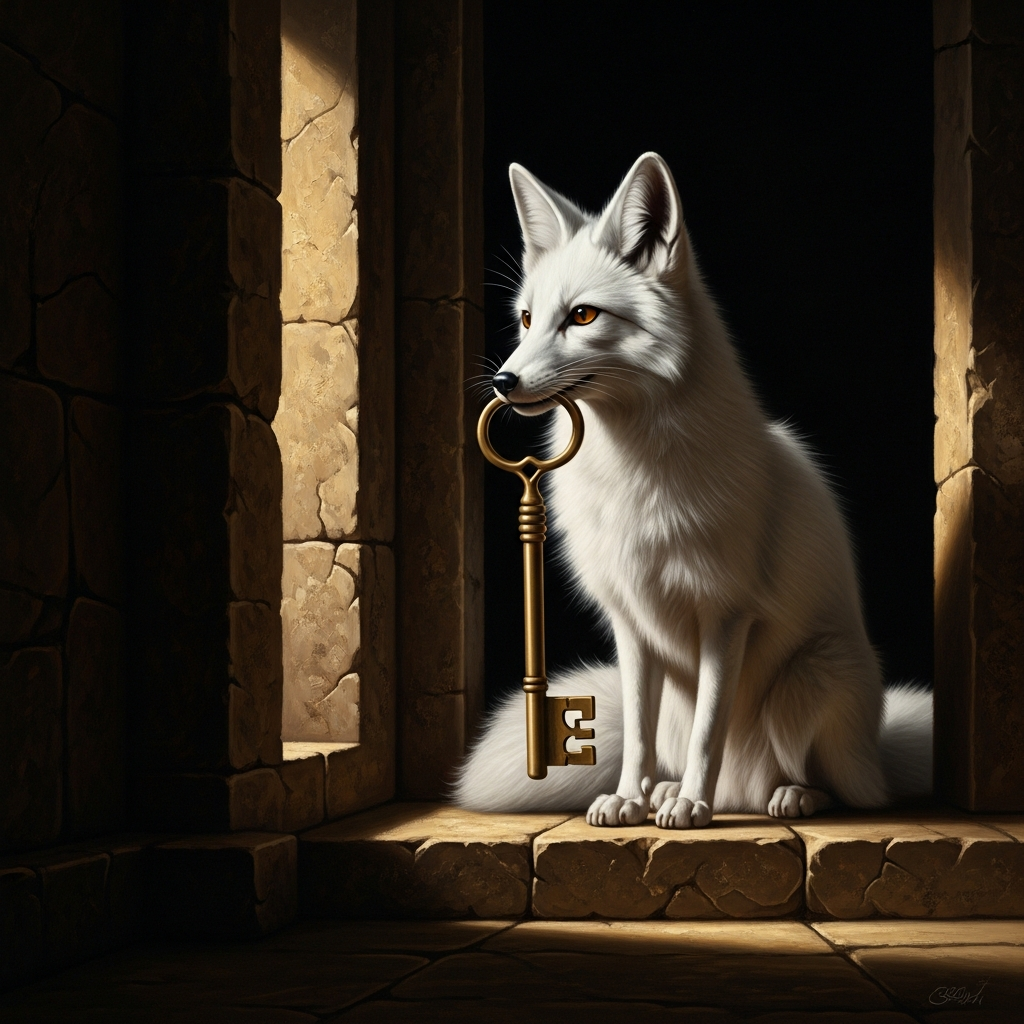
It is white — which is the color of the divine in Japan, the color of the shroud and the color of the shrine robe, the color that belongs to what is not quite of the ordinary world. It is larger than a natural fox. It sits at the edge of the lantern’s reach and watches him with a stillness that is not animal stillness but something else, something more like the stillness of a clerk reviewing a ledger.
It does not speak. In this telling, it does not need to. What it does is wait.
Yasubei speaks into the waiting. He explains his situation — the harvest, the flooding, the lost buyer, the debt. He explains what he needs. He explains that he has been faithful to the shrine, that he comes every new year and every harvest festival, that his family has maintained an Inari altar in their home for three generations. He is building a case for himself the way a man builds a case when he is afraid the verdict is already decided.
The fox continues to watch him.
And in the watching — in the quality of attention the fox brings to his recitation — Yasubei begins to hear his own words differently. The new year visit: he came, but he brought dried fish, not the abura-age the fox prefers, because the dried fish was cheaper. The harvest festival: he came in the afternoon, after his business was done, in a hurry, and he burned incense quickly and left without sitting in the prayer. The altar at home: his wife maintains it, not him; he passes it every morning on the way to the warehouse and does not stop.
He stops talking.
The theology of Inari is not a theology of miracles. This is the insight that the thirty thousand shrines encode in their architecture, in the arrangement of the stone foxes with their granary keys, in the fried tofu left at the base of the altar and not in the fire. You do not offer to Inari in order to receive. You offer to Inari because you have already received — the rice that grew, the rain that came at the right time, the market that was there when you needed it, the body that is strong enough to carry sacks of grain — and the offering is the acknowledgment that none of this was free, none of it was self-generated, none of it was purely the product of your industry and intelligence and willpower. The fox keeps the account. The fox has always kept the account. The granary key in its mouth is not a gift waiting to be given — it is a record of what has already been lent.
Yasubei’s ledger, as the fox’s silence helps him read it, shows that he has been drawing on a credit he stopped replenishing three years ago, when the business got good enough that he stopped feeling the need.
He does not receive a miracle that morning. The debt does not dissolve. The missing buyer does not reappear. What happens is smaller and more durable: he goes home and he sits before the household altar, the one his wife has been maintaining in his absence, and he makes a proper offering. He comes back to the Inari shrine the next morning, and the morning after that. He brings the right offering and he stays long enough to sit with the stillness rather than filling it with his case. He sends a portion of whatever he earns, even in the lean weeks, to the shrine fund that maintains the cedar grove. He begins to notice, in the discipline of the offering, that the abundance he had before the bad season was not the result of his own cleverness alone — it was the convergence of things he did not control and cannot claim credit for, tended by something he had stopped tending in return.
The business recovers. Not quickly. Not dramatically. The flooding recedes, the routes reopen, a new buyer appears in the spring market. The fox at the inner shrine is there some mornings and absent on others, and Yasubei learns to bring the offering regardless, because the theology of Inari is not conditional on the fox’s presence. The account is being kept whether or not the keeper is visible.
What Inari worshippers understand, and what thirty thousand shrines encode in vermillion wood and stone fox and granary key, is that abundance is borrowed, not owned. The rice came from a seed the deity made possible. The rain came from clouds no merchant controls. The market came from the labor of farmers and boatmen and buyers and an entire infrastructure of human connection that no single person built. The fox sits at the shrine not to grant wishes but to remind you that the wish was already granted — before you arrived, before you thought to ask, in the rain that fell last spring on the field that fed the harvest that became the sack that became the price that paid the debt you carried into the cedar dark before dawn. You owe the abura-age. You have always owed it. The fox has been waiting with the key.
Scenes
The vermillion torii gates of an Inari shrine rise in the pre-dawn
 Generating art…
 The fox sits at the inner shrine, white against the stone, watching
 Generating art…
 Dawn over the rice paddies
 Generating art…
 Echoes Across Traditions
Entities
- Inari Okami
- Kitsune
- Toyouke-Oshikami


Sources
- Karen Smyers, *The Fox and the Jewel: Shared and Private Meanings in Contemporary Japanese Inari Worship* (1999)
- Fiona Bramley-Moore, *Inari Okami: Kami of Abundance* (2018)
- *Yamashiro Fudoki* (topographical records, ~713 CE)
- Hiroko Nishida, *Kitsune: The Sacred Fox in Japanese Tradition* (2007)