Bois Caïman: The Pact at the Alligator Wood
Night of August 14, 1791 (the ceremony); August 22, 1791 (the rising) · Bois Caïman — Alligator Wood — in the mountains above Plaine du Nord, Saint-Domingue (now Haiti)
Contents
On the night of August 14, 1791, in a forest clearing in the mountains of northern Saint-Domingue, the houngan Dutty Boukman and the mambo Cécile Fatiman sacrifice a black pig to the loa Ezili Dantor, drink its blood, and swear an oath that lights the only successful slave revolt to found a nation.
- When
- Night of August 14, 1791 (the ceremony); August 22, 1791 (the rising)
- Where
- Bois Caïman — Alligator Wood — in the mountains above Plaine du Nord, Saint-Domingue (now Haiti)
The mountain hides them.
It is the night of August 14, 1791. The colony is Saint-Domingue, the richest sugar colony on earth — half a million enslaved Africans grinding cane for forty thousand French planters, on an island where the average enslaved person dies within seven years of arrival. The colony exports more wealth than the rest of the French Empire combined. Paris is two months away by sail. The French Revolution is two years old. The National Assembly has declared the rights of man and then carefully exempted the colonies.
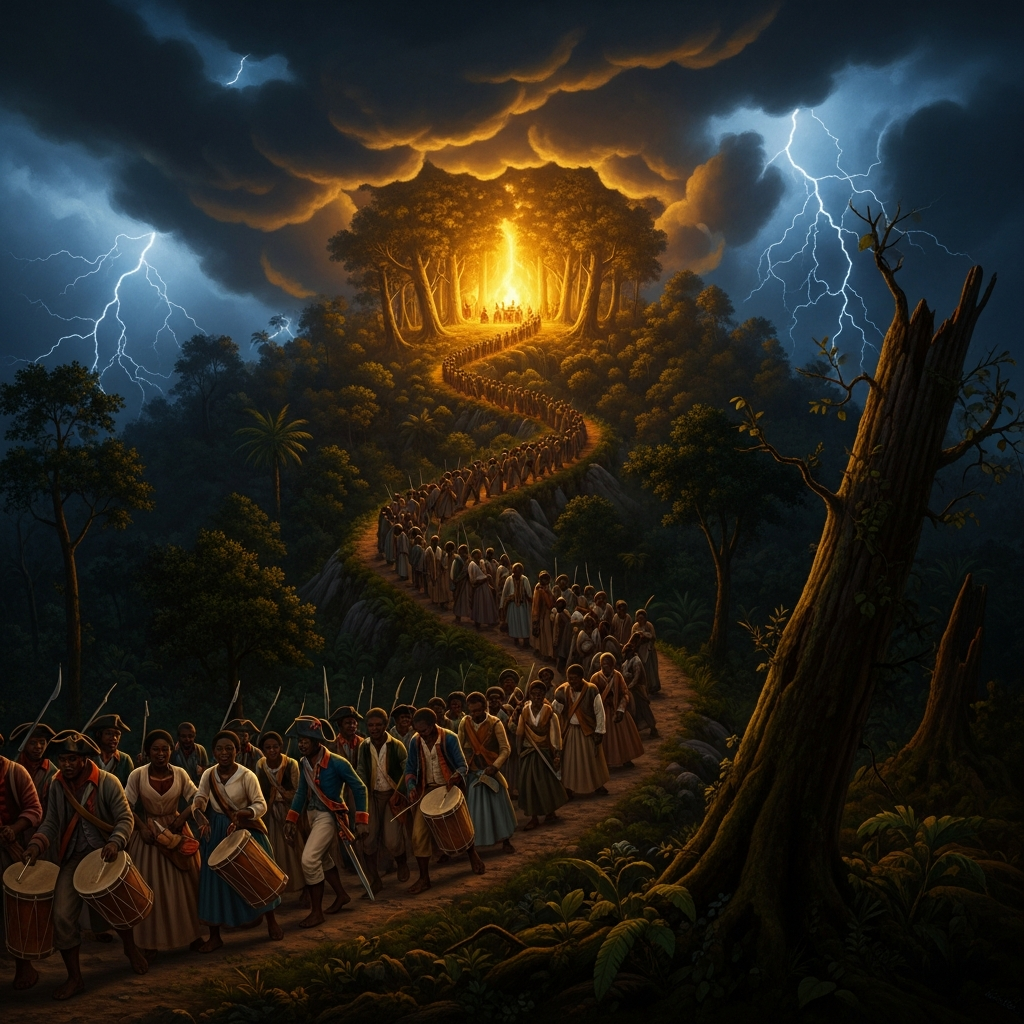
In the mountains above the Plaine du Nord, in a clearing called Bois Caïman — the Alligator Wood, named for a creature that does not actually live there — two hundred men and women have walked through the dark. They are coachmen and field slaves and house servants and commandeurs, the slave foremen who can read passes and travel between plantations. They are delegates. Each of them has come from a different estate, summoned in whispers, told only that there will be a meeting, that there will be drums, that Boukman will be there.
They climb under thunder. A storm has been hanging over the northern coast all day, lightning whitening the horizon every few minutes, no rain yet, just pressure. The wind in the mango trees sounds like talking.
Boukman is already in the clearing.
Dutty Boukman — Boukman Dutty, Book-man, the literate one, the coachman who can read English and French and possibly Arabic, born in Jamaica, sold to Saint-Domingue, a houngan of considerable power. He is enormous. He stands at the edge of the firelight with his arms folded, watching each delegate arrive, nodding once to each, saying nothing.
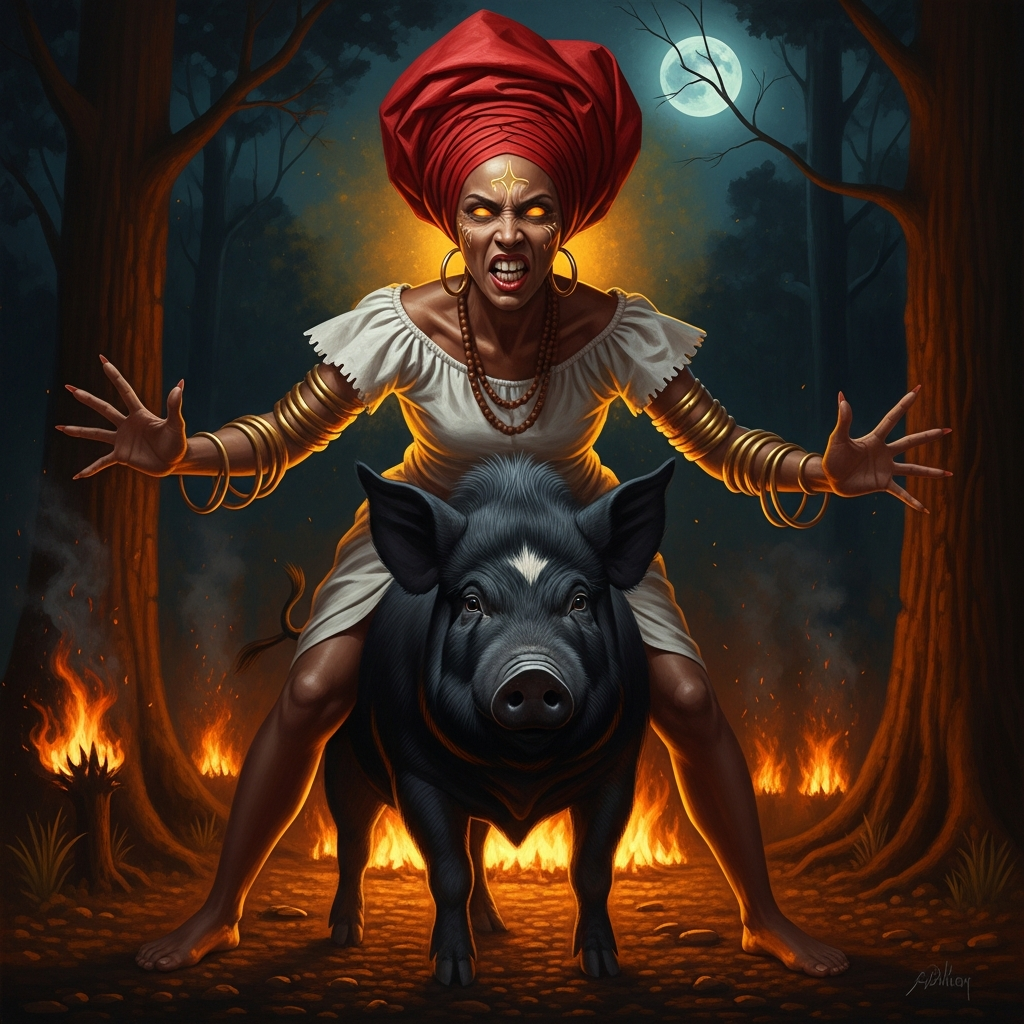
Beside him: a young woman in a red headwrap. Cécile Fatiman. The records will be uncertain about her — possibly the daughter of an African woman and a Corsican prince, possibly twenty, possibly older — but on this night she is the mambo, the priestess. She holds a long-bladed knife loosely at her thigh. She is humming under her breath, and the humming is the only sound in the clearing besides the wind.
Behind them, the poto-mitan of the night: not a temple post but a cottonwood tree at the center of the clearing, around which the delegates have arranged themselves in a rough circle. Two drummers sit at the base of the tree. A black pig — wild, captured that afternoon — is tethered to a stake near the fire, snorting and pulling at its rope.
The thunder closes overhead.
Boukman speaks.
He does not speak in French. The colony’s official language has nothing to say in this clearing. He speaks in Kreyòl — the language the slaves have been making for a hundred years out of West African grammar and French vocabulary and the necessity of secrecy — and his voice carries the way drums carry, low and even and unhurried.
The prayer he speaks that night will be quoted for two hundred years. The earliest written version comes from a French planter named Antoine Dalmas, who wrote it down twenty years later from interrogations and rumors. The Kreyòl original is lost. What survives, in French and then in English, runs:
The god who created the sun that gives us light, who rouses the waves and rules the storm, though hidden in the clouds, he watches us. He sees all that the white man does. The god of the white man inspires him with crime, but our god calls upon us to do good works. Our god who is good orders us to revenge our wrongs. He will direct our arms and aid us. Throw away the symbol of the god of the whites who has so often caused us to weep, and listen to the voice of liberty, which speaks in the hearts of us all.
The delegates listen. Some are weeping. Some are not. The drummers begin softly.
Cécile Fatiman steps forward.
The drumming shifts. It is the rhythm of Ezili Dantor — the Petwo rhythm, hot, fast, the rhythm of the warrior-mother loa, the dark Madonna of the Haitian pantheon, the loa whose face in the colony’s Catholic lithographs is the Black Madonna of Częstochowa, the Polish icon with the two scars on her cheek. Ezili Dantor is the loa for women who have been hurt and have decided to hurt back. She has a child on her hip. She has a knife in her hand. She does not speak French.
Fatiman begins to dance.
Her shoulders snap into the rhythm. Her head goes back. The red of her headwrap catches the firelight. She circles the cottonwood once, twice — and on the third circle she falls, but she does not fall, she is taken, and when she rises again her face has changed and her voice has changed and she is hissing through her teeth a sound that is not Cécile Fatiman’s sound. It is Ke-ke-ke-ke-ke — the only sound Ezili Dantor makes, the loa whose tongue, the legend says, was cut out by enemies long ago.
Ezili Dantor has come.
The delegates fall to their knees.
The mambo lifts the knife.
Two men bring the black pig forward. It does not struggle now. It is suddenly very still, the way animals sometimes go still in the presence of certain rituals, as if it understands the script. The mambo cuts the pig’s throat in one movement. The blood pours into a wooden bowl held below it. The bowl fills.
The mambo passes the bowl from delegate to delegate. Each man and woman drinks. Some drink and pass it on. Some drink and weep and pass it on. Some drink and hold the bowl above their heads for a long moment before passing.
As they drink, they swear.
They swear to kill or to die. They swear to keep the secret. They swear to follow the captains who have been chosen — Boukman, Jean-François, Biassou, Jeannot, men whose names the colony will learn very quickly — and to begin the rising on the night chosen, eight days from now, when the moon will be right and the watch on the great plain will be reduced.
Each delegate carries the oath back to a different plantation. Each delegate is a fuse.
The drumming continues until almost dawn. The clearing empties slowly. Cécile Fatiman, returning to herself, sits at the base of the cottonwood and stares at the embers. Boukman watches the eastern sky for the first gray.
The storm finally breaks. The rain starts.
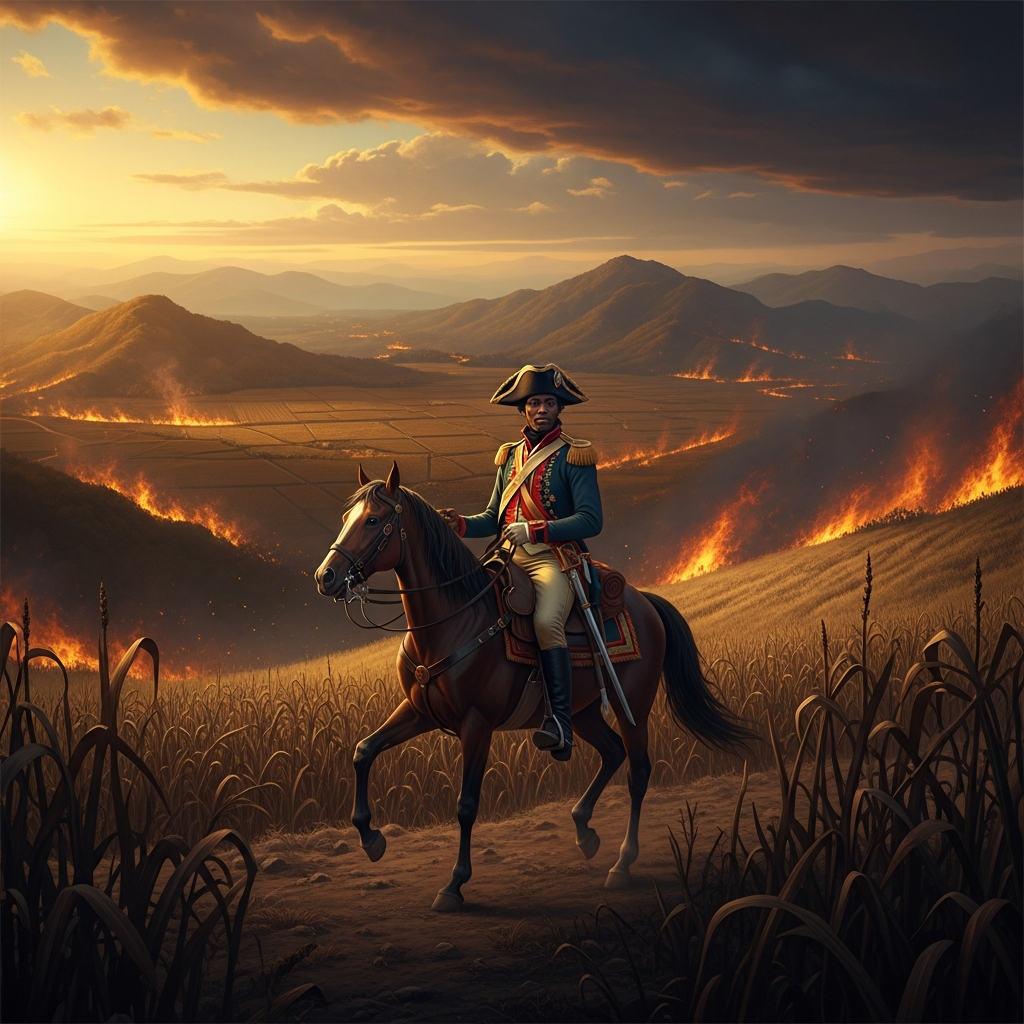
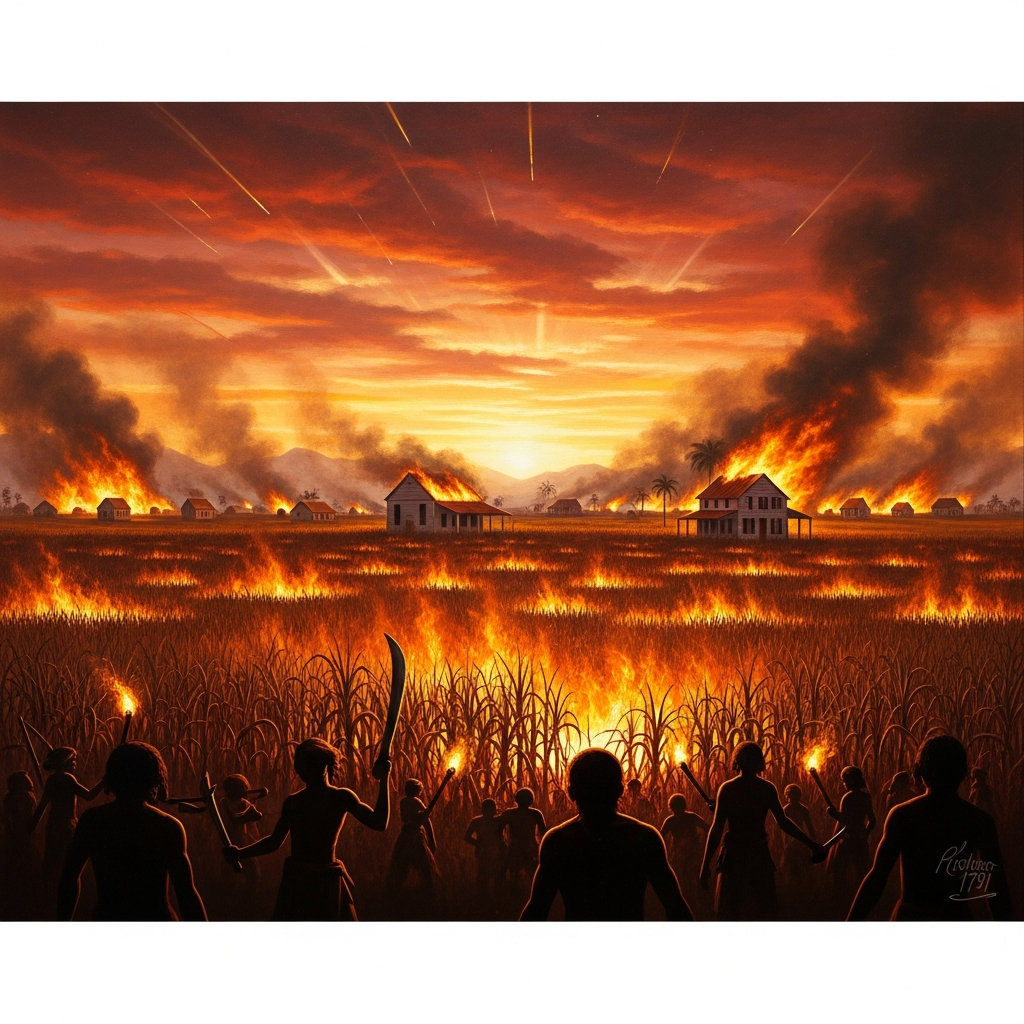
Eight days later, the northern plain is on fire.
On the night of August 22, 1791, slaves on plantations across the Plaine du Nord rise simultaneously. Cane fields burn. Sugar mills burn. Grands blancs — great white planters — are dragged from their beds. By dawn, a thousand plantations are smoke. By the second week, the entire northern province of Saint-Domingue is in revolt and the French commander in Cap-Français cannot send troops fast enough to hold any sector.
Boukman is killed in November, his head displayed in Cap-Français on a pike to discourage his followers. It does not discourage them. By 1793, the freed slaves are an army. By 1794, the French Republic — facing slave armies it cannot defeat and Spanish armies it can — abolishes slavery in the colonies and offers the rebels citizenship. A former coachman named Toussaint Louverture takes command. He fights the British to a standstill. He fights the French to a standstill. He governs.
In 1802, Napoleon sends his brother-in-law General Leclerc with twenty thousand troops to retake the colony and reimpose slavery. Yellow fever takes the French faster than the rebels do. Leclerc dies. Twenty thousand French soldiers die. Napoleon, broken by the Caribbean, sells the Louisiana Territory to Thomas Jefferson to recoup the loss.
On January 1, 1804, in the city of Gonaïves, Jean-Jacques Dessalines tears the white stripe out of the French tricolor, sews the blue and the red back together, and declares the independence of Haiti — the original Taino name of the island. He is the first head of state of the second republic in the Americas. He is the first head of state in modern history born into slavery.
The world has been informed.
The other slave societies of the Atlantic — the United States, Brazil, Cuba, the British Caribbean — would never sleep easy again. Every slaveholder in the Americas after 1804 knew the name Toussaint and dreamed of Bois Caïman. South Carolina banned the importation of Haitian-born slaves in fear of the contagion. Louisiana law was rewritten. The U.S. did not formally recognize Haiti until 1862, sixty years after independence, because to recognize Haiti was to admit it had happened.
It had happened. It had begun on a mountain, under thunder, in a clearing where a black pig was sacrificed and a priestess was mounted by a warrior-mother loa with two scars on her cheek and a knife in her hand. The Haitian Revolution is what happens when religion and politics refuse to be separated.
Eight days. From the prayer in the Alligator Wood to the burning of the northern plain. The world is built and unbuilt in that interval. Empires are made of paper, and paper burns.
Scenes
Two hundred enslaved delegates climb to the hidden clearing under thunder; the pig is brought in
 Generating art…
 Cécile Fatiman is mounted by Ezili Dantor; Boukman speaks the prayer that will be quoted for two centuries
 Generating art…
 Eight days later the northern plain is burning, and the world is learning that a slave revolt can win
 Generating art…
 Echoes Across Traditions
Entities
- Dutty Boukman (houngan and slave coachman)
- Cécile Fatiman (mambo of mixed Corsican and African descent)
- Ezili Dantor (the warrior-mother loa)
- Toussaint Louverture (then a coachman, soon to lead)
- Jean-Jacques Dessalines (future emperor)
Sources
- C.L.R. James, *The Black Jacobins: Toussaint L'Ouverture and the San Domingo Revolution* (1938, revised 1963)
- Carolyn E. Fick, *The Making of Haiti: The Saint Domingue Revolution from Below* (1990)
- Laurent Dubois, *Avengers of the New World: The Story of the Haitian Revolution* (2004)
- David Geggus (ed.), *The Haitian Revolution: A Documentary History* (2014)
- Antoine Dalmas, *Histoire de la révolution de Saint-Domingue* (1814) — early French account naming the ceremony